

Microsoft’s Ignite 2025 keynote showed the company taking a decisive step from conversational assistants to an enterprise-grade, governable army of AI agents — and Agent 365 is Microsoft’s answer to the operational headaches that follow when hundreds or thousands of autonomous agents start touching corporate data, apps and processes. The package Microsoft announced — Work IQ, Fabric IQ, Foundry IQ, Agent Factory, Copilot Studio, and the new Agent 365 control plane — is designed to make agents smarter, faster to deploy, and, critically, visible and controllable to IT and security teams. This feature set arrives with a clear governance narrative: treat agents like first‑class workforce members by giving them identities, lifecycle controls, telemetry and policy enforcement.
Microsoft’s Ignite messaging clustered around three linked promises:
The announcements at Ignite 2025 create a workable path from prototype to production for agents, but they also raise hard questions about scale forecasts, vendor dependence and the human cost of automation. Treat the platform capabilities as powerful tools that must be deployed with a disciplined AgentOps practice, and treat headline numbers — vendor‑commissioned forecasts or internally reported savings — as planning inputs that require independent validation in each organization’s context.
Source: Heise Online Microsoft aims to make AI agents smarter and monitor them better with Agent 365
 Overview
Microsoft’s Ignite messaging clustered around three linked promises:- Make agents smarter by grounding them in corporate context (Work IQ, Fabric IQ, Foundry IQ).
- Make agents easier to build and ship (Copilot Studio, Agent Factory, Foundry Agent Service).
- Make agents manageable and safe at scale (Agent 365 control plane, Entra identities, Defender/Purview integrations).
Background: why Microsoft is pushing agents now
The company’s framing is straightforward: modern business processes are becoming multi‑step, cross‑system workflows that are ripe for automation. AI agents — software that can plan, act and chain together tools and APIs — compress process latency and reduce manual orchestration. Microsoft argues that to scale agents safely you need identity, policy and telemetry baked in from development through runtime. That is the rationale behind coupling Copilot Studio and Foundry with a governance layer that reuses existing enterprise primitives (Entra, Defender, Purview). Two industry context points Microsoft highlighted:- A vendor‑commissioned IDC Info Snapshot projects a massive scale of agents — 1.3 billion agents by 2028 — which Microsoft cites to justify the urgency of a control plane. That IDC note is explicitly sponsored by Microsoft and should be treated as vendor‑commissioned market sizing rather than independent consensus.
- Microsoft has also publicly pointed to material internal AI productivity gains (reported savings figures are discussed below), positioning these features as both product and operational strategy.
What Agent 365 is — deep dive
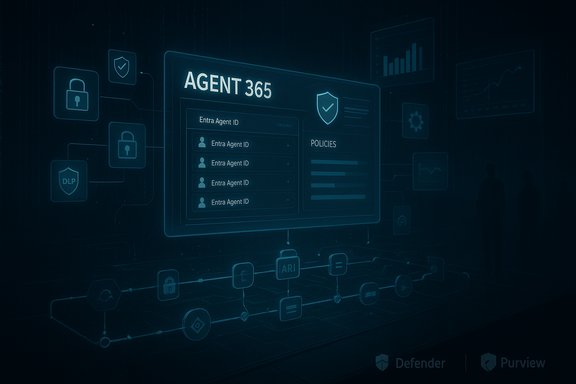
Agent 365 is pitched as the “control plane for agents.” In practical terms it bundles five core capabilities:- Registry: a tenant‑wide catalog of agents, including ownership, identity, status and access scopes.
- Access control: each agent can be represented as a directory principal (Entra Agent ID) and governed with conditional access, access reviews and least‑privilege policies.
- Visualization & telemetry: dashboards showing agent activity, latency, alerting on anomalous actions and lineage for audit and forensics.
- Interoperability: connectors and Model Context Protocol (MCP) support so agents can access apps, data and third‑party services while remaining governable.
- Security & compliance: integration points with Microsoft Defender, Microsoft Purview and the Foundry Control Plane to surface DLP, policy violations, suspicious calls and to quarantine agents when needed.
How Agent 365 fits into Microsoft’s agent pipeline
- Author: Copilot Studio (low‑code/no‑code) or developer tools in Azure AI Foundry build and test agents.
- Publish: Agents are published to an Agent Store or the tenant catalog for controlled access and reuse.
- Identity: Agents receive an Entra Agent ID (directory identity) and scoped permissions.
- Host: Agents run on Foundry, Windows 365 for Agents (Cloud PCs tuned for agent workloads), or third‑party runtimes.
- Govern: Agent 365 provides registry, monitoring, policy enforcement and remediation workflows.
Work IQ, Fabric IQ and Foundry IQ — the data backbone
The “IQ” stack is about giving agents reliable, semantically meaningful context so they make safer, more useful decisions:- Work IQ pulls signals from Microsoft 365 — emails, files, meetings, chats, relationships and habits — to model how people work and supply that memory/context to Copilot and agents. The result is an agent that can suggest the next meaningful step in a real workflow.
- Fabric IQ creates a semantic layer over analytics, time‑series and location data so agents can query business entities (orders, inventory, incidents) instead of raw tables. This helps agents reason about operational systems more reliably.
- Foundry IQ is a managed knowledge system that unifies multiple data sources (including Work IQ and Fabric IQ) and supports retrieval‑augmented grounding for agents, improving answer quality and reducing risky hallucination.
Agent Factory and Copilot Studio: building agents with guardrails
Microsoft’s Agent Factory bundles Copilot Studio, Foundry and role‑based training/support into a metered plan intended to accelerate agent builds across an organization. Copilot Studio supplies low‑code authoring, testing harnesses, multi‑agent orchestration patterns and model routing options (including multi‑vendor model choice). Foundry provides the pro‑developer runtime, model‑routing and observability primitives for production deployments. One‑click publishing from Foundry to Microsoft 365 and Agent 365 simplifies the developer‑to‑IT handoff. Key product mechanics:- Multi‑model routing for “best‑for‑purpose” model choice (e.g., Anthropic vs OpenAI).
- Automated agent evaluations and testing harnesses.
- Entra‑integrated provisioning flows that create an Entra Agent ID as part of publishing.
- Agent Store templates and approval workflows to reduce shadow agent risk.
Security and governance: Microsoft’s defense‑first pitch
Microsoft emphasizes a “governance‑first” posture: Agent 365 is not merely convenience tooling but a security control plane that ties agents into established defenses:- Entra Agent IDs make agents subject to conditional access, access reviews and JIT-style permissions.
- Defender integration provides runtime detection (anomalous behavior, API abuse).
- Purview/DLP policies can be extended to agent actions to prevent unauthorized exfiltration.
- Audit trails and event lineage enable forensic reconstruction of agent decisions and the data they touched.
Availability, licensing and the Frontier program
Agent 365 is being released through Microsoft’s Frontier early‑access program and surfaces inside the Microsoft 365 admin center for tenant admins. Many Copilot and agent features are rolling through staged preview channels (Frontier, Insider, public preview) rather than immediate GA; availability varies by region and tenant size. Microsoft also footnotes the IDC projection and pricing details in promotional materials. Organizations should expect controlled access early, with broader GA and licensing details to follow as Microsoft moves features out of Frontier.What’s confirmed vs. what needs caution
Confirmed (multiple sources):- Microsoft announced Agent 365 as a governance/control plane at Ignite 2025.
- Work IQ, Fabric IQ and Foundry IQ were described as intelligence/knowledge layers to ground agents.
- Agent Factory / Copilot Studio / Foundry integration and one‑click publishing were presented to shorten the path from dev to production.
- The IDC projection (1.3 billion agents by 2028) is a Microsoft‑sponsored Info Snapshot; it signals scale but should be treated as vendor‑commissioned forecasting rather than independent consensus. Use it as a planning input, not a deterministic target.
- Microsoft’s internal productivity/savings claims (reported $500 million saved in call centers and workforce reductions) originate from internal comments reported by Bloomberg and summarized by Reuters and other outlets. The figures are being widely reported but rest on internal remarks and anonymous sources; they are consequential but not equivalent to independently audited, line‑item financial disclosures. Flag as internally reported metrics.
Practical guidance for IT, Security and Line‑of‑Business teams
Agent 365 and the surrounding tools change operational practice. The following playbook is a practical, stepwise approach to piloting agents safely:- Inventory current automation: catalog existing bots, scripts and self‑service automations that could be agents in Agent 365’s registry.
- Define an Agent Governance Policy (owner, scope, retention, data access, human‑in‑the‑loop gating).
- Start with a monitor‑only pilot: onboard a small set of read‑only agents to validate telemetry, lineage and alerting.
- Use role‑based approvals in Copilot Studio and require Entra Agent ID enrollment before production publishing.
- Enforce least‑privilege permissions and session‑bound tokens for agent access to sensitive resources.
- Run red‑team tests and prompt‑injection exercises against agents to validate DLP and Purview protections.
- Build a deprovisioning playbook for orphaned or ownerless agents (automated quarantine is a must).
- Coordinate procurement, legal and risk — ensure third‑party model routing (Anthropic, OpenAI) is approved by compliance teams when data leaves Microsoft‑managed boundaries.
Benefits for enterprises
- Faster automation: Low‑code authoring and an Agent Store lower the barrier to automation for frontline teams.
- Operational control: Identity and lifecycle tooling reduce shadow agents and unmanaged sprawl.
- Auditability: Lineage, telemetry and centralized logs make agent actions reconstructable for compliance and forensic needs.
- Model choice: Multi‑model routing lets tenants route tasks to the model best suited for the job, supporting resilience and performance optimization.
Risks, tradeoffs and unanswered questions
- Data exposure and grounding quality — Agents are only as safe as the connectors and labels that feed them. If Purview, sensitivity labeling or data classification are incomplete, agents will make poor or risky decisions.
- Model routing and compliance boundaries — Choosing non‑Microsoft models (Anthropic, others) may route tenant data outside Microsoft‑managed environments; this has compliance implications that must be explicitly assessed. Microsoft warns about model hosting differences and the terms that may apply.
- Agent sprawl vs. operational debt — A central registry helps, but the human processes to maintain owner maps, runbooks and deprovisioning must exist or governance will fail.
- Vendor lock and ecosystem concentration — As Microsoft ties agent lifecycle to Entra, Defender and Purview, organizations should weigh the convenience of an integrated stack against the strategic risk of deep single‑vendor dependence.
- Overreliance on vendor forecasts — The IDC 1.3B projection was commissioned by Microsoft; planners should model adoption curves specific to their business rather than assuming global forecasts are directly applicable.
- Workforce and ethics — Public reporting that Microsoft saved hundreds of millions using AI and the company’s own 2025 workforce reductions underline the ethical and planning challenges companies face when automation displaces roles. Those operational decisions remain organization‑level and must be approached with transparency and re‑skilling commitments; the savings figures cited in the press are based on internal remarks and are not the same as audited financials.
Tactical checklist for security teams before enabling agent autonomy
- Lock down data connectors and require explicit Purview classification for any dataset an agent may access.
- Require Entra Agent ID enrollment and owner assignment for every agent.
- Enable monitor‑only telemetry ingestion for a 30–90 day validation period.
- Implement automated quarantining for ownerless or anomalous agents.
- Run continuous prompt‑injection and adversarial tests to validate model and DLP defenses.
- Explicitly document model routing policies and data residency implications for non‑Microsoft models.
What to watch next
- General availability timelines for Agent 365 beyond the Frontier program and the licensing contours for smaller customers.
- Third‑party integration depth — whether the Agent Store model accelerates partner adoption (ServiceNow, Workday, Adobe were mentioned as partners).
- Regulatory reactions — how regulators treat agent identities, audit trails and automated decision records in regulated industries.
- Independent benchmarks of Foundry IQ / Fabric IQ grounding quality — to see if agent grounding materially reduces hallucination and operational risk.
- Vendor disclosures — clearer, audited reporting on internal AI productivity claims and their direct relation to workforce changes.
Conclusion
Microsoft’s Agent 365 and companion technologies are not incremental feature updates — they represent a systemic design for agentic enterprise computing: identity‑bound, observable, and governed agents that can be composed into business workflows. For organizations already invested in Microsoft identity and security stacks, the promise is compelling: faster automation delivered with enterprise controls. But the technical gains come with governance responsibilities that cannot be baked in by software alone. Data hygiene, cross‑team processes, careful model‑routing policies and a culture of continuous validation are the operational prerequisites for success.The announcements at Ignite 2025 create a workable path from prototype to production for agents, but they also raise hard questions about scale forecasts, vendor dependence and the human cost of automation. Treat the platform capabilities as powerful tools that must be deployed with a disciplined AgentOps practice, and treat headline numbers — vendor‑commissioned forecasts or internally reported savings — as planning inputs that require independent validation in each organization’s context.
Source: Heise Online Microsoft aims to make AI agents smarter and monitor them better with Agent 365
