

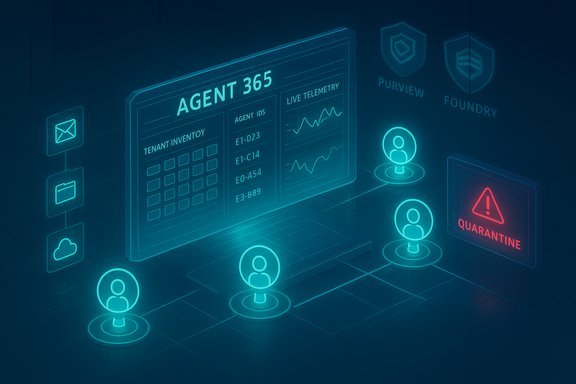
Microsoft’s new Agent 365 marks a deliberate shift from ad‑hoc AI helpers toward a managed, auditable fleet of AI agents—bringing identity, telemetry, and lifecycle controls to software that can plan, act, and interact across corporate systems. The product is presented as a single-pane control plane that catalogs every agent in a tenant, assigns directory identities, enforces least‑privilege access, and provides dashboards and alerts so IT teams can detect, quarantine, and govern agent behavior at scale.
Microsoft introduced Agent 365 as part of its broader agentic AI strategy at Microsoft Ignite 2025. The company frames this work as the operational plumbing enterprises need to scale AI agents safely across productivity apps, cloud services, and partner ecosystems. Agent 365 is positioned as the “control plane for agents” that ties together identity (Microsoft Entra), threat protection (Microsoft Defender), and data governance (Microsoft Purview) while integrating with Copilot Studio, Azure AI Foundry, and Microsoft 365 surfaces. The product is currently available through the Frontier early‑access program; tenants must enroll in Frontier and meet prerequisites (for example, at least one Microsoft 365 Copilot license) to enable Agent 365 in the Microsoft 365 admin center. Microsoft’s Learn documentation and product pages reflect preview‑phase disclaimers and a phased rollout schedule. Microsoft’s internal IT organization, Microsoft Digital, is acting as Customer Zero—using Agent 365 to inventory and govern agents that employees and teams create. Internal commentary highlights plans to use the platform for filtering agent inventories, quarantine workflows, blueprint ingestion and policy templates, and to align agent governance with existing tenant controls such as sensitivity labels and DLP. Those internal insights stress an ambition to enable self‑service agent creation but within guardrails and lifecycle rules.
Key Customer Zero practices called out internally include:
Source: Microsoft Deploying Microsoft Agent 365: How we're extending our infrastructure to manage agents at Microsoft - Inside Track Blog
 Background / Overview
Microsoft introduced Agent 365 as part of its broader agentic AI strategy at Microsoft Ignite 2025. The company frames this work as the operational plumbing enterprises need to scale AI agents safely across productivity apps, cloud services, and partner ecosystems. Agent 365 is positioned as the “control plane for agents” that ties together identity (Microsoft Entra), threat protection (Microsoft Defender), and data governance (Microsoft Purview) while integrating with Copilot Studio, Azure AI Foundry, and Microsoft 365 surfaces. The product is currently available through the Frontier early‑access program; tenants must enroll in Frontier and meet prerequisites (for example, at least one Microsoft 365 Copilot license) to enable Agent 365 in the Microsoft 365 admin center. Microsoft’s Learn documentation and product pages reflect preview‑phase disclaimers and a phased rollout schedule. Microsoft’s internal IT organization, Microsoft Digital, is acting as Customer Zero—using Agent 365 to inventory and govern agents that employees and teams create. Internal commentary highlights plans to use the platform for filtering agent inventories, quarantine workflows, blueprint ingestion and policy templates, and to align agent governance with existing tenant controls such as sensitivity labels and DLP. Those internal insights stress an ambition to enable self‑service agent creation but within guardrails and lifecycle rules.What Agent 365 is designed to do
Agent 365 groups core capabilities into five practical pillars that map to enterprise governance needs:- Registry: Provide a tenant‑wide inventory and discovery mechanism for agents—covering sanctioned agents, tenant‑registered agents, and “shadow” agents discovered by telemetry. This registry becomes the baseline for ownership, cost center binding, and lifecycle actions.
- Access control: Assign each agent a Microsoft Entra Agent ID and enforce least‑privilege access with conditional access policies, just‑in‑time permissions, and access reviews. In practice this treats agents as directory principals—subject to many of the same processes used for human users and service principals.
- Visualization & observability: Provide telemetry, dashboards, activity traces, and alerts that map agents to people, tools, and data sources. Operators can use these surfaces to reconstruct agent actions, monitor performance, and surface anomalous or risky behaviors.
- Interoperability: Support agents built in Copilot Studio, Azure AI Foundry, open‑source frameworks, and third‑party platforms—while using the Model Context Protocol (MCP) and connector patterns to standardize agent→tool communication. This aims to avoid vendor silos and make agents portable across runtimes.
- Security & data governance: Integrate with Microsoft Defender, Microsoft Purview, and existing DLP and sensitivity label controls to surface prompt‑injection, unapproved data exfiltration, and suspicious agent activity—and enable quarantining and remediation actions.
How the platform fits into Microsoft’s agent stack
Agent 365 is not a standalone product; it is an operational layer that maps across authoring, runtime, and the productivity surface:- Copilot Studio (low‑code/no‑code) and Azure AI Foundry are the common authoring and runtime paths where agents are built, iterated, and hosted. Agent 365 hooks into those flows or ingests published agent blueprints so IT can trace an agent’s origin and enforce policies.
- Agents can execute on endpoints, on specialized Cloud PCs (Windows 365 for Agents), or in Foundry‑hosted runtimes. The Windows side also introduces the Agent Workspace and MCP support so agents can discover trusted tool endpoints on devices while enforcing authorization and auditing at the OS level.
- Work IQ, Fabric IQ and Foundry IQ are the context services that Microsoft positions as the “memory and grounding” layers for agents—improving accuracy, reducing hallucinations, and providing entity semantics across business systems. Agent 365 sits adjacent to these, governing the agents that consume such context.
What Microsoft Digital (Customer Zero) is doing and why it matters
Microsoft Digital has been named Customer Zero for Agent 365 and is already experimenting with how to operationalize governance for internal agents. The team emphasizes six core governance principles—ranging from data hygiene and user‑level experiment spaces to containment of confidential data and lifecycle enforcement tied to attestation processes. Those internal learnings are instructive for other enterprises because they show how to map agent governance onto existing controls rather than inventing new, divergent processes.Key Customer Zero practices called out internally include:
- Enforcing a minimum governance bar that reuses Purview, sensitivity labeling, DLP, and activity logging so that agents are subject to the same controls as human apps.
- Allowing low‑risk, user‑owned experiments in controlled sandboxes—so employees can explore agent creativity without compromising enterprise data.
- Requiring enterprise documentation (attestation, runbooks, audits) for team‑ or business‑owned agents that handle sensitive flows or cross boundaries.
- Binding agent lifecycle to human processes: delete user‑owned agents when employees exit; tie team agents to attestation and SDLC stages.
Verifying major claims — what checks say
Several headline claims underpin the Agent 365 narrative. These are load‑bearing and merit cross‑verification.- Claim: Agent 365 is the control plane for enterprise agents and will be available via Frontier preview. Microsoft’s Ignite blog and Learn documentation confirm the control plane framing and Frontier preview requirement.
- Claim: Agents are given Entra Agent IDs and are treated like directory principals. Microsoft Learn explicitly documents Entra Agent ID assignment for agents and the need to manage agent lifecycle via admin centers.
- Claim: There will be 1.3 billion AI agents by 2028. Microsoft cites a sponsored IDC Info Snapshot projecting 1.3 billion agents by 2028, and several independent outlets have reported that Microsoft used that IDC figure in its Ignite messaging. The IDC projection was sponsored by Microsoft and should be treated as vendor‑commissioned market sizing rather than an independently validated universal prediction. Use it as a planning signal—don’t assume it is a deterministic forecast for every organization.
- Claim: Microsoft Digital reports “more than 100,000 agents on the Microsoft tenant today.” This is an internal, Customer Zero claim surfaced in Microsoft’s Inside Track commentary. There is no independent public verification of that tenant‑level number; treat it as an internal datapoint and validate against your tenant telemetry before assuming similar scale. Flagged as unverifiable externally.
- Claim: Agent 365 integrates Defender, Purview, and Foundry and provides quarantine/forensic workflows. Microsoft’s documentation and independent press coverage corroborate the integration story and the inclusion of telemetry and quarantine actions.
Strengths — where Microsoft gets this right
- Identity‑first governance model: Treating agents as directory principals (Entra Agent ID) is a practical, high‑leverage architectural choice. It allows organizations to reuse mature IAM tooling—access reviews, conditional access, deprovisioning—rather than inventing parallel flows for machine actors. This accelerates integration with existing security workflows.
- Integrated telemetry and observability: Centralizing telemetry in a single admin surface converts opaque agent actions into auditable traces. That visibility is essential for compliance, incident response, and cost control. Dashboards that map agent→people→data relationships close a major blind spot for operators.
- End‑to‑end pipeline from authoring to governance: Copilot Studio → Foundry → Agent 365 provides a plausible path from prototype to production, reducing handoff friction. Built‑in publishing and blueprinting reduce the risk of unmanaged shadow agents.
- Ecosystem and standards focus: Support for MCP and partner integrations reduces the risk of vendor lock‑in and helps vendors ship agentic products that can be discovered and governed centrally. This is important for heterogeneous enterprise environments.
- Customer Zero learning loop: Microsoft Digital acting as Customer Zero helps refine guardrails and operational patterns in ways that are likely to produce more mature admin surfaces and best practices for customers.
Risks, gaps, and practical cautions
- Data exposure and lineage complexity: Agents that can access mail, files, and third‑party systems multiply data flows. Even with Purview and DLP integration, it is nontrivial to prove lineage, retention, and deletion semantics for material that is ingested, cached by Foundry, or surfaced via Work IQ. Enterprises must validate data residency and retention controls—especially for regulated data.
- Operational blast radius: Agents authorized to take actions (create POs, send vendor emails, change infra) significantly increase the potential for automation errors and fraud. Agent 365 provides quarantine and policy controls, but your organization still needs human‑in‑the‑loop approvals, staged rollouts, and recovery runbooks.
- Shadow agents and telemetry limitations: Registry and discovery depend on telemetry and integrations. Agents running outside supported runtimes or with custom connectors may evade detection. Plan for a combination of telemetry ingestion, endpoint scanning, and explicit approval workflows to catch “shadow” deployments.
- Model and tool provenance: Multi‑model routing—using Anthropic, OpenAI, or vendor models—improves choice but complicates governance. You must know which model served which decision and hold model‑specific performance and safety metrics. Auditability across different model providers is operationally complex.
- Commercial uncertainty: Microsoft hinted at new agent license constructs and metered consumption but left many pricing details high level. Do not assume unlimited free tiers—model expected agent volumes carefully and negotiate with account teams.
- Overreliance on vendor forecasts: The IDC 1.3 billion‑agent projection is vendor‑sponsored. Treat market numbers as scenario inputs rather than destiny—plan governance on expected internal growth rather than global projections.
Practical playbook for IT leaders (15‑step starter plan)
- Enroll a small set of pilot tenants in Frontier to get hands‑on access to Agent 365 in monitor‑only mode.
- Build your agent catalog baseline: run discovery, capture owner, scope, and an initial risk score.
- Map agents to sensitivity labels and apply DLP templates where agents access confidential data.
- Enforce Entra Agent ID issuance for every published agent; require short‑lived tokens and just‑in‑time approvals for sensitive actions.
- Pilot quarantine and alerting playbooks for anomalous actions (e.g., large data exports, actions outside office hours).
- Require blueprint documentation (identity, capabilities, data access, lifecycle) before production publishing.
- Use dedicated Cloud PCs (Windows 365 for Agents) or Foundry runtimes for high‑risk agents to isolate runtime and logs.
- Integrate Agent 365 telemetry with your SIEM/SOAR to automate detection and enrichment.
- Define human‑in‑the‑loop approval gates for any agent that performs write actions with business impact.
- Run adversarial red teams for agent prompts and injection vectors; iterate defenses in Foundry.
- Create a cost model and showback mechanism for agent compute and model consumption.
- Train business owners on attestation processes and runbooks tied to agent lifecycle.
- Periodically review model routing choices and maintain versioned logs for model decisions.
- Establish a retire/deprovision policy for user‑owned agents when employees exit.
- Start small, measure ROI or risk reduction, then expand—do not flip an entire automation estate to autonomous agents overnight.
Realistic expectations: what Agent 365 will and won’t solve on day one
Agent 365 will give IT a much better inventory and control surface for agent activity—but it is not a silver bullet. It simplifies lifecycle management and reduces blind spots if you integrate telemetry widely and enforce identity. However:- It cannot, on its own, prevent every data leakage scenario—data lineage, caching semantics, and Foundry persistence must be validated per workload.
- It cannot replace sound process design; human approvals and proper runbooks remain essential for business‑critical actions.
- It will likely require organizational change: new owner roles, attestations, and budget models for agent costs.
The compliance and security calculus
Agent 365’s architecture respects core enterprise controls: identity, sensitivity labels, DLP, and Defender integrations. Those integrations make it feasible to bring agents into regulated environments—if you operationalize identity controls and evidence trails. Key security steps include:- Gate connectors so agents cannot access high‑sensitivity stores unless explicitly allowed.
- Apply risk‑based conditional access for agent identities, mirroring human conditional access policies.
- Bake telemetry into CI/CD so vulnerabilities are detected earlier in the lifecycle via Foundry integrations.
Strategic implications for enterprise architecture
- Identity becomes the linchpin: Architecture teams must treat agents like system principals and bake lifecycle hooks into provisioning pipelines.
- Observability is the new SLA: SLAs will expand beyond uptime to include decision traceability, action lineage, and model provenance. Architects should add these nonfunctional requirements to design docs.
- Platform choice matters less than governance: Whether you build agents in Copilot Studio, Foundry, or open‑source frameworks, enterprises need a consistent governance policy that Agent 365 can help enforce.
- Cross‑vendor ecosystems will grow: MCP and connector standards are nascent but crucial—invest in intermediate layers and adapters to reduce future rework.
Conclusion
Agent 365 codifies a pragmatic response to a predictable problem: as AI agents proliferate, organizations need a way to discover, identify, and govern them like any other managed resource. Microsoft’s control‑plane design—Entra Agent IDs, telemetry‑first observability, and integration with Defender and Purview—remaps established enterprise controls onto a new class of machine actors. The product is available in preview via the Frontier program, and Microsoft’s Customer Zero work in Microsoft Digital provides a useful early template for governance, lifecycle, and attestation workflows. However, Agent 365 is not a magic wand. Forecasts like the IDC 1.3 billion agents by 2028 are vendor‑commissioned planning signals rather than guaranteed outcomes; internal tenant figures cited by Microsoft (for example, “more than 100,000 agents” on Microsoft’s tenant) are useful but not independently verifiable. Organizations must pilot in monitor‑only mode, validate data lineage and retention semantics, enforce human‑in‑the‑loop approvals for risky actions, and budget for model and runtime costs. With those pragmatic guardrails in place, Agent 365 can materially reduce agent sprawl, surface operational risk, and accelerate safe adoption of agentic automation across the enterprise.Source: Microsoft Deploying Microsoft Agent 365: How we're extending our infrastructure to manage agents at Microsoft - Inside Track Blog
