

The sudden, industry‑wide rush to build autonomous AI agents has exposed a simple truth: the Internet we designed for humans is not optimized for trillions of machine‑to‑machine, agentic interactions — and the consequences of continuing to pretend otherwise are already visible in security gaps, privacy tradeoffs, performance limits, and regulatory headaches.
The last 18 months have seen a rapid transition from language models as tools for human interaction to language models as actors — autonomous agents that discover services, call APIs, negotiate, transact, plan, and persist state across sessions. Major platform vendors, research labs, and startups have pivoted from “LLM as chatbot” to building fully agentic stacks that combine planners, tool connectors, memory systems, and execution environments. This movement has spawned a parallel set of technical problems: identity and attestation for agents, safe tool invocation, observability at runtime, low‑latency and high‑throughput connectivity, privacy‑preserving data handling, and economic primitives for automated payments and commerce.
One clear articulation of the problem comes from recent commentary arguing that agents — when they number in the billions of users and potentially trillions of runtime instances — will need dedicated infrastructure: a parallel, AI‑native internet engineered for machine‑scale, machine‑speed interactions with explicit guardrails for safety, privacy, and compliance. That framing is not an exercise in futurism alone; it aligns with concrete product and standards work emerging from the industry, and it explains a wave of security research that is reclassifying agentic threats as first‑class network problems.
Microsoft’s integration of MCP concepts into Windows signals a key shift: operating systems — not just cloud APIs — are positioning themselves as first‑class hosts for agentic workloads. OS‑level registries, connector frameworks, and permission UIs give enterprises a way to manage agent access to local files, settings, and devices under user control. That design choice reduces the attack surface compared to ad‑hoc agent plugins and helps centralize audit trails.
Design priorities should be clear: identity and attestation, runtime policy enforcement, step‑level observability, connector hardening, and privacy‑first consent models. Vendors and standards groups must move fast to provide interoperable primitives so enterprises can safely adopt agents without recreating risk at planetary scale.
If the industry can combine robust engineering with thoughtful governance, agents will deliver enormous value. If it treats the problem as merely “another application stack” that can be bolted onto the human Internet, the damage — from systemic privacy loss to automated fraud and supply‑chain compromise — will follow at machine speed. The pragmatic path forward is to build the agent‑aware layers now, test them rigorously, and assume that the adversary will learn and adapt faster than the vendor roadmaps. Design with defense in mind, and the agent economy can be a monumental net benefit rather than a new systemic liability.
Source: AI: Reset to Zero AI: Weekly Summary. RTZ #1025
 Background / Overview
The last 18 months have seen a rapid transition from language models as tools for human interaction to language models as actors — autonomous agents that discover services, call APIs, negotiate, transact, plan, and persist state across sessions. Major platform vendors, research labs, and startups have pivoted from “LLM as chatbot” to building fully agentic stacks that combine planners, tool connectors, memory systems, and execution environments. This movement has spawned a parallel set of technical problems: identity and attestation for agents, safe tool invocation, observability at runtime, low‑latency and high‑throughput connectivity, privacy‑preserving data handling, and economic primitives for automated payments and commerce.One clear articulation of the problem comes from recent commentary arguing that agents — when they number in the billions of users and potentially trillions of runtime instances — will need dedicated infrastructure: a parallel, AI‑native internet engineered for machine‑scale, machine‑speed interactions with explicit guardrails for safety, privacy, and compliance. That framing is not an exercise in futurism alone; it aligns with concrete product and standards work emerging from the industry, and it explains a wave of security research that is reclassifying agentic threats as first‑class network problems.
What “AI agents need their own Internet” actually means
The idea of a separate infrastructure for agents isn’t about physically slicing the public Internet into two networks. It’s about designing a layered ecosystem — protocol, identity, routing, telemetry, governance, and economic rails — that treats agents as distinct actors with different operational needs than human browsers or mobile apps. Key differences include:- Scale and concurrency: Agents make far more API calls and connector invocations per user session than a human browsing a site. Networks must support high‑fanout, low‑latency behaviors without collapsing under load.
- Determinism and observability: Operators require deterministic traces of an agent’s plan and actions to audit and explain outcomes. Traditional HTTP logs are inadequate.
- Agent identity and attestation: Machines acting autonomously need cryptographic identities, verifiable capabilities, and runtime attestations to prove intention and provenance.
- Privacy by design: Agents will need compartmentalized access to personal data, on‑device context handling, and clear consent models that can be audited.
- Economic primitives: Agentic commerce — micro‑payments, subscriptions, delegated approvals — requires secure, atomic, and auditable payment protocols that work at machine speed.
- Safety guardrails: Runtime enforcement — policy checks, “stop‑loss” mechanisms, and safe‑execution sandboxes — must be integrated into the network fabric.
Industry signals: standards, OS-level work, and platform moves
Model Context Protocol and OS integration
One of the earliest concrete moves toward an interoperability layer for agents is the emergence of the Model Context Protocol (MCP) — an open protocol for agent discovery, context sharing, and tool integration. Platforms and operating systems are adopting MCP or MCP‑like registries to allow agents and tools to communicate with clear semantics for permissions and provenance.Microsoft’s integration of MCP concepts into Windows signals a key shift: operating systems — not just cloud APIs — are positioning themselves as first‑class hosts for agentic workloads. OS‑level registries, connector frameworks, and permission UIs give enterprises a way to manage agent access to local files, settings, and devices under user control. That design choice reduces the attack surface compared to ad‑hoc agent plugins and helps centralize audit trails.
Cloud vendors and agent platforms
Cloud providers and major AI vendors are racing to deliver end‑to‑end agent platforms that include identity, observability, runtime governance, and low‑latency execution. Expect to see:- Identity systems that issue unique agent IDs at creation and bind them to capabilities and tenant policies.
- Runtime policy enforcement (blocklists, sensitive‑data filters, intent verification) baked into execution pipelines.
- Observability products that record step‑level actions, tool calls, and external I/O as a standard telemetry stream.
- Prebuilt connectors (email, CRM, payment services) that include hardened, auditable tool invocation patterns.
Research and open protocols
Academic and open research communities are converging on primitives that matter: agent attestation (cryptographically verifiable capability statements), agent JWTs for delegation, zero‑trust runtime verification, and payment authorization protocols for machine‑initiated commerce. These proposals are the building blocks of a future governance layer for agents; they’re not yet universally standardized, but the pace of prototyping is rapid.Security: new threat models and the urgency of mitigation
The agent era changes adversary economics and technique sets in fundamental ways.Agent‑level attacks are network attacks
Traditional web attacks targeted human‑centric flows (phishing, credential theft, cross‑site scripting). Agents introduce classes of attacks that operate at machine scale:- Zero‑click prompt injection and Agent Hijacking: Researchers have demonstrated that agents can be tricked into executing arbitrary tool calls or exfiltrating data without human interaction, by poisoning discovery channels or abusing connector semantics. Injection chains can traverse discovery → tool call → response parse, and an attacker who can influence any step can pivot control.
- Memory poisoning and persistence attacks: Agents with persistent “memory” stores can be poisoned so that subsequent planning steps inherit compromised context.
- Agent‑to‑agent lateral movement: When agents discover and call other agents, a compromised agent can propagate a malicious plan through otherwise trusted execution paths.
- Supply chain and connector misuse: Untrusted connectors, poorly validated tool code, or shared third‑party connectors create high‑impact compromise vectors.
Zero Trust needs to be extended to agents
Applying Zero Trust principles to agentic systems is non‑optional. Agent identities must be assessed continuously: authenticate first, authorize narrowly, verify continuously, and assume compromise. However, classic Zero Trust models focus on human identity and device posture; agents require additional controls:- Capability attestation: Agents should present verifiable capabilities describing what they can do, what connectors they possess, and their intended purpose.
- Step‑level policy enforcement: Policies must be able to block or require human approval for certain tool calls at runtime (for example, payment or privileged access).
- Runtime telemetry and kill switches: Observability must capture the agent plan, tool invocations, and outcomes so defenders can detect anomalous action sequences and halt execution.
Operational recommendations for security teams
- Treat agents as first‑class subjects in identity systems and audit logs.
- Require unique agent credentials, ephemeral tokens, and capability bounding at creation time.
- Use runtime enforcement tools that can interpose on agent tool calls and inject policy decisions.
- Harden connectors (validate inputs/outputs, enforce least privilege) and maintain strict supply‑chain controls for third‑party tools.
- Implement “safe harbor” patterns: agents that receive suspicious instructions should escalate to a quarantined plan or fall back to human review rather than executing risky steps.
Privacy and data governance: consent, minimization, and accountability
Agentic interactions blur the lines between user intent and automated action. This creates immediate privacy and compliance challenges:- Consent modeling: Systems must capture granular consent for agent actions on specific data sources — e.g., “allow Agent X to read my project folder for the next 24 hours to draft an invoice.” Consent artifacts must be machine‑readable, revocable, and auditable.
- Data minimization: Agents should request minimal context necessary for a task and avoid long‑term retention of sensitive content unless explicitly authorized.
- On‑device vs. cloud tradeoffs: For sensitive workloads, hybrid models (local context indexing with remote reasoning) reduce exposure but complicate latency and model updates.
- Auditable trails: Every agent action that touches personal data should leave a tamper‑evident audit trail that maps to the consent artifact and policy decisions.
The technical blueprint for an “AI‑native” layer
What would a practical, deployable AI‑native set of infrastructure layers look like? Below is a working blueprint that blends protocols, operational controls, and network patterns.Core components
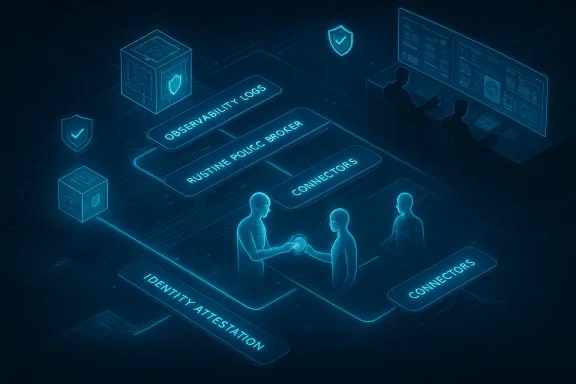
- Agent Registry and Discovery: A namespaced, permissioned registry where agents publish capabilities, identity attestations, and allowed connector lists. Discovery includes integrity checks and provenance metadata.
- Agent Identity & Attestation: Cryptographic keys bound to agent artifacts (code, memory hashes, owner identity). Attestations confirm that an agent instance matches a trusted image and that its capabilities have not been escalated.
- Runtime Policy Broker: A policy engine that evaluates tool calls against tenant rules, sensitive data policies, and global safety policies before allowing execution.
- Step‑level Observability & Tracing: Structured, immutable logs of plan steps, tool invocations, input/output snapshots (redacted for sensitive data), and decision timestamps.
- Connector Hardening and Sandboxing: Standardized connector interface contracts with built‑in input validation, scoped authentication, and sandboxed execution.
- Agent Payment & Authorization Protocols: Atomic payment primitives for machine‑initiated commerce that provide receipts, user authorization steps, and dispute hooks.
- Network QoS & Routing: Traffic engineering optimizations for agent workloads that prioritize reliability and low latency for real‑time tool calls, and isolate agent traffic in logical enclaves where operationally sensible.
- Privacy Enclaves and Data Diodes: For high‑assurance data flows, one‑way channels (data diodes) and secure enclaves that prevent downstream leakage.
Programming and deployment model
- Agents are defined as signed, declarative artifacts (intent spec + capability list).
- Creation issues an Agent ID and cryptographic attestations; tenant governance attaches policies and consent artifacts.
- At runtime, each step is sent to the Runtime Policy Broker which can allow, block, or require escalation.
- Tool calls are made through hardened connectors; connector calls are logged and verified.
- Final results are persisted under tenant retention policies, with redaction or deletion routines executed automatically.
Economic and regulatory considerations
A scaled agent economy raises questions about liability, accountability, and market structure.- Liability: When an agent acts autonomously and causes harm or loss, who is responsible — the agent owner, the agent developer, the platform operator, or the connector vendor? Pending regulatory frameworks are likely to require traceable chains of responsibility.
- Marketplace dynamics: Centralized registries for connectors and agents can become gatekeepers. Open standards and registries that support decentralized discovery can reduce vendor lock-in and foster competition.
- Payments and financial controls: Agent‑initiated payments must include strong non‑repudiation, authorization mechanisms, and dispute resolution flows; regulators will scrutinize machine‑initiated commerce closely.
- Cross‑border data flows and sovereignty: Agents that operate across regulatory regimes must honor data residency, consent, and export rules; platform operators must provide controls for policy enforcement by jurisdiction.
Strengths, near‑term opportunities, and business benefits
- Massive productivity gains: Well‑designed agents can automates multi‑step workflows, surface insights, and free human attention for higher‑value tasks.
- New user experiences: Agents that persist, adapt, and operate on behalf of users can deliver hyper‑personalized services while reducing friction.
- Platform differentiation: Vendors that integrate agent governance and observability as core platform services will gain enterprise trust and adoption.
- Edge and on‑device innovation: Running parts of agents locally preserves privacy and reduces latency, unlocking scenarios like offline personal agents or sensitive enterprise assistants.
Risks and open challenges
- Scale of compromise: A single exploit in a widely trusted connector or discovery mechanism can cascade rapidly across many agents and tenants.
- Opaque or misaligned goals: Agents that are poorly scoped or whose reward functions diverge from user intent can create unwanted outcomes at scale.
- Economic weaponization: Agents could be used to skew online marketplaces, create automated misinformation, or conduct systemic fraud at machine speed.
- Regulatory uncertainty: Without clear liability rules and standards, enterprises may hesitate to deploy agentic automation for high‑value processes.
- Human oversight fatigue: Reliance on agent automation may degrade human skill over time and make oversight brittle.
Practical checklist: what IT and security teams should do now
- Audit agent surfaces: inventory agent instances, connectors, and the data sources they can reach.
- Establish agent identity hygiene: unique agent IDs, short‑lived tokens, and capability bounding.
- Enforce least privilege on connectors and third‑party tools; require attestation from connector vendors.
- Implement runtime policy enforcement for high‑risk actions (payments, privileged access, external sharing).
- Capture step‑level telemetry for agent actions and integrate it with SIEM / XDR workflows.
- Train incident response teams on agent‑specific scenarios (memory poisoning, lateral agent movement).
- Build consent UX and policy mapping for user data access by agents.
- Design “human in the loop” escalation triggers for high‑impact decisions.
Toward governance: standards and the role of open protocols
Interoperability and safety will depend on a mix of open standards and vendor implementations. Vital areas for standardization include:- Agent capability signatures and attestation formats so that any registry can verify an agent’s declared capabilities.
- Step‑level policy languages that express human‑readable guardrails and machine‑enforceable rules.
- Secure connector interfaces with mandatory input/output schemas and signed manifests.
- Machine payment primitives for atomic, auditable agent commerce.
- Privacy metadata schemas for consent and retention, machine‑readable and enforceable across platforms.
Conclusion: build with humility and defensive design
The next decade will likely be defined as much by the networks we build for machines as by the models we train. The technical, security, and ethical challenges raised by agentic AI are real, immediate, and solvable — but only if the industry treats agents as a new class of networked actors that require explicit infrastructure, policy, and governance.Design priorities should be clear: identity and attestation, runtime policy enforcement, step‑level observability, connector hardening, and privacy‑first consent models. Vendors and standards groups must move fast to provide interoperable primitives so enterprises can safely adopt agents without recreating risk at planetary scale.
If the industry can combine robust engineering with thoughtful governance, agents will deliver enormous value. If it treats the problem as merely “another application stack” that can be bolted onto the human Internet, the damage — from systemic privacy loss to automated fraud and supply‑chain compromise — will follow at machine speed. The pragmatic path forward is to build the agent‑aware layers now, test them rigorously, and assume that the adversary will learn and adapt faster than the vendor roadmaps. Design with defense in mind, and the agent economy can be a monumental net benefit rather than a new systemic liability.
Source: AI: Reset to Zero AI: Weekly Summary. RTZ #1025
