

Microsoft has taken a major step toward making “Frontier Transformation” — the company’s phrase for large‑scale, agentic AI adoption across enterprises — feel operationally realistic for CIOs and CISOs by announcing Agent 365 as a unified control plane for AI agents and a new Microsoft 365 E7 bundle that folds advanced AI and security into a single enterprise SKU. These offerings, announced in Microsoft’s recent security briefing and covered by industry press, are positioned to arrive in production on May 1, 2026, with Agent 365 priced at $15 per user per month and Microsoft 365 E7 at $99 per user per month — a combination meant to give organizations a way to observe, govern, and secure agentic AI at scale while aligning agent identities and behaviors with existing identity, endpoint, and data protection tooling. ttps://venturebeat.com/technology/microsoft-says-ungoverned-ai-agents-could-become-corporate-double-agents-its)
The last 18 months have pushed AI beyond single‑query assistants into agentic behavior: multi‑step, stateful, and action‑oriented agents that can access systems, call APIs, persist context, and act on behalf of users. Enterprises that previously treated AI as a helpful service now face a governance problem on par with directory services and service accounts: how do you inventory, authenticate, govern and monitor autonomous actors that can move across systems and process sensitive data?
Microsoft’s response is twofold: (1) a control plane, Agent 365, intended to treat agents as first‑class, identity‑aware entities in the Microsoft ecosystem; and (2) Microsoft 365 E7, a premium enterprise SKU that bundles Copilotnded Defender/Entra/Purview protections to give security and IT teams a single purchase option to cover both people and agents. The company frames this as a security‑first approach to scaling agentic AI across the enterprise.
Microsoft first signaled the control‑plane idea at Ignite and follow‑on security posts last year; the march toward a production offering has been widely discussed within Microsoft community channels and early reporting. The new announcements build on existing Microsoft investments — Microsoft Defender, Microsoft Entra (identity), Microsoft Purview (data governance) and the Copilot ecosystem — to extend those protections to agents. ([microsoft.com](Microsoft Ignite 2025: Copilot and agents built to power the Frontier Firm | Microsoft 365 Blog Agent 365 claims to deliver
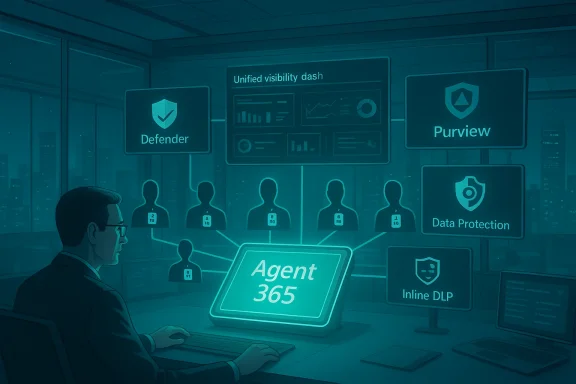
Agent 365 is described by Microsoft as the “control plane for agents.” Its feature set is designed to cover three broad needs: observability, secure identity and access, and data protection / compliance.
However, tools are not policy. The most important investments an organization can make are governance, process and testing: define who owns agents, how they are approved, how they are monitored and how incidents are handled. Start small, pilot in low‑risk domains, validate DLP and identity protections, then scale with automated lifecycle controls. Pay particular attention to licensing models and cost projections — agent counts and seat‑based economics are quickly underappreciated at scale.
For every CIO and CISO asking “Can I safely go all‑in on agentic AI?” the pragmatic answer today is yes — if you treat agents like the new class of privileged identities they are. Deploy well‑scoped pilots using Agent 365’s registry and Entra Agent ID, enforce least privilege and conditional access, run red‑team exercises that include agent attack scenarios, and implement prompt‑time DLP and retention policies to control data flow. When combined with a disciplined governance practice, these steps will let organizations extract productivity from agents while keeping the risks manageable.
Microsoft’s announcement marks the start of the next operational chapter for enterprise AI: tools that can act autonomously will be treated as first‑class citizens inside corporate security and identity frameworks. That’s the right direction — but the work of building policy, process, and technical rigor across the organization begins now. Prepare your inventories, update your identity and compliance playbooks, budget for licensing and telemetry costs, and — critically — test your incident response against agent‑oriented attack scenarios before you broaden production rollouts.
Conclusion: Agent 365 and Microsoft 365 E7 move the industry forward by offering a unified, identity‑first control plane for agentic AI. Enterprises willing to pair these tools with disciplined governance and security engineering stand to gain substantial productivity advantages — but only if they respect the new surface area and build the operational capabilities to monitor, contain, and remediate agent‑driven risk.
Source: Microsoft Secure agentic AI for your Frontier Transformation | Microsoft Security Blog
 Background / Overview
The last 18 months have pushed AI beyond single‑query assistants into agentic behavior: multi‑step, stateful, and action‑oriented agents that can access systems, call APIs, persist context, and act on behalf of users. Enterprises that previously treated AI as a helpful service now face a governance problem on par with directory services and service accounts: how do you inventory, authenticate, govern and monitor autonomous actors that can move across systems and process sensitive data?Microsoft’s response is twofold: (1) a control plane, Agent 365, intended to treat agents as first‑class, identity‑aware entities in the Microsoft ecosystem; and (2) Microsoft 365 E7, a premium enterprise SKU that bundles Copilotnded Defender/Entra/Purview protections to give security and IT teams a single purchase option to cover both people and agents. The company frames this as a security‑first approach to scaling agentic AI across the enterprise.
Microsoft first signaled the control‑plane idea at Ignite and follow‑on security posts last year; the march toward a production offering has been widely discussed within Microsoft community channels and early reporting. The new announcements build on existing Microsoft investments — Microsoft Defender, Microsoft Entra (identity), Microsoft Purview (data governance) and the Copilot ecosystem — to extend those protections to agents. ([microsoft.com](Microsoft Ignite 2025: Copilot and agents built to power the Frontier Firm | Microsoft 365 Blog Agent 365 claims to deliver
Agent 365 is described by Microsoft as the “control plane for agents.” Its feature set is designed to cover three broad needs: observability, secure identity and access, and data protection / compliance.
Observability and management
- Agent Registry: a centralized inventory of agents (including first‑party, partner and registered third‑party agents) surfaced to IT in the Microsoft 365 admin center and into security workflows (Defender / Purview). This aims to eliminate “unknown” agents that typically create governance gaps.
- Behavior and performance telemetry: adoption and usage metrics, an agent map showing relationships and dependencies, and per‑agent activity detail to support operations and capacity planning.
- Agent risk signals: integration m Microsoft Defender (compromise detection), Entra (identity risk), and Purview (insider-risk / sensitive data interactions) so security teams can evaluate agent risk similarly to human identities. Several features are stated to be in public preview as of the announcement.
Identity, access, and governance
- Agent ID (Entra identities for agents): each agent receives a unique identity in Microsoft Entra, enabling tenant‑wide policy enforcement and reducing unmanaged identity gaps. This lets organizations assign conditional access policies, identity protection, and lifecycle controls to agent identities.
- Conditional Access & Identity Protection for agents: real‑time policies that evaluate sign‑in risk, device compliance (from Intune), and custom attributes before allowing agents to act on behalf of users or systems.
- Identity Governance for agents: scoped access packages to ensure agents get only the permissions they need, plus auditing of granted access.
Data protection, compliance and runtime controls
- Data Security Posture Management for agents: visibility into data risks specific to agent interactions.
- Information Protection and Sensitivity Labels: agents inherit Microsoft 365 sensitivity labels so they must honor the same handling rules as users, preventing unauthorized exfiltration.
- Inline DLP for prompts: prompt‑time blocking to prevent personally identifiable information, credit‑card numbers, and other custom sensitive info types (SITs) from being processed by Copilot Studio agents.
- Insider Risk Management extended to agents: risky agent interactions get flagged and blocked like human insiders.
- Data lifecycle (prompt retention/deletion), audit and eDiscovery: treat agent interactions as auditable entities with retention/deletion rules and eDiscovery coverage.
Runtime and threat protections
Microsoft says Defender will bring agent‑specific protections for risks like prompt manipulation, model tampering and agent‑based attack chains. Specific runtime threat protections for agents using the Agent 365 tools gateway were announced to enter public preview in April 2026, with broader Defender integrations in preview at GA. Detection, investigation and response for Foundry and Copilot Studio agents will enable security teams to include agents in incident investigations and remediation.Why this matters: operational impacts for security and IT
The arrival of a vendor‑level control plane for agents is a practical recognition that agencies and service accounts were manageable at scale because they lived in a normalized identity and policy model. Agent 365 attempts to do the same for AI agents:- It normalizes agent identity by bringing agents into Entra, enabling conditional access and centralized auditing.
- It reduces blind spots by providing an agent registry and unified risk signals; this helps teams answer the basic questions: which agents exist, who created them, what resources do they access, and what data have they touched.
- It ties agent governance to existing workflows (Microsoft 365 admin center, Defender, Purview), lowering the friction for Security Operations, Compliance, and IT administration to adopt guardrails.
Critical assessment — strengths
- Identity-first approach reduces a major attack surface. Treating agents as identities in Entra enables established controls — conditional access, identity protection, access packages — to be applied to agents. That’s a pragmatic extension of zero‑trust principles to non‑human actors.
- Unified observability across stack reduces governance overhead. By integrating agent inventory and telemetry into existing admin and security portals, Microsoft lowers the barrier for SOCs and IT to include agents in routine monitoring and investigations. This reduces the need for custom tooling at least for customers standardized on Microsoft 365.
- Data protection integrated into runtime (inline DLP). Blocking sensitive tokens and SITs from being processed at prompt time is a concrete control that answers a top customer fear — that agents could leak sensitive data. Making that block happen in the runtime reduces the chances of accidental data exposure.
- Operational maturity: lifecycle and audit. Agent lifecycle controls, retention policies, and eDiscovery bring agents into compliance regimes in a way that’s auditable — a key requirement for regulated industries.
Critical assessment — risks, gaps, and open questions
- Vendor lock‑in and cross‑platform coverage.
- Microsoft’s value proposition is strongest inside Microsoft 365 and Azure. Organizations using hybrid clouds or multi‑vendor agent ecosystems will want assurances that Agent 365 can ingest telemetry and govern agents hosted outside Azure without heavy custom integration or vendor lock‑in. Microsoft claims partner and API registration support, but real interoperability and consistent enforcement depend on partner implementations and API parity. Early community conversations already surface this concern.
- Complexity and scale: agent identity management can balloon.
- If every agent, agent‑instance and ephemeral runner receives an Agent ID, identity counts could grow rapidly. That increases identity lifecycle complexity, inflates license counts and may create new administrative overhead (and likely cost). Organizations must design naming, scoping and lifecycle automation up front.
- Economics and licensing friction.
- At $15/user/month for Agent 365 and $99/user/month for E7, the economics for large enterprises must be modeled carefully. Seat‑based pricing for agents raises hard questions when agents act on behalf of multiple users or when non‑human system accounts require coverage. Microsoft’s articles and industry reporting indicate the new pricing, but buyers should expect detailed license guidance and potential consumption‑based add‑ons to appear as customers test scale.
- Security posture is only as good as configuration.
- Agent 365 provides the primitives — agent identities, conditional access and DLP — but misconfiguration (overbroad permissions, permissive conditional access rules, and insufficient DLP definitions) will still expose organizations. The security challenge shifts from tooling absence to governance competence and process. Several of the strongest protections are noted as public preview, which means they may change and not yet be fully hardened at GA.
- Privacy and cross‑jurisdictional compliance.
- Agent prompts often carry PII and regulated data. While Microsoft emphasizes sensitivity labels and retention controls, legal teams must map how agent prompts are stored, processed, and transferred — especially when agents use multi‑model or multi‑region reasoning or when partner agents operate outside a customer’s data boundary. Public previews and early documentation may not fully answer nuanced data residency questions.
- Emerging attack classes remain hard to mitigate automatically.
- Microsoft calls out prompt manipulation, model tampering, and agent‑based attack chains as specific threats. Defender integrations aim to detect and block some behaviors, but attackers will iterate quickly. Security teams should not treat Agent 365 as a silver bullet; it's an important control plane but must be complemented with red teaming, robust incident playbooks, and model provenance checks.
Practical guidance for CIOs, CISOs and security teams
If you’re responsible for delivering and securing agentic AI in your organization, here is a pragmatic readiness checklist and sequence of steps to adopt Agent 365 and E7 responsibly.Immediate (0–30 days)
- Take inventory of agent pilots and production agents. Document where agents run (Azure, on‑prem, third party), who owns them and what data they access.
- Engage procurement / licensing early. Validate the licensing model that will apply to your mix of human seats, service accounts and high‑scale agent workloads. Model the $15/user and $99/user numbers against your active agent counts and expected scale.
- Enable tenant‑level logging and retention baseline. Ensure that current log, audit and eDiscovery retention settings are sufficient to capture agent activity pending Agent 365 onboarding.
Near term (30–90 days)
- Pilot Agent 365 in a controlled environment. Onboard a narrow set of trusted agents (e.g., an internal HR agent, a field‑service agent) to validate registry, telemetry and DLP behavior.
- Define agent identity and lifecycle policy. Establish naming conventions, owner responsibilities, provisioning flows, automated deprovisioning rules, and approval gating.
- Map data flows and label sensitive content. Use Purview classification and sensitivity labels to ensure agents honor handling rules and are blocked from processing high‑risk SITs at runtime.
- Integrate agent telemetry into SOC workflows. Pipe Agent 365 events into your SIEM/SOAR and update detection rules to include agent behaviors and access patterns.
Medium term (90–180 days)
- Conduct adversary‑emulation and red‑team exercises focused on agents. Test scenarios like agent impersonation, prompt tampering and chained agent attacks to validate detection and response processes.
- Scale governance with automation. Automate access package issuance, periodic entitlement reviews and agent‑specific conditional access rules using Entra APIs.
- Refine incident response playbooks. Add agent playbooks: how to quarantine an agent identity, revoke keys/refresh tokens, and perform forensic analysis on agent prompt history and output.
Ongoing practices
- Least privilege everywhere. Treat agents like service accounts and apply least privilege access with just‑in‑time elevation where possible.
- Prompt hygiene and provenance. Record prompt provenance and model provenance for high‑risk agents; require human approval for actions that cause external data transfer or financial impact.
- Cost monitoring and forecasting. Track per‑agent and per‑workload usage and build chargeback models where agents act on behalf of multiple departments.
Technical caveats and verification of key claims
- Microsoft states Agent 365 will be generally available on May 1, 2026, Agent 365 priced at $15 per user per month, and Microsoft 365 E7 at $99 per user per month. Industry reporting from multiple outlets covered and corroborated the timing and price points at announcement. Organizations should validate final licensing terms and local price lists with their Microsoft account team because list prices and regional adjustments are typical in enterprise offerings.
- Several high‑impact Defender and runtime threat protections cited in Microsoft’s announcement are in public preview or scheduled for preview in April 2026; preview features change and should be treated as early access rather than production hardened. Confirm the preview status and roadmap for features such as runtime threat protection for gateway‑routed agents before assuming full parity with GA Defender protections.
- Microsoft references protecting “1.6 million customers at the speed and scale of AI.” Public communications and investor materials cite a range of customer figures for Microsoft security products; these numbers provide helpful scale context but should not be used as direct guarantees of specific coverage for third‑party or on‑prem agents that have not been integrated into Microsoft’s control plane. Verify exact SLAs, supported agent runtimes, and integration points with the Microsoft product team.
How vendors and ecosystem partners fit in
Microsoft’s story is explicitly ecosystem‑centric: partner agents and third‑party agents can be registered with Agent 365 and surfaced in the registry. This is vital because large enterprises will adopt multi‑vendor vendors, vertical SaaS vendors, custom agent suppliers). But there are three practical implications:- Integrations must be certified or well‑documented. Partners will need to expose the right telemetry, support Agent ID or equivalent federation, and honor DLP/sensitivity labels to ensure an enterprise’s policy perimeter extends to their agents.
- Partners become part of the audit trail. Customer risk profiles must include partner implementation capability and their ability to comply with customer retention, deletion and eDiscovery obligations.
- Contract and indemnity language will evolve. Expect to negotiate contractual assurances about agent behavior, data handling, and incident response responsibilities for third‑party agents surfaced in your Agent 365 registry.
Bottom line and recommended next moves
Microsoft’s Agent 365 and the Microsoft 365 E7 bundle are a meaningful step toward operationalizing agentic AI at enterprise scale by applying familiar identity, device and data controls to non‑human actors. For organizations standardized on Microsoft 365 and Azure, these offerings reduce a large part of the integration and governance work required to bring agents into an auditable, policy‑driven environment.However, tools are not policy. The most important investments an organization can make are governance, process and testing: define who owns agents, how they are approved, how they are monitored and how incidents are handled. Start small, pilot in low‑risk domains, validate DLP and identity protections, then scale with automated lifecycle controls. Pay particular attention to licensing models and cost projections — agent counts and seat‑based economics are quickly underappreciated at scale.
For every CIO and CISO asking “Can I safely go all‑in on agentic AI?” the pragmatic answer today is yes — if you treat agents like the new class of privileged identities they are. Deploy well‑scoped pilots using Agent 365’s registry and Entra Agent ID, enforce least privilege and conditional access, run red‑team exercises that include agent attack scenarios, and implement prompt‑time DLP and retention policies to control data flow. When combined with a disciplined governance practice, these steps will let organizations extract productivity from agents while keeping the risks manageable.
Microsoft’s announcement marks the start of the next operational chapter for enterprise AI: tools that can act autonomously will be treated as first‑class citizens inside corporate security and identity frameworks. That’s the right direction — but the work of building policy, process, and technical rigor across the organization begins now. Prepare your inventories, update your identity and compliance playbooks, budget for licensing and telemetry costs, and — critically — test your incident response against agent‑oriented attack scenarios before you broaden production rollouts.
Conclusion: Agent 365 and Microsoft 365 E7 move the industry forward by offering a unified, identity‑first control plane for agentic AI. Enterprises willing to pair these tools with disciplined governance and security engineering stand to gain substantial productivity advantages — but only if they respect the new surface area and build the operational capabilities to monitor, contain, and remediate agent‑driven risk.
Source: Microsoft Secure agentic AI for your Frontier Transformation | Microsoft Security Blog
