

Analytics Insight’s July 3, 2026 roundup names WorkOS, Auth0, Composio, Arcade, Microsoft Azure Foundry, and TrueFoundry among the notable identity and authentication platforms for AI agents and MCP servers in 2026. The list is useful, but the more important story is not which vendor wins a checklist. It is that AI agents have pushed identity from a background plumbing layer into the main security boundary for modern software. If an agent can read files, call APIs, approve workflows, and act for a user, then authentication is no longer just about logging in — it is about proving who or what is acting, why, and under whose authority.
For years, identity platforms won developers by removing boring work. They handled sign-in flows, SSO, MFA, directory sync, password resets, audit logs, and the endless edge cases around enterprise customers. That bargain still matters, and it explains why familiar names like WorkOS and Auth0 remain prominent in Analytics Insight’s list.
But AI agents change the shape of the problem. Traditional SaaS authentication asks whether Alice can log into an app. Agentic authentication asks whether Alice’s agent can open Salesforce, summarize a customer record, update Jira, query a database, and send a message in Slack — all without turning into a confused deputy with too much power.
That is a fundamentally harder security model. It requires identity systems to distinguish between a human, an app, a service account, an autonomous agent, and an agent acting on behalf of a human. It also requires audit trails that make sense after the fact: not merely “token used,” but “agent X used delegated authority from user Y to perform action Z against system W.”
Microsoft, Okta, Auth0, and the MCP ecosystem are converging on this same conclusion. The identity layer is becoming the place where agent behavior is bounded, logged, revoked, and explained.
It is also exactly the kind of abstraction security teams learn to fear. A clean interface for tool access is only safe if the authorization model underneath it is equally clean. Otherwise, MCP becomes a convenient highway between an unpredictable agent and a pile of sensitive business systems.
The MCP authorization specification has moved toward OAuth-based patterns, including authorization server metadata and token validation requirements. That matters because OAuth is the lingua franca of delegated access on the modern web. It gives the ecosystem a vocabulary for consent, scopes, protected resources, and tokens.
Yet standards do not automatically create safe deployments. A recent academic measurement study of real-world remote MCP servers reported widespread OAuth implementation flaws among tested servers. The exact numbers will evolve as the ecosystem matures, but the lesson is already clear: developers are racing to expose tools to agents faster than they are hardening the authentication paths around those tools.
That is why platform choices matter. An MCP server that relies on a hand-rolled token flow, copied sample code, or a shared API key may work in a demo. In production, it becomes another identity island — and identity islands are where attackers, misconfigured agents, and over-permissioned automations thrive.
That distinction matters. Many AI startups discover enterprise identity late. They build a clever agentic workflow, land a pilot, and then the buyer asks for SAML, SCIM, role mapping, MFA policies, domain verification, and logs that can satisfy internal compliance teams. The product roadmap suddenly becomes an identity roadmap.
WorkOS is strongest when the problem is customer-facing enterprise authentication. If an AI product needs to authenticate users from a customer’s Okta, Entra ID, Google Workspace, or other identity provider, WorkOS can save a team from turning its core product engineers into SSO specialists.
For MCP servers, the WorkOS value proposition is less about being the agent brain and more about grounding agent access in enterprise identity. The agent still needs a careful authorization model, but the surrounding application gains a mature path for knowing which organization, user, directory group, and policy context should shape what the agent can do.
That makes WorkOS particularly attractive to startups building AI tools for business customers. It is not the flashiest agent-specific stack, but it solves the first problem every enterprise AI vendor eventually faces: proving that the product can live inside someone else’s identity perimeter.
Okta announced Auth0 for AI Agents capabilities in 2026, including features aimed at MCP authentication, agents as principals, on-behalf-of token exchange, token vaulting, and fine-grained authorization. The product language is vendor-polished, but the underlying problem is real. Developers need to authenticate humans, agents, tools, and delegated actions without stuffing secrets into config files or reinventing OAuth.
The phrase “agent as principal” is especially important. In old systems, agents often hide behind service accounts or inherit a user token with little distinction. That makes auditing muddy. If the system cannot tell whether a human clicked a button or an agent acted autonomously under delegated authority, incident response becomes guesswork.
Auth0’s advantage is that developers already know it as an embeddable identity layer. Its SDKs, hosted login flows, token handling, and authorization patterns fit naturally into the way modern apps are built. If Auth0 can make agent identity feel like an extension of application identity rather than a separate security discipline, it has a strong claim on the next generation of AI-native software.
The risk is abstraction. Identity products often hide complexity until the edge cases arrive: multiple tenants, conflicting group claims, chained delegation, long-running agents, revoked consent, cross-organization workflows, and compliance-grade audit requirements. Auth0’s challenge is to make agent identity easy without making it simplistic.
For WindowsForum readers, this is the most consequential platform shift. Microsoft is not merely selling another developer identity service. It is trying to fold agent identity into the same administrative universe that already governs users, devices, apps, service principals, and privileged access across Microsoft 365 and Azure.
That has obvious appeal for IT. If an organization is already using Entra ID as the source of truth, the best agent identity platform may be the one that shows up in the existing admin center, respects existing access policies, and plugs into the same governance workflows. Security teams do not want a separate dashboard for every class of automation.
Azure AI Foundry strengthens that position because it connects model development, deployment, data access, and cloud security in one ecosystem. A team building agents inside Azure can use Microsoft-native identity primitives rather than bolt on identity after the fact. That may not satisfy every developer building cross-cloud systems, but it is compelling for enterprises that have standardized on Microsoft.
The strategic question is whether Microsoft’s agent identity model becomes portable enough. Enterprise agents will not stay politely inside Azure. They will call third-party APIs, consume MCP servers, connect to SaaS systems, and operate across hybrid estates. Microsoft has the installed base, but the agent era rewards identity systems that can govern across boundaries, not just within a tenant.
Composio, as described by Analytics Insight, focuses on AI tool integration, secure API connections, authentication management, and MCP integration. That makes sense because agents are only useful when they can do work. The bottleneck is often not the model; it is the messy, permissioned, rate-limited, OAuth-protected universe of business software.
Arcade similarly focuses on secure authentication, agent authorization, API access control, and developer tooling. In other words, it tries to sit directly at the point where an agent wants to act. That is where the security stakes are highest, because a bad permission decision can turn a helpful assistant into an accidental data exfiltration engine.
These platforms are interesting because they acknowledge a truth many application identity vendors are still adapting to: for agents, integrations are identity events. Connecting to Gmail, GitHub, Slack, Notion, Jira, Salesforce, or an internal API is not just plumbing. It is a decision about delegated authority.
The upside is speed. Agent developers do not want to write and maintain dozens of OAuth connectors, token refresh paths, permission screens, and revocation flows. The downside is concentration of risk. A platform that brokers many tool connections becomes a sensitive control point, and customers will need to understand how tokens are stored, scoped, rotated, audited, and revoked.
Composio and Arcade may be best understood as identity-adjacent agent infrastructure. They do not replace the enterprise IdP, but they can become the layer that translates identity into safe tool execution.
This is where many enterprises will actually feel the pain. The people building AI systems are not always traditional app developers. They are data scientists, platform engineers, ML engineers, and product teams deploying models, pipelines, notebooks, evaluation systems, vector stores, and agent services. Access control in that world is often fragmented.
TrueFoundry’s value is in tying AI deployment workflows to user access, team collaboration, infrastructure controls, and model management. That is less glamorous than “agent identity,” but it is essential. An organization cannot govern agents if it cannot govern who can deploy them, change prompts, attach tools, alter data connections, or push a model-serving endpoint into production.
This is also where Windows and enterprise IT teams should broaden their view. Agent security is not just runtime authorization. It is also build-time and deploy-time governance. The agent that leaks data tomorrow may be the one someone carelessly configured today.
Platforms like TrueFoundry matter because they place identity inside the AI delivery pipeline. The strongest security model is not a checkpoint at the end. It is a chain of controls from development to deployment to runtime to audit.
Service accounts were built for software, not judgment. They work reasonably well for predictable background jobs: copy a file, sync a directory, run a nightly report. AI agents are different because they operate over ambiguous instructions, dynamic context, and tool choices that may vary from one run to the next.
That means least privilege must become more contextual. An agent summarizing a document does not need permission to delete it. An agent drafting an email does not need permission to send it without approval. An agent querying customer data may need access to one account record, not the whole CRM.
The identity layer must therefore support delegation, scoped access, human approval, short-lived credentials, revocation, and policy evaluation at the moment of action. A static secret in an environment variable cannot carry that burden.
This is why the best platforms in 2026 are the ones that treat agents as first-class actors. Not humans, not ordinary apps, and not invisible service accounts — actors with identities, permissions, lifecycles, and logs.
If you live in Microsoft 365, Azure, and Entra, Microsoft’s stack may be the default center of gravity. Entra Agent ID and Azure AI Foundry offer the promise of agent governance inside the identity and cloud controls many admins already understand. That matters in enterprises where new security tools face procurement drag and operational resistance.
If your core challenge is connecting agents to external tools, platforms like Composio and Arcade may solve more immediate pain. They operate closer to the integration layer, where OAuth flows, token storage, and permission boundaries can become a full-time engineering burden.
If your biggest risk is AI deployment sprawl, TrueFoundry’s platform-style approach may be more relevant. The question is not only who can use an agent, but who can build one, deploy one, modify one, and connect it to production resources.
The wrong decision is to treat identity as something to add after the demo works. In 2026, that is backward. For agentic systems, identity is part of the product architecture.
That spread is healthy because the problem is too large for one category. AI agents touch application login, API security, SaaS integrations, cloud infrastructure, data governance, model deployment, audit logging, and endpoint workflows. No single product magically solves all of that.
The near-term winners will be platforms that interoperate cleanly. They will support OAuth-based patterns, work with existing IdPs, issue short-lived credentials, preserve user context, represent agents as distinct principals, and produce logs that security teams can actually investigate.
The losers will be platforms that hide complexity behind vague claims about “secure AI.” Buyers should ask hard questions. Can the platform distinguish agent action from user action? Can it revoke an agent without disabling a human account? Can it explain why an agent had access to a tool? Can it enforce least privilege dynamically? Can it integrate with the IdP the business already trusts?
Those are not niche security questions anymore. They are product questions.
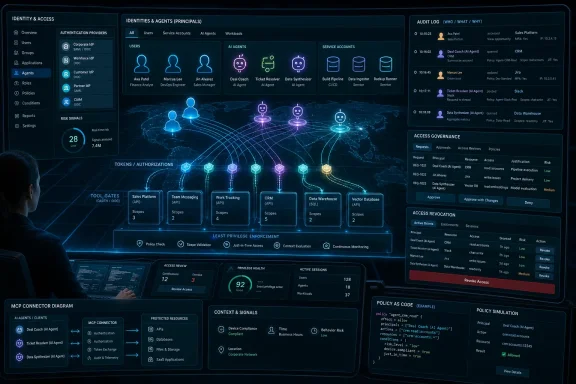 The Agent Era Turns Login Into a Control Plane
For years, identity platforms won developers by removing boring work. They handled sign-in flows, SSO, MFA, directory sync, password resets, audit logs, and the endless edge cases around enterprise customers. That bargain still matters, and it explains why familiar names like WorkOS and Auth0 remain prominent in Analytics Insight’s list.But AI agents change the shape of the problem. Traditional SaaS authentication asks whether Alice can log into an app. Agentic authentication asks whether Alice’s agent can open Salesforce, summarize a customer record, update Jira, query a database, and send a message in Slack — all without turning into a confused deputy with too much power.
That is a fundamentally harder security model. It requires identity systems to distinguish between a human, an app, a service account, an autonomous agent, and an agent acting on behalf of a human. It also requires audit trails that make sense after the fact: not merely “token used,” but “agent X used delegated authority from user Y to perform action Z against system W.”
Microsoft, Okta, Auth0, and the MCP ecosystem are converging on this same conclusion. The identity layer is becoming the place where agent behavior is bounded, logged, revoked, and explained.
MCP Made the Integration Problem Obvious, Then Exposed the Security Gap
The Model Context Protocol became popular because it gave developers a common way to connect AI systems to tools, data, and services. Instead of building one-off connectors for every app, an MCP client can talk to MCP servers that expose resources, prompts, and tools in a standard pattern. That is exactly the kind of abstraction developers love.It is also exactly the kind of abstraction security teams learn to fear. A clean interface for tool access is only safe if the authorization model underneath it is equally clean. Otherwise, MCP becomes a convenient highway between an unpredictable agent and a pile of sensitive business systems.
The MCP authorization specification has moved toward OAuth-based patterns, including authorization server metadata and token validation requirements. That matters because OAuth is the lingua franca of delegated access on the modern web. It gives the ecosystem a vocabulary for consent, scopes, protected resources, and tokens.
Yet standards do not automatically create safe deployments. A recent academic measurement study of real-world remote MCP servers reported widespread OAuth implementation flaws among tested servers. The exact numbers will evolve as the ecosystem matures, but the lesson is already clear: developers are racing to expose tools to agents faster than they are hardening the authentication paths around those tools.
That is why platform choices matter. An MCP server that relies on a hand-rolled token flow, copied sample code, or a shared API key may work in a demo. In production, it becomes another identity island — and identity islands are where attackers, misconfigured agents, and over-permissioned automations thrive.
WorkOS Is the Enterprise Doorway for Agentic SaaS
WorkOS appears in the Analytics Insight roundup as the obvious choice for companies building products that must sell into enterprises. That framing is right. WorkOS is not primarily an “AI agent identity company” in the narrow sense; it is an enterprise-readiness layer for developers who need SSO, directory sync, MFA, user management, and audit logs without spending a year recreating Okta-lite.That distinction matters. Many AI startups discover enterprise identity late. They build a clever agentic workflow, land a pilot, and then the buyer asks for SAML, SCIM, role mapping, MFA policies, domain verification, and logs that can satisfy internal compliance teams. The product roadmap suddenly becomes an identity roadmap.
WorkOS is strongest when the problem is customer-facing enterprise authentication. If an AI product needs to authenticate users from a customer’s Okta, Entra ID, Google Workspace, or other identity provider, WorkOS can save a team from turning its core product engineers into SSO specialists.
For MCP servers, the WorkOS value proposition is less about being the agent brain and more about grounding agent access in enterprise identity. The agent still needs a careful authorization model, but the surrounding application gains a mature path for knowing which organization, user, directory group, and policy context should shape what the agent can do.
That makes WorkOS particularly attractive to startups building AI tools for business customers. It is not the flashiest agent-specific stack, but it solves the first problem every enterprise AI vendor eventually faces: proving that the product can live inside someone else’s identity perimeter.
Auth0 Wants to Own the Developer Path Into Agent Identity
Auth0, now part of Okta, has long occupied a different lane: developer-friendly identity for applications that need to move quickly. Analytics Insight calls it a trusted all-round option, and that undersells the strategic shift underway. Auth0 is increasingly being positioned as the developer identity layer for agentic applications.Okta announced Auth0 for AI Agents capabilities in 2026, including features aimed at MCP authentication, agents as principals, on-behalf-of token exchange, token vaulting, and fine-grained authorization. The product language is vendor-polished, but the underlying problem is real. Developers need to authenticate humans, agents, tools, and delegated actions without stuffing secrets into config files or reinventing OAuth.
The phrase “agent as principal” is especially important. In old systems, agents often hide behind service accounts or inherit a user token with little distinction. That makes auditing muddy. If the system cannot tell whether a human clicked a button or an agent acted autonomously under delegated authority, incident response becomes guesswork.
Auth0’s advantage is that developers already know it as an embeddable identity layer. Its SDKs, hosted login flows, token handling, and authorization patterns fit naturally into the way modern apps are built. If Auth0 can make agent identity feel like an extension of application identity rather than a separate security discipline, it has a strong claim on the next generation of AI-native software.
The risk is abstraction. Identity products often hide complexity until the edge cases arrive: multiple tenants, conflicting group claims, chained delegation, long-running agents, revoked consent, cross-organization workflows, and compliance-grade audit requirements. Auth0’s challenge is to make agent identity easy without making it simplistic.
Microsoft’s Advantage Is That the Enterprise Already Lives in Entra
Microsoft Azure Foundry appears in Analytics Insight’s list as a practical option for organizations already invested in Microsoft’s cloud and security stack. That is the right read, but the deeper Microsoft story is Entra Agent ID. Microsoft has been explicit that AI agents need identities of their own, governed through familiar controls such as Conditional Access, identity governance, identity protection, and lifecycle management.For WindowsForum readers, this is the most consequential platform shift. Microsoft is not merely selling another developer identity service. It is trying to fold agent identity into the same administrative universe that already governs users, devices, apps, service principals, and privileged access across Microsoft 365 and Azure.
That has obvious appeal for IT. If an organization is already using Entra ID as the source of truth, the best agent identity platform may be the one that shows up in the existing admin center, respects existing access policies, and plugs into the same governance workflows. Security teams do not want a separate dashboard for every class of automation.
Azure AI Foundry strengthens that position because it connects model development, deployment, data access, and cloud security in one ecosystem. A team building agents inside Azure can use Microsoft-native identity primitives rather than bolt on identity after the fact. That may not satisfy every developer building cross-cloud systems, but it is compelling for enterprises that have standardized on Microsoft.
The strategic question is whether Microsoft’s agent identity model becomes portable enough. Enterprise agents will not stay politely inside Azure. They will call third-party APIs, consume MCP servers, connect to SaaS systems, and operate across hybrid estates. Microsoft has the installed base, but the agent era rewards identity systems that can govern across boundaries, not just within a tenant.
Composio and Arcade Treat Tool Access as the Product
Composio and Arcade represent a more agent-native category than WorkOS or traditional Auth0. Their pitch is not simply “add login to your app.” It is closer to “let agents connect safely to tools.” That is a different center of gravity.Composio, as described by Analytics Insight, focuses on AI tool integration, secure API connections, authentication management, and MCP integration. That makes sense because agents are only useful when they can do work. The bottleneck is often not the model; it is the messy, permissioned, rate-limited, OAuth-protected universe of business software.
Arcade similarly focuses on secure authentication, agent authorization, API access control, and developer tooling. In other words, it tries to sit directly at the point where an agent wants to act. That is where the security stakes are highest, because a bad permission decision can turn a helpful assistant into an accidental data exfiltration engine.
These platforms are interesting because they acknowledge a truth many application identity vendors are still adapting to: for agents, integrations are identity events. Connecting to Gmail, GitHub, Slack, Notion, Jira, Salesforce, or an internal API is not just plumbing. It is a decision about delegated authority.
The upside is speed. Agent developers do not want to write and maintain dozens of OAuth connectors, token refresh paths, permission screens, and revocation flows. The downside is concentration of risk. A platform that brokers many tool connections becomes a sensitive control point, and customers will need to understand how tokens are stored, scoped, rotated, audited, and revoked.
Composio and Arcade may be best understood as identity-adjacent agent infrastructure. They do not replace the enterprise IdP, but they can become the layer that translates identity into safe tool execution.
TrueFoundry Shows Why AI Platforms Cannot Dodge Access Control
TrueFoundry’s inclusion in the Analytics Insight list is notable because it is not primarily known as a consumer authentication brand. It sits closer to the AI platform and deployment layer, helping teams build, deploy, manage, and operate machine learning and AI applications. That makes its access-control story more operational than login-centric.This is where many enterprises will actually feel the pain. The people building AI systems are not always traditional app developers. They are data scientists, platform engineers, ML engineers, and product teams deploying models, pipelines, notebooks, evaluation systems, vector stores, and agent services. Access control in that world is often fragmented.
TrueFoundry’s value is in tying AI deployment workflows to user access, team collaboration, infrastructure controls, and model management. That is less glamorous than “agent identity,” but it is essential. An organization cannot govern agents if it cannot govern who can deploy them, change prompts, attach tools, alter data connections, or push a model-serving endpoint into production.
This is also where Windows and enterprise IT teams should broaden their view. Agent security is not just runtime authorization. It is also build-time and deploy-time governance. The agent that leaks data tomorrow may be the one someone carelessly configured today.
Platforms like TrueFoundry matter because they place identity inside the AI delivery pipeline. The strongest security model is not a checkpoint at the end. It is a chain of controls from development to deployment to runtime to audit.
The Old Service Account Model Is Not Good Enough
The lazy solution to agent authentication is to give the agent a service account and move on. It is familiar, automation-friendly, and easy to wire into existing systems. It is also exactly how organizations end up with standing privileges nobody owns, secrets nobody rotates, and actions nobody can attribute.Service accounts were built for software, not judgment. They work reasonably well for predictable background jobs: copy a file, sync a directory, run a nightly report. AI agents are different because they operate over ambiguous instructions, dynamic context, and tool choices that may vary from one run to the next.
That means least privilege must become more contextual. An agent summarizing a document does not need permission to delete it. An agent drafting an email does not need permission to send it without approval. An agent querying customer data may need access to one account record, not the whole CRM.
The identity layer must therefore support delegation, scoped access, human approval, short-lived credentials, revocation, and policy evaluation at the moment of action. A static secret in an environment variable cannot carry that burden.
This is why the best platforms in 2026 are the ones that treat agents as first-class actors. Not humans, not ordinary apps, and not invisible service accounts — actors with identities, permissions, lifecycles, and logs.
The Buying Decision Depends on Where the Trust Boundary Lives
The “best” platform depends less on brand ranking than on where the trust boundary sits. If you are building an enterprise SaaS product with AI features, WorkOS may be the practical first move because customers will demand SSO, directory sync, and auditability. If you are building developer-first agentic apps, Auth0’s AI agent direction deserves close attention.If you live in Microsoft 365, Azure, and Entra, Microsoft’s stack may be the default center of gravity. Entra Agent ID and Azure AI Foundry offer the promise of agent governance inside the identity and cloud controls many admins already understand. That matters in enterprises where new security tools face procurement drag and operational resistance.
If your core challenge is connecting agents to external tools, platforms like Composio and Arcade may solve more immediate pain. They operate closer to the integration layer, where OAuth flows, token storage, and permission boundaries can become a full-time engineering burden.
If your biggest risk is AI deployment sprawl, TrueFoundry’s platform-style approach may be more relevant. The question is not only who can use an agent, but who can build one, deploy one, modify one, and connect it to production resources.
The wrong decision is to treat identity as something to add after the demo works. In 2026, that is backward. For agentic systems, identity is part of the product architecture.
The 2026 Shortlist Is Really a Map of the Market
The useful way to read Analytics Insight’s roundup is not as a final verdict, but as a map of how the market is splitting. WorkOS represents enterprise-readiness identity. Auth0 represents developer identity moving into agents. Microsoft represents the incumbent enterprise control plane. Composio and Arcade represent agent-tool authorization. TrueFoundry represents AI platform governance.That spread is healthy because the problem is too large for one category. AI agents touch application login, API security, SaaS integrations, cloud infrastructure, data governance, model deployment, audit logging, and endpoint workflows. No single product magically solves all of that.
The near-term winners will be platforms that interoperate cleanly. They will support OAuth-based patterns, work with existing IdPs, issue short-lived credentials, preserve user context, represent agents as distinct principals, and produce logs that security teams can actually investigate.
The losers will be platforms that hide complexity behind vague claims about “secure AI.” Buyers should ask hard questions. Can the platform distinguish agent action from user action? Can it revoke an agent without disabling a human account? Can it explain why an agent had access to a tool? Can it enforce least privilege dynamically? Can it integrate with the IdP the business already trusts?
Those are not niche security questions anymore. They are product questions.
The Real Winners Will Make Agents Boring Enough to Govern
The most concrete lesson from the 2026 identity field is that AI security is becoming ordinary enterprise security — with stranger actors and faster failure modes. Teams should look past the marketing language and evaluate where each platform sits in the control chain.- WorkOS is strongest when an AI application needs enterprise SSO, directory sync, MFA, user management, and audit logs for business customers.
- Auth0 is a strong fit for developer teams that want application identity plus emerging agent-specific capabilities such as MCP authentication, delegated token exchange, and agent principals.
- Microsoft Azure Foundry and Entra Agent ID are most compelling for organizations already invested in Microsoft’s identity, governance, and cloud security ecosystem.
- Composio and Arcade are worth watching when the hard problem is safely connecting agents to many external tools and APIs.
- TrueFoundry belongs in the conversation when teams need to govern AI deployment, collaboration, infrastructure access, and model operations rather than only end-user login.
- Any serious agent identity strategy should avoid shared API keys and long-lived service accounts as the default authorization model.
References
- Primary source: Analytics Insight
Published: 2026-07-03T18:50:18.157395
Top Identity and Authentication Platforms for AI Agents
Explore the best identity and authentication platforms for AI agents and MCP servers in 2026, including WorkOS, Auth0, Composio, Arcade, Microsoft Azure Foundry, and TrueFoundry.www.analyticsinsight.net - Related coverage: agentmarketcap.ai
Okta for AI Agents Goes GA April 2026: The First Enterprise Identity Platform Purpose-Built for Agentic AI | AgentMarketCap
Okta for AI Agents launches April 30 with shadow AI discovery, agent lifecycle governance, and Auth0 Token Vault — here's how it competes with Microsoft Entra Agent ID.agentmarketcap.ai - Related coverage: mcp-framework.com
OAuth 2.1 | MCP Framework
Production-ready OAuth 2.1 authentication with JWKS, token introspection, and support for Auth0, Okta, AWS Cognito, and Azure ADwww.mcp-framework.com - Official source: techcommunity.microsoft.com
- Official source: microsoft.com
Secure Agent Access with Microsoft Entra | Microsoft Security
Take control of AI agent sprawl by managing, protecting, and governing agents with secure access for agents from Microsoft Entra.www.microsoft.com
- Related coverage: techradar.com
Okta unveils new framework to secure and protect enterprise AI agents | TechRadar
Okta wants to improve AI agent identity managementwww.techradar.com
- Related coverage: itpro.com
What is MCP? | IT Pro
MCP now underpins agentic AI systems – but how does it work and is it easy to use?www.itpro.com - Related coverage: okta.com
- Related coverage: assets.ctfassets.net
