

Microsoft Agent 365 is Microsoft’s enterprise control plane for AI agents, announced at Ignite 2025 and made generally available to commercial customers on May 1, 2026, as a $15-per-user monthly add-on and part of the new Microsoft 365 E7 suite. Its pitch is simple: if agents are becoming digital coworkers, then they need identity, policy, monitoring, and retirement plans. The harder truth is that Microsoft is trying to make itself the operating authority for a new class of nonhuman enterprise actor. That is both sensible and strategically loaded.
The most important thing about Agent 365 is not that it manages AI agents. It is that Microsoft has decided agents should be governed less like chatbots and more like employees, service accounts, and applications with badges.
That framing matters. Enterprise AI has moved from “ask Copilot to summarize this” into something messier: agents that read documents, call APIs, send email, query CRM records, trigger workflows, and hand tasks to other agents. Once software can act across systems on behalf of a user or team, the old model of treating it as a clever prompt box stops working.
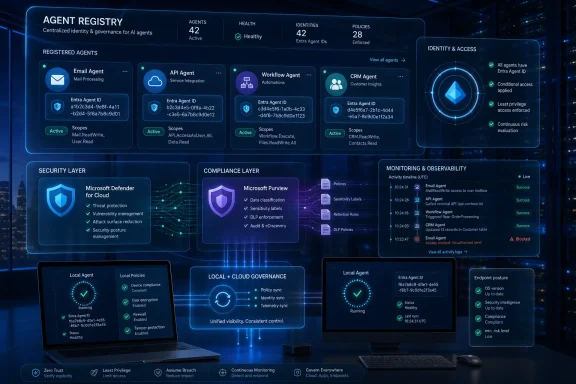
Agent 365 is Microsoft’s answer to that gap. It gives organizations a registry for agents, ties them into Microsoft Entra Agent ID, brings activity into Defender and Purview, and gives administrators a place to see what agents exist and what they are allowed to do. In Microsoft’s language, this is a control plane. In plainer English, it is an attempt to make AI agents administratively legible before they become operationally unmanageable.
The Blockchain Council article captures the broad product positioning accurately, but its tone undersells the more interesting tension. Agent 365 is not merely a governance tool arriving in response to customer demand. It is also a licensing and platform move: Microsoft is preparing for an enterprise world where the number of useful software actors may grow faster than the number of human seats.
That registry is more than a spreadsheet with better branding. Each governed agent can be associated with an identity, owner, permissions, lifecycle metadata, and observed behavior. The goal is to answer the questions administrators will otherwise ask only after something has gone wrong: who owns this agent, what does it access, why does it have that permission, and is it still needed?
This is where Microsoft Entra Agent ID becomes foundational. Microsoft is extending the identity plane to nonhuman actors so that agents can be authenticated, authorized, audited, and governed through familiar enterprise machinery. Interactive agents may act in a user context, while autonomous agents may require their own identity model. Either way, Microsoft wants the agent to become a first-class participant in access management rather than a script hiding behind someone’s OAuth token.
That is a necessary shift. The worst version of enterprise agent adoption is a swarm of automations tied to personal credentials, vendor secrets, and overbroad app registrations. The better version is a managed identity model where least privilege, conditional access, entitlement management, and lifecycle workflows apply to agents before they touch sensitive systems.
The risk is not theoretical. A business unit can build an agent in a low-code tool, a developer can run one locally against source repositories, and a vendor can connect one through a sanctioned application that IT believes it already understands. Each case may look harmless in isolation. At scale, the organization ends up with a distributed population of agents with uneven controls, unclear ownership, and inconsistent logging.
Agent 365’s promise is to pull those agents into view, classify them, and bring them under policy. Microsoft is leaning on Defender, Intune, Entra, and Purview to make that possible across managed endpoints, cloud services, data flows, and identity events. This is where the product becomes most interesting for WindowsForum readers: the endpoint is not a side detail. Local agents running on Windows devices are part of the governance problem, especially as developer tools and AI coding assistants increasingly behave like autonomous operators.
The uncomfortable truth for enterprises is that agent governance will not be solved by telling employees to stop experimenting. The tools are too useful, too easy to acquire, and too embedded in modern SaaS platforms. The more realistic strategy is detection, registration, policy enforcement, and graduated response. Agent 365 is built for that world.
That breadth creates pressure to over-permission agents in the name of productivity. The danger is obvious: an agent with too much access becomes a rich target, and an agent manipulated by malicious input can misuse permissions it was legitimately granted. Prompt injection and tool misuse are not just AI research curiosities when an agent can call business systems.
Agent 365 tries to answer this by tying access to agent identity, policy templates, tool permissions, MCP-connected services, and monitoring. Administrators can define which resources and tools an agent should use, then watch whether its behavior stays within expected boundaries. In theory, that lets organizations approve useful agents without handing them the keys to the tenant.
The phrase “in theory” matters. Governance platforms do not magically produce good governance. Someone still has to classify agents, define acceptable actions, tune alerts, review ownership, and retire abandoned agents. Agent 365 gives Microsoft-centric organizations a serious starting point, but it does not remove the need for architectural discipline.
That gives Microsoft a distribution advantage that smaller AI governance vendors will struggle to match. If an organization already lives in Microsoft 365 E5, adding agent governance through a familiar admin surface is easier to justify than introducing a separate control plane with its own logs, policies, connectors, and procurement cycle.
It also gives Microsoft a strategic advantage. By defining agent governance through Entra identities, Purview data controls, Defender signals, and Microsoft 365 admin workflows, the company strengthens the gravitational pull of its enterprise cloud. A third-party agent may be governed through Agent 365, but the governance vocabulary remains Microsoft’s.
That does not make the product cynical. Enterprises genuinely need a control layer for agents. But it does mean Agent 365 should be read as both a security product and a platform consolidation play. Microsoft is not just helping customers manage the agentic era. It is positioning Microsoft 365 as the place where that era is administered.
The open question is how deep that governance goes in practice. Registering an outside agent and assigning it an identity is one thing. Observing its runtime behavior, constraining its tools, mapping its data access, and responding to misuse with the same fidelity available for Microsoft-native agents is harder.
The Model Context Protocol matters here because tool access is becoming one of the central battlegrounds of agent security. Agents are only as safe as the systems they can reach and the actions they can invoke. If Agent 365 can help administrators govern which MCP servers and tools agents may use, it gives security teams a practical enforcement point.
Still, IT pros should be skeptical of any universal-control-plane story until they test it against their own mess. The real enterprise environment includes SaaS agents, local developer agents, browser-based agents, vendor-managed agents, and custom internal systems. Agent 365’s value will depend on how much of that world it can see with confidence and how much remains dependent on manual registration, partner support, or future integrations.
That packaging is classic Microsoft. The company identifies a new enterprise requirement, attaches it to security and compliance, and then folds it into a premium suite that encourages customers to climb the licensing ladder. For organizations already buying E5, Copilot, and advanced Entra capabilities, E7 may be a rational consolidation. For everyone else, it will look like yet another proof that AI transformation comes with a recurring invoice.
The licensing model is also notable because Agent 365 is licensed per user, not per individual agent in the simple sense. Agents acting on behalf of a licensed user are covered under that user’s license. That avoids the obvious nightmare of charging separately for every small agent an employee creates, but it also keeps the value metric tied to Microsoft’s traditional per-seat model.
This may become one of the more interesting tensions in enterprise software. If AI agents reduce the number of human workers needed for some workflows, vendors will look for ways to preserve revenue as work shifts from people to software actors. Agent 365 does not fully answer that question, but it points toward the next licensing fight: how much should organizations pay to govern nonhuman labor?
Defender integration is especially important because agent risk is behavioral. A safe-looking agent can become dangerous when it encounters hostile content, receives manipulated instructions, calls the wrong tool, or exposes sensitive output. Static approval at creation time is not enough. Runtime protection and anomaly detection matter.
Purview integration matters for a different reason: agents generate compliance questions. What data did the agent access? Did it expose regulated information? Did it create records that must be retained? Did it interact with sensitive content in ways that violate policy? If AI agents become business process participants, their actions become audit material.
But the operational burden should not be ignored. More visibility creates more events. More events create more triage. If Agent 365 produces noisy alerts or ambiguous risk scores, security teams may end up with another dashboard to babysit. The product’s success will depend not only on detection capability but on whether it helps teams prioritize the few agent behaviors that actually demand intervention.
That makes endpoint discovery and management crucial. If Agent 365 can surface locally running agents through Microsoft’s endpoint and security stack, it becomes more relevant to the day-to-day reality of administrators. The riskiest agent may not be the polished partner agent deployed from an approved catalog. It may be the one a power user installed to “speed up” a workflow involving customer exports, credentials, or internal documents.
This is also where Windows administrators will need to update their instincts. Traditional endpoint management focuses on software inventory, patch state, malware, configuration baselines, and user activity. Agent-era endpoint management adds a new layer: what autonomous tools are present, what they can touch, and whether their behavior matches policy.
For Windows shops, Agent 365 should be evaluated alongside Intune, Defender for Endpoint, application control, browser controls, and developer workstation policy. The agent problem is not separate from endpoint governance. It is becoming part of it.
Where the piece becomes less useful is in its promotional drift. Several sections pivot from Agent 365 into certification marketing, which is not inherently wrong but does blur the line between product analysis and lead generation. The result is an article that explains what Microsoft wants Agent 365 to be, while spending less time on the friction customers will encounter when turning that vision into policy.
Those frictions are where IT pros live. How complete is discovery across non-Microsoft agents? How cleanly do existing agents migrate into Entra Agent ID? How much work is required to define useful access templates? How noisy are security signals? How will organizations avoid creating a new class of ownerless, half-governed agent identities?
That is the difference between a product brief and an enterprise deployment. Agent 365 may be necessary infrastructure, but necessary infrastructure is still infrastructure: it has prerequisites, dependencies, political constraints, and failure modes.
The weakest argument is that a control plane will make agent adoption safe by default. It will not. Agent 365 can help organizations see agents, assign identities, enforce policies, monitor behavior, and integrate incident response. But it cannot decide which business processes should be automated, which data should remain off-limits, or how much autonomy is acceptable in a regulated workflow.
That means the product belongs in a broader governance program. Organizations need agent design standards, approval paths, owner accountability, access reviews, data classification, incident playbooks, and user education. Agent 365 can provide the administrative machinery, but policy still has to come from people.
There is also a cultural problem. Many employees will experience agent governance as friction after months of being told to experiment with AI. Microsoft and its customers have spent the last few years encouraging adoption; now IT departments must retrofit controls onto that enthusiasm. The organizations that handle this well will frame governance as a way to scale useful agents, not as a clampdown on innovation.
For some organizations, the math will be straightforward. If they are already deep in Microsoft 365, already buying Copilot, and already standardizing on Entra, Defender, Purview, and Intune, Agent 365 may be the least disruptive path to agent governance. The more agents they deploy, the more valuable a unified registry and policy model becomes.
For others, the decision will be more complicated. Mixed-cloud organizations, open-source-heavy engineering teams, and companies with mature non-Microsoft security stacks will need proof that Agent 365 can govern their actual agent population, not just the Microsoft-friendly part of it. They should pilot against messy real-world use cases rather than polished demos.
The broader lesson is that AI adoption is entering its second bill. The first bill was productivity tooling. The second is governance. Agent 365 is Microsoft’s argument that both bills should be paid through Microsoft 365.
 Microsoft Is Turning Agent Sprawl Into an Identity Problem
The most important thing about Agent 365 is not that it manages AI agents. It is that Microsoft has decided agents should be governed less like chatbots and more like employees, service accounts, and applications with badges.That framing matters. Enterprise AI has moved from “ask Copilot to summarize this” into something messier: agents that read documents, call APIs, send email, query CRM records, trigger workflows, and hand tasks to other agents. Once software can act across systems on behalf of a user or team, the old model of treating it as a clever prompt box stops working.
Agent 365 is Microsoft’s answer to that gap. It gives organizations a registry for agents, ties them into Microsoft Entra Agent ID, brings activity into Defender and Purview, and gives administrators a place to see what agents exist and what they are allowed to do. In Microsoft’s language, this is a control plane. In plainer English, it is an attempt to make AI agents administratively legible before they become operationally unmanageable.
The Blockchain Council article captures the broad product positioning accurately, but its tone undersells the more interesting tension. Agent 365 is not merely a governance tool arriving in response to customer demand. It is also a licensing and platform move: Microsoft is preparing for an enterprise world where the number of useful software actors may grow faster than the number of human seats.
The Registry Is the Product’s Real Center of Gravity
Every security platform eventually returns to inventory. You cannot govern what you cannot see, and you cannot secure what you cannot name. Agent 365 begins there, with an agent registry intended to collect Microsoft-built agents, partner agents, custom agents, and eventually the less tidy population of agents created or installed outside normal IT channels.That registry is more than a spreadsheet with better branding. Each governed agent can be associated with an identity, owner, permissions, lifecycle metadata, and observed behavior. The goal is to answer the questions administrators will otherwise ask only after something has gone wrong: who owns this agent, what does it access, why does it have that permission, and is it still needed?
This is where Microsoft Entra Agent ID becomes foundational. Microsoft is extending the identity plane to nonhuman actors so that agents can be authenticated, authorized, audited, and governed through familiar enterprise machinery. Interactive agents may act in a user context, while autonomous agents may require their own identity model. Either way, Microsoft wants the agent to become a first-class participant in access management rather than a script hiding behind someone’s OAuth token.
That is a necessary shift. The worst version of enterprise agent adoption is a swarm of automations tied to personal credentials, vendor secrets, and overbroad app registrations. The better version is a managed identity model where least privilege, conditional access, entitlement management, and lifecycle workflows apply to agents before they touch sensitive systems.
Shadow AI Is the Threat Microsoft Can Sell Against
The phrase shadow AI is doing a lot of work in Microsoft’s messaging, and for good reason. It gives IT leaders a familiar category for an unfamiliar problem. Shadow IT was SaaS adoption without permission; shadow AI is autonomous or semi-autonomous software acting without visibility.The risk is not theoretical. A business unit can build an agent in a low-code tool, a developer can run one locally against source repositories, and a vendor can connect one through a sanctioned application that IT believes it already understands. Each case may look harmless in isolation. At scale, the organization ends up with a distributed population of agents with uneven controls, unclear ownership, and inconsistent logging.
Agent 365’s promise is to pull those agents into view, classify them, and bring them under policy. Microsoft is leaning on Defender, Intune, Entra, and Purview to make that possible across managed endpoints, cloud services, data flows, and identity events. This is where the product becomes most interesting for WindowsForum readers: the endpoint is not a side detail. Local agents running on Windows devices are part of the governance problem, especially as developer tools and AI coding assistants increasingly behave like autonomous operators.
The uncomfortable truth for enterprises is that agent governance will not be solved by telling employees to stop experimenting. The tools are too useful, too easy to acquire, and too embedded in modern SaaS platforms. The more realistic strategy is detection, registration, policy enforcement, and graduated response. Agent 365 is built for that world.
Least Privilege Gets Harder When Software Starts Making Decisions
Least privilege is easy to recite and hard to implement. Agents make it harder because their usefulness often depends on crossing system boundaries. A useful finance agent may need email, spreadsheets, ERP data, document repositories, and approval workflows. A useful developer agent may need code, tickets, build systems, package repositories, and deployment context.That breadth creates pressure to over-permission agents in the name of productivity. The danger is obvious: an agent with too much access becomes a rich target, and an agent manipulated by malicious input can misuse permissions it was legitimately granted. Prompt injection and tool misuse are not just AI research curiosities when an agent can call business systems.
Agent 365 tries to answer this by tying access to agent identity, policy templates, tool permissions, MCP-connected services, and monitoring. Administrators can define which resources and tools an agent should use, then watch whether its behavior stays within expected boundaries. In theory, that lets organizations approve useful agents without handing them the keys to the tenant.
The phrase “in theory” matters. Governance platforms do not magically produce good governance. Someone still has to classify agents, define acceptable actions, tune alerts, review ownership, and retire abandoned agents. Agent 365 gives Microsoft-centric organizations a serious starting point, but it does not remove the need for architectural discipline.
Microsoft’s Advantage Is the Stack It Already Owns
Agent 365 is compelling because Microsoft does not have to build the whole governance story from scratch. Entra already owns identity for many enterprises. Purview already carries much of the compliance and data governance burden. Defender already sits inside security operations. Intune already manages endpoints. Microsoft 365 already contains the work data agents want to touch.That gives Microsoft a distribution advantage that smaller AI governance vendors will struggle to match. If an organization already lives in Microsoft 365 E5, adding agent governance through a familiar admin surface is easier to justify than introducing a separate control plane with its own logs, policies, connectors, and procurement cycle.
It also gives Microsoft a strategic advantage. By defining agent governance through Entra identities, Purview data controls, Defender signals, and Microsoft 365 admin workflows, the company strengthens the gravitational pull of its enterprise cloud. A third-party agent may be governed through Agent 365, but the governance vocabulary remains Microsoft’s.
That does not make the product cynical. Enterprises genuinely need a control layer for agents. But it does mean Agent 365 should be read as both a security product and a platform consolidation play. Microsoft is not just helping customers manage the agentic era. It is positioning Microsoft 365 as the place where that era is administered.
Cross-Platform Governance Is the Claim That Needs Watching
Microsoft says Agent 365 is not limited to agents built with Copilot Studio or Microsoft Foundry. The company has described support for agents from non-Microsoft platforms, open-source frameworks, and partner ecosystems, with Microsoft Entra Agent ID supporting third-party integration patterns. That cross-platform claim is essential because no large enterprise will run agents from one vendor only.The open question is how deep that governance goes in practice. Registering an outside agent and assigning it an identity is one thing. Observing its runtime behavior, constraining its tools, mapping its data access, and responding to misuse with the same fidelity available for Microsoft-native agents is harder.
The Model Context Protocol matters here because tool access is becoming one of the central battlegrounds of agent security. Agents are only as safe as the systems they can reach and the actions they can invoke. If Agent 365 can help administrators govern which MCP servers and tools agents may use, it gives security teams a practical enforcement point.
Still, IT pros should be skeptical of any universal-control-plane story until they test it against their own mess. The real enterprise environment includes SaaS agents, local developer agents, browser-based agents, vendor-managed agents, and custom internal systems. Agent 365’s value will depend on how much of that world it can see with confidence and how much remains dependent on manual registration, partner support, or future integrations.
E7 Shows the Price of the Agentic Workplace
Agent 365 is available as a standalone $15-per-user monthly add-on, and it is also included in Microsoft 365 E7, the new “Frontier Suite” Microsoft announced for general availability on May 1, 2026. E7 bundles Microsoft 365 E5, Microsoft 365 Copilot, Agent 365, Microsoft Entra Suite, and advanced security and compliance capabilities at a much higher per-user price point.That packaging is classic Microsoft. The company identifies a new enterprise requirement, attaches it to security and compliance, and then folds it into a premium suite that encourages customers to climb the licensing ladder. For organizations already buying E5, Copilot, and advanced Entra capabilities, E7 may be a rational consolidation. For everyone else, it will look like yet another proof that AI transformation comes with a recurring invoice.
The licensing model is also notable because Agent 365 is licensed per user, not per individual agent in the simple sense. Agents acting on behalf of a licensed user are covered under that user’s license. That avoids the obvious nightmare of charging separately for every small agent an employee creates, but it also keeps the value metric tied to Microsoft’s traditional per-seat model.
This may become one of the more interesting tensions in enterprise software. If AI agents reduce the number of human workers needed for some workflows, vendors will look for ways to preserve revenue as work shifts from people to software actors. Agent 365 does not fully answer that question, but it points toward the next licensing fight: how much should organizations pay to govern nonhuman labor?
Security Teams Will Like the Theory and Fear the Workload
For security operations teams, Agent 365 offers a welcome normalization of agent activity. Instead of treating AI agents as exotic exceptions, Microsoft wants them visible in the same broader security ecosystem as users, devices, applications, and data. That is the right direction.Defender integration is especially important because agent risk is behavioral. A safe-looking agent can become dangerous when it encounters hostile content, receives manipulated instructions, calls the wrong tool, or exposes sensitive output. Static approval at creation time is not enough. Runtime protection and anomaly detection matter.
Purview integration matters for a different reason: agents generate compliance questions. What data did the agent access? Did it expose regulated information? Did it create records that must be retained? Did it interact with sensitive content in ways that violate policy? If AI agents become business process participants, their actions become audit material.
But the operational burden should not be ignored. More visibility creates more events. More events create more triage. If Agent 365 produces noisy alerts or ambiguous risk scores, security teams may end up with another dashboard to babysit. The product’s success will depend not only on detection capability but on whether it helps teams prioritize the few agent behaviors that actually demand intervention.
The Windows Angle Is Local, Messy, and Underappreciated
Agent governance often sounds like a cloud management problem, but Windows endpoints are becoming a frontier of their own. Developer workstations, managed laptops, and local AI tools increasingly host agents that can read files, interact with terminals, modify code, and connect to cloud services. Those agents may never begin life in a Microsoft 365 admin center.That makes endpoint discovery and management crucial. If Agent 365 can surface locally running agents through Microsoft’s endpoint and security stack, it becomes more relevant to the day-to-day reality of administrators. The riskiest agent may not be the polished partner agent deployed from an approved catalog. It may be the one a power user installed to “speed up” a workflow involving customer exports, credentials, or internal documents.
This is also where Windows administrators will need to update their instincts. Traditional endpoint management focuses on software inventory, patch state, malware, configuration baselines, and user activity. Agent-era endpoint management adds a new layer: what autonomous tools are present, what they can touch, and whether their behavior matches policy.
For Windows shops, Agent 365 should be evaluated alongside Intune, Defender for Endpoint, application control, browser controls, and developer workstation policy. The agent problem is not separate from endpoint governance. It is becoming part of it.
Blockchain Council’s Version Gets the Shape Right but Sands Off the Edges
The Blockchain Council explainer presents Agent 365 as a foundational governance layer and correctly highlights the registry, access control, observability, interoperability, and security story. It also describes the product’s May 1, 2026 general availability, $15-per-user pricing, Microsoft 365 E7 inclusion, and links to Entra, Purview, and Defender. As a high-level summary, that is broadly aligned with Microsoft’s own positioning.Where the piece becomes less useful is in its promotional drift. Several sections pivot from Agent 365 into certification marketing, which is not inherently wrong but does blur the line between product analysis and lead generation. The result is an article that explains what Microsoft wants Agent 365 to be, while spending less time on the friction customers will encounter when turning that vision into policy.
Those frictions are where IT pros live. How complete is discovery across non-Microsoft agents? How cleanly do existing agents migrate into Entra Agent ID? How much work is required to define useful access templates? How noisy are security signals? How will organizations avoid creating a new class of ownerless, half-governed agent identities?
That is the difference between a product brief and an enterprise deployment. Agent 365 may be necessary infrastructure, but necessary infrastructure is still infrastructure: it has prerequisites, dependencies, political constraints, and failure modes.
The Useful Reading Is Between Microsoft’s Lines
The strongest argument for Agent 365 is not that Microsoft has invented agent governance. It is that agent governance is becoming unavoidable, and Microsoft has enough of the enterprise stack to make a credible first move.The weakest argument is that a control plane will make agent adoption safe by default. It will not. Agent 365 can help organizations see agents, assign identities, enforce policies, monitor behavior, and integrate incident response. But it cannot decide which business processes should be automated, which data should remain off-limits, or how much autonomy is acceptable in a regulated workflow.
That means the product belongs in a broader governance program. Organizations need agent design standards, approval paths, owner accountability, access reviews, data classification, incident playbooks, and user education. Agent 365 can provide the administrative machinery, but policy still has to come from people.
There is also a cultural problem. Many employees will experience agent governance as friction after months of being told to experiment with AI. Microsoft and its customers have spent the last few years encouraging adoption; now IT departments must retrofit controls onto that enthusiasm. The organizations that handle this well will frame governance as a way to scale useful agents, not as a clampdown on innovation.
The Agent Control Plane Becomes a Budget Conversation
Agent 365 deserves attention because it crystallizes where enterprise AI is heading: away from isolated assistants and toward managed fleets of software actors. That shift has technical consequences, but it also has budget consequences. Once agents become part of the enterprise operating model, they need lifecycle management, compliance evidence, threat detection, and identity governance. None of that is free.For some organizations, the math will be straightforward. If they are already deep in Microsoft 365, already buying Copilot, and already standardizing on Entra, Defender, Purview, and Intune, Agent 365 may be the least disruptive path to agent governance. The more agents they deploy, the more valuable a unified registry and policy model becomes.
For others, the decision will be more complicated. Mixed-cloud organizations, open-source-heavy engineering teams, and companies with mature non-Microsoft security stacks will need proof that Agent 365 can govern their actual agent population, not just the Microsoft-friendly part of it. They should pilot against messy real-world use cases rather than polished demos.
The broader lesson is that AI adoption is entering its second bill. The first bill was productivity tooling. The second is governance. Agent 365 is Microsoft’s argument that both bills should be paid through Microsoft 365.
The Admin Checklist Microsoft Just Made Unavoidable
Agent 365 is not a product IT leaders can evaluate only by reading feature grids. Its value depends on whether it maps to the organization’s real agent population, real data risks, and real enforcement points. The practical takeaways are sharper than the marketing.- Organizations should begin by inventorying known and suspected agents before turning on another layer of tooling.
- Agent identities should have named owners, scoped permissions, and lifecycle rules from the moment they are registered.
- Security teams should test Agent 365 against local, third-party, and open-source agents, not only Microsoft-native Copilot Studio scenarios.
- Purview and Defender integration should be treated as deployment requirements, not optional enhancements.
- Licensing should be modeled against current Microsoft 365 spend, expected Copilot adoption, and the likely growth of agent usage across departments.
- Administrators should assume that shadow AI will persist and design review, quarantine, and approval workflows accordingly.
References
- Primary source: Blockchain Council
Published: Tue, 09 Jun 2026 13:21:17 GMT
Microsoft Agent 365 - Blockchain Council
Explore Microsoft Agent 365 and how it helps organizations manage, govern, and orchestrate AI agents across enterprise environments.www.blockchain-council.org - Official source: blogs.microsoft.com
Introducing the First Frontier Suite built on Intelligence + Trust - The Official Microsoft Blog
Today Microsoft is announcing: Wave 3 of Microsoft 365 Copilot Expanded model diversity with Claude and next-gen OpenAI models available today General availability of Agent 365 on May 1 for $15 per user General availability of the new Microsoft 365 E7: The Frontier Suite on May 1 for $99 per...blogs.microsoft.com - Official source: microsoft.com
Microsoft Agent 365: The Control Plane for Agents
Observe, govern, and secure AI agents confidently with Agent 365. Extend Microsoft 365 and Microsoft Security controls to manage agentic AI at scale.www.microsoft.com
- Related coverage: techtarget.com
Microsoft 365 E7 adds AI governance; prices draw critiques | TechTarget
Microsoft plans to add Agent 365's AI governance to Microsoft 365 E7 in May, prompting analysts to question its pricing strategy.www.techtarget.com - Official source: learn.microsoft.com
Overview of agent identities in Microsoft Entra | Microsoft Learn
Learn about agent identities in Microsoft Entra ID, specialized identity constructs that enable secure authentication and authorization for AI agents in enterprise environments.learn.microsoft.com - Related coverage: zensai.com
Zensai Introduces Human Success Agent for Microsoft Agent 365 - Zensai
Zensai’s Human Success Agent strengthens Microsoft 365 environments with secure, compliant, and centrally managed AI learning experiences powered by Microsoftzensai.com
- Related coverage: winbuzzer.com
Microsoft Agent 365 Hits General Availability With Local AI Agent Controls
Microsoft has released Agent 365 to general availability, adding Defender and Intune controls for local AI agents on Windows alongside AWS and Gemini imports. winbuzzer.com
- Related coverage: techtask.com
Microsoft 365 E7 und Agent 365: Was hinter der «Frontier Suite» steckt • techtask consulting
Am 9. März 2026 hat Microsoft die nächste Stufe seiner Enterprise-Lizenzierungsstrategie eingeläutet, erstmals seit der Einführung von E5 im Jahr 2015 gibt eswww.techtask.com - Related coverage: windowscentral.com
Microsoft 365 premium E7 tier is "the First Frontier Suite" | Windows Central
Microsoft’s latest subscription tier promises AI power at $99/month, but analysts are skeptical about its benefits compared to existing plans.www.windowscentral.com - Related coverage: techradar.com
Microsoft is reportedly planning a new 365 tier which charges AI agents like humans | TechRadar
Microsoft 365 E7 could be in the workswww.techradar.com - Related coverage: licensingschool.co.uk
- Related coverage: pax8nebula.com
