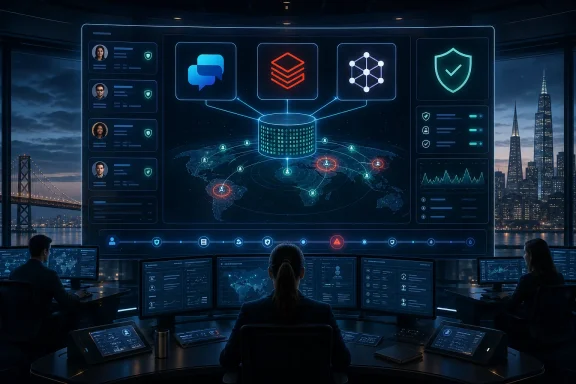
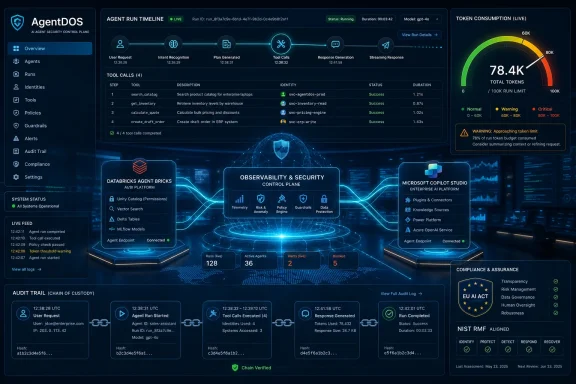
Trust3 AI announced AgentDOS on June 15, 2026, in San Francisco as an enterprise control plane for monitoring AI agents, tracing their actions, and tracking real-time token consumption across platforms including Databricks Agent Bricks and Microsoft Copilot Studio. The company’s pitch is simple: enterprises are no longer merely experimenting with chatbots; they are letting semi-autonomous software touch production data, business workflows, and budgets. That makes observability less of a developer convenience and more of a governance requirement. AgentDOS is therefore best read not as another dashboard, but as an attempt to turn agent sprawl into something security teams can actually audit.
The first wave of enterprise generative AI was easy to narrate. Employees typed prompts into a chatbot, CIOs wrote acceptable-use policies, and security teams worried about confidential text leaking into consumer services. That phase is not over, but it is no longer the frontier.
The frontier is now the agent: a system that can plan, call tools, retrieve files, query databases, trigger workflows, hand off work to other agents, and spend money on model inference while doing it. In that world, the question is not just whether an AI answer is correct. It is whether the system should have touched that data, invoked that connector, used that identity, or burned that many tokens in the first place.
That is the gap Trust3 AI is trying to occupy with AgentDOS. The company is framing the product around Discovery, Observability, and Security, a neat acronym that also happens to describe the operational headache now arriving in IT departments. You cannot govern what you cannot find; you cannot secure what you cannot reconstruct; and you cannot budget for what you cannot meter.
The announcement’s emphasis on token observability is especially telling. Cost control used to be a finance afterthought in AI pilots, often hidden inside cloud bills or vendor line items. With agents, token usage becomes a behavioral signal as well as an expense: a runaway agent, a poorly scoped retrieval loop, or an over-broad workflow can all manifest as unexpected consumption before they show up as a compliance incident.
That is why AgentDOS links token monitoring with scope drift, policy enforcement, and regulated data access. Trust3 AI says the platform can track consumption across agent platforms, set policy-driven limits, and flag activity before a budget overrun becomes a surprise. The important part is not the meter itself. It is the claim that token telemetry can be correlated with identity, purpose, tool usage, data lineage, and policy context.
Traditional observability products are good at telling a developer that a service returned a 500 error or that latency spiked after a deployment. They are less useful when the thing under investigation is a multi-step agent run that queried a patient dataset, summarized a document, called an internal API, delegated to another agent, and then produced an answer that may or may not be defensible. In that case, the relevant question is not simply “did it fail?” but “what exactly happened, and was it allowed?”
Trust3 AI is trying to reframe token usage as part of that forensic record. That is a smart move, because cost is often the lever that gets executive attention before abstract AI risk does. A platform that can say “this agent is about to exhaust its monthly allocation” will get a faster hearing than one that merely says “agentic governance is important.”
The deeper claim is more ambitious: that consumption, behavior, and compliance can be observed in one plane. If AgentDOS can make that claim hold up in production environments, it gives security and governance teams a vocabulary they understand. If it cannot, token observability risks becoming another attractive chart stapled onto an already crowded AI operations stack.
The Microsoft ecosystem has spent years teaching enterprises to think in terms of identity, conditional access, data loss prevention, audit logs, and administrative boundaries. Agentic AI complicates that model because the user’s intent can be laundered through a chain of automation. A human may ask a permitted question, but the agent may retrieve too broadly, invoke a connector in an unexpected way, or produce a derived output that crosses a policy line.
That is why agent traceability matters. If an AI agent built in Copilot Studio touches a SharePoint library, calls a custom connector, queries a Dataverse table, and then summarizes regulated content, the administrator needs more than a generic activity log. They need a replayable account of what the agent saw, why it acted, which identity was used, and what policy was in force at the time.
Microsoft has its own governance and security story, and no third-party vendor should be treated as automatically superior to the native stack. But heterogeneous enterprises rarely stay inside one vendor boundary. A company may use Copilot Studio for departmental automation, Databricks for data intelligence workflows, Snowflake for analytics, ServiceNow for IT operations, and custom agents wired together with emerging protocols. The appeal of a control plane such as AgentDOS is that it promises to sit across those silos.
That promise will resonate with admins who have already lived through SaaS sprawl, shadow IT, and cloud identity fragmentation. The agent era may rhyme with all three, except now the unsanctioned workflow can reason, retrieve, and spend money while no one is watching.
Engineering observability is necessary, but it is not the same as institutional accountability. A developer wants to know why an agent failed. A CISO wants to know whether the agent accessed protected data. A compliance officer wants to know whether the decision path can be defended. A CFO wants to know why inference costs doubled. A data owner wants to know whether the agent had a valid purpose.
AgentDOS is trying to consolidate those anxieties into a single governance layer. The company says agent actions are enriched with identity, declared purpose, data lineage, and live policy context. In plain English, that means the product is supposed to attach business meaning to technical telemetry.
That is harder than it sounds. “Purpose” is not a log field that naturally appears in most systems. Data lineage is messy even before AI gets involved. Identity becomes complicated when agents use service accounts, delegated permissions, or tool-specific credentials. Policy context can vary by data class, geography, department, user role, and task.
Still, the direction is right. The companies that succeed in enterprise AI governance will not be the ones that merely capture more exhaust. They will be the ones that turn that exhaust into evidence a regulator, auditor, or internal review board can understand.
Trust3 AI has a plausible origin story for this pitch. The company traces its lineage to people associated with Apache Ranger and Apache Atlas, projects deeply tied to access control and metadata governance in large data environments. That history does not guarantee success in agent governance, but it does explain the worldview: agents are not just apps; they are data access actors that need policy, metadata, and lineage wrapped around them.
As vendor anecdotes go, it is almost too perfect. There is protected health information, multi-cloud-ish infrastructure, runaway spend, audit preparation, and a CISO dashboard. It is exactly the scenario a governance vendor wants buyers to imagine when they ask whether agent control is urgent.
But the example is useful because it illustrates the shape of the problem even if readers should treat unsourced customer metrics with caution. Healthcare organizations are full of valuable, sensitive, fragmented data. They also face pressure to use AI for administrative work, summarization, clinical documentation support, revenue cycle management, patient communication, and operational analysis. Those are precisely the settings where “just log the prompt” is not enough.
The phrase “without valid purpose context” deserves attention. In regulated environments, access is not merely about whether an identity has permission in the abstract. It is about whether the access makes sense for a given task. An agent that can reach patient data for care coordination may not be justified in using the same data for a generic productivity request.
That is the governance frontier: not role-based access alone, but purpose-bound access enforced at runtime. Enterprises have been trying to get there for years in data governance. Agents make the need sharper because they can compress many small decisions into a single automated run.
The caveat is that real-world deployment will be messier than the story. Organizations will need to define approved scopes, map data sensitivity, integrate identity systems, ingest telemetry, normalize agent frameworks, and decide who owns remediation. A control plane can surface the problem, but it cannot magically resolve the organizational politics underneath.
OpenTelemetry has become the lingua franca of modern observability because it gives organizations a common way to collect traces, metrics, and logs across distributed systems. If agent observability is going to mature, it cannot depend solely on proprietary logging formats emitted by each AI platform. It needs a substrate that existing operations teams can route, store, query, and secure.
The challenge is that agent traces are not ordinary service traces. A normal distributed trace follows requests across services. An agent trace must capture prompts, retrievals, tool calls, intermediate reasoning artifacts where available, data access, identity propagation, and policy decisions. Some of those records may be sensitive. Some may be expensive to store. Some may be unavailable depending on the model provider or framework.
That creates a tension every enterprise will have to manage. Full-fidelity observability is attractive after an incident, but it raises its own data retention and privacy questions before one happens. If the trace includes prompts, retrieved documents, or tool responses, the observability layer may become a sensitive data system in its own right.
Trust3 AI appears aware of this, at least in its broader platform language, which emphasizes governance without sending sensitive AI content outside the customer environment. That kind of architecture will matter. Security teams will not accept a governance product that becomes a new leakage path.
The companies that win here will treat telemetry as regulated material, not debug exhaust. They will need encryption, retention controls, redaction, access policies, tamper evidence, and integration with enterprise audit systems. Agent observability is not just about seeing more. It is about seeing enough, preserving it properly, and restricting who can look.
That is the right battlefield. The danger of agents is not that they generate text. It is that they combine language with access. A chatbot without tools can hallucinate; an agent with tools can mutate records, leak context, trigger workflows, or query regulated datasets in ways no one anticipated.
Databricks and Snowflake matter because they are not just databases in the old sense. They are becoming AI workbenches, governance hubs, and data-product platforms. When agents operate there, they sit near the enterprise’s most valuable analytical assets. Observability at that layer is therefore more consequential than tracing a toy bot in a sandbox.
The same logic applies to Microsoft environments. Copilot Studio lowers the barrier to building business agents, which is useful precisely because it lets domain experts automate workflows without waiting for a central engineering team. But democratization always produces governance pressure. The more people who can create agents, the more urgently the organization needs inventory, ownership, policy, and lifecycle management.
This is where the “discover every agent” claim becomes central. Enterprises have a long history of underestimating how many applications, scripts, service principals, workflows, and connectors they actually run. Agents will amplify that problem because they can be created inside multiple platforms by different teams for different purposes. The first governance win may simply be showing executives the real inventory.
The EU AI Act has staged obligations over time, and enterprises are now trying to understand which systems fall into which risk categories, who is responsible, and what evidence must be preserved. The NIST AI RMF, while voluntary, has become a common vocabulary for mapping, measuring, managing, and governing AI risk. Both frameworks reward organizations that can connect policy to operational proof.
Agents make that proof harder. A conventional model deployment can often be evaluated as a relatively bounded system. An agent is more like a workflow generator operating over tools, data, and context. Its risk profile may change depending on what it can access, which user initiated it, what plugins are enabled, and what downstream action it can take.
That is why after-the-fact governance will fail. If compliance teams only review agents quarterly, they will miss the day-to-day reality of production behavior. If security teams only see alerts after data exfiltration, they will be stuck reconstructing a decision chain from incomplete logs. If finance teams only see aggregate cloud spend, they will not know which agent design produced the waste.
AgentDOS is part of a larger shift from policy-as-documentation to policy-as-runtime-control. The phrase is overused, but the concept is unavoidable. AI governance cannot live only in committees, spreadsheets, and approval workflows. It has to be enforced where agents act.
The more interesting question is not whether AgentDOS is first. It is whether Trust3 AI’s definition of the problem is more complete than the usual AI monitoring pitch. On that front, the announcement is directionally strong because it ties together agent inventory, runtime traces, token consumption, policy enforcement, regulated data access, and identity context.
That breadth is also a risk. A unified control plane can become powerful, but it can also become vague. Buyers should press for specifics: which platforms are supported today, which integrations are generally available, how telemetry is collected, where traces are stored, how sensitive content is protected, how policy enforcement works, and what happens when an agent crosses a boundary.
They should also ask whether AgentDOS can act inline or only observe. There is a big difference between “we detected that an agent accessed patient data without purpose context” and “we blocked that access at the moment it happened.” Observability is valuable, but governance teams ultimately need prevention, not merely elegant retrospectives.
The token control story deserves the same scrutiny. Real-time usage limits sound straightforward, but agents may call different models through different platforms, gateways, and vendors. Token accounting can vary by provider, model type, caching behavior, context window, and billing arrangement. A credible tool will need to normalize those differences without hiding the assumptions.
Still, skepticism should not obscure the real signal. The fact that vendors are converging on agent control planes means enterprise AI has moved beyond the “prompt safely” phase. The next competition is over who gets to be the system of record for autonomous software behavior.
That shift changes the product requirements. A developer tool can assume technical fluency and focus on traces, evaluations, and latency. A governance platform has to translate agent behavior into business accountability. Who owns the agent? What is it for? Which data did it access? Which policy did it violate? How much did it cost? What evidence can be produced for an audit?
The announcement’s healthcare example places the CISO at the center for a reason. Security leaders are becoming the clearinghouse for AI anxiety because agents cut across identity, data protection, application security, third-party risk, and incident response. They are also the people likely to be blamed when an AI workflow leaks information or takes an unauthorized action.
For Windows and Microsoft administrators, this should feel familiar. The job has always involved mediating between user empowerment and organizational control. PowerShell, macros, Power Platform, SharePoint sharing, Teams apps, OAuth consent, and third-party SaaS integrations all created versions of the same dilemma. Agents raise the stakes because they make automation more adaptive and less predictable.
The best IT teams will not respond by banning agents outright. They will build lanes: approved platforms, monitored connectors, scoped identities, data classifications, lifecycle rules, and escalation paths. Products like AgentDOS are betting that enterprises will need a dedicated control plane to make those lanes visible.
AgentDOS will earn its place only if it reduces ambiguity. It must answer questions that existing systems cannot answer cleanly. It must help teams distinguish a legitimate agent action from scope drift. It must tie token spikes to specific workflows. It must show the lineage of data used in an AI-generated decision. It must support remediation fast enough to matter.
That means integrations are not a side feature; they are the product. If the platform cannot talk to the systems where agents are built, identities are managed, data is stored, policies are defined, and incidents are investigated, it will become an isolated dashboard. The announcement’s references to Databricks, Copilot Studio, OpenTelemetry, Kafka, and broader cloud and data environments are therefore central to the credibility of the pitch.
There is also a cultural integration problem. AI platform teams may resist tools they see as slowing them down. Security teams may insist on controls that builders consider unrealistic. Compliance teams may demand evidence that engineers do not currently capture. A good control plane will not eliminate those tensions, but it can give each group a shared factual record.
The more mature organizations will use that record to tune policy rather than merely punish violations. If an agent repeatedly drifts outside scope, perhaps the scope is poorly defined. If a token budget is exhausted in days, perhaps the workflow needs architectural redesign. If regulated data access is constantly flagged, perhaps the data classification model is too coarse or the business process is riskier than leaders assumed.
That plumbing will be unglamorous. It will involve logs, traces, identity propagation, data catalogs, policy engines, cost meters, retention rules, and exception workflows. It will require arguments over what counts as an agent, who owns a workflow, how long prompts should be stored, and whether a delegated action is attributable to a user, a developer, a model provider, or the enterprise itself.
This is the predictable fate of successful technology. The exciting demo becomes infrastructure. The infrastructure becomes risk. The risk becomes governance. The governance becomes a budget line.
Trust3 AI’s bet is that enterprises need a dedicated layer for that budget line because agents do not fit neatly into existing categories. They are not merely applications, not merely users, not merely models, and not merely workflows. They are hybrids, and hybrid things tend to break organizational charts before they break technology stacks.
The company’s language is sometimes grand, as vendor language always is. “One Control Plane” and “Unified Trust Layer” are slogans until proven in the messy middle of enterprise deployment. But the problem statement is hard to dismiss. Agents are already being connected to business systems faster than many organizations can govern them.
 The Agent Era Has Reached the Boring, Dangerous Part
The first wave of enterprise generative AI was easy to narrate. Employees typed prompts into a chatbot, CIOs wrote acceptable-use policies, and security teams worried about confidential text leaking into consumer services. That phase is not over, but it is no longer the frontier.The frontier is now the agent: a system that can plan, call tools, retrieve files, query databases, trigger workflows, hand off work to other agents, and spend money on model inference while doing it. In that world, the question is not just whether an AI answer is correct. It is whether the system should have touched that data, invoked that connector, used that identity, or burned that many tokens in the first place.
That is the gap Trust3 AI is trying to occupy with AgentDOS. The company is framing the product around Discovery, Observability, and Security, a neat acronym that also happens to describe the operational headache now arriving in IT departments. You cannot govern what you cannot find; you cannot secure what you cannot reconstruct; and you cannot budget for what you cannot meter.
The announcement’s emphasis on token observability is especially telling. Cost control used to be a finance afterthought in AI pilots, often hidden inside cloud bills or vendor line items. With agents, token usage becomes a behavioral signal as well as an expense: a runaway agent, a poorly scoped retrieval loop, or an over-broad workflow can all manifest as unexpected consumption before they show up as a compliance incident.
Token Bills Are Becoming Audit Trails in Disguise
The phrase “token observability” sounds like procurement jargon until you map it onto how agents actually work. A token is not just a billing unit; it is the residue of a decision path. If an agent consumes far more tokens than expected, it may simply be verbose, but it may also be retrieving too much context, looping through failed tool calls, or wandering outside its declared task.That is why AgentDOS links token monitoring with scope drift, policy enforcement, and regulated data access. Trust3 AI says the platform can track consumption across agent platforms, set policy-driven limits, and flag activity before a budget overrun becomes a surprise. The important part is not the meter itself. It is the claim that token telemetry can be correlated with identity, purpose, tool usage, data lineage, and policy context.
Traditional observability products are good at telling a developer that a service returned a 500 error or that latency spiked after a deployment. They are less useful when the thing under investigation is a multi-step agent run that queried a patient dataset, summarized a document, called an internal API, delegated to another agent, and then produced an answer that may or may not be defensible. In that case, the relevant question is not simply “did it fail?” but “what exactly happened, and was it allowed?”
Trust3 AI is trying to reframe token usage as part of that forensic record. That is a smart move, because cost is often the lever that gets executive attention before abstract AI risk does. A platform that can say “this agent is about to exhaust its monthly allocation” will get a faster hearing than one that merely says “agentic governance is important.”
The deeper claim is more ambitious: that consumption, behavior, and compliance can be observed in one plane. If AgentDOS can make that claim hold up in production environments, it gives security and governance teams a vocabulary they understand. If it cannot, token observability risks becoming another attractive chart stapled onto an already crowded AI operations stack.
Microsoft Copilot Studio Makes This a WindowsForum Story
For WindowsForum readers, the Microsoft Copilot Studio reference is the hinge. Copilot Studio is one of the places where agent-building is being democratized inside Microsoft 365 and enterprise environments. That means agent governance is not just a problem for AI labs or Python-heavy platform teams; it is increasingly a problem for administrators who already live in Entra ID, Microsoft 365, Azure, Purview, Defender, and Power Platform governance.The Microsoft ecosystem has spent years teaching enterprises to think in terms of identity, conditional access, data loss prevention, audit logs, and administrative boundaries. Agentic AI complicates that model because the user’s intent can be laundered through a chain of automation. A human may ask a permitted question, but the agent may retrieve too broadly, invoke a connector in an unexpected way, or produce a derived output that crosses a policy line.
That is why agent traceability matters. If an AI agent built in Copilot Studio touches a SharePoint library, calls a custom connector, queries a Dataverse table, and then summarizes regulated content, the administrator needs more than a generic activity log. They need a replayable account of what the agent saw, why it acted, which identity was used, and what policy was in force at the time.
Microsoft has its own governance and security story, and no third-party vendor should be treated as automatically superior to the native stack. But heterogeneous enterprises rarely stay inside one vendor boundary. A company may use Copilot Studio for departmental automation, Databricks for data intelligence workflows, Snowflake for analytics, ServiceNow for IT operations, and custom agents wired together with emerging protocols. The appeal of a control plane such as AgentDOS is that it promises to sit across those silos.
That promise will resonate with admins who have already lived through SaaS sprawl, shadow IT, and cloud identity fragmentation. The agent era may rhyme with all three, except now the unsanctioned workflow can reason, retrieve, and spend money while no one is watching.
Trust3 AI Is Selling Governance to the People Who Get Blamed
The most revealing line in the announcement is not the product checklist. It is the insistence that AgentDOS is designed for security, compliance, and governance teams, not just developers. That positioning matters because the AI tooling market is still heavily shaped by builder-first platforms: frameworks, notebooks, tracing tools, prompt evaluators, and model dashboards meant to help engineering teams ship faster.Engineering observability is necessary, but it is not the same as institutional accountability. A developer wants to know why an agent failed. A CISO wants to know whether the agent accessed protected data. A compliance officer wants to know whether the decision path can be defended. A CFO wants to know why inference costs doubled. A data owner wants to know whether the agent had a valid purpose.
AgentDOS is trying to consolidate those anxieties into a single governance layer. The company says agent actions are enriched with identity, declared purpose, data lineage, and live policy context. In plain English, that means the product is supposed to attach business meaning to technical telemetry.
That is harder than it sounds. “Purpose” is not a log field that naturally appears in most systems. Data lineage is messy even before AI gets involved. Identity becomes complicated when agents use service accounts, delegated permissions, or tool-specific credentials. Policy context can vary by data class, geography, department, user role, and task.
Still, the direction is right. The companies that succeed in enterprise AI governance will not be the ones that merely capture more exhaust. They will be the ones that turn that exhaust into evidence a regulator, auditor, or internal review board can understand.
Trust3 AI has a plausible origin story for this pitch. The company traces its lineage to people associated with Apache Ranger and Apache Atlas, projects deeply tied to access control and metadata governance in large data environments. That history does not guarantee success in agent governance, but it does explain the worldview: agents are not just apps; they are data access actors that need policy, metadata, and lineage wrapped around them.
The Healthcare Example Shows the Product’s Best Argument and Its Biggest Caveat
The announcement includes a healthcare customer story, and it is crafted to hit every nerve ending of enterprise AI risk. A provider using Azure and Databricks reportedly deployed AgentDOS, found agents operating outside their declared scope, identified two accessing regulated patient datasets without valid purpose context, and caught another agent on pace to exhaust its monthly token allocation in 11 days.As vendor anecdotes go, it is almost too perfect. There is protected health information, multi-cloud-ish infrastructure, runaway spend, audit preparation, and a CISO dashboard. It is exactly the scenario a governance vendor wants buyers to imagine when they ask whether agent control is urgent.
But the example is useful because it illustrates the shape of the problem even if readers should treat unsourced customer metrics with caution. Healthcare organizations are full of valuable, sensitive, fragmented data. They also face pressure to use AI for administrative work, summarization, clinical documentation support, revenue cycle management, patient communication, and operational analysis. Those are precisely the settings where “just log the prompt” is not enough.
The phrase “without valid purpose context” deserves attention. In regulated environments, access is not merely about whether an identity has permission in the abstract. It is about whether the access makes sense for a given task. An agent that can reach patient data for care coordination may not be justified in using the same data for a generic productivity request.
That is the governance frontier: not role-based access alone, but purpose-bound access enforced at runtime. Enterprises have been trying to get there for years in data governance. Agents make the need sharper because they can compress many small decisions into a single automated run.
The caveat is that real-world deployment will be messier than the story. Organizations will need to define approved scopes, map data sensitivity, integrate identity systems, ingest telemetry, normalize agent frameworks, and decide who owns remediation. A control plane can surface the problem, but it cannot magically resolve the organizational politics underneath.
OpenTelemetry Is the Quiet Infrastructure Bet
Trust3 AI says AgentDOS can process high-volume logs and traces, including native OpenTelemetry telemetry, using Databricks Zerobus or Apache Kafka and aggregate signals into a unified console. That is not the flashiest part of the announcement, but it may be the most important technical choice.OpenTelemetry has become the lingua franca of modern observability because it gives organizations a common way to collect traces, metrics, and logs across distributed systems. If agent observability is going to mature, it cannot depend solely on proprietary logging formats emitted by each AI platform. It needs a substrate that existing operations teams can route, store, query, and secure.
The challenge is that agent traces are not ordinary service traces. A normal distributed trace follows requests across services. An agent trace must capture prompts, retrievals, tool calls, intermediate reasoning artifacts where available, data access, identity propagation, and policy decisions. Some of those records may be sensitive. Some may be expensive to store. Some may be unavailable depending on the model provider or framework.
That creates a tension every enterprise will have to manage. Full-fidelity observability is attractive after an incident, but it raises its own data retention and privacy questions before one happens. If the trace includes prompts, retrieved documents, or tool responses, the observability layer may become a sensitive data system in its own right.
Trust3 AI appears aware of this, at least in its broader platform language, which emphasizes governance without sending sensitive AI content outside the customer environment. That kind of architecture will matter. Security teams will not accept a governance product that becomes a new leakage path.
The companies that win here will treat telemetry as regulated material, not debug exhaust. They will need encryption, retention controls, redaction, access policies, tamper evidence, and integration with enterprise audit systems. Agent observability is not just about seeing more. It is about seeing enough, preserving it properly, and restricting who can look.
Databricks, Snowflake, and the New Data Gravity of Agents
AgentDOS arrives amid a broader scramble to attach governance to enterprise AI platforms before agents become unmanageable. Trust3 AI has recently announced integrations or security capabilities around Snowflake, Google Cloud’s agentic stack, MCP security, and now Databricks and Copilot Studio in the AgentDOS announcement. The pattern is clear: the company is trying to position itself wherever agents meet enterprise data.That is the right battlefield. The danger of agents is not that they generate text. It is that they combine language with access. A chatbot without tools can hallucinate; an agent with tools can mutate records, leak context, trigger workflows, or query regulated datasets in ways no one anticipated.
Databricks and Snowflake matter because they are not just databases in the old sense. They are becoming AI workbenches, governance hubs, and data-product platforms. When agents operate there, they sit near the enterprise’s most valuable analytical assets. Observability at that layer is therefore more consequential than tracing a toy bot in a sandbox.
The same logic applies to Microsoft environments. Copilot Studio lowers the barrier to building business agents, which is useful precisely because it lets domain experts automate workflows without waiting for a central engineering team. But democratization always produces governance pressure. The more people who can create agents, the more urgently the organization needs inventory, ownership, policy, and lifecycle management.
This is where the “discover every agent” claim becomes central. Enterprises have a long history of underestimating how many applications, scripts, service principals, workflows, and connectors they actually run. Agents will amplify that problem because they can be created inside multiple platforms by different teams for different purposes. The first governance win may simply be showing executives the real inventory.
The EU AI Act and NIST RMF Turn Nice-to-Have Logging Into Evidence
The announcement invokes the EU AI Act and the NIST AI Risk Management Framework, and that is not just compliance theater. Regulatory and standards pressure is pushing AI systems toward demonstrable accountability. Policies written in governance documents will not be enough if an organization cannot show how an automated system behaved in production.The EU AI Act has staged obligations over time, and enterprises are now trying to understand which systems fall into which risk categories, who is responsible, and what evidence must be preserved. The NIST AI RMF, while voluntary, has become a common vocabulary for mapping, measuring, managing, and governing AI risk. Both frameworks reward organizations that can connect policy to operational proof.
Agents make that proof harder. A conventional model deployment can often be evaluated as a relatively bounded system. An agent is more like a workflow generator operating over tools, data, and context. Its risk profile may change depending on what it can access, which user initiated it, what plugins are enabled, and what downstream action it can take.
That is why after-the-fact governance will fail. If compliance teams only review agents quarterly, they will miss the day-to-day reality of production behavior. If security teams only see alerts after data exfiltration, they will be stuck reconstructing a decision chain from incomplete logs. If finance teams only see aggregate cloud spend, they will not know which agent design produced the waste.
AgentDOS is part of a larger shift from policy-as-documentation to policy-as-runtime-control. The phrase is overused, but the concept is unavoidable. AI governance cannot live only in committees, spreadsheets, and approval workflows. It has to be enforced where agents act.
The Vendor Claim That Deserves Skepticism
Trust3 AI calls AgentDOS the first enterprise control plane to deliver full observability into AI agents, including real-time token monitoring across platforms. “First” claims are hard to adjudicate in a market moving this quickly, and readers should treat them as positioning rather than settled fact. The broader category is crowded with AI observability startups, cloud-native monitoring vendors, security platforms, model gateways, LLMOps tools, and native controls from the hyperscalers themselves.The more interesting question is not whether AgentDOS is first. It is whether Trust3 AI’s definition of the problem is more complete than the usual AI monitoring pitch. On that front, the announcement is directionally strong because it ties together agent inventory, runtime traces, token consumption, policy enforcement, regulated data access, and identity context.
That breadth is also a risk. A unified control plane can become powerful, but it can also become vague. Buyers should press for specifics: which platforms are supported today, which integrations are generally available, how telemetry is collected, where traces are stored, how sensitive content is protected, how policy enforcement works, and what happens when an agent crosses a boundary.
They should also ask whether AgentDOS can act inline or only observe. There is a big difference between “we detected that an agent accessed patient data without purpose context” and “we blocked that access at the moment it happened.” Observability is valuable, but governance teams ultimately need prevention, not merely elegant retrospectives.
The token control story deserves the same scrutiny. Real-time usage limits sound straightforward, but agents may call different models through different platforms, gateways, and vendors. Token accounting can vary by provider, model type, caching behavior, context window, and billing arrangement. A credible tool will need to normalize those differences without hiding the assumptions.
Still, skepticism should not obscure the real signal. The fact that vendors are converging on agent control planes means enterprise AI has moved beyond the “prompt safely” phase. The next competition is over who gets to be the system of record for autonomous software behavior.
The Buyer Is No Longer Just the AI Platform Team
One reason AgentDOS is timely is that the internal buyer for AI governance is changing. In 2023 and 2024, many enterprise AI decisions were driven by innovation teams, data science groups, and developer platforms racing to prove value. By 2026, the buyer group increasingly includes CISOs, chief data officers, compliance leaders, procurement teams, and line-of-business executives who have inherited the consequences.That shift changes the product requirements. A developer tool can assume technical fluency and focus on traces, evaluations, and latency. A governance platform has to translate agent behavior into business accountability. Who owns the agent? What is it for? Which data did it access? Which policy did it violate? How much did it cost? What evidence can be produced for an audit?
The announcement’s healthcare example places the CISO at the center for a reason. Security leaders are becoming the clearinghouse for AI anxiety because agents cut across identity, data protection, application security, third-party risk, and incident response. They are also the people likely to be blamed when an AI workflow leaks information or takes an unauthorized action.
For Windows and Microsoft administrators, this should feel familiar. The job has always involved mediating between user empowerment and organizational control. PowerShell, macros, Power Platform, SharePoint sharing, Teams apps, OAuth consent, and third-party SaaS integrations all created versions of the same dilemma. Agents raise the stakes because they make automation more adaptive and less predictable.
The best IT teams will not respond by banning agents outright. They will build lanes: approved platforms, monitored connectors, scoped identities, data classifications, lifecycle rules, and escalation paths. Products like AgentDOS are betting that enterprises will need a dedicated control plane to make those lanes visible.
The Governance Layer Will Have to Earn Its Place
The danger for Trust3 AI and its peers is that enterprises are already drowning in consoles. Security teams have SIEMs, SOAR platforms, endpoint tools, identity governance systems, data catalogs, cloud security posture management, SaaS security tools, DLP systems, and native cloud dashboards. Another pane of glass is not automatically welcome.AgentDOS will earn its place only if it reduces ambiguity. It must answer questions that existing systems cannot answer cleanly. It must help teams distinguish a legitimate agent action from scope drift. It must tie token spikes to specific workflows. It must show the lineage of data used in an AI-generated decision. It must support remediation fast enough to matter.
That means integrations are not a side feature; they are the product. If the platform cannot talk to the systems where agents are built, identities are managed, data is stored, policies are defined, and incidents are investigated, it will become an isolated dashboard. The announcement’s references to Databricks, Copilot Studio, OpenTelemetry, Kafka, and broader cloud and data environments are therefore central to the credibility of the pitch.
There is also a cultural integration problem. AI platform teams may resist tools they see as slowing them down. Security teams may insist on controls that builders consider unrealistic. Compliance teams may demand evidence that engineers do not currently capture. A good control plane will not eliminate those tensions, but it can give each group a shared factual record.
The more mature organizations will use that record to tune policy rather than merely punish violations. If an agent repeatedly drifts outside scope, perhaps the scope is poorly defined. If a token budget is exhausted in days, perhaps the workflow needs architectural redesign. If regulated data access is constantly flagged, perhaps the data classification model is too coarse or the business process is riskier than leaders assumed.
The Signal in AgentDOS Is That AI Governance Is Becoming Operational
AgentDOS is not important because every enterprise will buy it. It is important because it captures where the market is heading. AI governance is moving from principles to plumbing.That plumbing will be unglamorous. It will involve logs, traces, identity propagation, data catalogs, policy engines, cost meters, retention rules, and exception workflows. It will require arguments over what counts as an agent, who owns a workflow, how long prompts should be stored, and whether a delegated action is attributable to a user, a developer, a model provider, or the enterprise itself.
This is the predictable fate of successful technology. The exciting demo becomes infrastructure. The infrastructure becomes risk. The risk becomes governance. The governance becomes a budget line.
Trust3 AI’s bet is that enterprises need a dedicated layer for that budget line because agents do not fit neatly into existing categories. They are not merely applications, not merely users, not merely models, and not merely workflows. They are hybrids, and hybrid things tend to break organizational charts before they break technology stacks.
The company’s language is sometimes grand, as vendor language always is. “One Control Plane” and “Unified Trust Layer” are slogans until proven in the messy middle of enterprise deployment. But the problem statement is hard to dismiss. Agents are already being connected to business systems faster than many organizations can govern them.
The AgentDOS Checklist for Windows-Centric Enterprises
AgentDOS should be evaluated less as a magic shield and more as a signpost for the controls enterprises will need as Microsoft, Databricks, Snowflake, ServiceNow, Google Cloud, and custom frameworks all push agentic workflows deeper into production. The practical lesson is that token spend, data access, and agent behavior now belong in the same operational conversation.- Enterprises should maintain an inventory of AI agents across Copilot Studio, Databricks, cloud platforms, SaaS tools, and custom frameworks rather than assuming central IT already knows what exists.
- Token consumption should be monitored as both a cost metric and a behavioral signal that may reveal runaway loops, excessive retrieval, or poorly scoped automation.
- Agent traces should preserve enough context to reconstruct prompts, tool calls, data access, identity chains, and policy decisions without turning the observability system into an unmanaged sensitive-data repository.
- Security teams should distinguish passive detection from inline enforcement when evaluating agent governance platforms.
- Microsoft-focused administrators should treat Copilot Studio agents as governed enterprise actors, not merely productivity add-ons.
- AI governance programs should connect runtime evidence to frameworks such as the EU AI Act, NIST AI RMF, HIPAA, GDPR, and internal data policies instead of relying on static approval documents.
References
- Primary source: The AI Journal
Published: 2026-06-15T10:31:14.080902
AgentDOS by Trust3 AI: Improve AI Adoption with Token Observability | The AI Journal
SAN FRANCISCO, June 15, 2026 /PRNewswire/ -- AI agents are already operating inside enterprises with little visibility into what they do, what data theyaijourn.com - Related coverage: trust3.ai
What is Agent DOS? - Trust3 AI
Agent DOS is the operating model for governing AI agents at runtime. Three pillars: Discovery, Observability, Security. Full guide with examples and standards mapping.trust3.ai - Related coverage: prnewswire.com
- Related coverage: theorg.com
Trust3 AI | The Org
Trust3 IQ (Reliability): Ensure your AI agents, copilots, and RAG workflows always have the right context by offering them a searchable, unified knowledge layer that connects SQL databases, APIs, and unstructured data for more accurate, informed decisions in realtime.theorg.com