

Microsoft Principal R&D Solution Architect Sachin Gandhi used a June 29, 2026 Cloud Wars keynote excerpt to describe enterprise AI as a fast-growing ecosystem of Microsoft-built, partner-built, and customer-built agents spreading across finance, operations, services, and approval-heavy business workflows. The useful part of that message is not that Microsoft has another AI story to tell; it is that the company is trying to normalize agents as operational infrastructure. The risky part is the same thing. Once agents become numerous enough to touch every business function, the hard problem stops being model quality and starts being control.
The first wave of enterprise generative AI was sold as a better search box, a better writing assistant, or a polite intern embedded in the productivity suite. That was the Copilot phase: summon an assistant, ask a question, receive an answer, maybe paste it into a document. It was useful, but it was still largely conversational.
Gandhi’s framing points to a different phase. The agent is not merely answering a question; it is being positioned as a participant in a business process. That means reading signals from systems of record, deciding what action should happen next, producing a transaction or recommendation, and sometimes routing the result to a human for approval.
This is why Microsoft’s agent ecosystem matters to WindowsForum readers even if the moment itself came from a cloud-and-business-apps event rather than a Windows keynote. The modern Windows workplace is no longer just a fleet of endpoints. It is a mesh of Microsoft 365, Entra ID, Teams, Dynamics 365, Power Platform, Defender, endpoint management, and line-of-business applications, all of which become more complicated when autonomous or semi-autonomous agents begin acting inside them.
The slogan-friendly version is that AI agents will reduce manual work. The administrator-friendly version is more sobering: every agent is a new software actor with permissions, dependencies, prompts, connectors, audit requirements, and failure modes.
The agent push follows the same pattern. Microsoft first-party agents give the company polished examples and immediate product gravity. Partner-built agents in Copilot Studio give the ecosystem commercial breadth. Customer-built agents give enterprise buyers the comforting illusion, and sometimes the reality, that they can tailor automation to their exact workflows.
That three-layer model is important. If Microsoft only shipped its own agents, the story would be limited by its product roadmap. If it only offered a low-code studio, it would risk becoming another toolbox that enterprises buy and underuse. By combining first-party agents, partner inventory, and customer extensibility, Microsoft is trying to create a marketplace, a development surface, and an operational habit at the same time.
The danger is sprawl. Anyone who has managed Power Platform in a large organization knows the pattern: citizen development starts as empowerment and becomes governance work. Agents raise the stakes because they do not just store data or trigger a simple workflow. They can interpret context, call tools, summarize sensitive content, and initiate actions that look routine until something goes wrong.
That is where agents can be genuinely valuable. A finance team does not need an AI that writes a sonnet about invoices. It needs an agent that can notice a mismatch, gather supporting documents, draft a vendor email, reconcile a transaction, flag an exception, and move the case to a human when policy requires it. A field service organization does not need a generic chatbot; it needs something that understands technician availability, customer SLAs, parts inventory, routing constraints, and escalation rules.
This is the practical distinction between AI as interface and AI as process layer. An interface helps a human do the work. A process layer changes the shape of the work itself. Microsoft clearly wants enterprises to believe that agents can become that process layer across business functions.
For IT pros, the relevant question is not whether these use cases are plausible. Many are. The relevant question is whether the surrounding environment can support them with enough identity control, telemetry, data classification, lifecycle management, and rollback capability to make the automation trustworthy at scale.
A human approval step is only useful if the human has the information, time, and incentive to review the output properly. If an agent produces a polished recommendation and the approval queue is already overflowing, the workflow can become rubber-stamping with extra steps. Anyone who has watched users click through security prompts understands the problem.
The better interpretation is that human oversight gives enterprises a policy gradient. Low-risk, high-volume tasks can be more automated. Regulated, high-impact, or financially material actions can require explicit approval. Ambiguous cases can be escalated, while routine cases can be processed automatically.
That gradient is where enterprise architecture becomes important. Organizations will need to define not just whether humans are involved, but which humans, at what threshold, with what evidence, and with what audit trail. A manager approving a $40 expense report is not the same as a finance controller approving a supplier payment change, even if both workflows contain an “approve” button.
Low-code tools succeed because they collapse the distance between a business problem and a working solution. They fail when the organization forgets that a working solution is not the same thing as a supported, secure, compliant, and observable solution. Agents built by business users may solve real problems, but they may also encode policy misunderstandings, overreach with connectors, or depend on fragile assumptions about data shape and process behavior.
The partner layer adds another wrinkle. Partner-built agents can accelerate adoption, especially in verticals where Microsoft itself cannot build every specialized workflow. But enterprises will still need to ask familiar procurement questions in a new vocabulary: What permissions does this agent require? Where does data flow? How are prompts and actions logged? What happens when the underlying model changes? Who is responsible when a workflow action is wrong?
This is where IT departments should resist being cast as blockers. The goal is not to stop agent adoption. The goal is to keep the organization from recreating the worst parts of unmanaged macro culture, browser extensions, SaaS sprawl, and over-permissioned service accounts under a shinier AI banner.
Agents operating across business functions will depend heavily on identity context. They will need to know who requested an action, what that person is allowed to see, whether the device posture is trusted, whether the data is sensitive, and whether the workflow crosses policy boundaries. In a Microsoft-heavy environment, that pulls Windows devices, Entra ID, Conditional Access, Intune, Defender, Purview, and Microsoft 365 together into the operational substrate for agent governance.
The endpoint also remains a major source of risk. If an attacker compromises a user account or device, agent-enabled workflows can widen the blast radius unless the organization has strong controls around delegated permissions and action approvals. A compromised mailbox is bad. A compromised identity that can instruct or influence agents connected to finance, procurement, or service operations is worse.
That is why agent governance cannot live only in the business application. It has to be part of the broader security model. Device compliance, session risk, privileged identity management, data loss prevention, and audit logging all become more important when the software layer starts performing tasks rather than merely displaying information.
That integration is why Microsoft’s agent strategy may be more credible than a standalone AI vendor’s pitch. A generic AI assistant can be impressive in a demo, but enterprise automation needs durable access to systems, permissions, records, workflows, and governance. Microsoft can bundle the agent story into tools companies already license and administrators already manage.
But integration has a cost. The more enterprises build agent workflows around Microsoft 365, Dynamics, Power Platform, and Copilot Studio, the harder it becomes to unwind those dependencies later. The lock-in may not look like a classic proprietary file format. It may look like hundreds of small, useful automations that quietly assume Microsoft identity, Microsoft data structures, Microsoft connectors, Microsoft governance portals, and Microsoft licensing.
That does not make the strategy illegitimate. Most enterprise platforms create switching costs by becoming useful. But buyers should be honest about what they are buying. They are not just buying AI features; they are buying deeper operational dependence on Microsoft’s interpretation of the agentic enterprise.
This is not an academic concern. In traditional automation, errors can often be traced through deterministic logic. A script ran, a workflow triggered, an API returned a value, and the result followed from the code. Agents complicate this because their behavior may depend on prompts, retrieved context, model output, tool descriptions, and probabilistic interpretation.
That does not mean agents are unmanageable. It means that observability has to be designed into the system from the beginning. Logs that merely say an agent completed a task will not be enough. Enterprises will need explainability at the workflow level, not just at the model level.
Security teams will also need detection logic that treats agents as actors. If an agent suddenly accesses unusual records, performs actions outside its normal pattern, or receives prompts that appear to manipulate policy boundaries, that should be visible. The uncomfortable truth is that agent security will look less like chatbot moderation and more like workload identity security.
Other areas will move more slowly. Workflows with ambiguous accountability, messy data ownership, high regulatory burden, or unclear process definitions will be harder to automate safely. If a business process is already poorly understood, an agent may make it faster without making it better.
This is the part of the AI conversation that vendors tend to skate past. Agents do not eliminate the need for process discipline. They punish the absence of it. A well-documented workflow with clean data and clear escalation rules is a good candidate for automation. A political process held together by tribal knowledge and exceptions is a future incident report.
The result will be uneven adoption inside enterprises. Some teams will show impressive productivity gains. Others will build prototypes that never graduate. Still others will discover that their real problem was not a lack of AI, but a lack of process ownership.
That operating model should begin with identity and permissions. Agents should not inherit broad user access by default, and they should not become opaque super-users. They need scoped permissions, documented owners, review cycles, and clear decommissioning paths.
Data boundaries come next. If an agent can summarize, retrieve, or act on sensitive information, it must respect classification and retention policies. This is especially important in organizations that have already struggled with oversharing in Teams, SharePoint, and OneDrive.
Finally, IT should insist on lifecycle management. Agents should have environments, testing, version control where appropriate, approval gates, monitoring, and incident response playbooks. A business unit may build the agent, but the enterprise still owns the consequences.
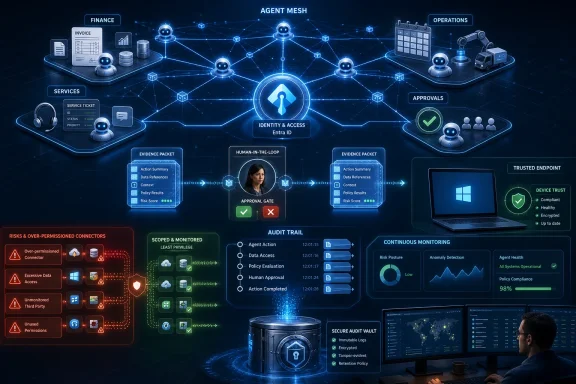 Microsoft’s Agent Pitch Has Moved Past the Chatbot Era
The first wave of enterprise generative AI was sold as a better search box, a better writing assistant, or a polite intern embedded in the productivity suite. That was the Copilot phase: summon an assistant, ask a question, receive an answer, maybe paste it into a document. It was useful, but it was still largely conversational.Gandhi’s framing points to a different phase. The agent is not merely answering a question; it is being positioned as a participant in a business process. That means reading signals from systems of record, deciding what action should happen next, producing a transaction or recommendation, and sometimes routing the result to a human for approval.
This is why Microsoft’s agent ecosystem matters to WindowsForum readers even if the moment itself came from a cloud-and-business-apps event rather than a Windows keynote. The modern Windows workplace is no longer just a fleet of endpoints. It is a mesh of Microsoft 365, Entra ID, Teams, Dynamics 365, Power Platform, Defender, endpoint management, and line-of-business applications, all of which become more complicated when autonomous or semi-autonomous agents begin acting inside them.
The slogan-friendly version is that AI agents will reduce manual work. The administrator-friendly version is more sobering: every agent is a new software actor with permissions, dependencies, prompts, connectors, audit requirements, and failure modes.
The Ecosystem Is the Product Now
Microsoft’s strongest strategic move has never been merely shipping one polished application. It has been turning a product into a platform and then making the platform feel inevitable. Windows did this for desktop software, Office did it for business documents, Azure did it for cloud infrastructure, and Teams became a collaboration layer because it sat where work already happened.The agent push follows the same pattern. Microsoft first-party agents give the company polished examples and immediate product gravity. Partner-built agents in Copilot Studio give the ecosystem commercial breadth. Customer-built agents give enterprise buyers the comforting illusion, and sometimes the reality, that they can tailor automation to their exact workflows.
That three-layer model is important. If Microsoft only shipped its own agents, the story would be limited by its product roadmap. If it only offered a low-code studio, it would risk becoming another toolbox that enterprises buy and underuse. By combining first-party agents, partner inventory, and customer extensibility, Microsoft is trying to create a marketplace, a development surface, and an operational habit at the same time.
The danger is sprawl. Anyone who has managed Power Platform in a large organization knows the pattern: citizen development starts as empowerment and becomes governance work. Agents raise the stakes because they do not just store data or trigger a simple workflow. They can interpret context, call tools, summarize sensitive content, and initiate actions that look routine until something goes wrong.
Domain-Specific Agents Are Where the Real Money Is
The examples in Gandhi’s remarks are revealing because they are boring in precisely the right way. Supplier communications, account reconciliation, field service scheduling, expense reporting, time tracking, and approvals are not science-fiction demos. They are the repetitive connective tissue of enterprise life.That is where agents can be genuinely valuable. A finance team does not need an AI that writes a sonnet about invoices. It needs an agent that can notice a mismatch, gather supporting documents, draft a vendor email, reconcile a transaction, flag an exception, and move the case to a human when policy requires it. A field service organization does not need a generic chatbot; it needs something that understands technician availability, customer SLAs, parts inventory, routing constraints, and escalation rules.
This is the practical distinction between AI as interface and AI as process layer. An interface helps a human do the work. A process layer changes the shape of the work itself. Microsoft clearly wants enterprises to believe that agents can become that process layer across business functions.
For IT pros, the relevant question is not whether these use cases are plausible. Many are. The relevant question is whether the surrounding environment can support them with enough identity control, telemetry, data classification, lifecycle management, and rollback capability to make the automation trustworthy at scale.
Human-in-the-Loop Is a Governance Feature, Not a Moral Comfort Blanket
The Cloud Wars summary highlights a key design choice: organizations can decide which workflows run autonomously and which require human oversight. That sounds reassuring, and in many cases it is. But human-in-the-loop should not be treated as a magic phrase that turns risky automation into safe automation.A human approval step is only useful if the human has the information, time, and incentive to review the output properly. If an agent produces a polished recommendation and the approval queue is already overflowing, the workflow can become rubber-stamping with extra steps. Anyone who has watched users click through security prompts understands the problem.
The better interpretation is that human oversight gives enterprises a policy gradient. Low-risk, high-volume tasks can be more automated. Regulated, high-impact, or financially material actions can require explicit approval. Ambiguous cases can be escalated, while routine cases can be processed automatically.
That gradient is where enterprise architecture becomes important. Organizations will need to define not just whether humans are involved, but which humans, at what threshold, with what evidence, and with what audit trail. A manager approving a $40 expense report is not the same as a finance controller approving a supplier payment change, even if both workflows contain an “approve” button.
Copilot Studio Becomes the New Shadow IT Battleground
Copilot Studio is central to this story because it promises to let organizations and partners build agents without treating every use case as a traditional software engineering project. That is attractive for business units that have waited years for IT queues to clear. It is also exactly the kind of promise that creates long-term governance debt.Low-code tools succeed because they collapse the distance between a business problem and a working solution. They fail when the organization forgets that a working solution is not the same thing as a supported, secure, compliant, and observable solution. Agents built by business users may solve real problems, but they may also encode policy misunderstandings, overreach with connectors, or depend on fragile assumptions about data shape and process behavior.
The partner layer adds another wrinkle. Partner-built agents can accelerate adoption, especially in verticals where Microsoft itself cannot build every specialized workflow. But enterprises will still need to ask familiar procurement questions in a new vocabulary: What permissions does this agent require? Where does data flow? How are prompts and actions logged? What happens when the underlying model changes? Who is responsible when a workflow action is wrong?
This is where IT departments should resist being cast as blockers. The goal is not to stop agent adoption. The goal is to keep the organization from recreating the worst parts of unmanaged macro culture, browser extensions, SaaS sprawl, and over-permissioned service accounts under a shinier AI banner.
The Windows Angle Is Identity, Endpoint Trust, and Work Context
At first glance, enterprise agents might seem like a cloud-app story rather than a Windows story. That separation is increasingly artificial. The Windows endpoint remains the place where many users authenticate, access data, join meetings, approve requests, handle documents, and interact with enterprise applications.Agents operating across business functions will depend heavily on identity context. They will need to know who requested an action, what that person is allowed to see, whether the device posture is trusted, whether the data is sensitive, and whether the workflow crosses policy boundaries. In a Microsoft-heavy environment, that pulls Windows devices, Entra ID, Conditional Access, Intune, Defender, Purview, and Microsoft 365 together into the operational substrate for agent governance.
The endpoint also remains a major source of risk. If an attacker compromises a user account or device, agent-enabled workflows can widen the blast radius unless the organization has strong controls around delegated permissions and action approvals. A compromised mailbox is bad. A compromised identity that can instruct or influence agents connected to finance, procurement, or service operations is worse.
That is why agent governance cannot live only in the business application. It has to be part of the broader security model. Device compliance, session risk, privileged identity management, data loss prevention, and audit logging all become more important when the software layer starts performing tasks rather than merely displaying information.
Microsoft’s Advantage Is Integration, and That Is Also the Lock-In
Microsoft has an obvious advantage in enterprise agents: it owns much of the work graph. Emails, chats, calendars, documents, meetings, SharePoint sites, Teams channels, business applications, identities, and security signals already sit inside its ecosystem for many organizations. Agents become more useful when they can draw from that context.That integration is why Microsoft’s agent strategy may be more credible than a standalone AI vendor’s pitch. A generic AI assistant can be impressive in a demo, but enterprise automation needs durable access to systems, permissions, records, workflows, and governance. Microsoft can bundle the agent story into tools companies already license and administrators already manage.
But integration has a cost. The more enterprises build agent workflows around Microsoft 365, Dynamics, Power Platform, and Copilot Studio, the harder it becomes to unwind those dependencies later. The lock-in may not look like a classic proprietary file format. It may look like hundreds of small, useful automations that quietly assume Microsoft identity, Microsoft data structures, Microsoft connectors, Microsoft governance portals, and Microsoft licensing.
That does not make the strategy illegitimate. Most enterprise platforms create switching costs by becoming useful. But buyers should be honest about what they are buying. They are not just buying AI features; they are buying deeper operational dependence on Microsoft’s interpretation of the agentic enterprise.
The Most Important Feature May Be the Audit Trail
AI vendors tend to market intelligence. Enterprises should pay more attention to evidence. When an agent acts, the organization needs to know what it saw, what it inferred, what tool it called, what data it changed, which policy allowed the action, and who approved it if approval was required.This is not an academic concern. In traditional automation, errors can often be traced through deterministic logic. A script ran, a workflow triggered, an API returned a value, and the result followed from the code. Agents complicate this because their behavior may depend on prompts, retrieved context, model output, tool descriptions, and probabilistic interpretation.
That does not mean agents are unmanageable. It means that observability has to be designed into the system from the beginning. Logs that merely say an agent completed a task will not be enough. Enterprises will need explainability at the workflow level, not just at the model level.
Security teams will also need detection logic that treats agents as actors. If an agent suddenly accesses unusual records, performs actions outside its normal pattern, or receives prompts that appear to manipulate policy boundaries, that should be visible. The uncomfortable truth is that agent security will look less like chatbot moderation and more like workload identity security.
The Automation Dividend Will Be Uneven
It is tempting to talk about enterprise agents as if every department will benefit at the same speed. That is unlikely. The best early use cases will be repetitive, data-rich, rule-bound, and expensive enough to justify automation work. Finance operations, service management, HR workflows, procurement, and customer support all fit that pattern.Other areas will move more slowly. Workflows with ambiguous accountability, messy data ownership, high regulatory burden, or unclear process definitions will be harder to automate safely. If a business process is already poorly understood, an agent may make it faster without making it better.
This is the part of the AI conversation that vendors tend to skate past. Agents do not eliminate the need for process discipline. They punish the absence of it. A well-documented workflow with clean data and clear escalation rules is a good candidate for automation. A political process held together by tribal knowledge and exceptions is a future incident report.
The result will be uneven adoption inside enterprises. Some teams will show impressive productivity gains. Others will build prototypes that never graduate. Still others will discover that their real problem was not a lack of AI, but a lack of process ownership.
Where IT Should Draw the Red Lines Early
The agent ecosystem is arriving with the usual enterprise technology paradox: wait too long and the business will route around IT; move too fast and the organization will accumulate invisible risk. The sensible path is to define the operating model before the number of agents becomes uncountable.That operating model should begin with identity and permissions. Agents should not inherit broad user access by default, and they should not become opaque super-users. They need scoped permissions, documented owners, review cycles, and clear decommissioning paths.
Data boundaries come next. If an agent can summarize, retrieve, or act on sensitive information, it must respect classification and retention policies. This is especially important in organizations that have already struggled with oversharing in Teams, SharePoint, and OneDrive.
Finally, IT should insist on lifecycle management. Agents should have environments, testing, version control where appropriate, approval gates, monitoring, and incident response playbooks. A business unit may build the agent, but the enterprise still owns the consequences.
Gandhi’s Agent Moment Leaves IT With a Very Practical Checklist
The keynote excerpt is most useful if it is read not as a product announcement, but as a signal of where Microsoft expects enterprise AI adoption to go next. The message is that agents will multiply, specialize, and move closer to operational workflows. That makes the next set of decisions architectural rather than cosmetic.- Enterprises should treat agents as software actors with identities, permissions, owners, and logs.
- Domain-specific agents will deliver the clearest value in repetitive, rule-heavy workflows such as reconciliation, scheduling, reporting, and approvals.
- Human review remains important, but it must be designed as a meaningful control rather than a decorative approval step.
- Copilot Studio can accelerate adoption, but unmanaged low-code agent creation will create governance debt quickly.
- Windows admins should expect endpoint trust, identity policy, and Microsoft 365 governance to become part of agent security.
- The long-term value of Microsoft’s agent ecosystem will depend less on flashy demos than on auditability, lifecycle management, and safe delegation.
References
- Primary source: Cloud Wars
Published: 2026-06-29T13:50:16.770357
Event Moment: Sachin Gandhi on the Expanding Enterprise Agent Ecosystem - Cloud Wars
Sachin Gandhi outlines how enterprises are scaling AI through a growing ecosystem of first-party, partner, and custom agents across core business functions.cloudwars.com
