

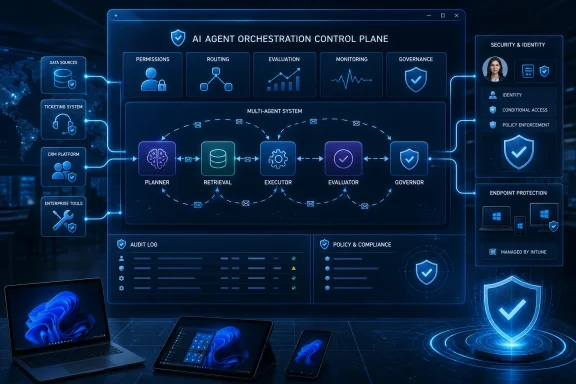
Enterprises are moving AI agents from pilots into production in 2026, with Databricks reporting a 327 percent surge in multi-agent systems in under four months and VentureBeat’s February tracker showing Microsoft leading orchestration-platform adoption among surveyed enterprise decision makers. The shift is not simply from “chatbot” to “better chatbot.” It is from isolated conversational software to software that can plan, call tools, manipulate data, and hand work to other agents. That makes orchestration—the control plane for permissions, routing, evaluation, monitoring, and governance—the real battlefield.
The easy story is that enterprises have finally warmed to AI agents. The harder and more useful story is that enterprises are discovering what happens when a demo becomes a dependency.
A chatbot can be tolerated as an assistant that gets things wrong. An agent that opens tickets, queries databases, writes code, provisions environments, or drafts customer-facing responses is part of the operating model. That changes the buyer, the risk conversation, and the technical architecture.
Databricks’ figures are striking because they point to agents moving into the plumbing. The company says more than 80 percent of databases on its platform are being built by AI agents, while multi-agent systems are growing far faster than single-purpose assistants. If that pattern holds beyond Databricks’ own customer base, the practical meaning is blunt: AI is no longer waiting politely in the productivity sidebar.
The enterprise question has therefore shifted. It is no longer “Which model is smartest?” It is “Which system gets to coordinate the work?”
Agents are different because they are designed to take action. A useful agent does not merely answer a question about a customer account; it may retrieve the account record, check policy, generate a response, update a CRM field, and escalate an exception. That requires access to systems that enterprises have spent decades locking down.
This is why the move from single chatbots to multi-agent systems matters. Multi-agent architecture implies specialization: one agent handles retrieval, another handles planning, another handles execution, another evaluates output, and another governs policy constraints. In theory, this makes AI workflows more reliable. In practice, it creates a distributed software system whose failure modes are harder to inspect than a conventional application.
The phrase multi-agent can make the whole thing sound futuristic, but the enterprise pattern is familiar. Companies are decomposing work into services, applying permissions, adding observability, and trying to prevent one component’s error from cascading across the rest of the workflow. The novelty is that some of those components reason probabilistically, generate text, and decide which tool to call next.
That is why the orchestration layer is suddenly strategic. The model may supply intelligence, but the orchestrator supplies the chain of custody.
Microsoft’s advantage is not that it has the only good models. In fact, its recent strategy has been to make Copilot and Azure increasingly multi-model. The advantage is that Microsoft already sits inside the enterprise tenant, the identity system, the productivity suite, the developer workflow, the security stack, and the procurement process.
That matters because agent orchestration is not just a developer preference. It touches Entra ID, Purview, Defender, Microsoft 365, GitHub, Power Platform, Azure, and the sprawling estate of Windows endpoints and line-of-business applications. For many IT departments, the least risky agent platform is the one that can be governed through tools they already understand, even if it is not the most elegant on a whiteboard.
Copilot Studio is particularly important because it turns agent building into an administrative and business-user activity, not only a software-engineering task. That is powerful and dangerous in equal measure. The same low-code convenience that helps a finance team automate approvals can also create a new class of shadow automation if governance lags behind enthusiasm.
Microsoft’s play is therefore classic platform strategy. It does not need every enterprise agent to be “a Microsoft agent” in a narrow sense. It needs the enterprise to decide that Microsoft is where agents are registered, secured, connected, observed, and billed.
But the enterprise market has a way of converting developer enthusiasm into platform governance. Once an agent touches production data, the questions multiply: Who approved the tool call? Which prompt version ran? What data was exposed? Was the output evaluated? Can the workflow be paused? Can legal discovery reconstruct what happened?
APIs can answer some of those questions, but usually by pushing implementation responsibility onto the customer. That is fine for sophisticated engineering organizations. It is less appealing for enterprises that want accountable defaults, compliance hooks, and an admin console that maps to existing controls.
OpenAI still has a formidable role because its models and developer ecosystem influence the entire category. Even when enterprises choose Microsoft as the control plane, OpenAI may remain a core model provider. But the market for agents is exposing a distinction that the chatbot era blurred: the company that supplies the intelligence is not always the company that owns the workflow.
That distinction is where the money and lock-in live.
The bigger signal is that enterprise buyers increasingly expect model choice. Microsoft’s own embrace of Anthropic models inside Copilot-related offerings underlines the point. Even the platform leader does not want to be seen as a single-model shop.
This creates an odd competitive geometry. Microsoft can be a distribution channel for Anthropic, a partner of OpenAI, a builder of its own models, and a rival to all of them in agent orchestration. OpenAI can be both a model supplier and a platform provider. Anthropic can be both a challenger and an ingredient inside other vendors’ stacks.
For customers, this is useful leverage, but it also creates architectural ambiguity. If an agent workflow uses Microsoft identity, Anthropic reasoning, OpenAI embeddings, Databricks data, ServiceNow tickets, and custom Python tools, who is responsible when it misfires? In traditional IT, the answer would be sorted through contracts and logs. In agentic IT, the logs had better be good.
The company says organizations using evaluation tools get nearly six times more AI projects into production, and those using governance see more than twelve times more. The temptation is to treat those numbers as proof that a specific vendor stack is the answer. The better reading is broader: enterprises are discovering that agents need a release discipline.
Evaluation is the missing bridge between impressive demos and durable systems. A chatbot can be judged by vibes during a pilot. An agent that touches a database needs test sets, regression checks, safety thresholds, red-team prompts, tool-call validation, and ongoing monitoring as models change.
Governance is the other half of that bridge. It decides which data an agent can see, which actions it can take, which human approvals are required, and how exceptions are handled. Without governance, agents remain trapped in pilots because nobody with operational responsibility wants to bless them.
This is why Databricks’ “80 percent of databases” claim is so provocative. Database creation has historically been a controlled act because persistence is power. If agents are now spinning up databases for development, testing, or application workflows at scale, the governance perimeter must move closer to the moment of creation.
Agents need memory, state, and context. They need to know what happened before, which tasks are pending, which documents are authoritative, and which actions have already been taken. That makes the database less like a passive storage bucket and more like a coordination substrate.
If agents create databases, populate them, query them, and use them to coordinate work, then data architecture becomes agent architecture. The old separation between “the app” and “the database” weakens when the agent is dynamically generating both the workflow and some of the persistence it needs to complete that workflow.
This has consequences for administrators. Environments may become more ephemeral, but the risks do not disappear just because the infrastructure is short-lived. A temporary database can still contain sensitive data. A development environment can still leak credentials. A test workflow can still train bad operational habits into production processes.
The practical burden shifts toward policy automation. Human review cannot scale if agents are creating infrastructure at machine speed. Enterprises will need templates, quotas, classification rules, lineage, expiration policies, and automated cleanup that assume agents are first-class actors.
That puts Microsoft Entra ID, conditional access, privileged identity management, and audit logging at the center of agent adoption. The agent is not just a bot with a friendly name. It is an actor in the tenant.
Endpoint management also becomes more important. As agents move from web chat into desktop workflows, browser automation, local files, developer environments, and eventually more direct operating-system interactions, the Windows endpoint becomes both a surface area and a control point. Intune policies, Defender telemetry, application control, and data-loss prevention will matter more, not less.
Power Platform is another pressure point. Low-code automation has already taught enterprises that productivity tools can become shadow IT at astonishing speed. Copilot Studio extends that pattern into agent creation, where the consequences of a poorly scoped workflow may be more serious than a brittle approval flow.
For administrators, the challenge is not to block all of this. That would simply drive teams toward unsanctioned tools. The challenge is to make the approved path faster than the workaround while still preserving auditability.
But orchestration also creates lock-in. The platform that manages agent identity, tool registries, memory, evaluation, deployment, and monitoring becomes hard to replace. Once hundreds of workflows are wired through a specific orchestration layer, switching costs pile up quickly.
This is why standards such as MCP and agent-to-agent protocols matter, but they will not magically dissolve platform power. Standards can make tools easier to connect and agents easier to compose. They do not eliminate the advantage of the vendor that owns the admin surface, the billing relationship, and the default integration path.
Enterprises should be clear-eyed about the trade. A tightly integrated Microsoft stack may reduce near-term risk and accelerate deployment, especially for organizations already standardized on Microsoft 365 and Azure. It may also make future diversification harder if the orchestration layer becomes the place where policy, workflow, and institutional knowledge accumulate.
The same applies to OpenAI, Anthropic, Databricks, ServiceNow, Salesforce, and every other vendor racing to become the agent hub. Each will argue that its layer is the natural place to coordinate work. The buyer’s job is to decide which layer deserves that much power.
In enterprise technology, the opposite is often true. Teams move faster when the rules are legible. Developers deploy more confidently when they know what data can be used, what approvals are required, and what logs will satisfy auditors later.
Agents make this even more pronounced because their behavior can be less predictable than conventional software. A deterministic script fails in expected ways. An agent may choose a different path depending on context, model behavior, prompt changes, retrieved documents, or tool availability. That makes predeployment evaluation and postdeployment observability essential.
The organizations that treat governance as a launch requirement will ship more because they will earn internal trust. The organizations that treat governance as paperwork will drown in pilots, exceptions, and executive anxiety.
Security teams should take particular note. The threat model for agents is not limited to hallucination. It includes prompt injection, excessive permissions, data exfiltration, malicious tool outputs, poisoned retrieval sources, and confused-deputy failures where an agent misuses legitimate authority. That is a security architecture problem, not a copywriting problem.
In real companies, autonomy will be tiered. Low-risk actions will run automatically. Medium-risk actions will require sampling, review, or delayed execution. High-risk actions will require explicit approval from accountable humans. The orchestration platform that makes those gradients easy to design will have an advantage.
This is where many early agent systems feel unfinished. They can call tools, but they do not always provide graceful handoffs. They can generate plans, but they cannot always expose uncertainty in a way that maps to business approval. They can log activity, but not always in a form that a compliance team can interpret.
The next generation of enterprise agent platforms will compete on these mundane details. Can an administrator freeze an agent? Can a reviewer see why it selected a tool? Can policy block an action without breaking the whole workflow? Can a team compare model versions before promoting a change?
The answers will matter more than benchmark scores.
That hybrid reality is not a failure. It is how enterprise IT absorbs new categories. The danger is pretending hybrid does not need architecture.
Without a deliberate agent architecture, organizations will accumulate incompatible pilots: one team’s Copilot Studio workflow, another team’s OpenAI-based app, a data-science group’s Databricks agents, a security team’s custom automation, and a business unit’s SaaS-native agents. Each may be defensible locally. Together, they can become an ungoverned mesh.
The orchestration fight is therefore also a fight over inventory. Enterprises need to know what agents exist, what they can access, what actions they can take, who owns them, and when they last passed evaluation. That sounds basic because it is. It is also where many organizations will stumble.
Asset management was hard enough when the assets were laptops, servers, and SaaS subscriptions. Now add semi-autonomous workflows that can be created by business users and modified by prompts.
The next phase of enterprise AI will be decided less by which assistant sounds smartest in a browser tab and more by which orchestration layer can survive contact with auditors, admins, developers, security teams, and impatient business units. Microsoft has the early distribution advantage, OpenAI has developer gravity, Anthropic has momentum, and Databricks is reminding everyone that data governance is where production dreams either harden or die. For Windows shops, the message is simple: agents are coming through the same doors as every previous platform shift—identity, management, security, and workflow—and the time to decide who controls those doors is before the agents start opening them on their own.
Source: Let's Data Science Enterprises Adopt AI Agents, Fight for Orchestration
 The Agent Boom Is Really an Operations Story
The easy story is that enterprises have finally warmed to AI agents. The harder and more useful story is that enterprises are discovering what happens when a demo becomes a dependency.A chatbot can be tolerated as an assistant that gets things wrong. An agent that opens tickets, queries databases, writes code, provisions environments, or drafts customer-facing responses is part of the operating model. That changes the buyer, the risk conversation, and the technical architecture.
Databricks’ figures are striking because they point to agents moving into the plumbing. The company says more than 80 percent of databases on its platform are being built by AI agents, while multi-agent systems are growing far faster than single-purpose assistants. If that pattern holds beyond Databricks’ own customer base, the practical meaning is blunt: AI is no longer waiting politely in the productivity sidebar.
The enterprise question has therefore shifted. It is no longer “Which model is smartest?” It is “Which system gets to coordinate the work?”
Chatbots Were the Training Wheels, Not the Destination
The first wave of enterprise generative AI was deliberately modest. Companies rolled out copilots for writing emails, summarizing meetings, searching documents, and helping developers move faster. Those systems were valuable, but they usually lived at the edge of the business.Agents are different because they are designed to take action. A useful agent does not merely answer a question about a customer account; it may retrieve the account record, check policy, generate a response, update a CRM field, and escalate an exception. That requires access to systems that enterprises have spent decades locking down.
This is why the move from single chatbots to multi-agent systems matters. Multi-agent architecture implies specialization: one agent handles retrieval, another handles planning, another handles execution, another evaluates output, and another governs policy constraints. In theory, this makes AI workflows more reliable. In practice, it creates a distributed software system whose failure modes are harder to inspect than a conventional application.
The phrase multi-agent can make the whole thing sound futuristic, but the enterprise pattern is familiar. Companies are decomposing work into services, applying permissions, adding observability, and trying to prevent one component’s error from cascading across the rest of the workflow. The novelty is that some of those components reason probabilistically, generate text, and decide which tool to call next.
That is why the orchestration layer is suddenly strategic. The model may supply intelligence, but the orchestrator supplies the chain of custody.
Microsoft Wants the Control Plane Before Anyone Notices It Is the Product
VentureBeat’s tracker gives Microsoft the early lead, with Copilot Studio and Azure AI Studio holding 38.6 percent primary-platform adoption among surveyed enterprise decision makers in February. OpenAI’s Assistants and Responses API followed at 25.7 percent, while Anthropic moved from no measurable share to 5.7 percent. The exact numbers should be read as a snapshot, not a census, but the direction is credible.Microsoft’s advantage is not that it has the only good models. In fact, its recent strategy has been to make Copilot and Azure increasingly multi-model. The advantage is that Microsoft already sits inside the enterprise tenant, the identity system, the productivity suite, the developer workflow, the security stack, and the procurement process.
That matters because agent orchestration is not just a developer preference. It touches Entra ID, Purview, Defender, Microsoft 365, GitHub, Power Platform, Azure, and the sprawling estate of Windows endpoints and line-of-business applications. For many IT departments, the least risky agent platform is the one that can be governed through tools they already understand, even if it is not the most elegant on a whiteboard.
Copilot Studio is particularly important because it turns agent building into an administrative and business-user activity, not only a software-engineering task. That is powerful and dangerous in equal measure. The same low-code convenience that helps a finance team automate approvals can also create a new class of shadow automation if governance lags behind enthusiasm.
Microsoft’s play is therefore classic platform strategy. It does not need every enterprise agent to be “a Microsoft agent” in a narrow sense. It needs the enterprise to decide that Microsoft is where agents are registered, secured, connected, observed, and billed.
OpenAI Has the Developer Mindshare, but Enterprises Buy More Than APIs
OpenAI’s position is different. Its Assistants and Responses API appeal to developers who want direct access to model behavior and agentic application patterns without inheriting a full Microsoft platform commitment. That is a strong proposition for product teams, startups inside large companies, and engineering groups building custom workflows.But the enterprise market has a way of converting developer enthusiasm into platform governance. Once an agent touches production data, the questions multiply: Who approved the tool call? Which prompt version ran? What data was exposed? Was the output evaluated? Can the workflow be paused? Can legal discovery reconstruct what happened?
APIs can answer some of those questions, but usually by pushing implementation responsibility onto the customer. That is fine for sophisticated engineering organizations. It is less appealing for enterprises that want accountable defaults, compliance hooks, and an admin console that maps to existing controls.
OpenAI still has a formidable role because its models and developer ecosystem influence the entire category. Even when enterprises choose Microsoft as the control plane, OpenAI may remain a core model provider. But the market for agents is exposing a distinction that the chatbot era blurred: the company that supplies the intelligence is not always the company that owns the workflow.
That distinction is where the money and lock-in live.
Anthropic’s Rise Shows the Market Is Still Fluid
Anthropic’s move from 0 percent to 5.7 percent in VentureBeat’s tracker is small in absolute terms, but it is meaningful because it suggests enterprises are not settling into a two-player Microsoft-versus-OpenAI map. Claude has developed a reputation for strong reasoning, coding, and long-context work, and Anthropic has pushed hard into enterprise positioning around safety and controllability.The bigger signal is that enterprise buyers increasingly expect model choice. Microsoft’s own embrace of Anthropic models inside Copilot-related offerings underlines the point. Even the platform leader does not want to be seen as a single-model shop.
This creates an odd competitive geometry. Microsoft can be a distribution channel for Anthropic, a partner of OpenAI, a builder of its own models, and a rival to all of them in agent orchestration. OpenAI can be both a model supplier and a platform provider. Anthropic can be both a challenger and an ingredient inside other vendors’ stacks.
For customers, this is useful leverage, but it also creates architectural ambiguity. If an agent workflow uses Microsoft identity, Anthropic reasoning, OpenAI embeddings, Databricks data, ServiceNow tickets, and custom Python tools, who is responsible when it misfires? In traditional IT, the answer would be sorted through contracts and logs. In agentic IT, the logs had better be good.
Databricks Is Selling the Boring Part, Which Is Why It Matters
Databricks’ report deserves attention not because vendor reports are neutral—they are not—but because its claims point to where production pain is appearing. Evaluation and governance are the variables associated with more projects reaching production. That is exactly what seasoned IT pros would expect.The company says organizations using evaluation tools get nearly six times more AI projects into production, and those using governance see more than twelve times more. The temptation is to treat those numbers as proof that a specific vendor stack is the answer. The better reading is broader: enterprises are discovering that agents need a release discipline.
Evaluation is the missing bridge between impressive demos and durable systems. A chatbot can be judged by vibes during a pilot. An agent that touches a database needs test sets, regression checks, safety thresholds, red-team prompts, tool-call validation, and ongoing monitoring as models change.
Governance is the other half of that bridge. It decides which data an agent can see, which actions it can take, which human approvals are required, and how exceptions are handled. Without governance, agents remain trapped in pilots because nobody with operational responsibility wants to bless them.
This is why Databricks’ “80 percent of databases” claim is so provocative. Database creation has historically been a controlled act because persistence is power. If agents are now spinning up databases for development, testing, or application workflows at scale, the governance perimeter must move closer to the moment of creation.
The Database Is Becoming an Agent Memory Layer
For WindowsForum readers, the database angle may seem less immediately relevant than Copilot in Microsoft 365 or agents inside Windows developer tools. It is actually central to the enterprise story.Agents need memory, state, and context. They need to know what happened before, which tasks are pending, which documents are authoritative, and which actions have already been taken. That makes the database less like a passive storage bucket and more like a coordination substrate.
If agents create databases, populate them, query them, and use them to coordinate work, then data architecture becomes agent architecture. The old separation between “the app” and “the database” weakens when the agent is dynamically generating both the workflow and some of the persistence it needs to complete that workflow.
This has consequences for administrators. Environments may become more ephemeral, but the risks do not disappear just because the infrastructure is short-lived. A temporary database can still contain sensitive data. A development environment can still leak credentials. A test workflow can still train bad operational habits into production processes.
The practical burden shifts toward policy automation. Human review cannot scale if agents are creating infrastructure at machine speed. Enterprises will need templates, quotas, classification rules, lineage, expiration policies, and automated cleanup that assume agents are first-class actors.
Windows Shops Will Feel This Through Identity, Endpoint Control, and Power Platform
The agent wars may sound like a cloud-platform fight, but Windows-heavy organizations will experience it in familiar places. Identity becomes the first battlefield. If an agent can act, it needs an identity; if it has an identity, it needs least privilege; if it has least privilege, someone must maintain the policy.That puts Microsoft Entra ID, conditional access, privileged identity management, and audit logging at the center of agent adoption. The agent is not just a bot with a friendly name. It is an actor in the tenant.
Endpoint management also becomes more important. As agents move from web chat into desktop workflows, browser automation, local files, developer environments, and eventually more direct operating-system interactions, the Windows endpoint becomes both a surface area and a control point. Intune policies, Defender telemetry, application control, and data-loss prevention will matter more, not less.
Power Platform is another pressure point. Low-code automation has already taught enterprises that productivity tools can become shadow IT at astonishing speed. Copilot Studio extends that pattern into agent creation, where the consequences of a poorly scoped workflow may be more serious than a brittle approval flow.
For administrators, the challenge is not to block all of this. That would simply drive teams toward unsanctioned tools. The challenge is to make the approved path faster than the workaround while still preserving auditability.
Orchestration Is the New Lock-In, Dressed as Safety
Every platform vendor will describe orchestration in the language of safety, reliability, and developer productivity. Much of that language is justified. Agents that can call tools and touch business systems absolutely need centralized controls.But orchestration also creates lock-in. The platform that manages agent identity, tool registries, memory, evaluation, deployment, and monitoring becomes hard to replace. Once hundreds of workflows are wired through a specific orchestration layer, switching costs pile up quickly.
This is why standards such as MCP and agent-to-agent protocols matter, but they will not magically dissolve platform power. Standards can make tools easier to connect and agents easier to compose. They do not eliminate the advantage of the vendor that owns the admin surface, the billing relationship, and the default integration path.
Enterprises should be clear-eyed about the trade. A tightly integrated Microsoft stack may reduce near-term risk and accelerate deployment, especially for organizations already standardized on Microsoft 365 and Azure. It may also make future diversification harder if the orchestration layer becomes the place where policy, workflow, and institutional knowledge accumulate.
The same applies to OpenAI, Anthropic, Databricks, ServiceNow, Salesforce, and every other vendor racing to become the agent hub. Each will argue that its layer is the natural place to coordinate work. The buyer’s job is to decide which layer deserves that much power.
Governance Is Not a Brake if It Is Built Into the Road
One of the most important claims in the Databricks reporting is that governance correlates with more production deployment, not less. That cuts against the lazy narrative that compliance teams only slow innovation.In enterprise technology, the opposite is often true. Teams move faster when the rules are legible. Developers deploy more confidently when they know what data can be used, what approvals are required, and what logs will satisfy auditors later.
Agents make this even more pronounced because their behavior can be less predictable than conventional software. A deterministic script fails in expected ways. An agent may choose a different path depending on context, model behavior, prompt changes, retrieved documents, or tool availability. That makes predeployment evaluation and postdeployment observability essential.
The organizations that treat governance as a launch requirement will ship more because they will earn internal trust. The organizations that treat governance as paperwork will drown in pilots, exceptions, and executive anxiety.
Security teams should take particular note. The threat model for agents is not limited to hallucination. It includes prompt injection, excessive permissions, data exfiltration, malicious tool outputs, poisoned retrieval sources, and confused-deputy failures where an agent misuses legitimate authority. That is a security architecture problem, not a copywriting problem.
The Winners Will Make Human Approval Feel Native
The fantasy version of agents is full autonomy: software workers completing tasks around the clock without human intervention. The enterprise version will be more constrained and more interesting.In real companies, autonomy will be tiered. Low-risk actions will run automatically. Medium-risk actions will require sampling, review, or delayed execution. High-risk actions will require explicit approval from accountable humans. The orchestration platform that makes those gradients easy to design will have an advantage.
This is where many early agent systems feel unfinished. They can call tools, but they do not always provide graceful handoffs. They can generate plans, but they cannot always expose uncertainty in a way that maps to business approval. They can log activity, but not always in a form that a compliance team can interpret.
The next generation of enterprise agent platforms will compete on these mundane details. Can an administrator freeze an agent? Can a reviewer see why it selected a tool? Can policy block an action without breaking the whole workflow? Can a team compare model versions before promoting a change?
The answers will matter more than benchmark scores.
The Near-Term Market Belongs to Hybrid Stacks
Despite the platform-concentration numbers, the likely near-term reality is hybrid. Large enterprises rarely pick one vendor for everything, especially in a market moving this quickly. They will use Microsoft where Microsoft is already embedded, OpenAI where developers want direct model access, Anthropic where Claude performs well, and Databricks where data and governance workflows are already anchored.That hybrid reality is not a failure. It is how enterprise IT absorbs new categories. The danger is pretending hybrid does not need architecture.
Without a deliberate agent architecture, organizations will accumulate incompatible pilots: one team’s Copilot Studio workflow, another team’s OpenAI-based app, a data-science group’s Databricks agents, a security team’s custom automation, and a business unit’s SaaS-native agents. Each may be defensible locally. Together, they can become an ungoverned mesh.
The orchestration fight is therefore also a fight over inventory. Enterprises need to know what agents exist, what they can access, what actions they can take, who owns them, and when they last passed evaluation. That sounds basic because it is. It is also where many organizations will stumble.
Asset management was hard enough when the assets were laptops, servers, and SaaS subscriptions. Now add semi-autonomous workflows that can be created by business users and modified by prompts.
The Agent Race Has Moved From Demo Screens to Change Boards
The most concrete lesson from the current data is that production adoption favors organizations that operationalize early. The glamorous part of agents is reasoning; the durable part is lifecycle management.- Enterprises are moving beyond single chatbots toward multi-agent systems that divide planning, retrieval, execution, and evaluation across specialized components.
- Microsoft currently has the strongest enterprise orchestration position because it already owns so much of the identity, productivity, security, and developer estate.
- OpenAI remains powerful with developers, but API strength alone does not settle enterprise questions about governance, auditability, and operational control.
- Anthropic’s rise shows that model and platform choice remain fluid, especially as customers demand multi-model options inside agent workflows.
- Evaluation and governance are becoming accelerators of production deployment rather than bureaucratic obstacles.
- Windows-centric IT teams should treat agents as tenant actors with identities, permissions, endpoints, logs, and lifecycle obligations.
The next phase of enterprise AI will be decided less by which assistant sounds smartest in a browser tab and more by which orchestration layer can survive contact with auditors, admins, developers, security teams, and impatient business units. Microsoft has the early distribution advantage, OpenAI has developer gravity, Anthropic has momentum, and Databricks is reminding everyone that data governance is where production dreams either harden or die. For Windows shops, the message is simple: agents are coming through the same doors as every previous platform shift—identity, management, security, and workflow—and the time to decide who controls those doors is before the agents start opening them on their own.
Source: Let's Data Science Enterprises Adopt AI Agents, Fight for Orchestration
