

ThoughtSpot, Commvault, Avanade and a wave of other vendors used the 24 November briefing cycle to sharpen two clear messages for the channel: agentic AI is moving from showpiece demos into production patterns, and data governance — not raw model capability — will decide who wins. The week’s announcements mix pragmatic commercial packaging for startups, guarded pathways for activating protected backup data, cloud partnerships that turn backups into AI-ready lakes, and new vendor tooling to manage, observe and remediate agent-driven activity. Taken together, these moves create immediate partner opportunities — and equally immediate responsibilities — for resellers, ISVs and managed services teams to prove they can operationalize trust, security and reliability around agents.
The announcements fit into three converging trends shaping enterprise AI adoption today: the shift from “AI features” to agentic products that act on live systems; a renewed emphasis on trusted data and governed access as the foundation for reliable agents; and the creation of partner-friendly commercial models that accelerate time to revenue for ISVs and mid-market customers. Vendors are packaging agentic capabilities with governance primitives — flat-fee startup bundles, guarded data enclaves, and agent lifecycle management — to reduce buyer friction and make it possible for channel partners to offer predictable outcomes rather than speculative pilots.
This analysis synthesizes vendor releases and industry reporting to highlight what each announcement means for the channel, where claims need validation, and the pragmatic steps partners should take to capture the emerging opportunity without inheriting disproportionate risk.
That shift turns conversations away from which model is best, and toward operational mastery: proving that agents can run, be audited, be undone when necessary, and deliver measurable business impact without creating new exposure. The vendors have started to supply the building blocks; the channel’s job now is to assemble, test and guarantee them in real-world settings.
Source: IT Europa The AI channel: 24 November - ThoughtSpot, Commvault, Avanade and more...
 Background
The announcements fit into three converging trends shaping enterprise AI adoption today: the shift from “AI features” to agentic products that act on live systems; a renewed emphasis on trusted data and governed access as the foundation for reliable agents; and the creation of partner-friendly commercial models that accelerate time to revenue for ISVs and mid-market customers. Vendors are packaging agentic capabilities with governance primitives — flat-fee startup bundles, guarded data enclaves, and agent lifecycle management — to reduce buyer friction and make it possible for channel partners to offer predictable outcomes rather than speculative pilots.This analysis synthesizes vendor releases and industry reporting to highlight what each announcement means for the channel, where claims need validation, and the pragmatic steps partners should take to capture the emerging opportunity without inheriting disproportionate risk.
Agentic analytics for startups: ThoughtSpot StartupSpot
What was announced
ThoughtSpot launched StartupSpot, a pre-packaged, embedded analytics program that lets early-stage companies add a conversational analytics agent — Spotter — into their product with a few lines of code. The program is sold as a flat annual subscription at $12,999 and is targeted at startups with under 50 employees and less than $3 million in revenue; the vendor says the bundle includes “unlimited data” and covers up to 50 external customers and 50 internal users. The goal is to eliminate the engineering tax of building an analytics stack and to provide enterprise-grade analytics features out of the box.Why the channel should care
- Predictable pricing and a single SKU make StartupSpot easy to resell or include in ISV bundles.
- Embedding a conversational analytics agent inside an application can materially shorten procurement cycles with enterprise buyers who expect analytics in modern SaaS.
- Implementation work shifts away from heavy engineering (dashboards, ETL pipelines) toward configuration, branding, and embedding — services that fit well with partner margins.
Caveats and verification
- Vendor-reported terms such as “unlimited data” and included query volumes should be validated in contract language; usage guardrails and concurrency limits are common and can materially affect economics. Treat the $12,999 flat-fee claim as a commercial headline that requires reading the fine print on query, concurrency and support limits.
- Startups must evaluate whether embedded inference costs, downstream upgrade paths, and data residency needs align with investor runway and customer SLAs.
From backup to AI-ready assets: Commvault’s Data Rooms and MCP
What Commvault announced
Commvault introduced Data Rooms, a secure, governed environment that gives authorized users controlled access to backup data for dataset curation, AI dataset preparation, and analytics without exposing raw backup stores. In parallel, Commvault unveiled a Model Context Protocol (MCP) server — a policy-based bridge that integrates Commvault Cloud with GenAI assistants (for example, ChatGPT Enterprise and Anthropic Claude) enabling natural-language queries and, crucially, policy-bound actions against backup/resilience tasks. The MCP server is positioned as both a query plane and an action plane that enforces enterprise guardrails.Why this matters
- Backup repositories historically have been siloed “cold” stores; Data Rooms and AWS/Cohesity-style cyber vaults turn those stores into AI-ready assets while preserving compliance and immutability.
- The MCP approach embraces a pragmatic reality: enterprises will connect their assistants to core systems. Providing a controlled, auditable gateway reduces integration friction and creates a natural managed-services opportunity for partners (MCP hosting, policy design, connector maintenance).
Risks and verification
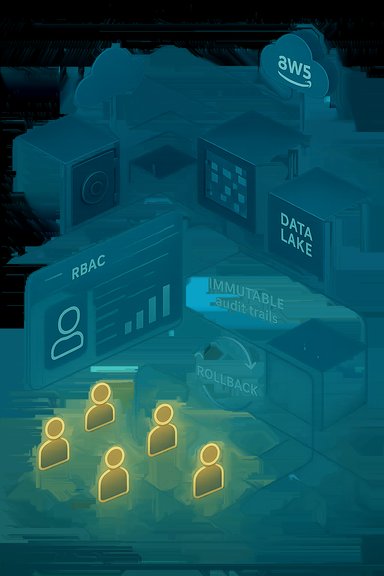
- Any vendor-hosted bridge that executes actions (not just queries) raises questions about authorization, auditability and rollback. Channel teams must insist on documented RBAC models, immutable audit trails, and rehearsed rollback playbooks before production deployments.
- The promise to automate dataset curation from backup artifacts is compelling, but performance characteristics (indexing time, query latency, privacy-preserving de-identification) vary by source and need pilot measurements.
Cloud partnership: Cohesity and AWS — cyber vaults, native backups, AI-ready lakes
The announcement
Cohesity signed a strategic collaboration agreement with Amazon Web Services to deepen native integrations (EC2, RDS, S3, DynamoDB), offer immutable cyber vaults across AWS regions, and surface backup content as an AI-ready data lake via Cohesity’s Gaia assistant. The collaboration emphasizes regulatory-grade immutability, private network isolation, and making protected, unstructured data available for analytics and generative use cases on AWS.Channel implications
- The AWS placement makes Cohesity’s cyber vaults attractive for customers who need geographic resilience and regulatory controls; partners that are already operating AWS practices can position Cohesity as the secure secondary-store layer that powers AI initiatives.
- Turning backup data into AI-ready assets creates new analytics and ML services (search, RAG/augmentation, compliance auditing) that partners can monetize.
Caveats
- Transforming backup stores into analytics lakes requires cataloging, schema normalization, and strong governance; the lift is non-trivial and favors partners with data engineering and security capabilities.
- Customer SLAs for restore performance and legal hold obligations must not be compromised when activating backup content for analytics.
Agent lifecycle, governance and remediation: Rubrik, Avanade and the operational stack
Rubrik and Microsoft Copilot Studio
Rubrik announced integration between Rubrik Agent Cloud and Microsoft Copilot Studio, positioning Rubrik as the tooling layer to discover, monitor, govern and remediate AI agents across Microsoft 365 surfaces (OneDrive, SharePoint, Copilot). The offering includes agent discovery, real-time policy enforcement, and a notable remediation capability called Agent Rewind for selective rollback of agent-driven changes. Rubrik is offering early access and emphasizes the need for agent lifecycle controls to scale safely.Avanade’s Agentic Platform
Avanade launched an Agentic Platform tailored for mid-market organizations, with a library of pre-built, industry-specific agents and templates built on Microsoft technologies and discoverable through Copilot Studio and Microsoft Foundry. The platform is explicitly aimed at turning AI pilots into revenue-generating production deployments and will integrate in the broader Microsoft Agent ecosystem.Why partners should be excited
- Agents that act on data and systems increase the value of managed services: governance, continuous observability, remediation SLAs, and agent engineering become recurring revenue lines.
- Pre-built industry agents accelerate time-to-value for mid-market customers lacking large data science teams; partners can productize vertical templates and manage lifecycle services.
Operational warnings
- Agent remediation is an essential control but also a complex service: rollback semantics, dependencies and cross-system effects must be rehearsed and contracted. Do not assume an “undo” is trivial.
- Discovery and monitoring tooling reduces operational blind spots, but detection without governance capability creates a false sense of security. Partners must design combined detection-and-enforcement offerings.
Data fabric and agentic automation: Informatica and Precisely
Informatica’s CLAIRE Agents and AI Agent Engineering
Informatica expanded its CLAIRE portfolio with CLAIRE Agents, enhanced CLAIRE GPT, and an AI Agent Engineering & Hub — a no-code platform for building, testing and deploying enterprise AI agents. The Fall 2025 release highlights agents for data exploration, pipeline building, and data quality automation, plus agent templates for Salesforce, Jira and Snowflake. Informatica positions CLAIRE Agents as the metadata-driven fabric that supplies trusted data to agents at scale.Precisely’s Gio and Agentic Fabric
Precisely introduced Gio, a conversational AI assistant embedded in the Precisely Data Integrity Suite, alongside an Agentic Fabric and the first specialized Data Catalog Agent. Gio turns data management tasks (discover, cleanse, tag) into natural-language interactions and automates cataloging of PII and critical data elements. The vendor emphasizes governance-first automation.Channel takeaways
- Trusted metadata and cataloging are the prerequisites for agents that make authoritative decisions; offerings that surface cataloged, governed data become channel sellable services.
- No-code agent engineering lowers implementation friction, but vendors explicitly state previews and phased availability; partners should design pilot programs that validate outcomes against customer KPIs.
Cautions on vendor claims
- Vendor statements about reducing manual tasks “from hours to minutes” or cutting implementation time dramatically are plausible outcomes but are inherently contextual. Partners must insist on proof-of-value runs using customer datasets and agreed success criteria. Treat headline efficiency claims as directional until validated by a controlled pilot.
Funding and vertical AI: Stuut’s autonomous AR platform
The news
Stuut Technologies raised $29.5M in Series A funding led by Andreessen Horowitz to accelerate its autonomous accounts receivable platform, which automates collections, payments, cash application, deductions and disputes. Stuut positions itself as an “AI co-worker” that reduces manual AR work, claims fast ERP integrations and vendor-cited improvements (e.g., 40% more revenue collected on time in vendor materials).Channel opportunity
- Vertical, outcome-driven agents (like AR automation) are natural channel plays: resellers can bundle connectors, integration services and outcome-based SLAs.
- The funding indicates investor appetite for agents that “do the work” rather than simply augment human workflows — a shift that favors vendors who can demonstrate measurable ROI.
Risk notes
- Vendor ROI figures (percent revenue collected, DSO improvements) are customer-reported and should be validated in a pilot that includes reconciled before/after financials.
- Integration with ERP systems (SAP, Oracle, NetSuite, Dynamics) is feasible but can surface complex edge cases (multi-currency payments, disputed invoices, portal behaviors) that increase project scope.
Product design and CAD: SOLIDWORKS 2026 goes agentic
What’s new
Dassault Systèmes announced SOLIDWORKS 2026, a major release that integrates generative and assistant-style AI into 3D design, drawing creation and collaboration. Enhancements include AI-assisted drawing automation, fastener recognition, selective loading for large assemblies, and a built-in assistant (AURA) to speed repetitive tasks. The release reinforces vendor messaging that domain-specific agentic features can materially boost productivity for design teams.Channel implications
- CAD and PLM resellers can now sell AI-driven productivity delta: fewer manual drawing hours, faster design iterations and simplified collaboration.
- Migration planning and add-in compatibility remain essential considerations; partners should provide upgrade readiness assessments and test matrices.
Practical advice for channel partners: where to place bets and how to mitigate risk
These vendor moves create clear commercial plays for the channel. The list below is a practical checklist to evaluate pilots and build repeatable offers.1. Due diligence: commercial and technical validation
- Request written SLA and contract language that defines included query volumes, concurrency limits, and any “unlimited” data clauses.
- Insist on a short, controlled pilot with measurable KPIs (e.g., DSO reduction, time saved per user, query latency, dataset freshness).
- Validate guardrails: RBAC models, audit trails, immutable logs, and rollback capabilities for any agent that can act.
2. Security, compliance and data residency
- For any offering that surfaces backup content or PII, demand data flow diagrams, retention policies, and attestations on immutability and regional residency. Commvault Data Rooms and Cohesity cyber vaults promise regulatory-grade immutability, but proof is procedural and contractual.
3. Packaging services for recurring revenue
- Offer Managed Agent Ops: discovery, policy configuration in Copilot Studio/Agent 365, observability, remediation SLAs and manifest updates.
- Create verticalized, quick-start packs (AR automation, ERP cost optimization, contact-center agents) with fixed scopes and clear acceptance criteria.
4. Technical playbook and rehearsals
- Build test harnesses that simulate agent failures and rehearsed rollback scenarios; rehearse data restores and selective rollbacks until the playbooks are reliable.
- Implement continuous validation routines to detect drift, unauthorized data access, and performance regressions.
5. Commercial guardrails with vendors
- Negotiate credits or exit terms if agents exceed forecasted inference or storage costs during pilots.
- Get clear commitments on roadmap timelines for features that matter to customers (e.g., connector parity, audit log retention, immutability attestations).
Strengths across the announcements
- The market is moving from feature experiments toward production-grade agent tooling: discoverability, governance, and remediation are now table stakes.
- Vendors are offering partner-friendly commercial models (flat-fee startup pricing, managed MCP hosting, pre-built agent libraries) that reduce procurement friction and accelerate time to revenue.
- The strategic focus on turning backups into AI-ready assets creates new data-led revenue motions for partners with cloud and data engineering practices.
Where marketing likely over-promises
- Efficiency and ROI percentages are vendor-supplied and highly context-dependent (industry, data quality, integration complexity). Treat them as directional unless validated in an audited pilot.
- “No-code” agent engineering reduces friction but does not eliminate the need for data readiness, test harnesses and robust governance. Agents acting on live systems multiply operational risk; tooling must be coupled with runbooks and SLAs.
Quick-reference checklist for channel engagements (copy into proposals)
- Business case: define 2–3 measurable KPIs and a 60–90 day pilot.
- Security: require SOC2/ISO attestations and provide data flow diagrams.
- Governance: define RBAC, audit trails and a remediation SLA.
- Cost controls: cap inference or token spend during pilot; require cost visibility.
- Change control: require vendor-supplied rollback tests and rehearsal plans.
- Exit path: include data portability and connector handover in the contract.
Conclusion
The 24 November wave of announcements signals a practical pivot in the enterprise AI market: vendors are packaging agentic capabilities with governance, secure activation of secondary data and partner-friendly commercial models to make agents operational and saleable. For the channel, the prize is substantial — higher-margin managed services, outcome-driven offerings and verticalized agent packs — but so is the responsibility. Successful partners will be the ones who combine data engineering, security expertise and disciplined delivery playbooks to convert vendor promises into reliable outcomes.That shift turns conversations away from which model is best, and toward operational mastery: proving that agents can run, be audited, be undone when necessary, and deliver measurable business impact without creating new exposure. The vendors have started to supply the building blocks; the channel’s job now is to assemble, test and guarantee them in real-world settings.
Source: IT Europa The AI channel: 24 November - ThoughtSpot, Commvault, Avanade and more...
