

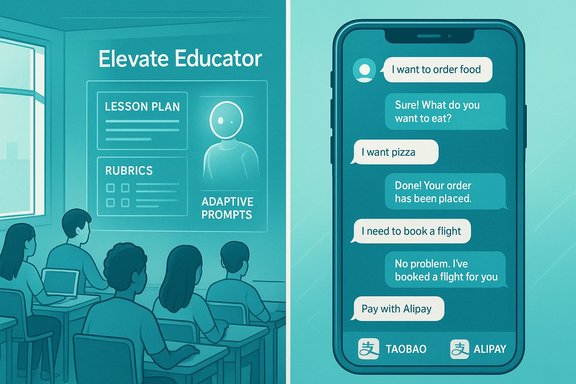
Microsoft’s education push and Alibaba’s consumer-AI update landed within hours of each other this week, and together they expose the same strategic trend: big tech is moving from answer engines toward agentic AI that not only answers questions but completes tasks, automates workflows and — crucially — hooks users into broader commercial and institutional ecosystems. The launches are notable for their scale and ambition: Microsoft unveiled Microsoft Elevate for Educators plus new, education‑focused Copilot capabilities and a limited student promotion, while Alibaba expanded its consumer Qwen app to execute purchases, payments and travel bookings inside chat. Both moves accelerate AI adoption in everyday scenarios, but they also raise immediate questions about equity, privacy, procurement, and platform lock‑in that schools, IT directors and regulators will need to address.
Microsoft’s Elevate narrative grew from a mid‑2025 strategic relaunch of its philanthropic and skills efforts into a broader corporate program. The company previously framed the effort around a multi‑year, multi‑billion dollar commitment intended to combine cash, cloud credits and training to help schools and nonprofits adopt AI responsibly. The new, concrete items announced include an educator credentialing and professional‑development program called Microsoft Elevate for Educators, new Copilot features designed specifically for teachers and learners, and a limited, timebound offer giving eligible higher‑education students 12 months of Microsoft 365 Premium plus LinkedIn Premium Career access. Microsoft’s public materials and company blog describe these moves as part of a five‑year Elevate package worth more than $4 billion in cash, services and technology. Alibaba’s consumer play with Qwen follows a rapid product ramp: the Qwen app moved from public beta in November to a major mid‑January update that folds Taobao, Alipay, Fliggy and other Alibaba ecosystem services directly into chat flows. The vendor describes the change as an evolution from conversational AI toward agentic assistants that can move users from intent to completion — for example, ordering food, buying groceries, booking flights and completing in‑chat payments without the user switching apps. The update is explicitly positioned as part of Alibaba’s strategy to turn the Qwen model into a gateway for daily life in China.
For education leaders and IT professionals, the pragmatic path is clear:
Source: EdTech Innovation Hub https://www.edtechinnovationhub.com...YTrMUiYi1FbiERf7EqCwaV-S9zMPwaTe4OmlYbrQHQ==]
 Background
Microsoft’s Elevate narrative grew from a mid‑2025 strategic relaunch of its philanthropic and skills efforts into a broader corporate program. The company previously framed the effort around a multi‑year, multi‑billion dollar commitment intended to combine cash, cloud credits and training to help schools and nonprofits adopt AI responsibly. The new, concrete items announced include an educator credentialing and professional‑development program called Microsoft Elevate for Educators, new Copilot features designed specifically for teachers and learners, and a limited, timebound offer giving eligible higher‑education students 12 months of Microsoft 365 Premium plus LinkedIn Premium Career access. Microsoft’s public materials and company blog describe these moves as part of a five‑year Elevate package worth more than $4 billion in cash, services and technology. Alibaba’s consumer play with Qwen follows a rapid product ramp: the Qwen app moved from public beta in November to a major mid‑January update that folds Taobao, Alipay, Fliggy and other Alibaba ecosystem services directly into chat flows. The vendor describes the change as an evolution from conversational AI toward agentic assistants that can move users from intent to completion — for example, ordering food, buying groceries, booking flights and completing in‑chat payments without the user switching apps. The update is explicitly positioned as part of Alibaba’s strategy to turn the Qwen model into a gateway for daily life in China. What Microsoft announced — the essentials
Microsoft Elevate for Educators: program and promise
- Free professional development and credentials. Microsoft is offering a new Microsoft Elevate Educator credential developed with partners such as ISTE and ASCD, plus an expanded community and achievement system for schools and districts. The program includes self‑paced courses, live sessions and AI simulations in multiple languages.
- $4+ billion commitment. Microsoft reiterates that the Elevate initiative will channel more than $4 billion over five years in cash, cloud credits and services to K–12 schools, community colleges and nonprofits, and aims to credential millions through an Elevate Academy. Public materials, however, do not break down how much of that figure is cash versus cloud credits or in‑kind services. That lack of transparent allocation matters to budget‑constrained districts.
- Student promotion. Eligible higher‑education students can sign up for 12 months of Microsoft 365 Premium and LinkedIn Premium Career at no cost for a limited period; the bundle includes Copilot features and expanded AI usage allowances. Districts and universities should confirm eligibility rules, enrollment windows and post‑promotion cost exposure.
New Copilot capabilities built for classrooms
- Teach (in Microsoft 365 Copilot). A workspace intended to streamline lesson planning: standards alignment, differentiation, rubric and assessment generation, and reading‑level adjustments. Microsoft says Teach is available now to Microsoft 365 Education customers at no extra charge.
- Microsoft Learning Zone (Copilot+ PC experience). An app that uses on‑device, Copilot+ capabilities to create adaptive activities and interactive lessons. Microsoft positions Learning Zone as the first Copilot+ PC experience for educators, optimized for devices with built‑in AI hardware.
- Study and Learn Agent. A student‑facing adaptive assistant previewing in the weeks after the announcement. It’s designed to scaffold learning, create practice activities like flashcards and quizzes, and encourage reflective thinking rather than simply delivering answers. Microsoft frames Study and Learn as suitable for learners aged 13 and older.
What Alibaba changed — the essentials
- In‑chat commerce and payments. Alibaba integrated Taobao Instant Commerce, Alipay, Fliggy and mapping services so that Qwen can complete multi‑step tasks (ordering food, buying groceries, booking flights) from a single prompt, including in‑chat payments and calls to merchants. The features moved into public testing in China immediately after the update.
- Agentic AI push. Alibaba describes the enhanced Qwen app as shifting from conversational interfaces toward assistants that can act autonomously to finish real‑world tasks — mirroring a broader industry trend where assistant capabilities extend into transactions and cross‑service automation. The company also reported Qwen has passed 100 million monthly active users, underscoring scale for consumer use cases.
- Model and ecosystem alignment. Qwen app is powered by Alibaba’s Qwen model family (including Qwen3) and is being embedded across consumer surfaces such as the Quark browser and other apps, prioritizing integration over a stand‑alone assistant. The strategy ties Qwen directly to commerce and services where Alibaba already dominates.
Why these moves matter: convergence on agentic assistants
Both Microsoft and Alibaba are pushing beyond chat to create assistants that complete workflows—booking flights, creating lesson plans, or ordering groceries—rather than just summarizing or replying. That change has three practical implications:- Higher utility, faster adoption. Tools that genuinely remove friction (complete a purchase, generate a standards‑aligned lesson plan) are easier for busy users to adopt. Time savings are a straightforward selling point for educators and consumers alike.
- Deeper ecosystem entrenchment. Once assistants become gateways to commerce, credentials, or school workflows, the incentives to stay inside a vendor’s ecosystem increase. For districts, that can simplify management — or it can create vendor lock‑in that complicates procurement and long‑term budgets.
- New governance, privacy and safety vectors. Agentic assistants that act on behalf of users multiply the surface for data collection, automated decisions and potential misuse (academic integrity issues, unauthorized purchases, model hallucinations that affect real transactions). The policy and technical controls must keep up.
Strengths: practical benefits for educators and users
- Time savings and workflow automation. Microsoft’s early pilots and case studies show measurable time savings for teachers on tasks like lesson planning and grading; automating routine tasks allows educators to spend more time on instruction, feedback and student engagement. Tools like Teach and Study and Learn are explicitly designed to reduce clerical load.
- Scale of training and credentials. Microsoft’s Elevate Academy and partner credentials could accelerate baseline AI literacy among educators at a scale few vendors can match, particularly if the program achieves its 20‑million skilling target. When implemented in tandem with device and connectivity support, training plus tools can produce tangible capacity building.
- Practical integration with existing workflows. For districts already using Microsoft 365, the new Copilot features arrive inside familiar apps (Word, Teams, OneNote) and can reduce friction for adoption compared with a standalone third‑party solution. Alibaba’s Qwen mirrors this logic for consumers by embedding commerce and booking flows where users already transact.
Risks, unknowns and critical caveats
1) $4 billion headline vs. allocation transparency
The public $4+ billion figure is real as a headline commitment, but Microsoft’s materials and independent reporting show the total mixes cash grants, cloud credits and in‑kind services without a public, line‑by‑line allocation. That matters because credits and one‑time services are not the same as recurring operating funding for under‑resourced districts. Procurement teams must ask for explicit breakdowns and contractual terms.2) Equity and deployment gaps
Free offers and training can still deepen divides if device and connectivity barriers remain. Well‑resourced districts are likeliest to run full pilots and integrate tools into curriculum; under‑resourced schools often lack the IT staff or time to do so. Any district accepting “free” access should pair it with an equity deployment plan that includes devices, connectivity and sustained PD time.3) Vendor lock‑in and curriculum influence
When a single vendor supplies credentials, the primary lesson‑planning assistant, and a pipeline to career services, schools risk orienting long‑term instruction and student records around that vendor’s formats and APIs. That raises portability and competition issues for procurement officers and state policymakers. Contracts should require data portability and open standards where feasible.4) Student privacy, data residency and legal compliance
Education deployments require strict attention to student data protections (FERPA in the U.S., equivalents internationally). Districts must obtain and review a robust Data Processing Addendum (DPA), confirm model training policies (does the vendor use student interactions to further train models?, and verify storage and residency commitments. Public materials do not always make these details explicit; ask for them before broad rollouts.5) Safety and security of agentic flows
Agentic features and deep links increase attack surface. Research has already shown prompt‑injection and chained behaviors can be abused to exfiltrate data or perform dangerous actions if controls aren’t strict. IT teams must apply security patches promptly and consider limiting Copilot Personal modes on managed devices in favor of tenant‑managed Copilot with enterprise DLP controls.6) Verifiability of learning outcomes
While tools promise adaptive learning and personalized study assistants, robust, independent evidence that these interventions improve long‑term learning outcomes at scale is still thin. Districts should require pilot evaluations with clear outcome metrics (mastery, retention, transfer of skills) rather than rely solely on vendor case studies. Flag any claim of learning gains for further independent evaluation before full adoption.Practical checklist for school leaders and IT directors
- Request a full breakdown of the $4+ billion Elevate commitment: cash vs. cloud credits vs. in‑kind services, timelines and eligibility criteria.
- Insist on a detailed DPA that addresses student data usage, model training, retention, third‑party access and data residency.
- Pilot Teach and Study and Learn Agent with explicit evaluation metrics: teacher time saved, student learning gains, equity of access, and academic integrity measures.
- Protect endpoints: apply vendor security patches promptly and evaluate Copilot Personal restrictions on managed devices; prefer tenant‑managed Copilot with Purview and DLP policies where appropriate.
- Plan for continuity and exit: document workflows, ensure data portability, and avoid brittle dependencies that would be costly to unwind.
Alibaba’s Qwen update — implications beyond commerce
Alibaba’s Qwen update demonstrates how consumer AI is moving straight into commerce and services, and that has broader implications:- Commercial friction removal. Integrating ordering, payments and booking into a single conversational flow reduces steps and improves conversion — a major win for commerce platforms but a new source of behavioral data and monetization for the platform.
- Regulatory and consumer protection issues. In‑chat purchases and agentic actions create new questions about authorization, dispute resolution, refunds and liability for incorrect or harmful automated actions. Regulators in multiple jurisdictions are already scrutinizing similar agentic features from other vendors; Alibaba’s rollout will likely attract attention inside China and abroad.
- Competition and ecosystem control. Embedding Qwen across Quark, Taobao and Alipay docks AI at the center of Alibaba’s consumer stack, mirroring Microsoft’s strategy to embed Copilot across Microsoft 365 and Edge. The result: competition becomes not just model quality but platform control of the transaction and data flows.
- Local advantages and geopolitical context. Alibaba can exploit its dominant local commerce and payments stack in China to deliver features Western rivals cannot easily match; conversely, international regulators and chip restrictions shape Alibaba’s hardware and model roadmaps. These dynamics matter for multinational companies comparing vendor choices.
Cross‑platform comparison: Microsoft vs Alibaba (and Alphabet)
- Strategy. Microsoft’s play emphasizes education, credentials, and enterprise‑grade governance tied into its productivity stack. Alibaba emphasizes consumer convenience and commerce integration within a single app. Both pursue agentic AI, but Microsoft leans into institutional adoption while Alibaba targets everyday transactions.
- Ecosystem leverage. Microsoft leverages Microsoft 365, LinkedIn and Windows/Copilot+ hardware; Alibaba leverages Taobao, Alipay and Fliggy. Each vendor uses pre‑existing transactional surfaces to accelerate agentic adoption.
- Governance posture. Microsoft highlights training and enterprise controls, though publicly available material leaves some allocation questions open. Alibaba’s consumer integration prioritizes speed and convenience; the company will need to clarify dispute, consent and safety mechanics as agentic features scale.
Verification, open questions and flagged claims
- The headline "$4+ billion" Elevate commitment is confirmed in Microsoft’s corporate blog and press materials; however, the precise split between cash grants and in‑kind credits is not public and should be treated as unverified until Microsoft provides a line‑item allocation. School leaders are advised to request written clarifications in procurement negotiations.
- Microsoft’s claim that Teach is available now to Microsoft 365 Education customers derives from the company announcement and product blog; procurement teams should still verify availability for their tenant region and account type (edu commercial vs consumer) before planning rollouts.
- Alibaba’s assertion that Qwen has 100 million monthly active users was reported by the company and covered in regional press; independent third‑party analytics corroborate strong growth but may use differing MAU definitions — treat the figure as indicative of scale rather than an audit‑grade metric.
- Claims of immediate learning‑outcome improvements from AI tools remain provisional. Vendor case studies show time savings; independent, randomized evaluations of learning gains are sparse. Districts deploying these tools should embed evaluation from day one.
Bottom line and recommended next steps
Microsoft’s Elevate for Educators and new classroom‑focused Copilot features significantly lower entry friction for schools to experiment with generative AI. Alibaba’s Qwen upgrade shows how quickly consumer AI can turn into a functional commerce layer. Both developments accelerate a shift toward assistants that do things rather than simply answer questions. That shift brings real productivity potential, but also immediate governance, privacy and equity challenges.For education leaders and IT professionals, the pragmatic path is clear:
- Treat announcements as the opening offer, not a turnkey solution. Verify eligibility, contractual terms and data protections before committing at scale.
- Run short, measurable pilots with explicit equity and evaluation goals. Capture teacher workload metrics and student learning indicators.
- Harden security posture preemptively: apply patches, evaluate Copilot personal vs tenant settings, and implement DLP and session controls.
- Insist on data portability and open export formats to avoid lock‑in and preserve future procurement flexibility.
Source: EdTech Innovation Hub https://www.edtechinnovationhub.com...YTrMUiYi1FbiERf7EqCwaV-S9zMPwaTe4OmlYbrQHQ==]
