

Charles Lamanna’s blunt framing — “six months, everything changes; six years, the new normal” — crystallizes a tension that has been quietly building inside Microsoft and across enterprise IT: generative AI is no longer content to be an assistant. It wants to act, decide, and execute. That shift from assistive to agentic AI is already visible in Microsoft’s product roadmaps, pilot projects, and partner pitches, and it forces a re-think of who controls outcomes, who owns identity, and how organizations build trustworthy, auditable systems for work that used to be done by people.
Microsoft’s Copilot initiative — from Microsoft 365 Copilot to Copilot Studio and Security Copilot — has evolved in public view from a helper that drafts and summarizes into a platform for building AI agents that can orchestrate multi-step workflows across apps, systems, and data sources. The strategy treats agents like the apps of the AI era: discrete, composable pieces of software that carry identity, permissions, telemetry, and the ability to act on behalf of users or teams. This is not mere marketing. Microsoft has published documentation and previewed platform primitives — Agent Workspace, Model Context Protocol (MCP), Agent IDs, and on-device Copilot+ hardware patterns — that together form a technical scaffolding for agentic workflows. Those primitives aim to make agents discoverable, auditable, and governable, even as they operate with increasing autonomy. Early pilots span finance invoice automation, customer-support workflows, logistics orchestration, and internal IT tasks.
Organizations that treat agents as production software — instrumented, governed, and under human accountability — will gain the most. Those that rush to turn agents loose without identity controls, DLP, and incident playbooks risk expensive mistakes. The technical promise is huge; the responsibility is commensurate.
Source: 3DVF "In 6 Months, Everything Changes": A Microsoft Executive Describes What Artificial Intelligence Will Really Look Like in 6 Years - 3DVF
 Background / Overview
Microsoft’s Copilot initiative — from Microsoft 365 Copilot to Copilot Studio and Security Copilot — has evolved in public view from a helper that drafts and summarizes into a platform for building AI agents that can orchestrate multi-step workflows across apps, systems, and data sources. The strategy treats agents like the apps of the AI era: discrete, composable pieces of software that carry identity, permissions, telemetry, and the ability to act on behalf of users or teams. This is not mere marketing. Microsoft has published documentation and previewed platform primitives — Agent Workspace, Model Context Protocol (MCP), Agent IDs, and on-device Copilot+ hardware patterns — that together form a technical scaffolding for agentic workflows. Those primitives aim to make agents discoverable, auditable, and governable, even as they operate with increasing autonomy. Early pilots span finance invoice automation, customer-support workflows, logistics orchestration, and internal IT tasks.Why “6 months” matters (and why to treat it as a forecast, not a guarantee)
Charles Lamanna’s timeline is deliberately provocative: short-term acceleration followed by multi-year systemization. There are three reasons leaders hear that as plausible — and three reasons they should temper expectations.- Plausible: model performance, developer tooling, and enterprise telemetry are converging faster than past platform shifts. Microsoft and its partners report expanding Copilot footprints and agent pilots with measurable time savings.
- Plausible: enterprises already automate routine approvals and invoices using RPA; agents simply generalize that capability across modern SaaS stacks and natural-language surfaces.
- Plausible: vendor momentum — product launches, partner commitments, and front-line pilot results — can produce a cascade of activations within months in receptive organizations.
The technical architecture of agentic AI (what’s changing under the hood)
Agents as identities, not just features
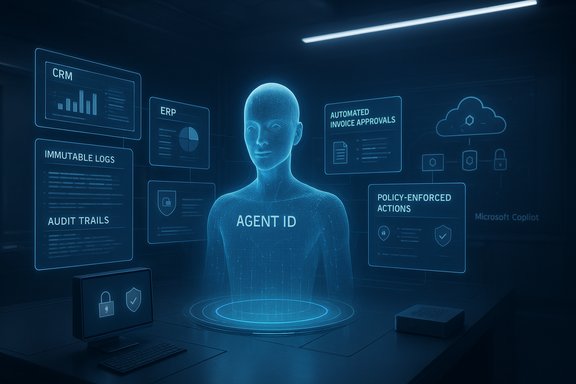
A core architectural shift is treating agents as first-class identities. Microsoft’s approach assigns Agent IDs and ties them into identity and access systems (Microsoft Entra), enabling lifecycle management, policy enforcement, and revocation. That moves agent governance from ad hoc controls to enterprise identity frameworks. This is a non-trivial change: agents must be authenticated, authorized, and traceable the same way human accounts are.Model Context Protocol (MCP) and tool orchestration
MCP is Microsoft’s answer for how agents discover and call app capabilities safely. Think of it like an API registry and permission model for the agent ecosystem: apps expose intents and actions that trusted agents can call, under policy rules the tenant controls. That registry is the connective tissue that lets agents coordinate across CRM, ERP, file stores, and messaging systems — the modern equivalent of a microservices contract, but applied to AI-driven workflows.Local vs. cloud inference — a hybrid operating model
Agentic systems will not be purely cloud or purely on-device. Microsoft’s Copilot+ concept and on-device NPUs promise low-latency, private inference for some tasks, while cloud-hosted models enable heavy-lift reasoning and cross-tenant orchestration. The runtime should be able to route tasks based on policy, privacy, cost, and latency needs. That routing is essential to combine responsiveness with enterprise data protection.Real-world momentum: pilots, evidence, and measurable outcomes
Multiple data points show growing adoption and early impact, though results are heterogeneous.- Microsoft’s Work Trend Index and corporate blogs report increasing experiments with agents and Copilot expansions within existing customers; many pilots report reduced task time, faster response rates, and heightened creative output when AI reclaims repetitive work.
- Industry studies (IDC, Microsoft-cited case studies) highlight productivity as the top expected outcome, with many respondents reporting ROI from early generative-AI projects. IDC’s analyses and forecasts emphasize agentic workflows as a top theme for enterprise digital transformation.
- Independent research — academic audits and workforce studies — signal that while automation potential is large, worker preferences and task complexity create a patchwork of automation-ready tasks versus those that require human judgment. Designing agent interventions with human agency in mind is essential.
Governance, security, and the “who keeps the keys?” problem
When AI transitions from suggestion to execution, control becomes central. Three defensive priorities emerge:- Identity and least privilege: Agents must be bound to identity systems with least-privilege access and conditional controls. Assigning Agent IDs and enforcing conditional access, MFA, and principle-of-least-privilege for agent actions reduces the blast radius of mistakes or compromises.
- Data protection and DLP: Agents that read and write across systems create new data egress pathways. Integrating agents with data-governance tools (Microsoft Purview or equivalents) and applying DLP to prompt inputs and outputs is non-negotiable for regulated data. Microsoft has extended Purview controls and browser-integrated DLP to address shadow-AI risks.
- Auditability and revocation: Agents need immutable logs, action attribution, and immediate revocation paths. Containment models like Agent Workspace — isolated, auditable execution sessions for agent activity — aim to provide this. But operationalizing audit trails across distributed services remains a complex engineering and policy challenge.
The workplace reorganization: jobs, skills, and new roles
Lamanna and others argue agents will create new jobs as they automate certain layers of work. Surveys and workforce studies support this mixed view: many roles will be redefined rather than eliminated, but rapid reskilling will be required across knowledge work. Key trends to expect:- New roles: AI ethics officer, agent architect, automation specialist, model reliability engineer, and AI ops. These roles combine policy, engineering, and domain knowledge.
- Skills shift: increased emphasis on prompt engineering, data hygiene, systems integration, and human-in-the-loop decision design. Organizations that invest in upskilling will capture more benefit.
- Redefinition of managerial duties: managers must monitor agent outcomes, set SLA-like KPIs for agent behavior, and design escalation patterns where human judgment overrides automated actions.
Practical checklist for IT and security leaders (a short playbook)
- Inventory: map the processes that could be automated and categorize them by risk, data sensitivity, and legal exposure.
- Pilot safely: start with a constrained, auditable pilot that has measurable KPIs and a rollback plan.
- Identity-first controls: assign Agent IDs, apply conditional access, use least-privilege roles, and require MFA for agent-triggering operations.
- Data governance: extend DLP and Purview-like controls to agent inputs/outputs and instrument prompt logging.
- Human-in-loop design: define when agents can act autonomously and when human approval is required.
- Incident playbooks: build AI-specific IR procedures — include prompt-injection detection, model output verification, and revocation practices.
- Measure and iterate: track time saved, error rate, escalation incidents, and compliance exceptions; use these metrics to decide scale.
Strengths and opportunities
- Productivity gains at scale: When agents remove repetitive, rule-based tasks, organizations can redeploy human effort toward judgment and creativity. Case studies and vendor telemetry suggest measurable time savings in content generation, admin tasks, and routine customer response.
- Faster decision cycles: Agents can orchestrate data across silos, shortening time-to-insight for operational decisions such as supply-chain exceptions or claims processing.
- Platform effects: Firms that standardize on agent platforms and governance can create reusable automation portfolios and accelerate digital transformation. The analogy is to early cloud migration: once the plumbing is in place, projects scale faster.
Risks, blind spots, and what could go wrong
- Concentration of control: If agent models, training data, and orchestration stacks are managed by a small group of vendors, organizations may face vendor lock-in and opaque model behavior. That raises legal, commercial, and auditability concerns.
- Operational risk from autonomous actions: Agents that execute transactions (approve invoices, change entitlements, update records) can propagate erroneous changes rapidly. Without strong human checks and transactional rollback, errors multiply faster than in manual systems.
- Security and compliance gaps: Shadow-AI usage, improper prompt scopes, and insufficient DLP controls can leak sensitive data into unmanaged models. Recent security blogs emphasize the need for web filters and browser-level DLP to block unsanctioned generative apps.
- False confidence: Models hallucinate. Agents that act on hallucinated outputs create real-world harm (financial, regulatory, reputational). Detection, verification, and fallback must be engineered from day one. Academic and industry research stress human oversight for high-consequence decisions.
A conservative roadmap for responsible adoption
- Phase 0 — Discovery (0–3 months): catalog use cases, map data classification, run tabletop exercises for agent failure modes.
- Phase 1 — Guarded Pilots (3–9 months): run limited, instrumented pilots with Agent IDs, DLP, and explicit human approval gates. Measure error rates and time-saved metrics.
- Phase 2 — Operationalize (9–24 months): codify policies, automate audit collection, integrate agent lifecycle into identity governance, and scale top-performing agent workflows.
- Phase 3 — Governance at scale (24+ months): continuous verification, model updates with reproducible training lineage, cross-tenant audits, and regulatory alignment.
The verdict: fast technical change, slower institutional change
Lamanna’s “six months / six years” shorthand captures a real dynamic: rapid technical capability improvements can create a sense of immediate urgency, while institutional adoption, governance, and social contract formation take longer. The next half-year will likely separate marketing noise from real product activation metrics; the next six years will decide whether agentic AI becomes a stable, auditable part of enterprise operations or merely an expensive layer of brittle automation.Organizations that treat agents as production software — instrumented, governed, and under human accountability — will gain the most. Those that rush to turn agents loose without identity controls, DLP, and incident playbooks risk expensive mistakes. The technical promise is huge; the responsibility is commensurate.
Closing thoughts
The practical future of work is being written now in agent registries, conditional access rules, prompt-scoped DLP policies, and pilot KPIs. Microsoft’s Copilot platform and the agent architecture it promotes are powerful accelerants — but they also force a reset in how IT, security, legal, and business stakeholders collaborate. The question for every CIO and security leader isn’t whether agents will act autonomously; it’s whether their organization will be ready to own, audit, and correct what those agents do. The next months will be decisive for proof-of-value; the next years will determine whether autonomy becomes a durable, trusted fabric of enterprise work.Source: 3DVF "In 6 Months, Everything Changes": A Microsoft Executive Describes What Artificial Intelligence Will Really Look Like in 6 Years - 3DVF
