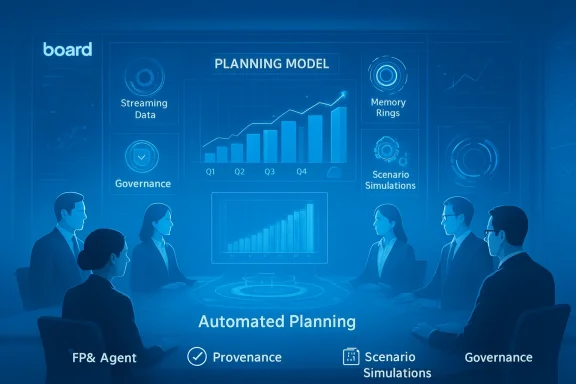
Board’s announcement that it has built a suite of domain-specific Board Agents on Microsoft Foundry marks a clear inflection point for how agentic AI is being folded directly into enterprise planning — and, importantly, how established planning platforms are positioning themselves to make multi-agent automation an operational, governed, and auditable capability for finance, merchandising, and supply chain teams.
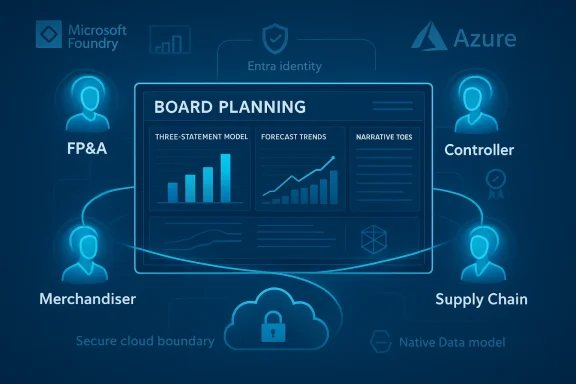
Board, a long-standing vendor in the enterprise planning market, released a strategic product initiative that embeds agentic AI into its Enterprise Planning Platform. The new offering — branded as Board Agents — includes role-oriented agents for the Office of Finance (FP&A and Controller Agents), with Merchandiser and Supply Chain Agents slated to follow. Board says these agents are built natively on its existing planning engine and were developed using Microsoft Foundry and Azure-native agent services to accelerate secure, cloud-native deployments.
This rollout reflects three market trends that have been building through 2024–2026: the move from single-chat assistants to coordinated multi-agent systems; enterprise demand for AI that operates on native business models and governed data; and cloud providers, led by Microsoft, packaging agent runtimes with identity, telemetry, and lifecycle controls to make production deployments feasible. The announcement positions Board as a vendor taking agentic AI from prototype to planning-center stage by combining domain-specific logic with cloud-level governance.
The combination is designed to deliver two practical advantages:
Multi-agent workflows are becoming a practical pattern when decisions require trade-offs across objectives (for example, margin vs. availability vs. working capital). Foundry and agent frameworks provide the runtime primitives — task routing, context sharing, and MVC-style orchestration — to support these use cases at scale.
However, significant work remains on adoption and risk management. Enterprises must treat agentic planning as a new operating modality that requires policy, controls, and continuous oversight. The real test will be how quickly organizations can move from advisory pilots to repeatable, auditable production cycles that measurably reduce forecasting error, shorten planning cycles, and improve decision outcomes without introducing new systemic risks.
For finance, merchandising, and supply chain leaders evaluating Board Agents, the prudent path is clear: validate the agent’s reasoning against canonical models, proceed incrementally, and require governance and human oversight until a robust track record is established. When implemented carefully, persona-driven agentic AI has the potential to make continuous planning genuinely continuous — not by replacing human judgment but by amplifying it with context-aware, auditable automation.
Source: Business Wire https://www.businesswire.com/news/h...ntic-AI-Into-the-Core-of-Enterprise-Planning/
 Background / Overview
Board, a long-standing vendor in the enterprise planning market, released a strategic product initiative that embeds agentic AI into its Enterprise Planning Platform. The new offering — branded as Board Agents — includes role-oriented agents for the Office of Finance (FP&A and Controller Agents), with Merchandiser and Supply Chain Agents slated to follow. Board says these agents are built natively on its existing planning engine and were developed using Microsoft Foundry and Azure-native agent services to accelerate secure, cloud-native deployments.This rollout reflects three market trends that have been building through 2024–2026: the move from single-chat assistants to coordinated multi-agent systems; enterprise demand for AI that operates on native business models and governed data; and cloud providers, led by Microsoft, packaging agent runtimes with identity, telemetry, and lifecycle controls to make production deployments feasible. The announcement positions Board as a vendor taking agentic AI from prototype to planning-center stage by combining domain-specific logic with cloud-level governance.
What Board announced — the essentials
- Board launched Board Agents, a set of persona-based, use-case specific AI agents designed to support planning decisions across finance, merchandising, and supply chain.
- The initial public release focuses on the FP&A Agent and Controller Agent for finance, with Merchandiser and Supply Chain Agents expected to follow.
- Board states these agents are the first enterprise planning capability it has developed on Microsoft Foundry, leveraging Azure’s agent runtimes, governance features, and marketplace integration.
- The company described the Agents as natively integrated into the Board Enterprise Planning Platform so that agents operate on the same assumptions, data models, and calculations used by human planners.
- Board announced a global availability date for the FP&A and Controller Agents of March 31, 2026, and plans to offer them through the Microsoft Marketplace.
- Messaging emphasizes enterprise-grade governance: identity-driven agent lifecycle, auditable interactions, secure tool invocation, and an orchestration layer to let agents collaborate on complex, cross-functional decisions.
Technical underpinnings: Microsoft Foundry, Agent Framework and what they bring
Microsoft Foundry and the agentic stack
Microsoft’s Foundry initiative and the Azure Foundry Agent Service provide the enterprise runtime and management layer Board cites. Key enterprise-grade features found in the Azure Foundry Agent Service and Microsoft Agent Framework include:- Multi-agent orchestration and workflow support for sequential, concurrent, and handoff patterns.
- Persistent memory and context systems that help agents maintain state across interactions.
- Built-in governance via Azure-native identity integration (Entra Agent ID), observability, auditing, and guardrails.
- Model Context Protocol (MCP) and connectors to enterprise APIs and data systems so agents can access controlled data and tools safely.
- One-click deployment options to Microsoft 365 surfaces (for example, Teams and Copilot) and hosting capabilities for managed agents.
How Board fits on top of Foundry
Board’s approach is to embed agents inside its own planning engine so they reason using the platform’s canonical data model, dimensions, and calculations (for example, integrated three-statement models, P&L and balance-sheet logic, inventory and assortment models). That means Board Agents do not merely access Board as an external data source; they are designed to operate on the same model, assumptions, and formulas that finance and operations teams already rely on.The combination is designed to deliver two practical advantages:
- Contextual accuracy: Agents operate on the platform’s single source of truth rather than attempting to reconstruct business logic from exported snapshots.
- Governed actuation: When agents recommend changes (for example, a forecast adjustment or inventory buy recommendation), the actions can be tied to the same approval, audit, and traceability workflows already in Board.
What the product claims mean in practice
Persona-based, use-case specific agents
Board highlights persona-based agents — the FP&A Agent, Controller Agent, Merchandiser Agent, and Supply Chain Agent — built to address core, well-defined planning tasks such as:- 3-statement modeling and validation (FP&A Agent)
- Integrated financial statement analysis and narrative generation (Controller Agent)
- Assortment and inventory optimization (Merchandiser Agent)
- Trade-off simulations and disruption detection (Supply Chain Agent)
Multi-agent orchestration for cross-functional decisions
Board emphasizes collaborative multi-agent orchestration: agents can negotiate, ask one another for inputs, and arrive at multi-dimensional recommendations that cross finance, inventory, and sourcing constraints.Multi-agent workflows are becoming a practical pattern when decisions require trade-offs across objectives (for example, margin vs. availability vs. working capital). Foundry and agent frameworks provide the runtime primitives — task routing, context sharing, and MVC-style orchestration — to support these use cases at scale.
Native awareness of planning models and Board Foresight integration
A standout claim is that Board Agents are natively aware of the platform’s planning model and integrate with Board Foresight for predictive analytics and external data signals. Board Foresight is an existing product in Board’s portfolio that brings external macroeconomic and industry indicators into forecasting and scenario modeling; embedding agentic automation on top of that external intelligence is a meaningful combination for continuous planning.Strengths and potential immediate benefits
- Faster time-to-value from AI: For enterprises that already run Board, embedding agents directly into the planning engine removes a large integration and modeling friction. Pre-built, role-specific agents can shorten pilots to production cycles.
- Better traceability and auditability: Agents operating inside the planning system inherit the platform’s calculation lineage, versioning, and access controls—important for finance teams subject to audit and compliance requirements.
- Cross-functional decisioning at speed: Multi-agent orchestration can reduce manual coordination overhead when modeling cross-functional trade-offs, enabling faster scenario generation and more frequent planning cycles.
- Enterprise governance from day one: Leveraging Microsoft Foundry’s identity, observability, and guardrail features gives enterprises a defensible starting point for risk controls, data access policies, and agent lifecycle management.
- Marketplace distribution and procurement cadence: Offering agents through the Microsoft Marketplace supports procurement via existing enterprise agreements and simplifies purchasing for Azure-aligned organizations.
Key risks, limitations, and cautionary notes
While the offering addresses obvious adoption barriers, several practical and technical risks remain. Each requires active mitigation during evaluation and rollout.1. Model reliability and hallucinations
- Generative models — even when orchestrated by multi-agent controllers — can still produce incorrect or misleading outputs when confronted with ambiguous data or model gaps.
- For finance and regulatory reporting, hallucinations are not merely embarrassing; they can produce materially wrong financial actions if not prevented by guardrails.
- Mitigation: insist on explainability, deterministic checks (reconciliation against canonical numbers), and an approval workflow that prevents agent-initiated changes from being enacted without human signoff.
2. Data privacy and data residency
- Board customers operate in regulated industries and multiple geographies. Agentic systems often require context, which can entice teams to expose wider datasets to models.
- Even if Microsoft Foundry supports regional hosting, enterprise teams must control what context is surfaced to which agent and ensure no customer data is used to train vendor models without explicit consent.
- Mitigation: require strict data-access policies, use private models or tenant-hosted agents, and verify no training on customer data occurs without contractual terms.
3. Over-reliance and deskilling
- Agents that automate significant parts of planning risk creating operational dependency. If the system becomes a black box, teams can lose the institutional knowledge needed to audit or override agent decisions.
- Mitigation: maintain human-in-the-loop processes, enforced review cycles, and deliberate knowledge transfer during adoption.
4. Vendor and platform lock-in
- Deep integration with Board’s planning model and Azure Foundry simplifies deployment but raises migration complexity if an enterprise later wants to move to a different planning platform or cloud.
- Mitigation: extract and export clear data lineage, favor open APIs, and negotiate portability clauses in contracts.
5. Cost and consumption surprises
- Running multi-agent workloads and persistent memory on cloud agent runtimes can be resource intensive. Foundry’s managed services may introduce ongoing consumption-based costs that require careful budgeting.
- Mitigation: run realistic POC scale tests, review Foundry pricing models, and design cost-control telemetry.
6. Governance and compliance readiness
- While Microsoft Foundry provides governance building blocks (identity, telemetry), organizations still must define operational policies: who approves agent behavior, how approvals are logged, how audits are performed.
- Mitigation: map agent workflows to existing SOX, internal control frameworks, and IT change management processes before enabling actioning capabilities.
Implementation checklist: how enterprises should evaluate Board Agents
- Confirm the agent’s operating boundaries: what data, models, and tools it can access.
- Validate lineage: ensure every recommendation or change is traceable back to model versions and source data.
- Run red-team scenarios: include “stress” tests for hallucination, edge cases, and adversarial inputs.
- Start with read-only mode: use agents to produce recommendations, not automatic changes, during early adoption.
- Define approval gates aligned with control frameworks: e.g., CFO sign-off thresholds for forecast changes above X%.
- Ensure local data residency and encryption requirements are met if needed.
- Pilot with a small number of power users and expand gradually based on measurable KPIs (forecast error reduction, cycle-time improvements).
- Build an operations runbook: monitoring alerts, degradation detection, rollback procedures, and cost thresholds.
Competitive landscape: who else is playing in agentic enterprise planning?
- Major cloud providers (Microsoft, Google, AWS) provide agent runtimes and toolkits; the difference is whether a planning ISV integrates them tightly into a planning engine.
- Enterprise planning and CPM (corporate performance management) vendors are racing to add AI features. Board’s choice to focus on persona-based, domain-constrained agents differentiates it from vendors offering general-purpose GenAI assistants.
- Niche players and consulting firms may assemble similar stacks using open-source agent frameworks, but these often lack the production governance and managed runtime controls Foundry offers.
- The real competitive battleground will be on integration depth (native model awareness), governance posture, and the ability to demonstrate reliable ROI in production.
Practical use cases and scenarios where Board Agents add value
FP&A Agent — faster, more trustworthy financial analysis
- Automates reconciliation across the three financial statements and flags inconsistencies.
- Generates narrative explanations for variance analysis and presents prioritized action items for the next planning cycle.
- Helps run what-if scenarios (interest-rate shock, FX movements) and quantify balance-sheet and cash-flow impacts quickly.
Controller Agent — improving close accuracy and consistency
- Focuses on close-readiness, intercompany matching, general ledger mapping optimization, and narrative generation for notes and disclosures.
- Reduces noise by surfacing true exceptions and automating repetitive mapping tasks.
Merchandiser Agent — turning demand signals into profitable action
- Interprets demand signals and aligns product mix, pricing, and inventory strategies to margin and revenue objectives.
- Suggests buys and markdown strategies across channels with margin-availability trade-offs modeled against financial targets.
Supply Chain Agent — risk-aware, resilient planning
- Detects early supply disruptions via external signals and internal inventory trends.
- Runs rapid trade-off scenarios between expedited freight, inventory buffers, and service-level targets.
Business and procurement implications
- Board’s decision to distribute its Agents through the Microsoft Marketplace aligns procurement with enterprise Azure agreements and existing vendor relationships. This can accelerate procurement cycles and support integrated billing under Azure commitments.
- Enterprises will need to budget for both Board licensing (if Agents are tied to Board subscriptions) and Foundry/Foundry Agent Service consumption. Expect mixed pricing models: per-seat or per-module for Board and usage-based charges for agent runtimes and storage in Azure.
- For Microsoft-centric organizations, the combination may offer operational simplicity. For multi-cloud or on-prem environments, evaluate portability options and on-prem agent hosting capabilities.
Verification notes and claims audit
- The posture that Board Agents are built on Microsoft Foundry and that Foundry supplies multi-agent orchestration, identity integration, and hosted agents aligns with Microsoft’s published Foundry capabilities.
- Board’s positioning that the Agents are natively integrated into its Enterprise Planning Platform and work with Board Foresight is consistent with Board’s product documentation and product pages describing Board Foresight and its external-data/predictive capabilities.
- The announced global availability date (March 31, 2026) for the FP&A and Controller Agents is a vendor-declared timeline; enterprises should confirm availability and any regional caveats at procurement time and verify Marketplace listings once published.
- Claims about immediate ROI are prospective; while domain-specific agents reduce integration friction, ROI will depend on scale, data quality, governance maturity, and change management — factors that vary by organization.
Best-practice recommendations for a safe roll-out
- Begin with targeted POCs that measure forecast accuracy, cycle time reductions, and user adoption.
- Keep agents in advisory/read-only mode during initial deployments; require human approval before writing changes into the planning model.
- Maintain strict data access policies: adopt fine-grained role-based controls for agent permissions and leverage Foundry’s identity features to map agents to human owners.
- Establish internal audit and compliance playbooks that include agent interaction logs as part of financial audit trails.
- Invest in training and change management: help FP&A, accounting, merchandising, and supply chain teams understand when and how to rely on agent outputs.
- Institute continuous evaluation: measure drift, monitor for hallucinations, and periodically re-validate models and connectors as business conditions change.
Final assessment: pragmatic innovation, not a magic bullet
Board Agents represents a practical step toward operationalizing agentic AI in enterprise planning. By combining role-focused agents with Board’s canonical planning model and Microsoft’s Foundry runtime, the offering addresses core obstacles that have held back many early AI pilots: model-context alignment, governance, and lifecycle management.However, significant work remains on adoption and risk management. Enterprises must treat agentic planning as a new operating modality that requires policy, controls, and continuous oversight. The real test will be how quickly organizations can move from advisory pilots to repeatable, auditable production cycles that measurably reduce forecasting error, shorten planning cycles, and improve decision outcomes without introducing new systemic risks.
For finance, merchandising, and supply chain leaders evaluating Board Agents, the prudent path is clear: validate the agent’s reasoning against canonical models, proceed incrementally, and require governance and human oversight until a robust track record is established. When implemented carefully, persona-driven agentic AI has the potential to make continuous planning genuinely continuous — not by replacing human judgment but by amplifying it with context-aware, auditable automation.
Source: Business Wire https://www.businesswire.com/news/h...ntic-AI-Into-the-Core-of-Enterprise-Planning/