

Agentic AI — systems that reason, plan and take actions across services rather than merely respond to prompts — has moved decisively out of proof‑of‑concept land and into the arms race of enterprise infrastructure, governance and procurement, with Databricks, Microsoft, AWS and a wave of vendors repositioning products, APIs and SLAs to make agents practical for regulated, high‑value workloads.
Agentic AI describes a class of AI systems that can autonomously execute multi‑step workflows: gather evidence, call tools or services, maintain memory, and take actions that change state in other systems. That shift — from answering questions to performing work — raises three interconnected demands for organizations: low‑latency, high‑throughput infrastructure; rigorous identity, audit and governance controls; and repeatable deployment patterns that bridge models to enterprise data and processes. Recent vendor rollouts and analyst briefings make that transition plain: enterprise platforms are embedding frontier models, cloud providers are repositioning around agent runtimes and silicon, and analyst houses are warning that adoption will depend les ness and controls.
This feature unpacks those developments, verifies key technical and commercial claims against public product documentation and vendor announcements, highlights what is provably new (and what remains promotional), and offers an operational playbook for Windows‑centric IT teams and enterprise architects planning agentic deployments.
Why this matters: moving a frontier model inside a governed data plane reduces egress risk, simplifies compliance boundaries, and lets teams exploit very large context windows for tasks such as contract analysis, multimodal document processing and long‑running agentic orchestrations. Those are practical wins for enterprises that must protect sensitive data and demonstrate control over model inputs and outputs.
Verification and caveats: Databricks’ product posts and PR confirm the integration and capability positioning. Independent verification of performance claims (latency under sustained load, cost per 1M‑token context, or model alignment on domain data) requires workload‑specific benchmarks; enterprises should insist on POCs with reproducible tests under expected transaction and concurrency profiles before accepting vendor headline metrics as contractual SLAs.
Verification and caveats: Microsoft documentation and Copilot blog posts validate the MCP and Agent ID concepts. The technical primitives are available in documentation, but the efficacy of those controls in complex, heterogeneous enterprise estates depends on integration completeness (e.g., how many third‑party connectors support full lifecycle revocation and end‑to‑end provenance). Independent testing of these cross‑system guarantees is necessary before enabling high‑risk agent actions.
Verification and caveats: IDC events and AWS briefings confirm the strategic emphasis. However, IDC briefs in partnership with vendors are directional; their numeric projections and forecasts shformed signals rather than audited facts. Buyers should seek independent benchmarks (e.g., model throughput vs. latency under representative workloads) and insist on capacity/price guarantees where cost predictability matters.
Conclusion
Agentic AI has reached an operational inflection: products and platforms now exist to make agents useful for real enterprise problems, but operational success depends on governance, observability, identity controls and cost discipline. The era of “agent as novelty” is ending; the era of “agent as service” has begun. Organizations that treat agents as first‑class operational entities — with registries, lifecycle policies and rigorous POCs — will capture the outsized productivity wins on offer while avoiding the new classes of risk agentic systems introduce.
Source: Forbes https://www.forbes.com/topics/agentic-ai/]
 Background / Overview
Agentic AI describes a class of AI systems that can autonomously execute multi‑step workflows: gather evidence, call tools or services, maintain memory, and take actions that change state in other systems. That shift — from answering questions to performing work — raises three interconnected demands for organizations: low‑latency, high‑throughput infrastructure; rigorous identity, audit and governance controls; and repeatable deployment patterns that bridge models to enterprise data and processes. Recent vendor rollouts and analyst briefings make that transition plain: enterprise platforms are embedding frontier models, cloud providers are repositioning around agent runtimes and silicon, and analyst houses are warning that adoption will depend les ness and controls.This feature unpacks those developments, verifies key technical and commercial claims against public product documentation and vendor announcements, highlights what is provably new (and what remains promotional), and offers an operational playbook for Windows‑centric IT teams and enterprise architects planning agentic deployments.
What changed this cycle: product integrations and the operational inflection
Databricks brings Gemini 3 Pro into the Lakehouse
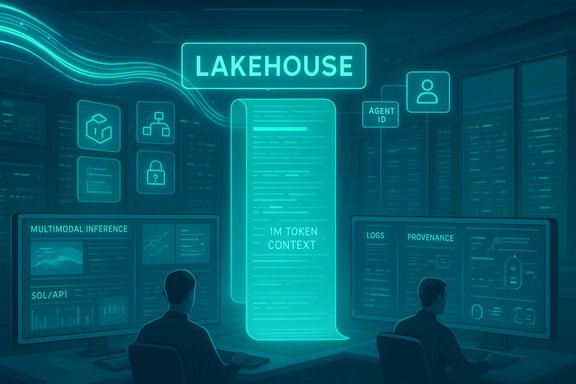
Databricks announced native access to Google’s Gemini 3 Pro inside the Databricks Data Intelligence Platform, positioning the Lakehouse as a secure, governed runway for agentic workloads that require deep access to enterprise content without exfiltrating it to third‑party endpoints. The Databricks blog and supporting press statements describe integrated capabilities — DBSQL ai_query, real‑time APIs, image + text multimodal inference, and managed scaling — that let organizations run Gemini 3 Pro against data in Unity Catalog and Lakehouse storage. The vendor explicitly pitches Gemini 3 Pro for large‑context reasoning (Databricks cites a 1‑million token context window as a competitive differentiator).Why this matters: moving a frontier model inside a governed data plane reduces egress risk, simplifies compliance boundaries, and lets teams exploit very large context windows for tasks such as contract analysis, multimodal document processing and long‑running agentic orchestrations. Those are practical wins for enterprises that must protect sensitive data and demonstrate control over model inputs and outputs.
Verification and caveats: Databricks’ product posts and PR confirm the integration and capability positioning. Independent verification of performance claims (latency under sustained load, cost per 1M‑token context, or model alignment on domain data) requires workload‑specific benchmarks; enterprises should insist on POCs with reproducible tests under expected transaction and concurrency profiles before accepting vendor headline metrics as contractual SLAs.
Microsoft’s Copilot Studio, Model Context Protocol and agent identity
Microsoft has been framing agentic workflows as first‑class platform features: Copilot Studio, Model Context Protocol (MCP) and Agent IDs change how agents are treated operationally (agents become identities, not ephemeral features). MCP explicitly standardizes how agents access resources and tools (file‑like resources, function‑callable tools and prompt templates) so that agents can be governed and instrumented as they act. Microsoft product material emphasizes connectoicrosoft Graph), identity binding, logging, and lifecycle controls as core primitives. Why this matters: treating an agent as an identity enables RBAC, token rotation, least‑privilege enforcement, and full audit trails — essential controls when agents will propose or enact changes in HR systems, finance, or production environments. The practical consequence for Windows shops is clear: agent lifecycle policies must be integrated into directory services and endpoint configurations, and Windows management tooling will need to include agent‑centric controls and observability.Verification and caveats: Microsoft documentation and Copilot blog posts validate the MCP and Agent ID concepts. The technical primitives are available in documentation, but the efficacy of those controls in complex, heterogeneous enterprise estates depends on integration completeness (e.g., how many third‑party connectors support full lifecycle revocation and end‑to‑end provenance). Independent testing of these cross‑system guarantees is necessary before enabling high‑risk agent actions.
AWS, IDC and the enterprise pivot: analyst signal meets cloud productization
AWS and IDC have been vocal about the enterprise implications of agentic AI. IDC‑sponsored events and AWS briefings frame agents as the next major productivity vector, and AWS has been reorganizing and productizing agent tools (AgentCore, Bedrock integratservices) to reduce the friction of moving from prototyping to production. The messaging focuses on long‑running “frontier” agents with persistent memory and enterprise governance primitives. Why this matters: AWS is aligning compute, silicon and product tooling to serve agentic workloads at scale — which directly affects cost structures (GPU hours, inference billing models) and procurement decisions. The analyst support from IDC helps set enterprise expectations that the move to agents is strategic rather than experimental.Verification and caveats: IDC events and AWS briefings confirm the strategic emphasis. However, IDC briefs in partnership with vendors are directional; their numeric projections and forecasts shformed signals rather than audited facts. Buyers should seek independent benchmarks (e.g., model throughput vs. latency under representative workloads) and insist on capacity/price guarantees where cost predictability matters.
Technical reality check: what is provably new — and what remains marketing
New, verifiable elements
- Integrated frontier models inside data platforms: Databricks’ native Gemini integration is real; it enables model execution inside the Lakehouse with SQL and REST APIs and emphasizes governance and large context windows. These are documented in product blogs and press releases.
- Platform primitives for agent governance: Microsoft’s MCP, Agent IDs, and Copilot Studio are documented product features designed to bind agents to identity, resources and tools, facilitating lifecycle management and auditability.
- Cloud productization of agent runtimes: AWS has published agent tooling and ecosystem messaging (AgentCore, S3 Vectors and Bedrock/Agent integration), and independent reporting confirms organizational reorgs focused on agent capabilities. These are verifiable via vendor announcements and press coverage.
Claims that require careful validation
- Performance and cost claims tied to “sub‑second” latency, token economics and 1M‑token context windows: vendors advertise context size and model strengths, but runtime performance and cost at entamatically by workload and caching strategy. Measured TTFT (time‑to‑first‑token) and sustained throughput under concurrency are essential POC metrics; vendor claims should be validated with reproducible tests. ([databricks.com](Launching Gemini 3 Pro on Databricks impact forecasts and macroeconomic uplift numbers (IDC and vendor‑sponsored figures): useful directional signals, but methodology and sample bias must be reviewed before using such figures for procurement or board‑level decisions. Treat headline percentages and “trillions in value” as directional rather than contractual.
- Security and alignment guarantees: vendors are offering built‑in guardrails and auditing — but the maturity of those controls across complex real‑world stacks is uneven. Independent pen tests, compliance attestations and SOC‑type evidence are needed before delegating high‑risk tasks to agents.
Risks, s and governance: an IT checklist
Agentic AI raises a distinct set of operational risks that compound traditional AI concerns with systems‑level failure modes.Identity and access: treat agents as privileged accounts
- Enforce lifecycle management: create, rotate and retire Agent IDs through the same identity governance that managese agents to conditional access and MFA‑enforced breakglass flows where possible.
- Apply least privilege: scope connectors and tokens to only the resources an agent requires; use ephemeral tokens and time‑bounded approvals for elevated actions.
Observability and non‑repudiation
- Log every agent input, decision and external call; include prompt text, model version, confidence metadata and output digests to .
- Ensure logs are tamper‑evident and stored with retention aligned to regulatory needs; consider immutable append logs for high‑risk activities.
Human‑in‑the‑loop and acceptance testing
- Gate destructive or financial actions behind human approvals. For decisions that change state (payroll, code pushes, customer communications), require a human review step as a policy default.
- Enforce automated acceptance tests: for automated code changes, run unit and integration tests in staging with rollbacks and canary duction enactment.
Data sovereignty, provenance and RAG controls
- Prefer zero‑copy or in‑place model execution inside governed data planes where possible (for example, models running inside a Lakehouse), to reduce egress risk and simplify lineage. Databricks’ Gemini integration is explicitly positioned this way.
- Version and catalog training and retrieval corpora; validate retrieval augmentation (RAG) pipelines for freshness and sensitivity labeling — garbage in will still produce garbage out, only faster.
Cost control and capacity planning
- Negotiate contractual protections: price caps, burst protections, transparent billing metrics (tokens, inference seconds, GPU hours) and defined SLAs for TTFT and throughput under agreed loads.
- Instrument usage and create hard budget alerts; agents with long contexts and persistent memory can generate runaway costs if left unchecked.
Practical steps for Windows admins and enterprise IT teams
- Catalog agentable use cases by risk: high (infrastructure changes, payroll), medium (customer communications), low (summarization, internal search).
- Start small: pilot one domain with clets and an explicit rollback plan.
- Require vendor POCs with reproducible benchmarks: TTFT, sustained throughput, and worst‑case latency under expected concurrency.
- Integrate agents into existing identity and endpoint management: enroll Agent IDs in your directory, apply conditional access, audit and lifecycle policies.
- Insist on independent security assessments for connectors and third‑party agents; treat marketplaces as supply‑chain risk vectors.
- Build an Agent Registry and AgentOps: record agent definitions, data scopes, connectors, test coverage and ownership.
Market and competitive implications
Vendor differentiingle‑model accuracy to systems engineering
The new battleground is not only model quality but the glue between models and enterprise data: retrieval pipelines, memory caches, orchestration, governance and multi‑model routing. Vendors that offer integrated stacks (model + data plane + governance) reduce integration friction but raise portability and lock‑in concerns for buyers. Enterprise procurement should weigs against migration costs and insist on portability mechanisms (containerized runtimes, model artefacts, documented APIs).Channel and partner opportunities
Managed services, resellers and system integrators will find immediate demand for AgentOps: onboarding, connector maintenance, governance design, and observability. Vendors are already abilities with partner‑friendly terms to speed adoption, which creates both commercial opportunity and responsibility for partners to prove secure, measurable outcomes.Workforce effects and new roles
Agentic deployments shift work from repetitive tasks to oversight, prompt engineering, and agent governance roles. Expect growing demand for "agent operators", prompt engineers, model auditors and human‑in‑the‑loop review teams. Upskilling and role redesign are necessary complements to technology investment.Case examples and vendor claims: what to test in a POC
- Databricks + Gemini 3 Pro: validate latency and cost for your largest contexts; test multimodal pipelines (image + text + structured data) in production‑scale queries; measure the effect of caching and model selection (Gemini 3 Pro vs. Gemini 2.5 Flash) on cost and accuracy.
- Microsoft Copilot Studio: verify MCP connector behavior in mixed environments; confirm that Agent IDs can be revoked and that logs include sufficient provenance to run audits or rollbacks after an automated action.
- AWS agent runtimes and S3 vectors: run workload tests for Bedrock/AgentCore with your data shapes and check cost models under sustained inference. Confirm contractual protections for price and capacity.
Predictions and idence‑based)
- Short term (6–18 months): accelerated pilot to production transitions in high‑value domains (legal, customer support, internal IT automation) where data is already cataloged and governance is feasible. Expect vendors to expand managed agent runtimes and to push more integrated model+dajectory is consistent with recent platform announcements and analyst events.
- Medium term (18–36 months): focus will shift from product features to operational metrics: TTFT under sustained load, agent success rate, cost per business outcome. Enterprises that can instrument these metrics will capture disproportionate value. Vendor claims about macroeconomic uplift will remain directional until independent studies with transparent methodology are published.
- Regulatory and governance pressures will increase as agents make operational decisions. Expect region‑specific rules that address algorithmic accountability, explainability and consent flows in regulated industries. Organizations that design governance now will face lower compliance friction later.
Strengths, opportunities and systemic risks — a balanced assessment
- Strengths: Agentic AI can compress multi‑step human workflows, automate complex orchestration and unlock value where decisions require synthesizing large, multimodal content sets. Platform integrations (model + data plane) materially reduce engineering friction for enterprises that value security and governance.
- Opportunities: Channel partners can monetize AgentOps; small and medium businesses can embed agents for customer automation and marketing when packaged with guardrails; development teams can offload rote work to agents and focus on higher‑value engineering.
- Risks: Operationalizing agents increases attack surface, introduces potential for amplified errors (hallucinations with real‑world effects), and concentrates vendor dependence. Economic forecasts rooted in vendor‑sponsored briefs should be used with caution. Independent measurement, strict governance and staged rollouts are essential to capture benefits safely.
Final takeaways for Windows‑centric IT and enterprise decision makers
- Treat agentic features as operational services, not optional UX enhancements: incorporate them into identity, logging, backup and incident response playbooks.
- Prioritize testable, measurable pilots: require reproducible benchmarks for performance, cost and safety before broad rollout.
- Demand transparency: require vendors to document model versions, training data provenance (where feasible), connector security posture and independent security attestations.
- Plan for AgentOps: dedicated roles for agent lifecycle, governance and human‑in‑the‑loop oversight are as important as model choice.
- Hedge lock‑in: design for portability (containerized runtimes, documented APIs, import/export of agent definitions) and include contractual capacity/cost guardrails.
Conclusion
Agentic AI has reached an operational inflection: products and platforms now exist to make agents useful for real enterprise problems, but operational success depends on governance, observability, identity controls and cost discipline. The era of “agent as novelty” is ending; the era of “agent as service” has begun. Organizations that treat agents as first‑class operational entities — with registries, lifecycle policies and rigorous POCs — will capture the outsized productivity wins on offer while avoiding the new classes of risk agentic systems introduce.
Source: Forbes https://www.forbes.com/topics/agentic-ai/]
