

The holiday shopping season has arrived with a new cast of digital helpers: smarter AI assistants and autonomous shopping agents from Amazon, Walmart, Google, and AI-platforms like ChatGPT and Gemini that promise to research gifts, track prices, and—even more remarkably—place orders or call stores on your behalf. These tools are no longer simple chat-based recommenders; they pair large language models with retailer catalogs, price-trackers, payment systems, and agentic automation to move shoppers from "what should I buy?" to "it's ordered" with far less friction. Industry forecasts from retail analytics firms suggest agent-enabled commerce could influence a measurable share of Cyber Week sales, but the technology also raises fresh concerns about privacy, accuracy, and how shopping decisions are shaped behind the scenes.
AI-powered shopping assistants trace their roots to early chatbot and recommendation engines, but the current wave is defined by three advances. First, generative models now handle multi-step conversational tasks—interpreting constraints (budget, size, style), synthesizing reviews, and refining search results through follow-up questions. Second, integrations between AI models and retailer systems let assistants see real inventory, pricing history, and merchant rules in near real time. Third, “agentic” capabilities let assistants take actions: place orders, set price alerts that auto-trigger purchases, or call physical stores to check stock levels. Combined, these changes shift AI from adviser to active participant in commerce, creating both convenience and new risk vectors for shoppers and merchants alike.
Longer term, three trajectories are plausible:
Shoppers should treat this technology like any powerful tool: use it where it helps, monitor its actions closely, and keep control firmly in their own hands. Retailers and platform owners should commit to transparency and robust safeguards as they scale agentic commerce, because long‑term consumer trust will determine whether these assistants are accepted—replacing frustration with delight, or creating new problems that undercut their value.
Source: Newser Holiday Shopping, Now With More Bots
 Background
AI-powered shopping assistants trace their roots to early chatbot and recommendation engines, but the current wave is defined by three advances. First, generative models now handle multi-step conversational tasks—interpreting constraints (budget, size, style), synthesizing reviews, and refining search results through follow-up questions. Second, integrations between AI models and retailer systems let assistants see real inventory, pricing history, and merchant rules in near real time. Third, “agentic” capabilities let assistants take actions: place orders, set price alerts that auto-trigger purchases, or call physical stores to check stock levels. Combined, these changes shift AI from adviser to active participant in commerce, creating both convenience and new risk vectors for shoppers and merchants alike.What’s new this holiday season
Agentic AI: from chat to action
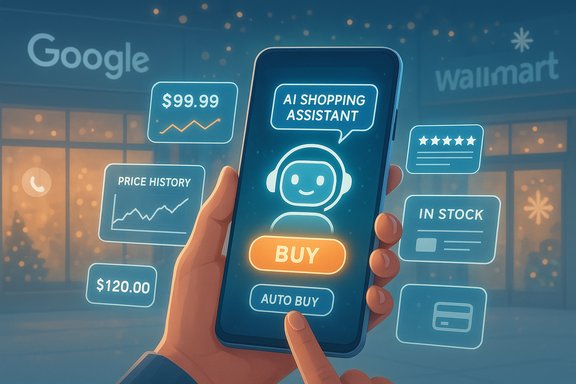
The most visible change is the rise of agentic AI—assistants that can act autonomously. Instead of simply handing back links or product lists, these agents can:- Track an item’s price and complete a purchase when it hits a shopper’s target.
- Place orders through integrated payment systems like merchant checkouts or mobile wallets.
- Call participating local stores to ask staff about inventory, pricing, and promotions.
- Persist user preferences (memories) to personalize future recommendations and auto-reorder essentials.
Major players and their offerings
- Google has expanded its shopping suite to include agentic features that let the assistant call stores to confirm availability, summarize responses, and offer agentic checkout that can buy items for you when set price conditions are met. This leverages voice‑call automation plus Google’s Shopping catalog and payment integrations to blur the line between search and transaction.
- Amazon has continued to develop its in‑house AI shopping assistant, which can retrieve price histories, set price alerts, auto-buy items when thresholds are reached, and retain memory about your preferences to refine suggestions. The assistant is tied tightly to Amazon’s storefront and payment infrastructure.
- Walmart launched a generative AI assistant inside its app to summarize reviews, suggest items for events, and integrate with reordering and checkout experiences. Walmart and other retailers are also working with external AI platforms to reach shoppers inside third‑party chat apps.
- OpenAI / ChatGPT has introduced shopping features that let users discover products through conversation and, in several partner integrations, complete purchases within the chat environment for participating merchants.
How the systems work (simplified)
Data plumbing and real-time signals
At the core are three connected systems:- Large language models (LLMs) that handle the conversation, interpret constraints, and generate human‑readable summaries and action plans.
- Product and pricing graphs maintained by retailers or platforms that provide catalog data, inventory status, and historical pricing.
- Action layer and integrations that let agents set alerts, invoke checkouts (via Google Pay, merchant APIs, or marketplace payment flows), or place outbound voice calls to stores.
Voice calling and human interaction
One of the most talked‑about innovations is the agent that will place a phone call to a store employee to ask if a product is in stock. Those calls are typically executed by an automated calling system that discloses it is an AI and is limited to participating merchants who have not opted out. The agent then parses the human response and summarizes availability, price, and promos for the shopper. This is a practical solution to local inventory gaps, but it introduces new operational and ethical considerations around consent, working‑time impacts on store staff, and the quality of spoken information.Why retailers are doubling down on AI assistants
- Conversion lift and convenience. Early deployments show shoppers who use AI assistants tend to convert at higher rates. Automating price checks and streamlining checkout reduce friction.
- Higher customer lifetime value. Memory features let assistants suggest complementary items and make reordering easier, pushing more spend through the platform over time.
- New ad/monetization channels. Retailers and platforms can monetize agent interactions with “sponsored prompts” or featured placements inside the assistant’s flow.
- Operational savings. AI can triage common customer questions and summarize reviews, lowering customer‑service costs while scaling personalization.
Consumer benefits — practical and immediate
- Faster gift discovery. Conversational search handles nuanced constraints (e.g., “gifts for a 70‑year‑old gardener under $50”) and returns curated lists with pros and cons.
- Price tracking and deal capture. You can set thresholds and let the agent hunt for a deal or auto-purchase when conditions are met.
- Centralized research. Agents can summarize hundreds of reviews and present side‑by‑side comparisons in seconds.
- Hands‑free local checks. The call‑a‑store feature saves the chore of phoning multiple locations for scarce items.
Major risks and downside scenarios
While the features are appealing, they come with significant caveats.1. Accuracy and hallucination risk
LLMs still make factual errors. When an agent synthesizes specs or availability, mistakes can lead to purchasing the wrong product or relying on outdated stock information. Retailer integrations mitigate this, but not all queries are fully grounded in real‑time data, so verification is essential.2. Unintended purchases and authorization
Agentic auto‑buy features can place orders automatically. While vendors promise opt‑in controls and cancellation windows, there are edge cases: shared accounts, children with phone access, or misconfigured price thresholds can cause unwanted charges. Strong authentication, purchase confirmations, and clear logs are imperative.3. Privacy and data‑profiling
These assistants depend on memory and cross‑service signals—your purchase history, browsing patterns, saved addresses, and payment methods. That profile improves personalization but also concentrates sensitive commerce data. Shoppers should expect more targeted offers and re‑use of profile data unless clear privacy controls are offered.4. Returns and post‑purchase friction
Faster ordering and “bracketing” purchases (buying multiple sizes/colors) can increase return rates. Retailers see higher return volumes when AI reduces buying friction, which can erode margins and complicate logistic forecasts.5. Market concentration and gatekeeping
When major platforms control discovery and transact directly, independent merchants, review sites, and influencers risk losing visibility. Sponsored prompts or algorithmic bias toward marketplace inventory could disadvantage small sellers unless regulatory and platform governance address fairness.6. Impact on frontline store staff
Automated calls to stores increase workload for store employees who must answer AI‑initiated queries. Even with opt‑out options, increased call volume could disrupt operations and create compliance headaches for merchants.Safety, transparency, and regulatory blind spots
The legal and regulatory frameworks around agentic commerce are still catching up. Key areas that need clarity include:- Disclosure obligations. When an AI calls a store, regulations and best practice suggest the caller must clearly identify itself as an AI. Boundaries for acceptable automation in voice interactions should be standardized.
- Contract formation. Auto‑buying agents raise questions about what constitutes shopper consent and when a contract is executed—especially when agents operate across multiple merchant sites or payment providers.
- Data portability and control. Shoppers should be able to see and revoke what the assistant remembers. Platforms must provide accessible memory controls and export/deletion options.
- Liability for errors. If an agent places an erroneous order (wrong size, misleading description), determining whether responsibility lies with the model, the merchant, or the platform is non‑trivial.
Practical safety checklist for shoppers
- Review memory and preferences settings. Tighten what the assistant can store and for how long.
- Set purchase safeguards. Use two‑step confirmation for high‑value purchases and review auto‑buy settings.
- Monitor payment methods. Use a dedicated card or payment method for automated transactions and enable alerts.
- Check cancellation and refund policies. Understand the time windows for canceling agent‑placed orders.
- Limit sharing and account access. Protect devices and app access with strong authentication and parental controls.
- Validate details manually for critical buys. For expensive or warranty‑sensitive items, confirm specs on the merchant page even if the agent summarizes them.
Retailer and merchant implications
- Merchants must decide participation levels. Stores can opt in or out of agentic calling, but opting out may lower discoverability inside AI flows. Smaller merchants must weigh operational overhead versus exposure.
- New ad inventory and monetization models. Assistants create placements—sponsored suggestions, featured spots inside conversational lists, and prioritized merchant actions—that can become lucrative ad channels.
- Inventory and customer‑service strain. Real‑time agent checks can inflate foot traffic or call volume to stores; staffing and fulfillment systems must adapt.
- Brand trust and customer reps. Merchants receiving AI‑calls will need staff training to handle automated interactions and verify suspicious callers.
Technical and developer considerations
Developers and platform teams building or integrating shopping agents should prioritize:- Grounding LLM responses in authoritative merchant APIs to avoid hallucinations.
- Audit trails for actions taken by agents: timestamped logs, user approvals, and reversible operations.
- Granular consent mechanics and explainable defaults (e.g., opt‑out for auto-buy).
- Rate limiting for outbound calls and respectful interaction patterns that avoid spamming merchants.
- Secure tokenization of payment credentials to minimize exposure in case of data breaches.
What to expect next
The coming months will be a testing ground. Expect iterative rollouts, merchant opt‑ins/opt‑outs, and early consumer learning. Industry projections estimate that agentic features could influence a notable subset of Cyber Week purchases as shoppers experiment with convenience features like price‑tracking auto‑buys and agentic checkout. At the same time, retailers and platforms will refine guardrails—clearer consent UIs, cancellation windows, and human review steps—driven by user feedback and regulatory attention.Longer term, three trajectories are plausible:
- Mainstream adoption with strong controls. Assistants become ubiquitous tools for planning and executing purchases while robust consent and transparency standards protect consumers.
- Fragmented ecosystem. Adoption grows unevenly; some shoppers embrace agents while others prefer traditional search and marketplaces, leaving marketers to juggle both strategies.
- Regulatory pushback. If agentic commerce leads to systemic problems—fraud, unfair competition, or privacy harms—regulators could impose limits that change how agents are allowed to operate.
Bottom line
The 2025 holiday season is the first one where agentic AI moves beyond toy features into commerce with teeth: calling stores, auto‑buying when prices drop, and integrating directly with payment systems. These tools promise real convenience—faster discovery, hands‑off deal capture, and deeply personalized recommendations—but they also demand vigilance. Privacy controls, clear consent for purchases, rigorous grounding of product facts, and sensible defaults on automated actions are essential to ensure that the convenience of AI assistants does not come at the cost of consumers’ money or autonomy.Shoppers should treat this technology like any powerful tool: use it where it helps, monitor its actions closely, and keep control firmly in their own hands. Retailers and platform owners should commit to transparency and robust safeguards as they scale agentic commerce, because long‑term consumer trust will determine whether these assistants are accepted—replacing frustration with delight, or creating new problems that undercut their value.
Source: Newser Holiday Shopping, Now With More Bots
