

Enterprise software is growing more structured and, paradoxically, more opaque: as organizations centralize identity and governance to give AI-driven automation a reliable foundation, they are creating new systemic blind spots where visibility, accountability, and trust can break down.
Enterprise IT has always balanced two competing pressures: the need for consistent, enforceable policy across systems, and the need to allow business teams to customize workflows and tools to get work done. Over the past two years that balance has sharply shifted toward centralization as AI agents and automation are folded into everyday processes. Vendors and platform teams are treating AI agents as first-class identities, provisioning per‑agent accounts, and building control planes to catalog, audit, and govern agent activity — in short, turning software into governed agents rather than freeform utilities.
That move is not cosmetic. When automation escalates from human-assisted macros to fleets of persistent agents that plan and act on behalf of users, the enterprise security and governance model must change. Centralized identity, telemetry, and policy enforcement promise to reduce fragmentation and give automation a consistent operating context. But centralization alone does not guarantee transparency: controls can be strong on paper while the runtime behavior of agents and policy enforcement remains difficult to observe or reason about.
But centralization is not a panacea. It reduces certain classes of fragmentation while creating others — particularly around runtime visibility and operational accountability.
Runtime gating introduces its own dependencies: telemetry collection, artifact signing, replayable audit trails, and clearly defined exception-handling workflows. Absent those elements, runtime inspection becomes a brittle chokepoint rather than a reliable safety net.
This external impersonation risk complicates human-in-the-loop workflows. If an agent flags an audio clip as executive approval, how should the system weigh that artifact against cryptographic authentication or human confirmation? There is no single technical fix; the solution is layered: authentication at the source, robust provenance metadata, and operational rules for accepting media as authoritative.
But beware the trade-offs:
Technical controls — per-agent identities, runtime gates, standardized telemetry — are necessary, but they are not sufficient. Organizations must build operational muscles: define roles and SLAs, run red teams, and make exception handling routine. Only by combining architecture, tooling, and governance can enterprises capture the productivity benefits of AI agents without surrendering visibility and control.
Source: TechTarget Enterprise software control has its blind spots | TechTarget
 Background
Enterprise IT has always balanced two competing pressures: the need for consistent, enforceable policy across systems, and the need to allow business teams to customize workflows and tools to get work done. Over the past two years that balance has sharply shifted toward centralization as AI agents and automation are folded into everyday processes. Vendors and platform teams are treating AI agents as first-class identities, provisioning per‑agent accounts, and building control planes to catalog, audit, and govern agent activity — in short, turning software into governed agents rather than freeform utilities.That move is not cosmetic. When automation escalates from human-assisted macros to fleets of persistent agents that plan and act on behalf of users, the enterprise security and governance model must change. Centralized identity, telemetry, and policy enforcement promise to reduce fragmentation and give automation a consistent operating context. But centralization alone does not guarantee transparency: controls can be strong on paper while the runtime behavior of agents and policy enforcement remains difficult to observe or reason about.
Why enterprise software is becoming more structured
Agents as identities, not features
Historically, enterprise software treated automation as a capability of an application — a script, a macro, or a scheduled task — not as an independent actor. Today, vendors are assigning directory-level identities to agents, and platforms are building agent registries and lifecycle controls that look very much like user account management. That architectural shift reframes governance: an agent can now have entitlements, tokens, and telemetry that require the same lifecycle controls we use for human identities.- Microsoft and other platform vendors are provisioning per-agent accounts and confined runtimes that allow agents to perform UI-level and API actions while being subject to policy enforcement.
- Identity-first approaches treat agents as auditable resources, enabling access graphs, least-privilege policies, and centralized discovery of automation across cloud and on-prem systems.
Platform integrations and the push for one control plane
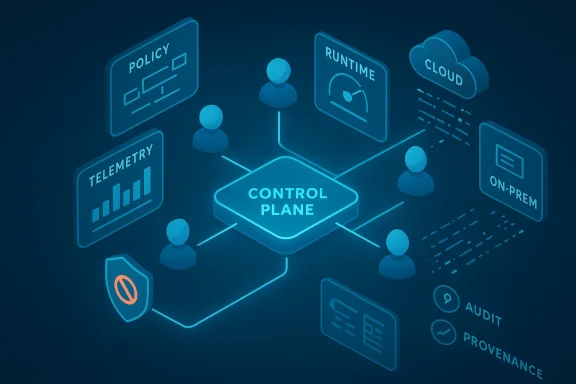
Several product families are converging on a single control plane approach: discover agents, assign identities, enforce least privilege, monitor telemetry, and offer runtime gates that inspect actions before they execute. Enterprise orchestration stacks and identity vendors are building tooling that attempts to span cloud providers, RPA tools, and model-hosting platforms. The business justification is straightforward: unified controls promise lower operational risk and easier compliance.The stability argument for centralization
Proponents of centralization make two converging claims:- Centralized identity and policy models reduce fragmentation, making enforcement uniform across integrated systems.
- When automation operates inside consistent application structures, the probability of unpredictable behavior decreases because agents default to known identity and authorization flows.
But centralization is not a panacea. It reduces certain classes of fragmentation while creating others — particularly around runtime visibility and operational accountability.
Where visibility lags: the new blind spots
The visibility gap is organizational as much as technical
As enforcement and identity are centralized, enterprises often assume visibility improves automatically. In practice, several gaps open:- Instrumentation gaps: not every agent platform emits uniform telemetry, and logs may be siloed across the model host, orchestration system, application, and network. This makes reconstructing a causal chain of agent actions difficult.
- Policy interpretation gaps: centralized policy may be enforced differently across platforms. What looks like a consistent policy at the control plane can translate to divergent enforcement code paths at runtime.
- Accountability gaps: even when telemetry exists, organizations often lack clear operational processes for monitoring, triaging, and remediating agent misbehavior. Governance is as much a process problem as a technical one.
Runtime inspection and the “last mile” of enforcement
Responding to the visibility gap, vendors are adding runtime inspection gates that interpose on planned agent actions and accept or reject them in milliseconds. This model shifts enforcement from build-time policy checks to runtime decisioning — the so-called interpose-and-approve pattern. The upside is significant: you can stop unsafe agent behavior in real time. The downside is complexity: runtime inspection must operate at scale, with low latency, and it must itself be auditable and secure.Runtime gating introduces its own dependencies: telemetry collection, artifact signing, replayable audit trails, and clearly defined exception-handling workflows. Absent those elements, runtime inspection becomes a brittle chokepoint rather than a reliable safety net.
Governance and accountability: who watches the watchers?
Governance is not only code
Automating oversight requires well-defined organizational roles and operational processes. When agents replace human actions, you still need humans to:- Specify acceptable performance and failure modes.
- Define escalation paths when agents misbehave.
- Maintain metrics and run continuous validation.
- Own remediation and exception decisions.
Measuring agent reliability and behavior
Monitoring AI agents requires a new performance rubric — not just uptime or latency, but accuracy, grounding, and policy alignment. Practical measures include:- Task success rate and error classification.
- Frequency and severity of hallucinations or unsupported assertions.
- Data access patterns and unusual token or permission usage.
- Rate of exception handling and human overrides.
Security risks that grow with centralization
Centralization reduces some risks but magnifies others. Here are the principal danger zones.Identity and token flaws can be catastrophic
When agents are first-class identities, flaws in identity systems or token validation can allow an attacker to impersonate an agent or move laterally across tenants. Recent analysis and disclosures show the attack surface at the management plane — tokens, SSO flows, and RBAC — can lead to severe cross-tenant or cross-service compromises if not correctly implemented. Treating an agent as an identity saves governance work, but it also makes identity the single point of failure.Agent hijacking, prompt injection, and zero-click attacks
Automation platforms and RAG (retrieval-augmented generation) systems have demonstrated vulnerabilities that allow attackers to inject malicious content into a model’s context or memory, causing it to leak secrets, alter behavior, or take unsafe actions. Attack demonstrations — including so-called AgentFlayer zero-click hijacks and prompt-injection chains — show how trusted automation can be turned into persistent insider threats. Enterprises must assume agents running with broad entitlements are attractive and high-value targets.Data exfiltration through automation channels
Automated agents that can read email, documents, CRM records, or cloud storage are potential exfiltration channels. Vulnerabilities in the integration layer—an improper API contract, a logging gap, a misconfigured connector—can be exploited to siphon data without triggering traditional alerts. Centralization makes the attack surface coherent but also concentrated: one misconfiguration in the identity or connector plane can yield broad access.The trust problem: deepfakes and the external identity crisis
The internal governance challenges are mirrored externally. Deepfake tools for audio and video have become cheap and widely available, changing the baseline of what people can credibly forge. That trend undermines assumptions about authenticity in executive communications, recorded approvals, and multimedia evidence. In a world where both agents (internal) and deepfakes (external) can convincingly act or appear like humans, enterprises must re-evaluate what constitutes a trustworthy artifact.This external impersonation risk complicates human-in-the-loop workflows. If an agent flags an audio clip as executive approval, how should the system weigh that artifact against cryptographic authentication or human confirmation? There is no single technical fix; the solution is layered: authentication at the source, robust provenance metadata, and operational rules for accepting media as authoritative.
Practical recommendations: closing the blind spots
Below are concrete steps enterprises can take to shore up the visibility, governance, and trust gaps created by agentic centralization. These combine technical controls, operational processes, and governance reforms.Identity and access: treat agents as high-risk identities
- Assign per-agent identities and short-lived credentials; avoid shared keys.
- Apply least privilege and ensure entitlement inventories are continuously reconciled.
- Enforce multi-factor requirements and conditional access for sensitive actions.
- Capture and validate token usage and anomalies at the control plane.
Runtime controls and telemetry
- Deploy a runtime gate that inspects planned agent actions and enforces deny/allow decisions, with full audit trails. Ensure the gate is itself instrumented and subject to the same governance as agents.
- Standardize agent telemetry formats across model hosts and orchestration layers so logs can be aggregated and correlated.
- Retain replayable logs and context (model inputs, retrieval records, prompt history) for forensic investigation.
Operational governance and accountability
- Define clear roles: owner (who defines acceptable outcomes), operator (who runs and monitors), and auditor (who verifies compliance).
- Establish SLAs and SLOs that include accuracy and policy alignment, not just uptime.
- Run regular red-team exercises against agent workflows to identify prompt injection, memory corruption, and privilege escalation risks.
Process and policy: exception handling and human oversight
- Create deterministic escalation pathways when agents fail or produce unexpected outputs.
- Define what outcomes require explicit human approval, and where automated acceptance is permissible.
- Maintain an exception registry for every non-deterministic decision the agent takes so auditors can review and measure exceptions over time.
Data and model hygiene
- Isolate sensitive data from models unless strict controls and redaction are in place.
- Use retrieval provenance and data marking to know what content was used to generate an answer.
- Ensure model updates are versioned and test suites run against known benchmarks before rollout.
Dealing with deepfakes and external trust erosion
- Require cryptographic signing for critical recorded communications where possible.
- Employ provenance metadata for multimedia artifacts and favor authenticated channels for policy‑sensitive interactions.
- Train incident response and legal teams to respond rapidly to impersonation events and reputational attacks.
Vendor and tooling posture: what to look for
Not all enterprise tooling is equal. When evaluating vendors or building internal platforms, prioritize capabilities that directly reduce blind spots:- Identity-first governance that discovers agents and maps entitlements across cloud and on-prem systems.
- Runtime inspection and interposition support with low-latency decisioning.
- End-to-end telemetry and replayable event graphs that include model inputs, retrieval contexts, and connector calls.
- Integration with security operations tooling to escalate suspicious agent activity to SOC workflows.
A pragmatic maturity roadmap (for IT leaders)
Enterprises should treat adoption of agentic automation the way they treat major architectural changes: phased, measurable, and governed.- Inventory: Discover all automation, agents, and low-code flows across the organization, and assign owners.
- Baseline: Capture current telemetry, policies, and exception rates to create an evidentiary baseline.
- Pilot: Deploy a runtime gate and per-agent identity model for a narrow, high-value use case (e.g., contract renewal triage).
- Harden: Expand instrumentation, entitlements, and attack surface testing (prompt injection, token misuse).
- Scale: Transition to full orchestrated control plane with integrated SOC playbooks and auditability.
Strengths, trade-offs, and residual risks
Centralizing control delivers clear benefits: unified policy, simplified audits, and the ability to apply organization-wide controls. It also creates a single locus where security, compliance, and reliability can be managed more efficiently. Vendors and early adopters are already showing the operational benefits of identity-driven agent governance.But beware the trade-offs:
- Concentration risk: identity or token-plane failures become multi-system outages or vectors for broad compromise.
- Visibility illusions: control-plane policy does not automatically translate to runtime understandability; tooling gaps remain.
- Operational debt: governance is a human problem — organizations often underestimate the people and process investment required to monitor automated systems.
Conclusion
The evolution of enterprise software into an ecosystem of governed, identity-backed agents is both inevitable and beneficial — but it raises a clear challenge: centralization solves fragmentation, yet it also creates blind spots where runtime behavior, accountability, and trust can fray. The answer is not to halt automation but to treat that automation as a new class of corporate asset that requires identity‑first governance, rigorous runtime inspection, replayable telemetry, and clear operational ownership.Technical controls — per-agent identities, runtime gates, standardized telemetry — are necessary, but they are not sufficient. Organizations must build operational muscles: define roles and SLAs, run red teams, and make exception handling routine. Only by combining architecture, tooling, and governance can enterprises capture the productivity benefits of AI agents without surrendering visibility and control.
Source: TechTarget Enterprise software control has its blind spots | TechTarget
