

Kyndryl’s new Agentic AI Digital Trust service promises to act as a centralized control plane for governing autonomous AI agents at scale — a timely product given the rapid enterprise push into agentic automation and the governance gaps that have followed in its wake.
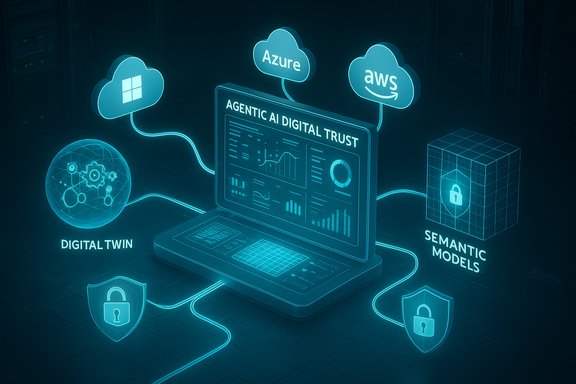
Kyndryl announced Agentic AI Digital Trust on November 19, 2025 as part of its wider Agentic AI Framework, positioning the new service as a security-first control center to discover, certify, monitor and remediate autonomous agent behavior across hybrid and multi-cloud estates. The company explicitly frames the offering as a lifecycle governance capability that spans agent discovery and registration, testing and certification, continuous policy enforcement, logging and compliance reporting, and managed AI detection and response (AI‑MDR). The announcement cites Kyndryl’s 2025 Readiness Report statistics — notably that 68% of organizations are heavily investing in AI and 61% report increased pressure to show ROI from AI — as the business rationale for a trust-and-governance product aimed at regulated and mission‑critical environments. Those survey figures are embedded in Kyndryl’s messaging and used to justify the need for stricter agent controls. Kyndryl’s go‑to‑market and technical narrative emphasizes ecosystem integration over lock‑in. The Digital Trust service is advertised to work "alongside existing security systems" and to support major hyperscalers and partner ecosystems; Kyndryl specifically calls out Microsoft Fabric IQ, Fabric Digital Twin Builder, and Fabric Real‑Time Intelligence as modeling and simulation primitives used to validate agent behavior in virtualized environments.
Source: Petri IT Knowledgebase Kyndryl Launches New Agentic AI Digital Trust Service
 Background / Overview
Kyndryl announced Agentic AI Digital Trust on November 19, 2025 as part of its wider Agentic AI Framework, positioning the new service as a security-first control center to discover, certify, monitor and remediate autonomous agent behavior across hybrid and multi-cloud estates. The company explicitly frames the offering as a lifecycle governance capability that spans agent discovery and registration, testing and certification, continuous policy enforcement, logging and compliance reporting, and managed AI detection and response (AI‑MDR). The announcement cites Kyndryl’s 2025 Readiness Report statistics — notably that 68% of organizations are heavily investing in AI and 61% report increased pressure to show ROI from AI — as the business rationale for a trust-and-governance product aimed at regulated and mission‑critical environments. Those survey figures are embedded in Kyndryl’s messaging and used to justify the need for stricter agent controls. Kyndryl’s go‑to‑market and technical narrative emphasizes ecosystem integration over lock‑in. The Digital Trust service is advertised to work "alongside existing security systems" and to support major hyperscalers and partner ecosystems; Kyndryl specifically calls out Microsoft Fabric IQ, Fabric Digital Twin Builder, and Fabric Real‑Time Intelligence as modeling and simulation primitives used to validate agent behavior in virtualized environments. What Kyndryl says the service delivers
Core capabilities (vendor description)
- Agent discovery and inventory — automated discovery of sanctioned and shadow agents, with registration into a single catalog and lifecycle registry.
- Testing, certification and digital twin simulation — use of digital twin modeling to simulate agent actions against business processes and assets prior to production deployment. Kyndryl highlights Microsoft Fabric Digital Twin Builder as the simulation engine for scenario testing.
- Policy enforcement & continuous monitoring — runtime enforcement of policies, conditional gating for risky actions, and continuous auditing for compliance evidence.
- AI‑MDR and threat detection — agent‑aware monitoring tuned to detect misuse patterns such as unauthorized tool calls, prompt injection signatures, or anomalous data egress sequences.
- Reporting & compliance packs — automated evidence generation for regulatory frameworks referenced by Kyndryl (EU AI Act, NIST, ISO frameworks appear in Kyndryl messaging).
How Kyndryl integrates Microsoft Fabric and digital twins
Kyndryl describes the use of Microsoft Fabric IQ and related Fabric components to create business‑centric semantic models and digital twin environments where agents can be trained, tested and certified before production rollout. The idea is to give security, compliance and business owners a replayable environment to stress‑test agent plans, measure lineage, and produce auditable evidence that guardrails were verified under controlled conditions. This design choice ties the control plane to a modeling and simulation layer rather than relying purely on prompt governance or post‑hoc logging, a notable shift that makes it easier to show step‑by‑step evidence of agent behavior for auditors and regulators. Kyndryl frames this as particularly useful for regulated industries where demonstrable compliance is required.Why this matters now: market context and competing narratives
Agentic automation — fleets of supervised or semi‑autonomous agents that can reason, chain tools and act on behalf of users — has moved quickly from research demos to large pilot programs at enterprises. That speed has exposed governance gaps: agents create identities, cross‑system connectors, and automated flows that traditional IAM, DLP and SIEM systems were not designed to inventory or enforce. Kyndryl’s new offering is explicitly a response to that gap. Independent industry coverage places Kyndryl’s launch in a crowded field: major cloud hyperscalers are shipping agent governance primitives (identity binding, registries, and runtime policies), SIEM/XDR vendors are adding agent‑aware detections, and systems integrators are packaging advisory plus managed delivery to accelerate safe production adoption. Kyndryl’s differentiator is an infrastructure‑first posture combined with large managed‑services scale and pre‑built integrations into Microsoft’s agent ecosystem.Strengths — what Kyndryl gets right
- Lifecycle posture, not point controls. The focus on discovery → test → certify → enforce offers a pragmatic operational model that maps to how enterprises actually deploy software services. Treating agents as first‑class lifecycle entities (with identities, owners and test artifacts) addresses the root cause of “shadow agent” sprawl.
- Simulation and auditability. Using digital twins and semantic models to validate agent behavior before production provides tangible audit artifacts and reduces the likelihood that a deployed agent will take an untested, risky action. This is a real step beyond reactive logging.
- Ecosystem pragmatism. Kyndryl’s design to integrate with heterogenous hyperscaler stacks and with enterprise security tools reduces the integration lift for customers already invested in Microsoft, AWS or Google Cloud ecosystems. That’s a realistic commercial play for large enterprises.
- Mainframe focus for practical value. Kyndryl extends the Agentic AI Digital Trust framework into mainframe modernization and IBM z/OS operations, promising faster incident resolution and lifecycle compliance for legacy platforms where uptime and auditability are paramount. That alignment solves an immediate operational problem for a large cohort of Kyndryl customers.
Risks and open questions — what to watch closely
- Operational complexity and hidden costs. Agent fleets multiply operational surface area: each agent is a principal with credentials, connectors, and potential data paths. Running continuous simulation, red‑teaming, and monitoring at scale has compute and labor costs that will quickly add up unless bounded by strict governance and chargeback models. Kyndryl’s marketing emphasizes capability more than expected TCO; buyers should demand transparent pricing and pilot estimates.
- Signal vs. noise in detection. Agentic behaviors produce a high‑volume of telemetry. The practical value of AI‑MDR hinges on signal fidelity: correlation rules, model‑aware detection, and robust baselining. Without careful tuning, security teams risk alert fatigue or missed incidents. Buyers should insist on evidence from scaled pilots showing detection fidelity.
- Vendor claims and verification. Kyndryl cites simulations and compliance evidence packs, but the effectiveness of a digital twin depends on the fidelity of the model and the quality of data feeding it. Enterprises must insist on verifiable pilot results and reproducible acceptance criteria, not marketing demonstrations. Where Kyndryl references standards compliance (EU AI Act, NIST, ISO), procurement contracts should map those claims to specific artifacts and measurable SLAs.
- Third‑party MCP / connector risk. The Model Context Protocol (MCP) and connector registries standardize agent tool access but create choke points that attackers could exploit if misconfigured. Ensuring connectors are signed, minimally scoped and subject to continuous verification is essential — and enforcement should happen outside the model (at the network & runtime layer), not inside the agent’s logic. Kyndryl’s service must be validated for how it closes this gap in real deployments.
- Regulatory and contractual exposure. Agentic systems that perform writes (for example, modify records or approve transactions) create legal and regulatory risk. Enterprises must define human‑in‑the‑loop thresholds, rollback procedures, liability clauses and audit traceability. Kyndryl’s compliance packs are promising, but buyers should require explicit contractual commitments around incident responsibility and evidence retention.
Practical adoption playbook for IT leaders
The following pragmatic sequence helps Cisco‑, Microsoft‑ or multicloud customers pilot safely and measure impact:- Scope and classify: Inventory candidate processes and classify data sensitivity. Pick 1–2 low‑risk, high‑value workflows for a narrow pilot (e.g., ticket triage, non‑custodial knowledge retrieval).
- Establish agent identity & lifecycle rules: Require each pilot agent to have an owner, cost center, Entra/AD identity, short‑lived credentials, and an enrollment/deprovision workflow. Treat agents as service principals subject to reviews.
- Simulate in a digital twin: Use the Fabric Digital Twin or equivalent sandbox to run adversarial tests and measure boundary behavior. Document evidence packs for compliance reviewers.
- Shadow → gated run → limited autonomy: Start in shadow mode (agents propose), then enable gated writes with human approval, and only afterwards enable fully autonomous operations for idempotent, low‑risk tasks.
- Integrate telemetry and SOAR playbooks: Forward agent telemetry to SIEM/XDR, build SOAR runbooks for agent suspension and credential rotation, and simulate agent compromise scenarios.
- Cost governance and chargeback: Meter inference cost, telemetry ingestion, and twin simulation compute — apply caps and business unit chargebacks to avoid runaway cloud bills.
- Red‑team and continuous evaluation: Schedule adversarial tests and retraining cycles, with formal acceptance criteria for re‑certifying agents after model updates or connector changes.
Mainframe modernization: why Kyndryl’s angle matters
Kyndryl’s heritage is in large, regulated enterprise systems and mainframe operations. Marrying agentic governance to mainframe modernization is more than marketing: IBM z/OS estates are often high‑value, high‑risk environments where agentic automation can produce material productivity gains if implemented with robust audit trails and rollback semantics. Kyndryl’s separate announcement of mainframe‑focused agentic services shows the vendor intends to operationalize the Digital Trust framework in real, legacy environments — a pragmatic play for customers that cannot afford long outages or opaque automation. That said, mainframes have unique constraints (stateful batch jobs, strict change control windows, and specialized skills). Any agent that writes to mainframe systems must be bounded by strong pre‑commit checks, immutable evidence trails, and human approval gates that map to existing ITIL change practices. Kyndryl’s messaging highlights these integrations, but customers must verify them via joint proof‑of‑value tests.Vendor and competitive landscape
Kyndryl sits among several vendor classes racing to capture enterprise agent governance: hyperscaler platform teams (Microsoft, Google, AWS), security vendors adding runtime agent protections, and systems integrators packaging managed agent services. Kyndryl’s strength is combining infrastructure delivery scale, existing mainframe and enterprise relationships, and a “control‑plane + simulation” narrative that appeals to regulated industries. CRN and other trade outlets note Kyndryl’s strategy of moving from advisory to operationalized managed delivery for agentic AI — a logical extension of its services business. Buyers should benchmark three dimensions when comparing vendors:- Governance & evidence: Can the vendor produce machine‑readable proof that an agent was tested, approved and audited?
- Operability: How easily does the vendor integrate with existing IAM, Purview/DSPM, SIEM, and runbook systems?
- Economics: Are simulation, detection and red‑teaming consumptions realistic and contractually bounded?
Verification, caveats and unverifiable claims
- Kyndryl’s press materials include survey statistics (68% heavily investing in AI; 61% pressured to show ROI) used to rationalize the product. Those survey numbers come from Kyndryl’s own Readiness Report and are presented as evidence of market need; buyers should treat such vendor‑run surveys as context rather than proof of a specific ROI for their environment.
- Kyndryl’s efficacy claims (speed of remediation, reduction of platform outages, or specific compliance timelines) will depend on how the service is configured and on customer data shapes. Independent third‑party pilots and proof‑of‑value runs are essential before accepting broad performance or cost claims.
- The fidelity of Fabric‑based digital twins depends on the quality and completeness of the enterprise semantic models; creating and maintaining those models is nontrivial and may require significant time and business involvement. The service’s value is proportional to the maturity of that modeling work.
Checklist for procurement and security teams (quick reference)
- Require an initial 8–12 week POC with explicit acceptance criteria (detection accuracy, time‑to‑suspend an agent, evidence pack completeness).
- Insist on data residency, DPA and contractual commitments for telemetry and simulation artifacts.
- Validate connector signing, revocation latency and token rotation mechanics in your tenant.
- Demand runbooks for agent compromise scenarios and SLAs for incident notification and support.
- Negotiate cost transparency for the three cost drivers: inference (model) spend, simulation compute, and telemetry ingestion.
Conclusion
Kyndryl’s Agentic AI Digital Trust answers a clear and growing enterprise need: auditable, lifecycle governance for agentic automation that spans hybrid estates and legacy systems. By combining a centralized control plane with simulation (digital twin) testing and managed detection, Kyndryl offers a practical path for regulated enterprises to pilot and scale agent fleets without abandoning existing security investments. However, the product does not eliminate the hard work. Operational complexity, model and connector risk, telemetry scale, and cost management remain nontrivial challenges that require disciplined pilots, clear contractual commitments and independent verification. Organizations should treat Digital Trust as a capability to be proven in targeted use cases — not as a turnkey cure for all agentic risks — and should validate claims through reproducible POCs and third‑party audits before broad rollout. Kyndryl’s mainframe integrations and ecosystem emphasis make the offering compelling for enterprise customers with large, regulated estates. For IT leaders ready to pilot agentic automation, the sensible path is the one Kyndryl describes in marketing — simulate, certify, monitor, and only then allow scaled autonomous actions — but with the addition of contractual guardrails, cost transparency and independent validation baked into procurement. (Background coverage and product details referenced from Kyndryl’s announcements and industry analysis.Source: Petri IT Knowledgebase Kyndryl Launches New Agentic AI Digital Trust Service
