

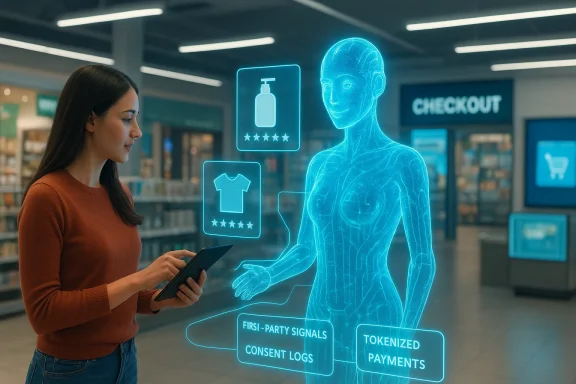
Retailers are rushing to put their merchandise into the hands of AI agents — and in doing so they’re trading direct consumer relationships, deep behavioral data, and parts of the customer experience for convenience, reach and the promise of a new discovery channel.
The opening weeks of 2026 made a point: major retailers and marketplaces are no longer treating AI shopping as an experiment. Walmart, Target and Etsy announced or expanded integrations with Google’s Gemini and Google’s new Universal Commerce Protocol; Target, Etsy and many others had already launched commerce experiences inside OpenAI’s ChatGPT last year. Amazon, meanwhile, has doubled down on its own assistant strategy with Rufus, while Walmart promotes Sparky inside its app. These moves follow last year’s wave of agentic commerce pilots — OpenAI’s Instant Checkout for Etsy and Shopify merchants being one of the most visible examples — and sit alongside vendor and analyst data showing AI-driven referrals to retail sites growing by multiples during the 2025 holidays.
This isn’t incremental channel expansion. It’s a potential re-architecture of discovery, consideration and checkout: instead of shoppers beginning at a brand or marketplace website and being funneled through search or paid channels, discovery may start inside an AI agent that chooses which stores to surface and — increasingly — decides where and how to complete the purchase.
OpenAI’s Instant Checkout — debuted in late 2025 — demonstrated the friction-reducing power of in-chat payment tokens and express checkout for single-item transactions, initially supporting Etsy sellers and rolling toward millions of Shopify merchants. The UX simplification is obvious: one fewer tab, one fewer payment form, less abandonment. Early pilots and company-reported telemetry show substantial relative increases in AI-originated referrals and orders, creating a sense of urgency among brands that want to capture that growth.
But retailers must treat this as a strategic capability, not merely a distribution toggle. The choices made now — how product data is structured, what telemetry is required in partner contracts, how fraud controls adapt, and whether first-party relationships are protected — will determine whether agentic commerce is a durable opportunity or a transfer of value to a new set of gatekeepers.
The pragmatic path is obvious: integrate where it makes sense, instrument obsessively, preserve first-party signals and negotiate data and discovery terms that keep the customer relationship intact. Those who prepare to live in a multi-agent world — with standards, provenance, and operational resilience — will be the ones to turn this moment’s convenience into long-term advantage.
Source: Retail Dive Retail’s risky AI commerce bet
 Background: the quick pivot to agentic commerce
The opening weeks of 2026 made a point: major retailers and marketplaces are no longer treating AI shopping as an experiment. Walmart, Target and Etsy announced or expanded integrations with Google’s Gemini and Google’s new Universal Commerce Protocol; Target, Etsy and many others had already launched commerce experiences inside OpenAI’s ChatGPT last year. Amazon, meanwhile, has doubled down on its own assistant strategy with Rufus, while Walmart promotes Sparky inside its app. These moves follow last year’s wave of agentic commerce pilots — OpenAI’s Instant Checkout for Etsy and Shopify merchants being one of the most visible examples — and sit alongside vendor and analyst data showing AI-driven referrals to retail sites growing by multiples during the 2025 holidays. This isn’t incremental channel expansion. It’s a potential re-architecture of discovery, consideration and checkout: instead of shoppers beginning at a brand or marketplace website and being funneled through search or paid channels, discovery may start inside an AI agent that chooses which stores to surface and — increasingly — decides where and how to complete the purchase.
Why retailers are making the bet
Meet consumers where they are
Retail leaders’ public rationale is simple: customers increasingly use chat and conversational interfaces for product discovery; being absent from those surfaces risks irrelevance. Google, at NRF 2026, framed agentic commerce as a natural next step — a “Universal Commerce Protocol” (UCP) to let agents speak to retail systems and a buy button inside Gemini and AI Mode in Search to complete purchases without leaving the conversation. Google’s CEO emphasized partnership with retailers and an aspiration to keep merchants as “merchant of record” while enabling native checkout inside Google surfaces.OpenAI’s Instant Checkout — debuted in late 2025 — demonstrated the friction-reducing power of in-chat payment tokens and express checkout for single-item transactions, initially supporting Etsy sellers and rolling toward millions of Shopify merchants. The UX simplification is obvious: one fewer tab, one fewer payment form, less abandonment. Early pilots and company-reported telemetry show substantial relative increases in AI-originated referrals and orders, creating a sense of urgency among brands that want to capture that growth.
New discovery surfaces can democratize reach
Conversational agents that synthesize context — a user’s intent, budget, preferences and previous behavior — have the potential to surface long-tail, independent sellers that traditional SEO or paid ads might miss. Companies like Etsy and indie merchants see upside: a small maker with excellent metadata and reviews can be recommended to a perfect buyer. Google and Shopify emphasize that improved catalog hygiene and standardized feeds make distribution across agents easier, lowering engineering barriers for SMBs.The central risks: data, disintermediation and gatekeepers
Loss of the direct relationship and first-party signals
When a shopper’s discovery-to-purchase flow happens inside a third-party agent, the retailer may capture only the final order and fulfillment call — not the full journey that explains how the purchase was arrived at. That journey holds the most valuable first-party signals: nuanced search queries, interaction sequences, A/B prompts, time-on-product and product comparison patterns. If those signals are owned, processed or retained by the AI platform — and only sparsely shared back — the retailer loses critical context that powers personalization, merchandising and lifetime value analysis. Kritically, the agent becomes the retailer’s new “customer of record” in behavioral terms. Google’s public messaging attempts to reconcile this by saying retailers remain merchant of record and should “succeed together,” but the practical truth is that technical and contractual data flows will determine who actually owns the insights.Algorithmic gatekeeping and ranking risk
Agents rank results using their own criteria — often weighing instant-purchase enablement, feed quality and platform policies. OpenAI has already said factors like Instant Checkout enablement affect merchant ranking. That means merchants who opt out — or who have poor metadata — risk being invisibilized on these surfaces. Over time, a handful of assistants could act as distribution gatekeepers, shifting bargaining power from brands and marketplaces to agent owners. For retailers, that’s a concentration-of-power risk that mirrors past platform dynamics on mobile stores and large marketplaces.Data-sharing, privacy and regulatory exposure
Agentic shopping raises thorny privacy questions: what transactional and behavioral data is stored in the agent, how long is it retained, is it used to train models, and who can cross-reference that data across services? Regulators are already scrutinizing algorithmic transparency and ad disclosure; the addition of in-chat checkout, tokenized payments and potential cross-platform profiling moves these issues from academic to regulatory hotspots. Deloitte’s 2026 Retail Outlook found 81% of executives expect generative AI to weaken brand loyalty by 2027 — an implicit admission that agents may favor objective signals (price, availability) over brand, and that oversight will be required as discovery becomes agent-led.Operational and fraud risks
Instant Checkout and tokenized payments reduce friction but open new fraud vectors: token reuse, prompt injection attacks that generate false orders, or rapid spikes in AI-sourced orders that overwhelm fulfillment. Merchants must strengthen fraud detection, implement short-lived checkout tokens, reconcile token-to-order provenance, and prepare customer service playbooks for AI-originated disputes. Early industry guidance emphasizes idempotent order ingestion, near-real-time inventory sync and enhanced monitoring of chargebacks and returns for AI-sourced flows.What the data says — and what to believe
Industry metrics have been striking, but they require careful interpretation.- Adobe’s holiday analysis reported massive jumps in AI-driven referrals during the 2025 season: Adobe’s press release and analytics pages cite increases in the high hundreds of percent for AI-driven traffic to retail sites and a sharp spike on Cyber Monday. Adobe’s numbers have been widely cited as evidence that AI referrals are real and growing, though exact percentages vary by reporting window (Nov 1–Dec 31 vs Nov 1–Dec 1). Treat headline multipliers as directional but verify attribution definitions for your own analytics.
- Deloitte’s 2026 Retail Industry Global Outlook surveyed 330 retail executives and found strong expectations for agentic adoption — including the eye-catching 81% figure about generative AI weakening brand loyalty by 2027 — underscoring executive-level concern about agent intermediaries. Deloitte’s methodology and sample frame are public, which strengthens the credibility of the finding.
- Vendor-reported multipliers from platforms and commerce providers (Shopify, Microsoft, OpenAI pilots) demonstrate momentum, but they are company-defined metrics and often lack third-party auditable attribution methods. Independent verification and careful instrumentation at the merchant level remain essential.
Early strategies for retailers: pragmatic steps to retain control
If you run a brand, marketplace, or retail IT organization, treating agentic commerce as a new channel — not a marketing experiment — is critical. Practical measures include:- Fix your catalog and data foundation now.
- Ensure canonical SKUs, GTIN/UPC where possible, normalized titles, images with alt text and machine-readable attributes.
- Adopt schema and feed standards compatible with agentic protocols (UCP, Agentic Commerce Protocols) and regularly validate feed freshness.
- Implement robust provenance and telemetry.
- Log prompt→agent-response→token issuance→order ID flows so you can attribute conversions accurately and reconcile tokens to orders for fraud investigations.
- Harden payment and fraud defenses.
- Use short-lived tokens, device fingerprinting, transaction risk scoring adapted for agent-sourced purchases, and automated anomaly detection tuned for conversational flows.
- Preserve first-party relationships.
- Capture email or loyalty enrollment at checkout whenever possible (even in agentic flows), and design post-purchase flows that drive customers back to owned channels.
- Negotiate commercial and data terms.
- When enabling agentic checkouts, insist on transparent reporting, access to the interaction logs that led to conversions (where feasible), and clear rules on training-usage of merchant data.
- Pilot intentionally and instrument relentlessly.
- Start with low-complexity SKUs (consumables, single-item products) and ramp controls before enabling broad, in-chat checkout options.
Where agentic commerce helps and where it hurts
Strengths and clear ROI vectors
- Reduced friction and higher conversion velocity: agents compress decision-making and can reduce abandonment, especially for single-item purchases or well-scoped purchases where agent confidence is high.
- New discovery for the long tail: well-described niche items can be surfaced in personalized flows, democratizing reach for small merchants.
- Frictionless express checkout: tokenized payments and saved credentials translate into higher impulse conversions and lower cart abandonment. OpenAI’s Instant Checkout and Google’s native buy buttons make this concrete.
Weaknesses and structural harms
- Brand anonymity: if agents default to the “best fit” over brand affinity, brand-driven loyalty programs risk erosion — one reason Deloitte’s surveyed executives flagged brand loyalty risk.
- Vendor lock-in risk: if agents favor integrated merchants or those paying for placement, small merchants could be pressured into costly integrations or fees.
- Hallucinations and inaccuracies: generative systems can confidently produce false product details; when that drives purchases, it creates costly returns and reputational damage.
- Regulatory and trust friction: inconsistent disclosure practices and opaque ranking can invite enforcement actions and consumer backlash.
The competitive landscape: who stands to gain
- Big tech (OpenAI, Google, Microsoft) can embed commerce into their AI ecosystems and monetize discovery and payments, capturing a new engagement-to-revenue loop. Google’s UCP push shows a strategy to make Gemini a business-facing commerce conduit, while OpenAI’s Instant Checkout is already a revenue experiment.
- Marketplaces with logistics scale (Amazon, Walmart) can leverage fulfillment and trust to defend share. Amazon’s Rufus and Walmart’s Sparky are examples of retailers building their own agentic surfaces to avoid ceding the discovery layer entirely. Retailers with strong fulfillment can offer a seamless end-to-end experience that agents may prefer to route to.
- Commerce infrastructure providers (Shopify, PayPal, Stripe) that offer standardized feeds, tokenized checkout and orchestration can become the “plumbing” merchants rely on to appear across many agents without bespoke integrations. Their role is analogous to app store SDKs in the mobile era.
A practical checklist for CIOs and CMOs
- Audit: Product feeds, inventory parity, return rates and fraud incidence for AI-originated orders.
- Contract: Data access and logging requirements in any agent or platform agreement; insist on machine-readable interaction logs when possible.
- Experiment: Triangulate vendor-reported uplift with internal A/B tests and isolate AI channel cohorts in analytics.
- Educate: Train customer support teams on AI-originated flows and prepare scripts for the new types of disputes that may arise.
- Diversify: Maintain owned channels (apps, email, loyalty) and don’t centralize discovery on any single assistant.
What to watch next
- Commercial terms will harden. As platforms demonstrate transactional scale, expect fee models or placement economics to emerge — merchants should model margin impact scenarios now.
- Standards and interoperability. UCP and competing agentic protocols will compete for adoption; cross-agent portability and open standards would materially reduce lock-in risk.
- Regulatory attention. Expect consumer-protection authorities to focus on disclosure, data use for model training, and dispute resolution for in-chat purchases.
- Attribution normalization. Industry groups or auditors may push for standardized definitions of “AI-originated referral” to reduce the opacity around vendor multipliers.
Conclusion: a sensible bet with trade-offs
Agentic commerce will reshape retail — but it is not a free lunch. For retailers, the upside is clear: new discovery channels, faster conversions and potential reach into audiences that prefer conversational interactions. For platforms, the upside is equally clear: deeper engagement and new monetization paths.But retailers must treat this as a strategic capability, not merely a distribution toggle. The choices made now — how product data is structured, what telemetry is required in partner contracts, how fraud controls adapt, and whether first-party relationships are protected — will determine whether agentic commerce is a durable opportunity or a transfer of value to a new set of gatekeepers.
The pragmatic path is obvious: integrate where it makes sense, instrument obsessively, preserve first-party signals and negotiate data and discovery terms that keep the customer relationship intact. Those who prepare to live in a multi-agent world — with standards, provenance, and operational resilience — will be the ones to turn this moment’s convenience into long-term advantage.
Source: Retail Dive Retail’s risky AI commerce bet
