

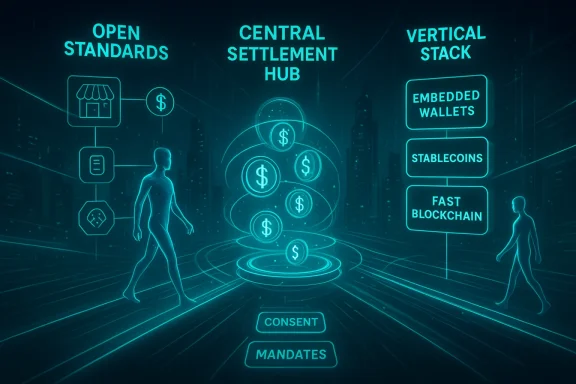
The fight over who gets paid when an AI buys something for you has moved from whiteboard demos to production code — and the industry is splitting into two clear camps. One camp, led by Google and a coalition of more than sixty incumbents, is building an open, standards-first path that stitches agentic commerce into existing payments rails. The other, led by Stripe, is assembling a vertically integrated stack — from stablecoin issuance and wallet primitives to a purpose-built payments blockchain — that aims to make agentic transactions trivial for developers and AI platforms alike. Both approaches are live in practice today: OpenAI’s Instant Checkout runs on Stripe’s Agentic Commerce Protocol, and Google has published an Agent Payments Protocol and broader commerce spec that ties payments directly into Gemini and Search. The split is more than a protocol argument; it’s a fight for the “pipe” through which trillions in future AI-driven transactions will flow. //stripe.com/newsroom/news/stripe-openai-instant-checkout)
Agentic commerce — AI agents that discover, decide, purchase, and even handle returns on behalf of humans — is moving from research labs into consumer products. ChatGPT and Copilot can now surface product recommendations and, critically, complete purchases without sending users to third-party checkout pages. That capability requires not just UI changes, but a new set of plumbing: identity and authorization primitives for agents, secure delegation of payment credentials, fraud controls for machine-driven intent, and settlement rails that work at the scale and speed agents will demand.
Two distinct strategies have emerged in the marketplace:
For consumers the immediate effects will be subtle: smoother checkout in chat, fewer redirects, and—if the industry succeeds—faster fulfilment. For businesses and regulators, the stakes are far higher: identity, liability, reserve transparency and the economics of who collects fees when machines act on behalf of humans. The technical choices we make now — whether to accept signed digital mandates or a new tokenized settlement lane — will determine who gets the tolls of agentic commerce.
Finally, a practical reminder: the headlines and whitepapers tell one story; the real proof will be in production. Watch for where volume concentrates, who builds the dispute-resolution playbooks, and how quickly compliance regimes adapt to agentic flows. When the first large-scale refund dispute lands that involves multiple parties — the agent provider, the platform, the PSP, the issuer — we’ll see which architecture genuinely balances convenience with accountability. Until then, both roads will be paved and the market will decide which lane is faster.
Source: PANews AI Payment Battle: Google Brings 60 Allies, Stripe Builds Its Own Entire Road
 Background / Overview
Agentic commerce — AI agents that discover, decide, purchase, and even handle returns on behalf of humans — is moving from research labs into consumer products. ChatGPT and Copilot can now surface product recommendations and, critically, complete purchases without sending users to third-party checkout pages. That capability requires not just UI changes, but a new set of plumbing: identity and authorization primitives for agents, secure delegation of payment credentials, fraud controls for machine-driven intent, and settlement rails that work at the scale and speed agents will demand.Two distinct strategies have emerged in the marketplace:
- Standards and alliances: Google’s approach emphasizes an open protocol that lets merchants, payment providers, and AI platforms interoperate while relying on existing financial infrastructure and trusted intermediaries. It’s a coalition playbook: design a common language, invite banks and card networks, and embed payments into AI surfaces such as Gemini and Search.
- Vertical integration: Stripe’s playbook has been to acquire or build each layer of the stack: stablecoin rails and custody, embedded wallets, token orchestration, and a payments-optimized blockchain (Tempo). That lets Stripe offer a single-decision, end-to-end option for AI-native commerce: one integration, a predictable settlement asset (USDC), and minimized friction for agentic flows.
How the two camps differ — a technical and commercial breakdown
Stripe’s full-stack bet: buy, build, and bundle
Stripe’s moves over 2024–2026 read like a textbook on vertical platform construction. Key milestones include:- The acquisition of Bridge, a stablecoin orchestration and issuance platform, closed in early 2025 (reported deal value: $1.1 billion). That purchase gave Stripe direct control over issuance, reserve management, and stablecoin settlement flows.
- The introduction of Stablecoin Financial Accounts, allowing businesses in 101 countries to hold and settle in USD-denominated stablecoins and to move funds across eight blockchains — a product announced by Stripe in May 2025. That makes Stripe a custodian and onramp for USDC flows in many jurisdictions.
- The acquisition of embedded wallet infrastructure provider Privy (June 2025), which packages developer-friendly embedded wallets and key management at scale — reportedly used by tens of millions of accounts. That solves a critical UX problem: let apps have wallets without forcing users to adopt external crypto tooling.
- The incubation of Tempo, a payments-focused Layer-1 blockchain co-developed with Paradigm and billed for sub-second confirmations, ultra-low fees, and native stablecoin gas mechanics. Tempo’s testnet and partner sign-ups (including banks, card networks, and large merchants in early reports) convert Stripe’s strategy from product bets into a running rail for high-frequency, agentic settlement. Multiple press reports in late 2025 covered a $500M Series A for Tempo and testnet launches.
- The release of payment primitives and standards aimed at agentic flows — Stripe co-developed the Agentic Commerce Protocol (ACP) with OpenAI and backed Instant Checkout implementations in ChatGPT. ACP is an open spec, but it’s intimately tied to Stripe’s payments stack and developer tools, making Stripe the obvious first-mover for many merchants and AI platforms that integrate quickly.
Google’s alliance-first play: open standards, incumbents, and modularity
Google took a different route. Rather than owning the entire stack, it published standards and rallied a broad coalition of payment incumbents:- In September 2025 Google released the Agent Payments Protocol (AP2), an open framework designed to create verifiable, auditable “mandates” that let agents act with delegated authorization while preserving merchant and bank risk controls. The initial coalition reportedly exceeded 60 partners including Mastercard, American Express, PayPal, and Coinbase. AP2 emphasizes compatibility with existing payment methods — cards, bank transfers — as well as tokenized rails.
- In January 2026 Google unveiled the Universal Commerce Protocol (UCP) at NRF: a broader commerce standard co-developed with retailers and merchants (Shopify, Etsy, Wayfair, Target, Walmart) to standardize product metadata, cart semantics, delegated authorization, and checkout across AI surfaces like Gemini and AI Mode in Search. Google’s approach is to make agentic commerce interoperable across platforms while preserving merchant control and existing governance, payment, and chargeback flows.
The settlement truth: why USDC matters to both sides
No matter which entry point wins the developer mindshare, settlement is where the money actually moves — and stablecoins matter.- Circle’s USDC is widely considered the most “compliant” dollar stablecoin available to institutional players; Circle has published reserve disclosures and, in 2025–2026, publicly filed financial results as a listed company (NYSE: CRCL) that describe USDC reserve management. Those attributes make USDC the default choice for enterprises and regulated counterparties that need auditability and provable backing.
- Both Stripe and Google’s integrations already route volume into USDC rails, at least in practice: Stripe’s stablecoin accounts explicitly support USDC, and early ACP/Instant Checkout pilot flows rely on tokenized USD settlement. Google’s AP2 and UCP ecosystem — which includes Coinbase among its partners — also includes USDC as a settlement option in pilot scenarios. The net effect is that settlement economics (fees, reserve returns, custody) will often be determined by a small set of stablecoin issuers and custodians.
The commercial stakes: who collects the tolls?
The underlying economic question is simple: when an AI spends money on your behalf, who extracts the fee for enabling that flow?- Platforms and assistants (OpenAI, Microsoft Copilot, Google Gemini) can get a cut by controlling the checkout surface and routing volume through preferred PSPs or by collecting platform fees on commerce conversions. ACP’s tight integration with ChatGPT’s Instant Checkout demonstrates this model: OpenAI and Stripe capture platform and processing economics.
- Payment processors and card networks can preserve existing swap-and-fee economics by extending those rails into agentic flows — Google’s AP2/UCP coalition includes card networks and PSPs who can continue to capture fees for authorization, clearing and settlement if the flows stay within card-rail compatibility.
- Stablecoin issuers and settlement networks capture an entirely different revenue pool: reserve income, treasury returns, custody and distribution fees. If large volumes migrate into tokenized settlement, issuers with scale (and the regulatory standing to be trusted) gain a new, recurring revenue stream. Circle’s public filings and recent product expansions show how reserve income and distribution economics can be large and influential.
- New rails (Tempo and other L1/L2 networks) can capture micro-fee economics — lower per-transaction fees but enormous volume — and ancillary network effects (token utility, liquidity partnerships, native fee capture). Tempo’s design goals (sub-second finality, tiny fees, native stablecoin gas) make this a plausible play if agentic commerce volumes materialize.
Risks, unresolved questions and what could go wrong
Agentic commerce promises convenience, but it also widens and reframes long-standing payments and consumer-protection problems.- Accountability & consumer protection: When an agent buys the wrong product, ships to the wrong address, or purchases an unauthorized item, who is responsible? Mandates and signed intent records can help, but they don’t automatically solve refund disputes, warranty claims, or merchant fraud. Google’s AP2 mandates try to create auditable trails, but real-world dispute resolution still sits across multiple parties: platforms, PSPs, card networks, merchants, and possibly stablecoin issuers. Expect regulatory pressure to force clearer liability models.
- Regulatory fragmentation: The U.S. GENIUS Act (Guiding and Establishing National Innovation for U.S. Stablecoins Act) and similar international rules have introduced stringent reserve and audit requirements for payment stablecoins. That clarity helps USDC-style issuers, but it also creates fragmentation for cross-border agentic commerce. Firms must navigate AML/KYC, custody and issuer eligibility in multiple jurisdictions — complexity that could slow merchant adoption or lock-in winners with compliant onshore issuers.
- Operational risk at machine scale: Agents will generate vastly higher transaction counts and new micropayment patterns (e.g., API-based charge-as-you-go for services or tiny purchases). The reliability, latency, and reconciliation systems that work for humans may fail at agent scale unless settlement rails and fraud models evolve. Stripe’s Tempo and x402-like primitives target these problems, but new failure modes will appear in production.
- Concentration & dependency: If large flows consolidate through a few issuers or blockchains, the system becomes dependent on a small number of entities (issuers, custodians, or L1 maintainers). That concentration raises systemic risk: a reserve shortfall, custody outage, or regulatory clampdown on a dominant issuer could cascade across agentic commerce. Circle’s public listing and disclosure regime reduce opacity for USDC, but concentration risks remain.
- Privacy and profiling: Agents need access to user data and preferences to act on behalf of humans. That access increases privacy risks and creates new incentives for data monetization. Standards that define what agents can store and how consent is recorded will be essential. Google’s and Stripe/OpenAI’s protocols both include consent primitives, but the enforcement and governance of those primitives will be evaluated by regulators and civil society.
Where the evidence converges — and where we should be cautious
Multiple independent reports and primary announcements confirm the broad outlines:- Stripe and OpenAI publicly launched the Agentic Commerce Protocol (ACP) and Instant Checkout in ChatGPT on September 29, 2025. The specification and reference materials are available from both companies’ press channels.
- Google announced the Agent Payments Protocol (AP2) in September 2025 and moved UCP into the open ecosystem at NRF in January 2026; the vendor coalition supporting these efforts includes major card networks, PSPs and retailers. That coalition approach is documented in Google’s developer and press materials and corroborated by multiple trade outlets.
- Stripe’s acquisition of Bridge and its subsequent investments (Stablecoin Financial Accounts, Privy, Tempo incubation) are well-documented across financial press and Stripe’s own communications. Those moves create a credible full-stack alternative to the open-standards model.
- Circle’s role as a compliant settlement provider (USDC issuer) accelerated in 2025–2026 as stablecoin legislation and institutional interest increased; Circle’s public filings and press releases show the company operating at scale and serving as a common settlement asset for both camps.
What enterprises, banks, and ISVs should do today
- Experiment with both models, but instrument everything. Integrate ACP or UCP endpoints in test environments and measure failure modes, chargeback workflows, and reconciliation latency. Track how agent-initiated orders propagate through your ERP, fulfillment and returns systems.
- Treat mandates and intent records as first-class legal artifacts. Ensure legal counsel and compliance functions can link a mandate to a verifiable consent record. These artifacts will be critical in disputes and regulatory audits.
- Map your settlement exposure. If you accept tokenized settlement (USDC or otherwise), ensure custody, reserve transparency, and liquidity channels are robust. If you rely on card rails, document where agent flows diverge from human flows and test for fraud scenarios.
- Build for revocability and human override. Agentic commerce should default to human review for high-value or novel purchases; escalation and controlled revocation reduce the risk of runaway agent spend.
- Engage regulators early. The GENIUS Act and parallel regulatory developments have compliant issuance and custody. Firms that shape policy and propose realistic consumer protections will have an advantage when the market consolidates.
The likely near-term outcomes
- Expect a period of coexistence and market segmentation. Large retailers and financial incumbents will favor the Google/UCP/AP2 path where existing compliance and card rails matter. Startups, developer-first platforms, and AI-native players will favor Stripe’s ACP + Tempo approach for low-latency, token-native commerce. Both models can scale; competition will be decided by speed of adoption, merchant economics, and regulatory clarity.
- Settlement will remain concentrated. USDC-like, highly-audited stablecoins will dominate institutional settlement unless credible, regulated alternatives emerge. That concentration creates both efficiency and systemic risk.
- Regulators will push for clearer liability and dispute-resolution frameworks. The real-world friction point — refunds, returns, and chargebacks from agent-initiated purchases — will prompt consumer protection rules tailored to delegation and digital mandates.
Conclusion
We are watching a classic platform war refracted through the lens of payments infrastructure. One side is building via open standards and alliances that keep banks and card networks in the loop; the other is building a vertically integrated, token-native stack that promises lower friction and dramatic cost savings. Both approaches are live today and both have credible claims on the future.For consumers the immediate effects will be subtle: smoother checkout in chat, fewer redirects, and—if the industry succeeds—faster fulfilment. For businesses and regulators, the stakes are far higher: identity, liability, reserve transparency and the economics of who collects fees when machines act on behalf of humans. The technical choices we make now — whether to accept signed digital mandates or a new tokenized settlement lane — will determine who gets the tolls of agentic commerce.
Finally, a practical reminder: the headlines and whitepapers tell one story; the real proof will be in production. Watch for where volume concentrates, who builds the dispute-resolution playbooks, and how quickly compliance regimes adapt to agentic flows. When the first large-scale refund dispute lands that involves multiple parties — the agent provider, the platform, the PSP, the issuer — we’ll see which architecture genuinely balances convenience with accountability. Until then, both roads will be paved and the market will decide which lane is faster.
Source: PANews AI Payment Battle: Google Brings 60 Allies, Stripe Builds Its Own Entire Road
