

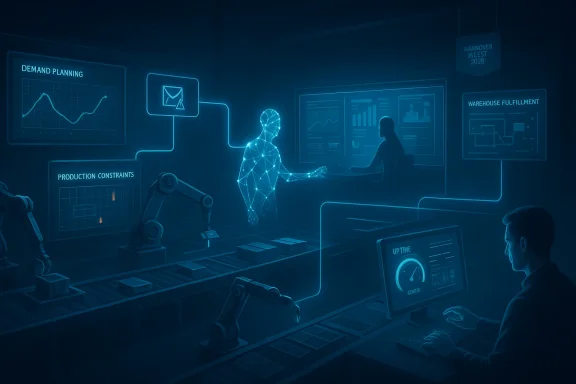
Manufacturing’s next competitive battleground is no longer just plant efficiency or ERP hygiene; it is the speed and quality of decisions made across the value chain. Microsoft’s latest Dynamics 365 message, timed to Hannover Messe 2026, argues that agentic ERP can help manufacturers respond faster to demand swings, supplier disruptions, production constraints, and equipment downtime without forcing teams to leave the systems where work already happens. The pitch is straightforward but ambitious: connect planning, sourcing, fulfillment, commerce, and service so that decisioning moves as quickly as the disruption itself. (microsoft.com)
For years, manufacturing software has promised a single version of the truth. In practice, that truth was often fragmented across planning tools, procurement inboxes, warehouse systems, service desks, and finance dashboards. Microsoft’s April 16, 2026 post is notable because it reframes the ERP conversation around action, not just visibility, and places Copilot and agents at the center of operational execution. The article’s core claim is that manufacturers need more than analytics; they need connected systems that can turn signals into aligned responses inside the flow of work. (microsoft.com)
That framing arrives at a moment when manufacturers are still coping with volatile demand, fragile supply networks, inventory risk, and the persistent fear of missing customer commitments. Microsoft explicitly describes an environment where plants must protect margins and maintain uptime while responding to disruption with incomplete or delayed information. In other words, the problem is not lack of data. The problem is that data arrives too late, lives in too many places, and is too disconnected from the operational decision that must be made. (microsoft.com)
The company’s answer is Dynamics 365 as an agentic ERP foundation. Microsoft says the platform unifies data, analytics, automation, and collaboration so that demand, supply, capacity, and cost can all influence action. That is an important distinction: this is not just “AI in ERP,” but an attempt to make ERP the orchestration layer for decisions that cross departments and time horizons. The article repeatedly returns to the idea that the gap between knowing and doing is where manufacturing value is lost. (microsoft.com)
There is also a strategic event layer to the announcement. Microsoft ties the story to Hannover Messe 2026 and positions the event as the stage for “industrial intelligence.” That matters because Hannover Messe is one of the industry’s most visible proving grounds for automation, industrial software, and connected factory narratives. By placing agentic ERP on that stage, Microsoft is signaling that AI agents are not a side feature; they are part of its manufacturing platform story for 2026 and beyond. (microsoft.com)
The Poloplast quote in the post reinforces that point. The company says Dynamics 365 populates item-level details into master planning, removing manual exporting and making it easier to produce the next production cycle’s budget. That is a classic ERP value story, but it also highlights an AI-era nuance: the benefit is not only speed, but reduced friction in how planning data becomes executable. (microsoft.com)
The Farmlands Cooperative quote is instructive because it describes a very human pain point: reading the email, finding the order, identifying affected lines, decoding the vendor’s message, and recommending action. The company says Dynamics 365 will save 20 hours weekly across the team. Even if individual numbers vary by customer, the pattern is clear: the value is in collapsing a multi-step investigative workflow into a shorter, guided sequence. (microsoft.com)
Still, the shop floor is a difficult proving ground for AI. Production environments are noisy, physical, and highly sensitive to false confidence. If an agent flags the wrong issue or misses a real one, the consequences are immediate and expensive. That is why the article’s recurring “human in control” language is important; it acknowledges that agentic assistance must complement, not replace, supervisory judgment. (microsoft.com)
One subtle but important point is that the article ties production insights to downstream customer commitments. That connection matters because many factories still treat production as isolated from promise-date logic. Microsoft is arguing for a more integrated model in which a constraint on the line can flow outward into fulfillment and service decisions fast enough to avoid broken promises. (microsoft.com)
The addition of Researcher in Microsoft 365 Copilot to Dynamics 365 Field Service is a second notable step, now in public preview. Microsoft says it can quickly surface work orders, asset and service history, and parts availability, drawing context from both Field Service data and Microsoft 365 signals. That broadens the field service agent’s context and should reduce the time technicians and managers spend assembling background information before acting. (microsoft.com)
The Orkla Food quote underscores another key point: trust. When the warehouse manager says the system is doing the considerations for picking, packing, and customer details, he is describing a shift from manual judgment to system-assisted execution. That shift only works if users believe the recommendations are reliable and current. Trust is the hidden infrastructure behind every successful warehouse AI deployment. (microsoft.com)
The broader strategic implication is that warehouse management is moving closer to promise-date management. In a disconnected environment, the warehouse simply ships what is ready. In Microsoft’s model, warehouse decisions are tightly linked to demand and customer commitments, which means fulfillment behavior can adjust more intelligently as conditions change. (microsoft.com)
The article’s language suggests Microsoft sees digital ordering as a production-aligned capability, not just a front-end convenience. That could be especially compelling for industrial distributors and manufacturers with complex dealer ecosystems. The ability to automate repeat buying while preserving pricing and allocation discipline is a practical advantage, not a speculative one. (microsoft.com)
At a competitive level, this pushes Microsoft closer to a platform story that spans ERP, commerce, and service together. Rivals that still treat these as separate implementation tracks may struggle to match the simplicity of an integrated decision loop. The challenge, of course, is implementation complexity: the more integrated the system, the more disciplined the master data and process governance must be. (microsoft.com)
The examples Microsoft cites are revealing. Experlogix focuses on quote acceleration and rule validation, Cegeka on recall orchestration and traceability, and Staedean on engineering change impact analysis. Each use case targets a moment when speed, accuracy, and cross-functional understanding are especially valuable. That is a strong signal that Microsoft sees the highest-value agentic use cases in the edges of manufacturing complexity, not just the center. (microsoft.com)
The opportunity is not just efficiency, but resilience. A system that spots risk earlier and replans faster can reduce the operational cost of volatility. That matters in a world where customers expect tighter service levels and supply chains face more frequent disruption. (microsoft.com)
There is also a governance issue. The more decisions agents can recommend or initiate, the more important it becomes to define approval boundaries, audit trails, and exception handling. Manufacturers will want human control in exactly the places where errors are most expensive, especially in quality, engineering change, and customer commitments. (microsoft.com)
It will also be worth watching how much control customers can keep over the decision process. The most successful deployments are likely to be the ones that blend automation with strong approval workflows, transparent rationale, and clear escalation paths. In manufacturing, the winning formula is usually assistive intelligence first, autonomy later. (microsoft.com)
A third area to monitor is ecosystem depth. If partners continue building valuable vertical agents on the ERP MCP Server, Microsoft could create a differentiated manufacturing platform with a much broader use-case footprint than a single-vendor suite usually achieves. That would strengthen its competitive position against ERP rivals, industrial software vendors, and point-solution AI startups alike. (microsoft.com)
Source: Microsoft Becoming a Frontier Manufacturing Firm: Agentic decisions across the manufacturing value chain - Microsoft Dynamics 365 Blog
 Background
For years, manufacturing software has promised a single version of the truth. In practice, that truth was often fragmented across planning tools, procurement inboxes, warehouse systems, service desks, and finance dashboards. Microsoft’s April 16, 2026 post is notable because it reframes the ERP conversation around action, not just visibility, and places Copilot and agents at the center of operational execution. The article’s core claim is that manufacturers need more than analytics; they need connected systems that can turn signals into aligned responses inside the flow of work. (microsoft.com)That framing arrives at a moment when manufacturers are still coping with volatile demand, fragile supply networks, inventory risk, and the persistent fear of missing customer commitments. Microsoft explicitly describes an environment where plants must protect margins and maintain uptime while responding to disruption with incomplete or delayed information. In other words, the problem is not lack of data. The problem is that data arrives too late, lives in too many places, and is too disconnected from the operational decision that must be made. (microsoft.com)
The company’s answer is Dynamics 365 as an agentic ERP foundation. Microsoft says the platform unifies data, analytics, automation, and collaboration so that demand, supply, capacity, and cost can all influence action. That is an important distinction: this is not just “AI in ERP,” but an attempt to make ERP the orchestration layer for decisions that cross departments and time horizons. The article repeatedly returns to the idea that the gap between knowing and doing is where manufacturing value is lost. (microsoft.com)
There is also a strategic event layer to the announcement. Microsoft ties the story to Hannover Messe 2026 and positions the event as the stage for “industrial intelligence.” That matters because Hannover Messe is one of the industry’s most visible proving grounds for automation, industrial software, and connected factory narratives. By placing agentic ERP on that stage, Microsoft is signaling that AI agents are not a side feature; they are part of its manufacturing platform story for 2026 and beyond. (microsoft.com)
Why this matters now
The manufacturing market has been moving from predictive reporting toward assisted decision-making for several years, but agentic systems promise something more operationally aggressive. Instead of merely highlighting a risk, they can decode the risk, identify impacted orders, and recommend or even initiate next steps. That shift can compress reaction time across procurement, production, warehousing, and service. It is not yet the same as full autonomy, but it is a meaningful step toward partial automation with human oversight. (microsoft.com)- The story centers on decision latency as the real enemy.
- It treats ERP as an execution system, not a reporting silo.
- It positions AI as embedded infrastructure, not a separate tool.
- It emphasizes real-time coordination across functions.
- It uses customer examples to make the case for practical value.
Demand Planning and the New Forecasting Mindset
Microsoft’s first major claim is that agentic demand planning can sense shifts earlier. The article says demand planning should apply structured phase-in and phase-out logic with external signals to account for market dynamics, while Copilot accelerates data analysis, scenario modeling, and market-intelligence incorporation. That language suggests a hybrid planning model: statistical forecasting remains important, but planners get AI-assisted judgment layered on top. (microsoft.com)From static forecasts to dynamic planning
The deeper implication is that manufacturers can no longer treat demand plans as annual artifacts or monthly rituals. When market signals change quickly, forecast accuracy alone is not enough; firms need a process that updates assumptions fast enough to matter. Microsoft’s emphasis on “immersion” and “intelligent segmentation” indicates a push toward more granular, context-aware planning rather than one-size-fits-all forecasts. (microsoft.com)The Poloplast quote in the post reinforces that point. The company says Dynamics 365 populates item-level details into master planning, removing manual exporting and making it easier to produce the next production cycle’s budget. That is a classic ERP value story, but it also highlights an AI-era nuance: the benefit is not only speed, but reduced friction in how planning data becomes executable. (microsoft.com)
- Better segmentation can improve forecast relevance.
- External signals can help catch demand inflection earlier.
- Item-level visibility matters more than aggregate dashboards.
- Manual export steps are still a major planning bottleneck.
- Planning quality depends on how quickly assumptions can change.
Procurement as an Early Warning System
The most concrete product announcement in the post is the Procurement Agent in Dynamics 365 Supply Chain Management, which Microsoft says is available in public preview. According to the company, the agent decodes supplier communications, identifies production orders and inventory positions at risk, and performs impact analysis so teams can act before delays turn into OTIF failures. That is a meaningful shift from reactive vendor management to preemptive operational triage. (microsoft.com)Turning supplier emails into operational intelligence
This is where the “agentic” label starts to earn its keep. Many supply chain systems can flag a late shipment; fewer can parse the supplier’s message, map it to affected lines, and surface the customer commitments that might break. If Microsoft’s approach works as described, procurement stops being a clerical back office and becomes a live risk-management function. (microsoft.com)The Farmlands Cooperative quote is instructive because it describes a very human pain point: reading the email, finding the order, identifying affected lines, decoding the vendor’s message, and recommending action. The company says Dynamics 365 will save 20 hours weekly across the team. Even if individual numbers vary by customer, the pattern is clear: the value is in collapsing a multi-step investigative workflow into a shorter, guided sequence. (microsoft.com)
- Supplier exceptions become production risks, not just procurement issues.
- Impact analysis is more valuable than notification alone.
- Human control remains central in Microsoft’s framing.
- The biggest gain may be exception handling, not routine purchasing.
- OTIF performance depends on faster triage.
Production Constraints and Shop-Floor Decisioning
Microsoft’s next emphasis is on production constraints. The article says Copilot, connected to Dynamics 365 Supply Chain Management via the Dynamics 365 MCP Server, can provide AI-generated insights to schedules, inventory, and orders. It also says Copilot can surface quality-related alerts and suggest targeted inspections to prevent recurring recalibration issues. That creates a tighter feedback loop between what happens on the floor and what gets replanned upstream. (microsoft.com)Where AI meets the schedule
The practical promise here is exception management. Supervisors spend less time gathering disparate facts and more time deciding whether to reschedule, reposition inventory, or adjust order promises. Microsoft links this directly to higher Overall Equipment Effectiveness, fewer unplanned stops, and better on-time delivery. Those are exactly the metrics manufacturing leaders care about, which makes the argument commercially strong. (microsoft.com)Still, the shop floor is a difficult proving ground for AI. Production environments are noisy, physical, and highly sensitive to false confidence. If an agent flags the wrong issue or misses a real one, the consequences are immediate and expensive. That is why the article’s recurring “human in control” language is important; it acknowledges that agentic assistance must complement, not replace, supervisory judgment. (microsoft.com)
One subtle but important point is that the article ties production insights to downstream customer commitments. That connection matters because many factories still treat production as isolated from promise-date logic. Microsoft is arguing for a more integrated model in which a constraint on the line can flow outward into fulfillment and service decisions fast enough to avoid broken promises. (microsoft.com)
Equipment Uptime and Field Service
If procurement is the early warning system and production is the reaction layer, then equipment uptime is the hard constraint that can make or break everything else. Microsoft says unplanned downtime, delayed service, or poorly coordinated technician schedules can quickly cascade into constrained capacity and missed targets. The company’s answer is the Scheduling Operations Agent in Dynamics 365 Field Service, which dynamically coordinates assignments based on geography, skills, certification, capacity, travel time, and SLA commitments. (microsoft.com)Service intelligence as manufacturing protection
This is a smart positioning move. Many manufacturers think of field service as customer support, but in practice it is also a production-protection function. If a critical asset goes down, the ability to schedule the right technician quickly can preserve throughput, avoid bottlenecks, and keep constrained lines moving. Microsoft is effectively turning service operations into a manufacturing resilience tool. (microsoft.com)The addition of Researcher in Microsoft 365 Copilot to Dynamics 365 Field Service is a second notable step, now in public preview. Microsoft says it can quickly surface work orders, asset and service history, and parts availability, drawing context from both Field Service data and Microsoft 365 signals. That broadens the field service agent’s context and should reduce the time technicians and managers spend assembling background information before acting. (microsoft.com)
- Uptime is no longer just an asset-management issue.
- Technician scheduling can influence production reliability.
- Parts availability and service history matter together.
- Context-rich service data can reduce repeat visits.
- Field service becomes part of the supply chain conversation.
Warehouse Execution and Fulfillment Speed
The warehouse section is where Microsoft’s “agentic ERP” argument becomes operationally tangible. The post says intelligent inventory on-hand balancing updates slotting to align demand with pick zones, guides inbound put-away to the best locations, and optimizes pick routes on the outbound side. The stated result is higher throughput with the same labor, plus lower picking cost. That is a classic warehouse efficiency story, but it is now wrapped in AI-driven dynamic decisioning. (microsoft.com)Dynamic slotting as a labor multiplier
This matters because warehousing is one of the clearest places where small improvements compound. Better slotting reduces travel time, better put-away reduces congestion, and better route optimization improves picker productivity. In a labor-constrained environment, those gains can be the difference between keeping up and falling behind. (microsoft.com)The Orkla Food quote underscores another key point: trust. When the warehouse manager says the system is doing the considerations for picking, packing, and customer details, he is describing a shift from manual judgment to system-assisted execution. That shift only works if users believe the recommendations are reliable and current. Trust is the hidden infrastructure behind every successful warehouse AI deployment. (microsoft.com)
The broader strategic implication is that warehouse management is moving closer to promise-date management. In a disconnected environment, the warehouse simply ships what is ready. In Microsoft’s model, warehouse decisions are tightly linked to demand and customer commitments, which means fulfillment behavior can adjust more intelligently as conditions change. (microsoft.com)
- Higher throughput comes from reducing travel and search time.
- Dynamic slotting can make static warehouses feel adaptive.
- Better put-away decisions help prevent future congestion.
- Execution quality depends on trusted recommendations.
- Warehouse speed now affects order promise integrity.
Commerce, Ordering, and the Revenue Edge
Microsoft’s commerce section is especially interesting because it extends the agentic ERP idea beyond operations into revenue. The company says Dynamics 365 Commerce supports B2B, B2B2B, and multioutlet models across direct customers, distributors, and dealer networks. Agentic B2B commerce, in Microsoft’s framing, can automate routine ordering, replenishment, and quote-to-order workflows while staying tied to pricing, inventory, warehousing, and production planning. (microsoft.com)Why commerce belongs inside ERP
This is a subtle but important market signal. Manufacturers increasingly need order management that reflects actual supply constraints rather than aspirational availability. When digital commerce sits outside ERP, it can create false promises and operational disconnects. Embedding commerce inside the operational core reduces that risk and gives sales channels a more realistic view of what the business can deliver. (microsoft.com)The article’s language suggests Microsoft sees digital ordering as a production-aligned capability, not just a front-end convenience. That could be especially compelling for industrial distributors and manufacturers with complex dealer ecosystems. The ability to automate repeat buying while preserving pricing and allocation discipline is a practical advantage, not a speculative one. (microsoft.com)
At a competitive level, this pushes Microsoft closer to a platform story that spans ERP, commerce, and service together. Rivals that still treat these as separate implementation tracks may struggle to match the simplicity of an integrated decision loop. The challenge, of course, is implementation complexity: the more integrated the system, the more disciplined the master data and process governance must be. (microsoft.com)
Partner Agents and Ecosystem Expansion
Microsoft devotes a substantial section to partner agents, which may be the most telling part of the entire post. The company says partners are building agents for engineering change impact analysis, product recalls, and configure-price-quote workflows using the Dynamics 365 ERP MCP Server. That tells us Microsoft is not trying to build every manufacturing agent itself; it is creating a platform where specialized workflow intelligence can be layered on top. (microsoft.com)Specialization is the point
This approach makes sense because manufacturing is too broad for a single generic agent strategy. Engineering change, traceability, recalls, and CPQ all have different data structures and risk profiles. Partner-built agents can encode industry-specific logic while still benefiting from the common context and controls of Dynamics 365. (microsoft.com)The examples Microsoft cites are revealing. Experlogix focuses on quote acceleration and rule validation, Cegeka on recall orchestration and traceability, and Staedean on engineering change impact analysis. Each use case targets a moment when speed, accuracy, and cross-functional understanding are especially valuable. That is a strong signal that Microsoft sees the highest-value agentic use cases in the edges of manufacturing complexity, not just the center. (microsoft.com)
- Partner agents can go deeper than generic copilots.
- Engineering and quality workflows are prime targets.
- Traceability is becoming a first-class AI use case.
- CPQ is a natural fit for embedded intelligence.
- Ecosystem breadth strengthens the platform story.
Strengths and Opportunities
Microsoft’s manufacturing message is strongest when it connects AI to concrete operational pain points. The post avoids abstract “AI transformation” language and instead focuses on procurement delays, production constraints, equipment uptime, warehouse flow, and quote-to-order friction. That grounding gives the story credibility and makes the value proposition easier for manufacturing leaders to evaluate. (microsoft.com)The opportunity is not just efficiency, but resilience. A system that spots risk earlier and replans faster can reduce the operational cost of volatility. That matters in a world where customers expect tighter service levels and supply chains face more frequent disruption. (microsoft.com)
- Earlier risk detection across planning, procurement, and service.
- Faster replanning when demand or supply changes.
- Improved OTIF performance through tighter decision loops.
- Lower labor waste in procurement and warehouse workflows.
- Better customer promise accuracy through connected execution.
- Stronger partner ecosystem through specialized agents.
- More practical AI adoption because agents live in existing workflows.
Risks and Concerns
The biggest concern is that the promise of agentic ERP may outpace operational readiness in many manufacturers. AI-assisted workflows sound compelling, but success depends on data quality, process discipline, and user trust. If those foundations are weak, the system may produce impressive demos without delivering durable day-to-day value. (microsoft.com)There is also a governance issue. The more decisions agents can recommend or initiate, the more important it becomes to define approval boundaries, audit trails, and exception handling. Manufacturers will want human control in exactly the places where errors are most expensive, especially in quality, engineering change, and customer commitments. (microsoft.com)
- Data fragmentation can still undermine AI outputs.
- False confidence could be costly on the shop floor.
- Integration complexity may slow deployment.
- Change management will be as hard as the technology.
- Governance requirements increase as decisions become more automated.
- Overpromising ROI could trigger disappointment.
- Vendor lock-in may concern large enterprises with heterogeneous stacks.
What to Watch Next
The most important thing to watch is whether Microsoft converts this narrative into measurable customer outcomes. Public preview features, partner quotes, and event positioning are all useful, but manufacturing buyers will want evidence of better OTIF, lower inventory risk, faster quote cycles, and reduced downtime. If those metrics improve, the agentic ERP story gains real weight. (microsoft.com)It will also be worth watching how much control customers can keep over the decision process. The most successful deployments are likely to be the ones that blend automation with strong approval workflows, transparent rationale, and clear escalation paths. In manufacturing, the winning formula is usually assistive intelligence first, autonomy later. (microsoft.com)
A third area to monitor is ecosystem depth. If partners continue building valuable vertical agents on the ERP MCP Server, Microsoft could create a differentiated manufacturing platform with a much broader use-case footprint than a single-vendor suite usually achieves. That would strengthen its competitive position against ERP rivals, industrial software vendors, and point-solution AI startups alike. (microsoft.com)
- Public preview adoption for the Procurement Agent.
- Real-world performance of Researcher in Field Service.
- Customer feedback on MCP Server-based agents.
- Evidence of ROI in warehouse and demand planning.
- Expansion of partner-built agents into more workflows.
Source: Microsoft Becoming a Frontier Manufacturing Firm: Agentic decisions across the manufacturing value chain - Microsoft Dynamics 365 Blog
