

Global Micro Solutions has launched an agentic governance, risk and compliance platform on Microsoft Azure in June 2026, aiming to automate audit preparation, evidence collection, and compliance monitoring across Microsoft 365, Azure, server infrastructure, and network perimeter estates. The South African Microsoft partner is not merely adding a chatbot to a compliance portal; it is trying to turn the Microsoft tenant itself into the audit record. That distinction matters because the GRC market is moving from document-heavy declarations toward live operational proof. If GMS is right, the next compliance race will be won less by prettier dashboards than by systems that can prove, daily, what an environment actually looks like.
For years, compliance work has been haunted by a familiar ritual: the screenshot scramble. Someone in IT exports policies, captures portal pages, annotates spreadsheets, updates risk registers, and hopes the evidence still matches reality by the time an auditor asks for it. That ritual was never elegant, but it survived because audits were periodic and infrastructure changed slowly enough for paperwork to pretend it was current.
Cloud broke that bargain. Microsoft 365 and Azure environments now shift continuously: Conditional Access policies change, devices fall in and out of compliance, identities accumulate permissions, and workloads appear in places no control owner remembers approving. A spreadsheet can describe intent; it cannot prove the operational state of a tenant at 9 a.m. yesterday or explain why a remediation ticket closed two days later.
GMS is positioning its platform directly at that gap. Its model is built around four phases — assess, configure, prove, and stay compliant — but the crucial verb is prove. The company says the platform collects evidence daily across 93 ISO/IEC 27001 controls, links policy language to actual Microsoft tenant configuration, and maintains live ISMS registers for risk, assets, incidents, suppliers, corrective actions, and other audit artefacts.
That is a meaningful shift in framing. Instead of treating GRC as a reporting layer sitting above operations, the platform treats GRC as an operating model embedded inside Microsoft Cloud administration. In theory, that makes compliance less of a quarterly performance and more of a continuously observed system condition.
GMS appears to understand that the credibility of an audit agent depends less on conversational polish than on restraint. The company says its AI-powered Audit Agent retrieves evidence directly from a customer’s Microsoft tenant, reasons against frameworks including ISO/IEC 27001, and cites the source of every response. Just as important, it says the agent declines to answer when evidence is missing rather than fabricating a response.
That refusal behavior is not a nice-to-have. It is the line between an assistant that helps an auditor navigate evidence and a hallucination engine dressed up as governance software. In a regulated environment, “I don’t know because the evidence is absent” is often the most valuable answer a system can give.
The hard part will be maintaining that discipline at scale. Compliance evidence is messy, permissions are fragmented, and control mappings vary between organizations. A system that can answer only when it has a defensible evidentiary chain will feel less magical than a generic chatbot — but it may be far more useful.
That target should be read carefully. Microsoft Secure Score is a posture metric, not a universal proof of security, and any serious administrator knows it can reward configurations that may not fit every environment. But it remains a practical baseline because it translates a sprawl of identity, device, application, and data controls into a common operational language.
For Microsoft-focused organizations, that common language is useful. Secure Score recommendations, Defender signals, Entra controls, Intune policies, Azure Policy, and Microsoft Graph data already form much of the substrate administrators use to govern the estate. GMS is betting that the most efficient way to automate GRC is not to create a separate universe of controls, but to read and enforce the state of the Microsoft universe already in place.
The risk is platform gravity. A deeply Microsoft-native GRC platform may be strongest where the customer estate is already standardized on Microsoft 365, Azure, Defender, Intune, Entra, and related services. For hybrid organizations with significant AWS, Google Cloud, legacy ERP, custom applications, or non-Microsoft endpoint tooling, the Microsoft tenant is only part of the truth.
Still, the claim is plausible in a narrower sense. If a customer is already in Microsoft 365 and Azure, and if the platform can automatically assess controls, deploy baseline security capabilities, generate evidence, and open remediation tickets, then the early stages of audit preparation can compress dramatically. Manual discovery and evidence collection consume enormous time in traditional programs.
The more interesting claim is not speed but repeatability. A one-time sprint to pass an audit can produce a beautiful evidence pack and a brittle operating model. A daily evidence cycle, if implemented correctly, can show whether the controls survived contact with normal business change.
That is where auto-closing remediation tickets after two consecutive verified checks matters. It suggests the platform is not simply creating findings but tying findings to a closed-loop validation process. Administrators will care deeply about how those checks are defined, how exceptions are handled, and whether the platform can distinguish accepted risk from unresolved drift.
That matters because GRC automation is not merely a product engineering problem. It is an implementation problem, a managed services problem, and a trust problem. Customers do not just need software that can read tenant configuration; they need someone to interpret what the configuration means, remediate it without breaking the business, and defend the evidence trail under auditor scrutiny.
South Africa is also a useful proving ground for this category. POPIA, GDPR exposure, ISO/IEC 27001 certification pressure, and the downstream influence of European regulations such as NIS2 create a compliance environment where medium-sized and regulated organizations need more maturity than their internal teams can always sustain. The market may not have the budget profile of the largest US or European enterprises, but it has the same need for defensible controls.
GMS’s emphasis on regulated industries in South Africa as primary deployment surfaces is therefore logical. Financial services, healthcare, public-sector suppliers, and technology providers increasingly face the same question: can they prove the state of their controls without turning audit season into an organizational fire drill?
That matters because no real compliance program lives entirely inside Microsoft 365. Risk registers may need to connect to service desks, HR systems, ERP platforms, supplier management tools, training records, and customer-facing applications. Audit evidence often has to cross the boundary between cloud configuration and business process.
A GRC platform without integration becomes another destination users must feed. A GRC platform with credible integration can become part of the operational nervous system. That is the difference between a tool that produces reports and a platform that can trigger action when a control fails.
Flowgear’s IAMCP recognition as ISV Partner of the Year also gives the story a Microsoft-channel dimension. Partner awards are not technical validation in themselves, but they indicate that the company is building in a way Microsoft’s ecosystem recognizes: Azure Marketplace alignment, co-sell readiness, security posture, and customer success. For buyers in Microsoft-heavy environments, that ecosystem fit can influence procurement as much as feature depth.
What is unsettled is the operating model. Many GRC tools still begin from frameworks, policies, and workflow. Cloud security posture tools begin from assets, misconfigurations, and exposure. AI governance tools begin from model and agent behavior. The enterprise buyer increasingly needs all three views to converge.
GMS is approaching convergence from the Microsoft managed-services side. That gives it practical advantages: it can deploy controls, collect evidence from the tenant, manage tickets, and bring customers toward a measurable posture. But it also means the product’s credibility will depend on operational execution, not just the elegance of its AI layer.
The winners in this market will likely be the platforms that make evidence boring. Not invisible, not decorative, and not generated after the fact — boring in the sense that it appears every day, with provenance, consistency, and enough context for a human to challenge it. Auditability is the opposite of magic.
Those questions are not objections; they are the purchase process. Any platform that claims to automate compliance must itself become part of the compliance boundary. The agent needs identity, access control, logging, change management, and review. The automation that monitors drift must not introduce a new source of unmanaged drift.
There is also a cultural problem. Compliance teams often speak in control language, while cloud engineers speak in configuration language. A successful agentic GRC system has to translate between the two without flattening the nuance. “MFA is enabled” is not the same as “privileged access is governed appropriately,” and “a policy exists” is not the same as “the policy applies to the right users under the right conditions.”
GMS’s strongest argument is that it can connect these layers inside a managed operating model. Its weakest possible failure mode would be letting the AI interface oversimplify the underlying engineering. For the IT pros reading this, the demo that matters is not the chatbot answering an auditor’s question; it is the evidence chain behind the answer.
That shift favors cloud-native evidence collection. If a tenant can show whether devices are encrypted, whether privileged roles are protected, whether logging is enabled, whether Defender policies are active, and whether risky configurations have been remediated, then an auditor can test reality rather than rely on procedural assurances. The old audit binder does not disappear, but it becomes downstream of operational telemetry.
This is also where AI can be useful without pretending to be a judge. An agent that retrieves evidence, summarizes control status, identifies missing artefacts, and explains why a requirement is or is not satisfied can reduce friction. It should not replace accountability. Someone still has to own the control, accept the risk, and decide whether the business can live with the exception.
The best version of this technology makes compliance more honest. It exposes gaps earlier, makes drift visible, and reduces the temptation to assemble a narrative after the fact. The worst version makes compliance theatre faster. The difference will be provenance, governance, and the willingness to say “no evidence found.”
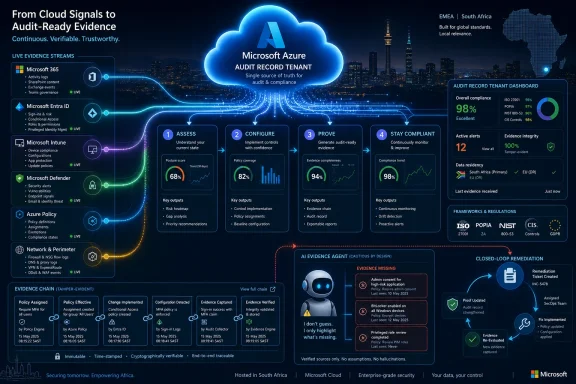 The Audit File Moves From Binder to Tenant
For years, compliance work has been haunted by a familiar ritual: the screenshot scramble. Someone in IT exports policies, captures portal pages, annotates spreadsheets, updates risk registers, and hopes the evidence still matches reality by the time an auditor asks for it. That ritual was never elegant, but it survived because audits were periodic and infrastructure changed slowly enough for paperwork to pretend it was current.Cloud broke that bargain. Microsoft 365 and Azure environments now shift continuously: Conditional Access policies change, devices fall in and out of compliance, identities accumulate permissions, and workloads appear in places no control owner remembers approving. A spreadsheet can describe intent; it cannot prove the operational state of a tenant at 9 a.m. yesterday or explain why a remediation ticket closed two days later.
GMS is positioning its platform directly at that gap. Its model is built around four phases — assess, configure, prove, and stay compliant — but the crucial verb is prove. The company says the platform collects evidence daily across 93 ISO/IEC 27001 controls, links policy language to actual Microsoft tenant configuration, and maintains live ISMS registers for risk, assets, incidents, suppliers, corrective actions, and other audit artefacts.
That is a meaningful shift in framing. Instead of treating GRC as a reporting layer sitting above operations, the platform treats GRC as an operating model embedded inside Microsoft Cloud administration. In theory, that makes compliance less of a quarterly performance and more of a continuously observed system condition.
Agentic GRC Is a Trust Problem Before It Is an AI Problem
The phrase “agentic GRC” will make some administrators flinch, and not without reason. The enterprise software market has spent the past two years attaching “AI agent” to everything from ticket triage to expense approvals. In compliance, the stakes are higher because a confident but wrong answer can become audit evidence, risk acceptance, or board-level assurance.GMS appears to understand that the credibility of an audit agent depends less on conversational polish than on restraint. The company says its AI-powered Audit Agent retrieves evidence directly from a customer’s Microsoft tenant, reasons against frameworks including ISO/IEC 27001, and cites the source of every response. Just as important, it says the agent declines to answer when evidence is missing rather than fabricating a response.
That refusal behavior is not a nice-to-have. It is the line between an assistant that helps an auditor navigate evidence and a hallucination engine dressed up as governance software. In a regulated environment, “I don’t know because the evidence is absent” is often the most valuable answer a system can give.
The hard part will be maintaining that discipline at scale. Compliance evidence is messy, permissions are fragmented, and control mappings vary between organizations. A system that can answer only when it has a defensible evidentiary chain will feel less magical than a generic chatbot — but it may be far more useful.
Microsoft’s Cloud Becomes the Control Plane
The GMS approach is conspicuously Microsoft-native. The platform operates across Microsoft 365, Azure, server infrastructure, and the network perimeter, with evidence collection reportedly using tenant-level data and Microsoft security posture signals. It also deploys 78 Microsoft zero trust capabilities across seven architectural pillars, aiming to push customers toward a Microsoft Secure Score of 75 or higher.That target should be read carefully. Microsoft Secure Score is a posture metric, not a universal proof of security, and any serious administrator knows it can reward configurations that may not fit every environment. But it remains a practical baseline because it translates a sprawl of identity, device, application, and data controls into a common operational language.
For Microsoft-focused organizations, that common language is useful. Secure Score recommendations, Defender signals, Entra controls, Intune policies, Azure Policy, and Microsoft Graph data already form much of the substrate administrators use to govern the estate. GMS is betting that the most efficient way to automate GRC is not to create a separate universe of controls, but to read and enforce the state of the Microsoft universe already in place.
The risk is platform gravity. A deeply Microsoft-native GRC platform may be strongest where the customer estate is already standardized on Microsoft 365, Azure, Defender, Intune, Entra, and related services. For hybrid organizations with significant AWS, Google Cloud, legacy ERP, custom applications, or non-Microsoft endpoint tooling, the Microsoft tenant is only part of the truth.
The Eight-Week Audit Readiness Claim Is the Real Test
GMS says customers can reach audit readiness in eight weeks, compared with traditional multi-month programs. That is the kind of claim that grabs executive attention and makes practitioners start asking what “readiness” means. Certification readiness, internal audit readiness, evidence portal readiness, and genuine operational maturity are not the same thing.Still, the claim is plausible in a narrower sense. If a customer is already in Microsoft 365 and Azure, and if the platform can automatically assess controls, deploy baseline security capabilities, generate evidence, and open remediation tickets, then the early stages of audit preparation can compress dramatically. Manual discovery and evidence collection consume enormous time in traditional programs.
The more interesting claim is not speed but repeatability. A one-time sprint to pass an audit can produce a beautiful evidence pack and a brittle operating model. A daily evidence cycle, if implemented correctly, can show whether the controls survived contact with normal business change.
That is where auto-closing remediation tickets after two consecutive verified checks matters. It suggests the platform is not simply creating findings but tying findings to a closed-loop validation process. Administrators will care deeply about how those checks are defined, how exceptions are handled, and whether the platform can distinguish accepted risk from unresolved drift.
The South African Angle Is More Than Local Color
The announcement leans heavily on Global Micro’s history, and for once the backstory is relevant. Founder and Chief Security Architect JJ Milner is presented as part of South Africa’s early hosted Microsoft infrastructure wave, with GMS claiming a 36-year arc from hosted Exchange and desktop-as-a-service work to Microsoft Cloud security and now agentic GRC. The company says it has delivered more than 50,000 Microsoft workload migrations and operates Microsoft estates for more than 1,200 customers across EMEA and the Americas.That matters because GRC automation is not merely a product engineering problem. It is an implementation problem, a managed services problem, and a trust problem. Customers do not just need software that can read tenant configuration; they need someone to interpret what the configuration means, remediate it without breaking the business, and defend the evidence trail under auditor scrutiny.
South Africa is also a useful proving ground for this category. POPIA, GDPR exposure, ISO/IEC 27001 certification pressure, and the downstream influence of European regulations such as NIS2 create a compliance environment where medium-sized and regulated organizations need more maturity than their internal teams can always sustain. The market may not have the budget profile of the largest US or European enterprises, but it has the same need for defensible controls.
GMS’s emphasis on regulated industries in South Africa as primary deployment surfaces is therefore logical. Financial services, healthcare, public-sector suppliers, and technology providers increasingly face the same question: can they prove the state of their controls without turning audit season into an organizational fire drill?
Flowgear Makes the Platform Less of an Island
The Flowgear connection is easy to overlook, but it may be one of the more important pieces of the launch. Flowgear, a Global Micro company, is described as a .NET-based integration platform hosted on Azure, SOC 2 Type 2 certified, with 140 global partners and 1,000 certified developers. In plain terms, that gives GMS an integration layer for the systems that sit outside Microsoft’s first-party control plane.That matters because no real compliance program lives entirely inside Microsoft 365. Risk registers may need to connect to service desks, HR systems, ERP platforms, supplier management tools, training records, and customer-facing applications. Audit evidence often has to cross the boundary between cloud configuration and business process.
A GRC platform without integration becomes another destination users must feed. A GRC platform with credible integration can become part of the operational nervous system. That is the difference between a tool that produces reports and a platform that can trigger action when a control fails.
Flowgear’s IAMCP recognition as ISV Partner of the Year also gives the story a Microsoft-channel dimension. Partner awards are not technical validation in themselves, but they indicate that the company is building in a way Microsoft’s ecosystem recognizes: Azure Marketplace alignment, co-sell readiness, security posture, and customer success. For buyers in Microsoft-heavy environments, that ecosystem fit can influence procurement as much as feature depth.
The Market Is Crowded, but the Category Is Still Unsettled
GMS says the agentic AI for GRC category does not yet exist in the form it is building. That is partly true and partly vendor ambition. There are already companies pitching AI-assisted compliance, continuous controls monitoring, automated evidence collection, and agentic middleware for GRC. The phrase “agentic” is new; the pressure to automate control testing is not.What is unsettled is the operating model. Many GRC tools still begin from frameworks, policies, and workflow. Cloud security posture tools begin from assets, misconfigurations, and exposure. AI governance tools begin from model and agent behavior. The enterprise buyer increasingly needs all three views to converge.
GMS is approaching convergence from the Microsoft managed-services side. That gives it practical advantages: it can deploy controls, collect evidence from the tenant, manage tickets, and bring customers toward a measurable posture. But it also means the product’s credibility will depend on operational execution, not just the elegance of its AI layer.
The winners in this market will likely be the platforms that make evidence boring. Not invisible, not decorative, and not generated after the fact — boring in the sense that it appears every day, with provenance, consistency, and enough context for a human to challenge it. Auditability is the opposite of magic.
Administrators Will Ask Harder Questions Than Executives
Executives will hear the promise: faster readiness, less audit pain, better posture, AI-supported assurance. Administrators will ask the uncomfortable questions. What permissions does the Audit Agent require? How is tenant data stored? Can evidence collection be scoped? What happens when a Microsoft API changes? How are false positives handled? Can the system survive a complex exception process?Those questions are not objections; they are the purchase process. Any platform that claims to automate compliance must itself become part of the compliance boundary. The agent needs identity, access control, logging, change management, and review. The automation that monitors drift must not introduce a new source of unmanaged drift.
There is also a cultural problem. Compliance teams often speak in control language, while cloud engineers speak in configuration language. A successful agentic GRC system has to translate between the two without flattening the nuance. “MFA is enabled” is not the same as “privileged access is governed appropriately,” and “a policy exists” is not the same as “the policy applies to the right users under the right conditions.”
GMS’s strongest argument is that it can connect these layers inside a managed operating model. Its weakest possible failure mode would be letting the AI interface oversimplify the underlying engineering. For the IT pros reading this, the demo that matters is not the chatbot answering an auditor’s question; it is the evidence chain behind the answer.
The Compliance Burden Is Becoming a Configuration Burden
The broader trend is unmistakable. ISO/IEC 27001, privacy regimes such as POPIA and GDPR, and security directives such as NIS2 increasingly reward organizations that can show living controls rather than retrospective intent. Policies still matter, but configuration is becoming the primary language of proof.That shift favors cloud-native evidence collection. If a tenant can show whether devices are encrypted, whether privileged roles are protected, whether logging is enabled, whether Defender policies are active, and whether risky configurations have been remediated, then an auditor can test reality rather than rely on procedural assurances. The old audit binder does not disappear, but it becomes downstream of operational telemetry.
This is also where AI can be useful without pretending to be a judge. An agent that retrieves evidence, summarizes control status, identifies missing artefacts, and explains why a requirement is or is not satisfied can reduce friction. It should not replace accountability. Someone still has to own the control, accept the risk, and decide whether the business can live with the exception.
The best version of this technology makes compliance more honest. It exposes gaps earlier, makes drift visible, and reduces the temptation to assemble a narrative after the fact. The worst version makes compliance theatre faster. The difference will be provenance, governance, and the willingness to say “no evidence found.”
The Signal Inside the GMS Launch
The practical lesson from this launch is not that every organization should rush to buy an agentic GRC platform. It is that the direction of travel is now clear: compliance evidence is moving closer to live infrastructure, and Microsoft-centric estates are a natural early target.- Organizations already standardized on Microsoft 365, Entra, Intune, Defender, and Azure will be the easiest candidates for tenant-driven evidence automation.
- Audit teams should treat AI-generated compliance answers as navigational aids unless each answer includes clear evidence provenance and human-reviewable source material.
- Security teams should evaluate the permissions, logging, and data handling of the agent itself as part of the control environment.
- Microsoft Secure Score can be a useful posture benchmark, but it should not be mistaken for a complete risk model or a substitute for business-specific control judgment.
- The most valuable automation may be closed-loop remediation, where findings become tickets and tickets close only after verified control recovery.
- Integration beyond Microsoft Cloud will determine whether platforms like this become operational systems or remain specialized audit accelerators.
References
- Primary source: ITWeb
Published: Mon, 01 Jun 2026 06:46:00 GMT
Global Micro Solutions launches agentic GRC platform on Microsoft Azure | ITWeb
The agentic GRC platform extends the company's operating model into AI-led automated audit and continuous evidence collection across the Microsoft Cloud. www.itweb.co.za
- Related coverage: flowgear.net

Global Micro Solutions - Flowgear
www.flowgear.net
- Related coverage: globalmicro.com
Server Security & Compliance | Global Micro Solutions
Extend cloud governance to every Windows, Linux, and SQL Server. Azure Arc, Defender for Cloud, automated patching, and CIS benchmarks — without migration.globalmicro.com - Related coverage: za.linkedin.com
Global Micro Solutions | Secure. Comply. Succeed | LinkedIn
Global Micro Solutions | Secure. Comply. Succeed | 1,287 followers on LinkedIn. Secure. Comply. Succeed. | Global Micro Solutions (GMS) is a Microsoft Solutions Partner specialising in cloud security, ISO-aligned compliance, and managed cyber operations for mid-market and enterprise...za.linkedin.com
- Related coverage: linkedin.com
Flowgear Wins Microsoft ISV Partner of the Year Award | Global Micro Solutions | Secure. Comply. Succeed posted on the topic | LinkedIn
Global Micro Solutions recognises Flowgear as the Award Winner of the Microsoft ISV Partner of the Year at the IAMCP South Africa Partner Awards 2026. This win, reflects sustained execution, real commercial scale, innovation and a clear position inside the Microsoft ecosystem as an AI... - Official source: adoption.microsoft.com
- Related coverage: ispe.org
- Related coverage: aegisitsolutions.net
- Official source: marketingassets.microsoft.com
