
Microsoft’s plan to recast Windows 11 as an agentic operating system—one that anticipates needs and takes action via autonomous AI agents—has provoked an unprecedented wave of user and developer backlash, exposing fault lines in trust, privacy, and platform stewardship that Microsoft must address if it hopes to keep Windows at the center of modern computing.
Microsoft’s public positioning of Windows as “evolving into an agentic OS” signals a deliberate shift: AI will move from optional assistant features into the core mechanics of the operating system. The company frames this transition as a productivity leap—AI agents that can automate workflows, manage settings intelligently, and connect local devices with cloud services to produce faster, more contextual outcomes. This builds on work already visible in Windows Copilot, Copilot+ initiatives, and a set of new on-device AI experiences that Microsoft has rolled into Windows 11 over the past two years.
The reaction has been swift and angry. Longtime Windows enthusiasts, power users, IT administrators, and developers have argued that an OS that acts for the user risks acting against the user’s intentions—altering settings without consent, performing opaque actions that complicate troubleshooting, and creating new attack surfaces for privacy leaks. The backlash intensified after the head of Windows publicly discussed the agentic vision and then moved to restrict replies on his social post amid the flood of criticism. The optics of the exchange—grand AI promises colliding with thousands of frustrated replies—illustrate a deeper problem: adding autonomy to the OS without first repairing foundational trust erodes the social license to innovate.
The technical reality is important: on-device AI can preserve privacy and responsiveness when models run locally, but only if the underlying hardware is capable of sustaining those workloads without crippling battery life or responsiveness. Microsoft’s approach—tightening hardware thresholds and gating features to certified devices—addresses performance and user experience concerns, but it also fragments availability and fuels perceptions of vendor-driven obsolescence.
Recall crystallized a broader worry: if Windows starts to record, interpret, and act on granular user behavior by default or by design, the OS moves from being a tool that users control to a system that records users’ private lives in service of convenience.
If the company anchors autonomy in clear consent, robust protections, and enterprise-grade governance, agentic features could unlock new workflows and modernize the PC. If not, the backlash will harden into long‑term distrust and rocky enterprise adoption. The path forward is technical and ethical: design agentic behavior that respects users, not one that assumes convenience trumps control.
Source: WebProNews Microsoft’s AI Overhaul Sparks Windows 11 Uproar: Executives Face the Backlash
 Background / Overview
Microsoft’s public positioning of Windows as “evolving into an agentic OS” signals a deliberate shift: AI will move from optional assistant features into the core mechanics of the operating system. The company frames this transition as a productivity leap—AI agents that can automate workflows, manage settings intelligently, and connect local devices with cloud services to produce faster, more contextual outcomes. This builds on work already visible in Windows Copilot, Copilot+ initiatives, and a set of new on-device AI experiences that Microsoft has rolled into Windows 11 over the past two years.The reaction has been swift and angry. Longtime Windows enthusiasts, power users, IT administrators, and developers have argued that an OS that acts for the user risks acting against the user’s intentions—altering settings without consent, performing opaque actions that complicate troubleshooting, and creating new attack surfaces for privacy leaks. The backlash intensified after the head of Windows publicly discussed the agentic vision and then moved to restrict replies on his social post amid the flood of criticism. The optics of the exchange—grand AI promises colliding with thousands of frustrated replies—illustrate a deeper problem: adding autonomy to the OS without first repairing foundational trust erodes the social license to innovate.
What Microsoft is proposing: the “Agentic” Windows
A leap beyond Copilot
Microsoft’s Copilot started as a conversational assistant integrated into Windows and key apps. The agentic OS concept pushes beyond Copilot’s chat-driven model to autonomous agents that proactively perform tasks—anticipating needs, orchestrating multi-step workflows across apps and services, and making local or cloud-based decisions with minimal human prompting.- These agents are meant to: detect opportunities for automation, surface contextual suggestions, take remedial steps when performance issues arise, and coordinate across devices and cloud resources.
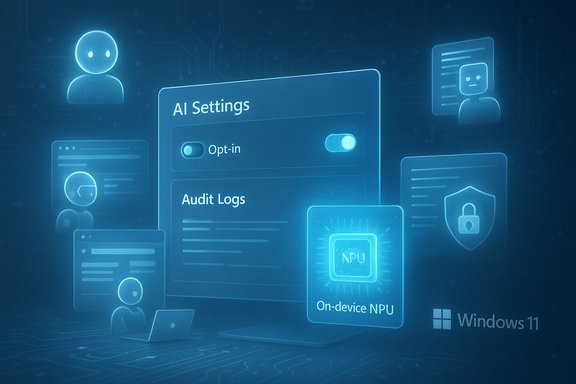
- The vision includes a hybrid model: some intelligence runs locally on device NPUs (neural processing units) while heavier models may execute in the cloud when needed.
Hardware and certification realities
Microsoft has concurrently introduced Copilot+ PC and device guidance that favors machines with on-board NPUs capable of accelerating AI workloads locally. The company’s certified spec for many on-device AI experiences centers on NPUs delivering very high throughput. That means many existing “AI-capable” laptops and desktops will not qualify for the premium on-device features Microsoft demos, creating a clear hardware upgrade pathway—and frustration for users who bought “AI PCs” on earlier promises.The technical reality is important: on-device AI can preserve privacy and responsiveness when models run locally, but only if the underlying hardware is capable of sustaining those workloads without crippling battery life or responsiveness. Microsoft’s approach—tightening hardware thresholds and gating features to certified devices—addresses performance and user experience concerns, but it also fragments availability and fuels perceptions of vendor-driven obsolescence.
Why the community pushed back so hard
Erosion of user control and predictability
Two decades of incremental changes have conditioned many Windows users to expect a certain level of control. Power users and system administrators prize predictability, auditability, and the ability to script or undo system actions. Autonomous agents that modify system state, adjust privacy or performance settings, or alter workflows without explicit, obvious consent threatens those expectations.- Power-user workflows often depend on finely tuned configurations; an agent that “optimizes” battery or updates drivers on its own can introduce hard-to-diagnose regressions.
- Enterprise admins worry about audit trails and the ability to enforce policies. Autonomous actions that bypass conventional logging or policy checks undermine enterprise governance.
Privacy and the specter of Recall
The Recall feature—an AI-powered “digital memory” that snapshots on-screen activity to create a searchable timeline—has become the emblem of these privacy fears. Recall was widely critiqued during preview phases for its potential to capture passwords, financial information, and sensitive communications. Microsoft pulled the feature for rework amid the uproar and later relaunched a revamped, opt-in version limited to certified Copilot+ devices with local processing and enhanced controls. Even so, security researchers and privacy advocates warned that a local stores-of-everything approach remains inherently risky: malware, physical access, or misconfiguration could expose highly sensitive data.Recall crystallized a broader worry: if Windows starts to record, interpret, and act on granular user behavior by default or by design, the OS moves from being a tool that users control to a system that records users’ private lives in service of convenience.
Stability, bloat, and the “fix the basics” argument
Supporters of a more conservative path point to recurring quality issues: buggy updates, regressions in core subsystems, and feature bloat that strains resources on modest hardware. For many critics, the complaint is straightforward: prioritize reliability, performance, and configuration sanity before layering in agentic automation. The sentiment is not anti-AI per se—it’s a plea for polish, predictable updates, and less intrusive monetization and upsell.Forced migration context
Timing matters. Windows 10 reached end of support in mid-October 2025, and Microsoft’s messaging that Windows 11 is the recommended path has amplified friction. Many organizations and users face hardware or policy constraints that prevent easy upgrades, making an AI-first Windows seem like a push that benefits new hardware sales more than existing users.Executive response and the public relations problem
The Windows leadership acknowledged the backlash and said the company is listening, with comments like “We know we have a lot of work to do.” That posture—sincere in tone—has not fully calmed critics for two reasons.- The statement addressed process and listening rather than concrete safeguards, controls, or explicit rollbacks of agentic features.
- The decision to limit social engagement around the announcement (locking replies) created an impression of defensive posture rather than open dialogue, reinforcing the narrative that user feedback is noticed only after it gains viral traction.
Strengths of the agentic approach
Real productivity gains when done carefully
Autonomous agents can remove repetitive tasks and glue workflows together in ways that are difficult with manual interactions. For example:- Auto-assembling related documents, emails, and browser tabs into a session summary could save hours for knowledge workers.
- Intelligent triage of performance issues—diagnosing a driver conflict and restoring a previous driver—could reduce helpdesk tickets.
- Natural-language re-finding of a work artifact (what Recall promises) can shorten search times and reduce friction.
Potential for better privacy through local AI
If implemented correctly, running models locally on NPUs can reduce cloud dependency and keep sensitive data on-device. Local inference avoids sending granular usage telemetry to servers and—when combined with secure enclaves and strong encryption—can be a privacy-forward architecture.Platform-level automation unlocks new developer scenarios
An agentic OS can expose primitives that empower third-party developers to compose and orchestrate user workflows safely. Well-designed APIs for consent, auditing, and intent-capture could enable richer ecosystems than the current app-by-app automation model.Major risks and gaps that remain unaddressed
Loss of agency and opaque decision-making
Autonomy without clear, continuous consent mechanisms risks eroding user agency. The central question is not whether AI can make decisions, but whether users will be able to easily understand, approve, monitor, and reverse those decisions. Without explicit, accessible controls, agentic features become “black boxes” that undermine user trust.Security of stored context and local AI artifacts
Local storage of snapshots, indexes, and model state—if not properly compartmentalized—becomes a high-value target for attackers. Malware that escalates privileges could access the very data Microsoft claims to protect. Similarly, backup procedures or recovery tools that copy system images could inadvertently capture sensitive archives unless those paths are designed to honor exclusion lists and encryption.Fragmentation and hardware-driven exclusion
Requiring premium NPUs for flagship features creates two problems: it leaves a large installed base behind, and it incentivizes rapid hardware refresh cycles that may not be sustainable for many users and enterprises. This is both a strategic and a reputational risk: if the most compelling features only work on new hardware, the perception grows that the OS is tied chiefly to hardware sales.Auditing and enterprise governance
Enterprises require audit trails, non-repudiation, and the ability to set and enforce policy centrally. Agentic actions must be fully auditable and manageable by enterprise tools—otherwise IT will view these features as unmanageable risk. Without explicit enterprise controls, agentic capabilities may face regulatory and procurement pushback.Unverified claims and rumor risks
Some community narratives suggest internal budget reallocation away from legacy products toward AI, or that Microsoft will force certain AI features. These claims are plausible in a company reprioritizing resources, but they are not verifiable without internal financial disclosures. Public discourse should treat such assertions as speculative until backed by line-item evidence.What responsible design should look like (practical guardrails)
To earn user trust, agentic Windows features need to be built with explicit, verifiable guardrails. Practical design elements include:- Granular, understandable opt-in for each autonomous capability, with per-action consent for high-risk operations.
- Clear, consistent audit logs that record what an agent did, why, and how to revert it—visible in both consumer settings and enterprise management consoles.
- Strong local-data protections: hardware-isolated enclaves, separate encryption keys, and exclusion lists for sensitive apps (banking, medical, certain browser modes).
- Enterprise policy surfaces: group policy and MDM controls must allow admins to disable, limit, or mandate agent behavior, and to export logs centrally.
- Model transparency: explainers that describe what models are used, what data they reference, and the heuristics that trigger actions—written plainly for non-technical users.
- Easy rollback and remediation tools: if an agent changes system state, undo should be as discoverable and reliable as the action itself.
- Third‑party security audits and red teaming before wide launch, plus an independent bug-bounty program with dedicated reward tiers for agentic attack surfaces.
Short-term fixes Microsoft should prioritize now
- Ship robust, discoverable opt-out toggles for every agentic feature—visible at first boot, in Settings, and in enterprise configuration portals.
- Publish clear, machine-readable audit logs and an admin API that integrates with existing SIEM and MDM tools.
- Limit default behavior to suggestions rather than actions until the feature passes a wide trust audit and is explicitly enabled.
- Release a public, plain-language threat model for Recall and other high-risk features, including specific mitigations for local and remote attacks.
- Commit to a staged rollout plan with conservative defaults and transparent changelogs that explain why each automated behavior exists.
Longer-term strategies and governance
An agentic OS is effectively a socio-technical instrument: it changes workflows and expectations. Microsoft should consider:- A governance council composed of product, privacy, security, enterprise customers, and independent privacy experts to review high-risk features before wide releases.
- A public transparency report summarizing how often agentic features performed actions without explicit user commands, what categories of data were involved, and how many opt-ins vs opt-outs occurred.
- Developer toolkits that encourage safe composition: APIs that require explicit user intent tokens, secure enclaves for storing agent state, and certified action templates that have passed Microsoft’s privacy and security review.
The broader industry context
Microsoft is not operating in a vacuum. Competitors have taken different stances:- Apple tends to emphasize on-device models and privacy-protecting defaults in macOS, pitching privacy as a differentiator.
- Google adopts a hybrid approach, balancing cloud power with local processing where possible and offering modular features across Android and Chrome OS.
Conclusion: an opportunity, but only with trust
The agentic OS vision promises real productivity improvements, but the rollout demonstrates a crucial business lesson: technical capability alone does not guarantee acceptance. For an operating system used daily by billions, trust is the most important resource. Microsoft’s next moves—building auditable controls, honoring user agency, and communicating transparently—will determine whether agentic Windows becomes a celebrated evolution or a cautionary tale.If the company anchors autonomy in clear consent, robust protections, and enterprise-grade governance, agentic features could unlock new workflows and modernize the PC. If not, the backlash will harden into long‑term distrust and rocky enterprise adoption. The path forward is technical and ethical: design agentic behavior that respects users, not one that assumes convenience trumps control.
Source: WebProNews Microsoft’s AI Overhaul Sparks Windows 11 Uproar: Executives Face the Backlash
