

The best AI certification in 2026 depends on the job you need to prove: Microsoft 365 administrators should prioritize AB-900, business leaders should consider Google Cloud’s Generative AI Leader, and experienced production developers should target AWS Certified Generative AI Developer – Professional. Builders who need to demonstrate a specific working skill should add a Microsoft Applied Skills credential, while dedicated MLOps professionals should avoid treating a general AI badge as a substitute for platform operations experience.
That role-first answer matters because the market has moved beyond a single ladder from “AI fundamentals” to “AI engineer.” Credentials now separate Microsoft 365 governance, business adoption, generative AI application development, and production operations—and one certification still appearing in older recommendation lists can no longer be earned.
Choose the credential that matches what your employer expects you to administer, build, approve, or operate. Do not begin with vendor popularity or a generic ranking.
That scope reflects how workplace AI arrives in many Windows-centric organizations. The administrator is rarely being asked to train a model; the immediate work involves understanding services, protecting organizational data, governing access, and performing basic administrative tasks for Copilot and agents.
AB-900 is therefore a better fit for Microsoft 365 administrators, junior identity professionals, service-desk staff moving into administration, and IT generalists supporting a Copilot rollout. It is not a production application-development credential, and candidates should not present it as evidence that they can design retrieval systems, evaluate foundation models, or operate a generative AI application at scale.
Timing matters this month. Microsoft says the English exam will update on July 22, 2026, four days after this article’s publication date. Anyone studying now should use the study guide associated with the updated exam rather than relying entirely on earlier notes, videos, or practice questions.
The practical sequence for an administrator is straightforward: learn the Microsoft 365 and identity foundations, prepare against the current AB-900 objectives, and then add a Microsoft Applied Skills credential aligned with a task performed at work. That combination supplies both breadth and a narrower practical signal.
That makes it the clearest match among these options for managers, consultants, product owners, sales leaders, change-management professionals, and departmental decision-makers. It addresses the business-level understanding needed to discuss generative AI opportunities and adoption without pretending that every leader must also become a cloud engineer.
The credential should be skipped by candidates who need their next job application to prove implementation ability. Knowing how to identify an AI use case is not the same hiring signal as building, securing, evaluating, and monitoring the resulting application.
It can still be useful before a technical specialization when someone is moving from operations, finance, HR, or another business function into AI program ownership. The value comes from matching the credential to decision authority—not from collecting an “AI leader” title without involvement in real adoption work.
This distinction echoes a broader pattern in WindowsForum’s coverage of AI tools selected by task: the useful comparison begins with the work being done, not with a universal winner. Certification decisions should follow the same rule.
Its scope includes retrieval-augmented generation, agents, security, governance, evaluation, monitoring, and cost optimization. Those subjects place the exam firmly in production GenAI engineering rather than introductory prompt use or high-level business awareness.
The experience guidance should be taken seriously. A developer who has completed tutorials but has not dealt with production applications, operational constraints, evaluation, or security is unlikely to obtain the intended value simply by memorizing AWS terminology.
For qualified candidates, however, AIP-C01 connects application development with several concerns that separate a demonstration from a service an organization can support. RAG and agents receive much of the attention, but monitoring, governance, evaluation, and cost control are equally important once a workload has users, data access, and a budget.
That operational breadth also makes AIP-C01 relevant to developers working closely with MLOps or platform teams. It does not automatically prove ownership of an entire machine-learning operations discipline, but it can validate production GenAI responsibilities that overlap with it.
WindowsForum’s examination of AI agent builders and their governance, cost, and human-oversight tradeoffs reinforces why these topics belong together. Choosing an agent framework is only one part of the job; someone must also secure, evaluate, monitor, and pay for the deployed system.
That difference changes their hiring signal. A certification can indicate that a candidate understands the responsibilities across a role; an Applied Skills credential indicates that the candidate completed tasks within a defined technical scenario.
For early-career builders, an Applied Skills credential can be a sensible bridge between training and a role-based exam. For experienced administrators or developers, it can document a newly acquired capability without requiring another broad fundamentals certification.
The best sequence depends on the gap in the résumé:
Older articles, course pages, résumé guides, and training catalogs may continue to recommend AI-102 because it was previously a major Azure AI credential. That does not make those materials fraudulent, but it does make their certification advice stale.
Candidates who already earned Azure AI Engineer Associate can still describe the credential accurately according to its status. New candidates, however, should not buy an AI-102 course or begin an AI-102 study plan without recognizing that the earning path has closed.
The retirement illustrates why “best certification” lists age badly. Exam availability, objectives, and vendor credential structures change faster than many training roundups, so the first check should always be whether the named exam is active on the vendor’s official credential site.
AIP-C01 overlaps with production GenAI operations through monitoring, security, governance, evaluation, and cost optimization. It is consequently relevant for an AWS developer sharing operational responsibility, but candidates should not infer that every production AI certification validates every MLOps function.
The safer approach is to begin with the job description and platform. If the role owns application integration, agents, RAG, and production behavior on AWS, AIP-C01 is a logical target. If it owns Microsoft 365 Copilot administration, AB-900 is closer. If it owns one defined Microsoft implementation task, an Applied Skills lab may provide the more precise evidence.
The credential should follow the system, not the other way around.
The useful 2026 certification plan is therefore a sequence, not a leaderboard: AB-900 for Microsoft 365 administration, Generative AI Leader for business adoption, AIP-C01 for experienced production builders, and Applied Skills for targeted proof of execution. The next milestone is July 22, when AB-900’s English exam updates and administrators will need to ensure that their preparation follows the revised objectives.
That role-first answer matters because the market has moved beyond a single ladder from “AI fundamentals” to “AI engineer.” Credentials now separate Microsoft 365 governance, business adoption, generative AI application development, and production operations—and one certification still appearing in older recommendation lists can no longer be earned.
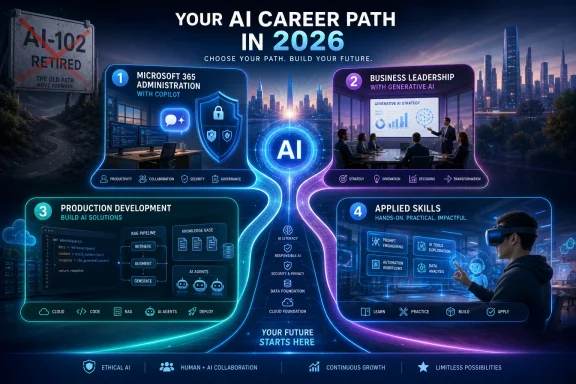 The 2026 Decision Tree Starts With Your Actual Work
Choose the credential that matches what your employer expects you to administer, build, approve, or operate. Do not begin with vendor popularity or a generic ranking.- If you administer Microsoft 365, identity, data protection, Copilot, or agents, pursue Microsoft 365 Certified: Copilot and Agent Administration Fundamentals through exam AB-900.
- If you influence AI strategy but do not build production systems, consider Google Cloud’s Generative AI Leader certification.
- If you already develop production applications and implement generative AI on AWS, target AWS Certified Generative AI Developer – Professional through exam AIP-C01.
- If you need to prove that you can complete one concrete Microsoft technology scenario, earn a relevant Microsoft Applied Skills credential before or alongside a broader certification.
- If your job is primarily deployment reliability, monitoring, governance, cost control, and lifecycle operations, treat MLOps as a separate track. Select credentials only after confirming that their assessed environment matches the platform you operate.
- Skip Microsoft Certified: Azure AI Engineer Associate and exam AI-102 as new goals. Microsoft retired both on June 30, 2026.
AB-900 Fits the Administrator Now Responsible for AI
Microsoft 365 Certified: Copilot and Agent Administration Fundamentals is the most direct choice for administrators whose AI responsibilities sit inside the Microsoft 365 environment. Microsoft Learn describes AB-900 as a beginner credential covering Microsoft 365, identity, data protection, governance, Copilot, and agents.That scope reflects how workplace AI arrives in many Windows-centric organizations. The administrator is rarely being asked to train a model; the immediate work involves understanding services, protecting organizational data, governing access, and performing basic administrative tasks for Copilot and agents.
AB-900 is therefore a better fit for Microsoft 365 administrators, junior identity professionals, service-desk staff moving into administration, and IT generalists supporting a Copilot rollout. It is not a production application-development credential, and candidates should not present it as evidence that they can design retrieval systems, evaluate foundation models, or operate a generative AI application at scale.
Timing matters this month. Microsoft says the English exam will update on July 22, 2026, four days after this article’s publication date. Anyone studying now should use the study guide associated with the updated exam rather than relying entirely on earlier notes, videos, or practice questions.
The practical sequence for an administrator is straightforward: learn the Microsoft 365 and identity foundations, prepare against the current AB-900 objectives, and then add a Microsoft Applied Skills credential aligned with a task performed at work. That combination supplies both breadth and a narrower practical signal.
Google’s Leader Credential Belongs in the Boardroom Track
Google Cloud’s Generative AI Leader certification is explicitly designed for any job role, including candidates without hands-on technical experience. Its exam costs $99, and the certification remains valid for three years.That makes it the clearest match among these options for managers, consultants, product owners, sales leaders, change-management professionals, and departmental decision-makers. It addresses the business-level understanding needed to discuss generative AI opportunities and adoption without pretending that every leader must also become a cloud engineer.
The credential should be skipped by candidates who need their next job application to prove implementation ability. Knowing how to identify an AI use case is not the same hiring signal as building, securing, evaluating, and monitoring the resulting application.
It can still be useful before a technical specialization when someone is moving from operations, finance, HR, or another business function into AI program ownership. The value comes from matching the credential to decision authority—not from collecting an “AI leader” title without involvement in real adoption work.
This distinction echoes a broader pattern in WindowsForum’s coverage of AI tools selected by task: the useful comparison begins with the work being done, not with a universal winner. Certification decisions should follow the same rule.
AIP-C01 Is for Builders With Production Experience
AWS Certified Generative AI Developer – Professional is the strongest fit in this group for experienced developers delivering generative AI applications. AWS identifies candidates for AIP-C01 as having at least two years of production application experience and one year of hands-on generative AI implementation experience.Its scope includes retrieval-augmented generation, agents, security, governance, evaluation, monitoring, and cost optimization. Those subjects place the exam firmly in production GenAI engineering rather than introductory prompt use or high-level business awareness.
The experience guidance should be taken seriously. A developer who has completed tutorials but has not dealt with production applications, operational constraints, evaluation, or security is unlikely to obtain the intended value simply by memorizing AWS terminology.
For qualified candidates, however, AIP-C01 connects application development with several concerns that separate a demonstration from a service an organization can support. RAG and agents receive much of the attention, but monitoring, governance, evaluation, and cost control are equally important once a workload has users, data access, and a budget.
That operational breadth also makes AIP-C01 relevant to developers working closely with MLOps or platform teams. It does not automatically prove ownership of an entire machine-learning operations discipline, but it can validate production GenAI responsibilities that overlap with it.
WindowsForum’s examination of AI agent builders and their governance, cost, and human-oversight tradeoffs reinforces why these topics belong together. Choosing an agent framework is only one part of the job; someone must also secure, evaluate, monitor, and pay for the deployed system.
Applied Skills Supply the Missing Proof of Execution
Microsoft Applied Skills credentials are not simply smaller versions of conventional certifications. Microsoft describes them as scenario-based credentials earned through interactive, lab-based assessments, while its broader certifications use exams aligned with job roles and a wider body of knowledge.That difference changes their hiring signal. A certification can indicate that a candidate understands the responsibilities across a role; an Applied Skills credential indicates that the candidate completed tasks within a defined technical scenario.
For early-career builders, an Applied Skills credential can be a sensible bridge between training and a role-based exam. For experienced administrators or developers, it can document a newly acquired capability without requiring another broad fundamentals certification.
The best sequence depends on the gap in the résumé:
- Add Applied Skills first when practical evidence is missing and the target job names a specific Microsoft scenario.
- Add Applied Skills after a certification when the broad credential does not demonstrate the project work an employer needs.
- Skip unrelated Applied Skills credentials when they merely increase badge count without reinforcing the target role.
- Do not rely on a narrow lab credential alone when the job requires broad architectural, administrative, or operational judgment.
AI-102 Is Now a Historical Credential, Not a Recommendation
Microsoft retired the Azure AI Engineer Associate certification and exam AI-102 on June 30, 2026. As of July 18, it should not appear in a current list as an exam readers can schedule and earn.Older articles, course pages, résumé guides, and training catalogs may continue to recommend AI-102 because it was previously a major Azure AI credential. That does not make those materials fraudulent, but it does make their certification advice stale.
Candidates who already earned Azure AI Engineer Associate can still describe the credential accurately according to its status. New candidates, however, should not buy an AI-102 course or begin an AI-102 study plan without recognizing that the earning path has closed.
The retirement illustrates why “best certification” lists age badly. Exam availability, objectives, and vendor credential structures change faster than many training roundups, so the first check should always be whether the named exam is active on the vendor’s official credential site.
The MLOps Track Needs More Than an AI Badge
MLOps professionals should judge certifications by whether they assess the systems they actually operate: deployment, monitoring, governance, evaluation, cost, and lifecycle reliability. A business-leadership credential is too broad, while an administrator fundamentals exam covers a different environment.AIP-C01 overlaps with production GenAI operations through monitoring, security, governance, evaluation, and cost optimization. It is consequently relevant for an AWS developer sharing operational responsibility, but candidates should not infer that every production AI certification validates every MLOps function.
The safer approach is to begin with the job description and platform. If the role owns application integration, agents, RAG, and production behavior on AWS, AIP-C01 is a logical target. If it owns Microsoft 365 Copilot administration, AB-900 is closer. If it owns one defined Microsoft implementation task, an Applied Skills lab may provide the more precise evidence.
The credential should follow the system, not the other way around.
Short Answers for the Final Choice
The strongest starting point for a Microsoft 365 administrator
AB-900 is the clearest fit because it covers Microsoft 365, identity, data protection, governance, Copilot, and agents. Candidates preparing now should account for the English exam update scheduled for July 22, 2026.The best option for a nontechnical business leader
Google Cloud’s Generative AI Leader is designed for any job role and does not require hands-on technical experience. Its $99 exam and three-year validity make it a relatively focused business-adoption credential.The right credential for an experienced GenAI developer
AIP-C01 is the strongest match when the candidate already has production application and hands-on GenAI implementation experience. Its coverage extends from RAG and agents to evaluation, monitoring, governance, security, and cost optimization.The credential candidates should remove from a 2026 study plan
AI-102 should be removed because Microsoft retired the exam and Azure AI Engineer Associate certification on June 30, 2026. Any current recommendation presenting it as earnable is outdated.The useful 2026 certification plan is therefore a sequence, not a leaderboard: AB-900 for Microsoft 365 administration, Generative AI Leader for business adoption, AIP-C01 for experienced production builders, and Applied Skills for targeted proof of execution. The next milestone is July 22, when AB-900’s English exam updates and administrators will need to ensure that their preparation follows the revised objectives.
References
- Primary source: learn.microsoft.com
Loading…
learn.microsoft.com - Independent coverage: cloud.google.com
Loading…
cloud.google.com - Independent coverage: aws.amazon.com
Loading…
aws.amazon.com - Independent coverage: docs.aws.amazon.com
Loading…
docs.aws.amazon.com - Primary source: WindowsForum
Loading…
windowsforum.com