

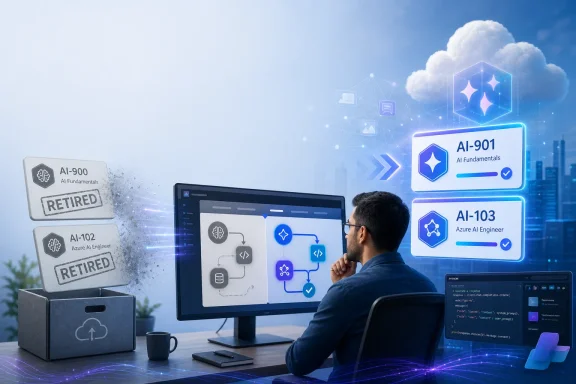
A July 18 guide from Analytics Insight on “top AI architecture certifications” is already out of date on two of its most prominent Microsoft recommendations. Microsoft retired both Azure AI Fundamentals exam AI-900 and Azure AI Engineer Associate exam AI-102 on June 30, 2026, weeks before the article’s publication date.
The distinction matters for Windows admins, developers, and IT staff using certification lists to plan training budgets or book an exam. AI-900 and AI-102 are not merely scheduled for a future refresh; they are no longer current exam paths.
Per Microsoft Learn, AI-900 has been replaced by AI-901 for the Azure AI Fundamentals certification. The new fundamentals exam is not quite the same entry-level option described in the guide: Microsoft says candidates need foundational technical skills, familiarity with Azure resources, and knowledge of Python syntax and programming techniques. Its objectives now split between identifying AI concepts and capabilities and implementing AI solutions with Microsoft Foundry.
That makes AI-901 a more hands-on starting point than the older AI-900, which Microsoft positioned for both technical and non-technical candidates without data-science or software-engineering experience.
AI-102’s replacement is AI-103, which leads to the Azure AI Apps and Agents Developer Associate credential. Microsoft describes the newer certification as covering the design, development, and deployment of Azure AI solutions using Python and Microsoft Foundry, including generative AI, agentic systems, computer vision, text analysis, and information extraction. For organizations standardizing on Azure, this is the relevant intermediate path now—not AI-102.
AWS Certified AI Practitioner is appropriately positioned for beginners and business-facing technical staff. AWS says its exam covers AI and machine-learning fundamentals, generative AI, foundation-model applications, responsible AI, and security, compliance, and governance. AWS Certified Machine Learning Engineer – Associate is substantially more technical: AWS recommends at least a year of AI/ML and AWS experience, with the exam focused on building, operationalizing, deploying, and maintaining machine-learning workloads.
Google Cloud’s Generative AI Leader is also a business-level credential with no technical prerequisite. Google’s Professional Machine Learning Engineer certification, by contrast, expects strong programming, data-platform, MLOps, and production ML experience; Google recommends three or more years of industry experience, including at least one year designing and managing Google Cloud solutions.
Databricks Certified Generative AI Engineer Associate remains a reasonable option for teams already committed to the Databricks platform. Databricks says it tests LLM-enabled application design, Vector Search, model serving, MLflow, Unity Catalog, RAG applications, and LLM chains, while recommending roughly six months of hands-on platform experience. NVIDIA’s current associate-level Generative AI LLMs certification is another focused option for those working with NVIDIA tooling and accelerated AI infrastructure.
The distinction matters for Windows admins, developers, and IT staff using certification lists to plan training budgets or book an exam. AI-900 and AI-102 are not merely scheduled for a future refresh; they are no longer current exam paths.
 Microsoft’s AI credential reset
Per Microsoft Learn, AI-900 has been replaced by AI-901 for the Azure AI Fundamentals certification. The new fundamentals exam is not quite the same entry-level option described in the guide: Microsoft says candidates need foundational technical skills, familiarity with Azure resources, and knowledge of Python syntax and programming techniques. Its objectives now split between identifying AI concepts and capabilities and implementing AI solutions with Microsoft Foundry.That makes AI-901 a more hands-on starting point than the older AI-900, which Microsoft positioned for both technical and non-technical candidates without data-science or software-engineering experience.
AI-102’s replacement is AI-103, which leads to the Azure AI Apps and Agents Developer Associate credential. Microsoft describes the newer certification as covering the design, development, and deployment of Azure AI solutions using Python and Microsoft Foundry, including generative AI, agentic systems, computer vision, text analysis, and information extraction. For organizations standardizing on Azure, this is the relevant intermediate path now—not AI-102.
The rest of the list needs context
Several non-Microsoft recommendations in the article remain valid, but they serve different audiences rather than forming a universal “AI architect” ladder.AWS Certified AI Practitioner is appropriately positioned for beginners and business-facing technical staff. AWS says its exam covers AI and machine-learning fundamentals, generative AI, foundation-model applications, responsible AI, and security, compliance, and governance. AWS Certified Machine Learning Engineer – Associate is substantially more technical: AWS recommends at least a year of AI/ML and AWS experience, with the exam focused on building, operationalizing, deploying, and maintaining machine-learning workloads.
Google Cloud’s Generative AI Leader is also a business-level credential with no technical prerequisite. Google’s Professional Machine Learning Engineer certification, by contrast, expects strong programming, data-platform, MLOps, and production ML experience; Google recommends three or more years of industry experience, including at least one year designing and managing Google Cloud solutions.
Databricks Certified Generative AI Engineer Associate remains a reasonable option for teams already committed to the Databricks platform. Databricks says it tests LLM-enabled application design, Vector Search, model serving, MLflow, Unity Catalog, RAG applications, and LLM chains, while recommending roughly six months of hands-on platform experience. NVIDIA’s current associate-level Generative AI LLMs certification is another focused option for those working with NVIDIA tooling and accelerated AI infrastructure.
The practical choice
Certification buyers should start with the cloud and data platform their employer actually runs, then select an exam whose stated experience level matches their day-to-day work. For Microsoft-oriented learners, replace AI-900 with AI-901 and AI-102 with AI-103 before spending time on training material or exam vouchers.References
- Primary source: Analytics Insight
Published: 2026-07-18T11:30:00+00:00
Best AI Architecture Certifications for Beginners and Professionals in 2026
Discover the best AI architecture certifications for beginners and professionals in 2026. Compare Microsoft, AWS, Google Cloud, NVIDIA, and Databricks certifications to advance your AI career.www.analyticsinsight.net