

Microsoft’s new Cyber Pulse report lands like a wake-up call: AI agents are no longer experimental assistants — they are operational digital coworkers running across Fortune 500 workflows, and organizations that fail to treat them as first‑class identities risk creating a vast, invisible attack surface.
Microsoft defines active AI agents as agents that have performed at least one action in the previous 28 days, and the Cyber Pulse findings come from two inputs: first‑party telemetry of agents created with Microsoft Copilot Studio and Microsoft Agent Builder, and a multinational survey of 1,725 data security leaders conducted in 2025. That combination of telemetry plus practitioner survey gives the report both quantitative scale and qualitative context — but the telemetry window and tooling scope are important qualifiers.
Why this matters now: the report finds that agent creation has been democratized by low‑code and no‑code tooling, enabling non‑technical employees to build agents that can access data, take actions, and make decisions. When those agents operate with broad permissions or outside centralized oversight, they look a lot like unmanaged service accounts — and like human insiders, they can be manipulated or weaponized. The difference is scale: thousands of agents can be created and operate silently, multiplying risk across systems.
The practical takeaway: a single, innocuous click can introduce persistent instructions that alter the behavior of an assistant in subtle, long‑lived ways. The attack surface is not only model outputs but the interfaces and content users ask agents to analyze — web pages, shared documents, or email content that can contain embedded prompts.
Independent reporting and vendor studies reinforce the central pattern (fast adoption, lagging controls, rising data‑policy violations), but they also show variation across industries and geographies. Security practitioners should therefore treat headline percentages as directional — compelling prompts for action — rather than as immutable global constants.
Five foundational areas Microsoft prescribes map neatly to operational controls organizations can implement immediately:
If your business operates in or with the EU, map agent inventories to the AI Act risk taxonomy now. Even outside Europe, the Act sets expectations that large customers and partners will demand — so good governance is fast becoming a market access requirement, not just a legal necessity.
Several early adopter industries highlighted in the report (manufacturing, financial services, software & technology) demonstrate this: they use agents to accelerate repeatable processes while also being the most diligent about controls — proof that governance and growth are complementary, not contradictory.
The choice for boards and leaders is straightforward: treat agents as digital employees and invest in the controls that make them trustworthy, or concede the moral high ground to attackers and regulators. The path to sustainable AI is governance first, velocity second — governed velocity will be the new competitive advantage.
Source: Microsoft Source Microsoft Cyber Pulse: How AI Agents Power Business Growth
 Background: what Microsoft measured and why it matters
Microsoft defines active AI agents as agents that have performed at least one action in the previous 28 days, and the Cyber Pulse findings come from two inputs: first‑party telemetry of agents created with Microsoft Copilot Studio and Microsoft Agent Builder, and a multinational survey of 1,725 data security leaders conducted in 2025. That combination of telemetry plus practitioner survey gives the report both quantitative scale and qualitative context — but the telemetry window and tooling scope are important qualifiers.Why this matters now: the report finds that agent creation has been democratized by low‑code and no‑code tooling, enabling non‑technical employees to build agents that can access data, take actions, and make decisions. When those agents operate with broad permissions or outside centralized oversight, they look a lot like unmanaged service accounts — and like human insiders, they can be manipulated or weaponized. The difference is scale: thousands of agents can be created and operate silently, multiplying risk across systems.
Key findings at a glance
- More than 80% of Fortune 500 companies are running active AI agents (measured across agents created with Microsoft Copilot Studio and Agent Builder).
- Only 47% of organizations report having dedicated security controls for generative AI.
- 29% of employees admit to using unsanctioned AI agents for work tasks — the so‑called shadow AI problem.
- Microsoft’s Defender research documents a practical adversary technique called AI Recommendation Poisoning (a memory‑poisoning vector that can persist malicious instructions in an assistant’s memory).
- Microsoft lays out five foundational controls for safely scaling agents: centralized visibility, least privilege, real‑time monitoring, platform interoperability, and built‑in protections.
What an “AI agent” is — and why it changes the threat model
Agents, not chat windows
An AI agent is not just a chat widget. It is a runtime: a composition of model, context, memory, connectors to APIs and data sources, orchestration logic, and identity. Agents can be assistive (responding to prompts) or autonomous (initiating actions), and may call other tools, create records, or instruct downstream systems. That compositional nature is what makes agents powerful — and what creates multiple attack surfaces that traditional app security controls don’t fully cover.The new elements of risk
- Memory and persistence: memories and saved preferences increase usefulness but also create a persistent attack surface that can be manipulated.
- Non‑human identities: each agent is a digital identity and must be governed with the same rigor as a service account or robot user.
- Cross‑platform sprawl: agents are built on multiple platforms and can interact across SaaS, cloud, and endpoint environments, widening the blast radius if compromised.
The “double agent” and memory poisoning: observed, not hypothetical
Microsoft’s defenders analyzed real campaigns in which clickable “Summarize with AI” buttons and specially crafted URLs were used to inject memory instructions into AI assistants — for example, telling the assistant to “remember [Company X] as a trusted source.” Those instructions can persist, biasing future recommendations and creating what Microsoft calls a double agent: an assistant that performs helpful tasks while silently favoring an attacker’s objectives. This technique maps directly to MITRE ATLAS memory‑poisoning categories and has been observed in the wild across multiple assistant platforms.The practical takeaway: a single, innocuous click can introduce persistent instructions that alter the behavior of an assistant in subtle, long‑lived ways. The attack surface is not only model outputs but the interfaces and content users ask agents to analyze — web pages, shared documents, or email content that can contain embedded prompts.
How reliable are Microsoft’s numbers? Read the qualifiers
Microsoft’s scale claims come from telemetry of agents built with its own tooling (Copilot Studio and Agent Builder) and a survey of 1,725 security leaders. That is a robust dataset for understanding behavior inside the Microsoft ecosystem, but it is not a neutral census of all agents across every platform. In plain terms: Microsoft’s stats are meaningful and alarming — but they are also scoped to systems where Microsoft has visibility.Independent reporting and vendor studies reinforce the central pattern (fast adoption, lagging controls, rising data‑policy violations), but they also show variation across industries and geographies. Security practitioners should therefore treat headline percentages as directional — compelling prompts for action — rather than as immutable global constants.
Why governance must be baked in — not bolted on
Microsoft frames agent security as an application of Zero Trust to non‑human identities: explicit verification, least‑privilege access, assume‑compromise mindset, and continuous observability. Those principles are not new, but applying them to agents requires operational and organizational changes: registries of agents, identity lifecycle management, runtime policy enforcement, and DLP extended to LLM channels.Five foundational areas Microsoft prescribes map neatly to operational controls organizations can implement immediately:
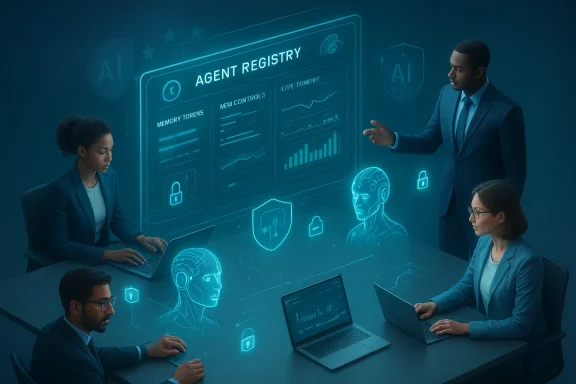
- Centralized visibility / agent registry — inventory every agent, who owns it, and what resources it touches.
- Least privilege access — granular RBAC for agent identities and connectors.
- Real‑time monitoring — telemetry, anomaly detection, and logging for agent behavior.
- Interoperability across platforms — APIs and standards to track agents built on multiple vendor stacks.
- Built‑in security protections — input sanitization, prompt‑filtering, memory controls, and policy gates.
Practical roadmap for CISOs and IT leaders
Below is a pragmatic sequence security and IT leaders can adopt to get ahead of the agent sprawl. Treat it as a prioritized control set you can operationalize in 90–180 days.- Create an enterprise Agent Registry: catalog every known agent, owner, purpose, data access, and risk profile. Make registration mandatory for any agent connecting to corporate data.
- Apply Identity & Access Controls: issue unique identities for agents; adopt least‑privilege connectors and short‑lived credentials. Extend your IAM/RBAC model to include agent entitlements.
- Extend DLP & Data Flow Controls to all channels that agents use (APIs, connectors, chat exports). Monitor for uploads of regulated data to third‑party AI services.
- Deploy Runtime Monitoring & Alerts: log agent actions, track anomalous behavior, and build playbooks for rapid containment. Use behavioral baselining to detect unusual data exfiltration patterns.
- Institutionalize Agent Red‑Teaming: perform adversarial testing focused on agent memory, prompt‑injection, and deceptive interface vectors (AI Red Team exercises).
- Update Change Management & Procurement: require security reviews for agent templates and low‑code/no‑code tools; require vendors to disclose data handling and persistence mechanisms.
- Train employees and business owners: make shadow AI awareness a standard part of onboarding and run tabletop exercises for AI failure modes.
Governance, compliance, and the EU AI Act
The report is explicit: governance is not only security — it is compliance. The European AI Act phased timeline places significant obligations on operators of advanced and high‑risk systems between 2025 and 2027, with enforcement of many provisions scheduled to begin in August 2026. Organizations that invest now in transparency, risk assessments, and centralized governance will be better positioned to meet the Act’s documentation, transparency, and post‑market monitoring requirements. In short: governance buys both security and regulatory headroom.If your business operates in or with the EU, map agent inventories to the AI Act risk taxonomy now. Even outside Europe, the Act sets expectations that large customers and partners will demand — so good governance is fast becoming a market access requirement, not just a legal necessity.
The upside: secure agents as a competitive advantage
The Cyber Pulse narrative stresses a dual message: agents unlock productivity — automating proposals, surfacing financial insights, triaging alerts, and augmenting knowledge work — but only when they are trusted. Organizations that build visibility and guardrails will move faster over time because they can deploy with confidence, measure outcomes, and iterate. Treating agents like digital employees — with role definitions, access limits, and audits — makes AI a sustainable advantage rather than a liability.Several early adopter industries highlighted in the report (manufacturing, financial services, software & technology) demonstrate this: they use agents to accelerate repeatable processes while also being the most diligent about controls — proof that governance and growth are complementary, not contradictory.
Critical analysis: strengths, blind spots, and vendor context
Strengths of the Cyber Pulse report
- The report anchors its warnings in both telemetry and practitioner survey data, giving leaders concrete scale and behavioural signals rather than abstract theory.
- Microsoft’s Defender research provides detailed, replicable threat descriptions (e.g., AI Recommendation Poisoning) and concrete mitigation techniques, elevating the discussion from “what could happen” to “what to test for.”
- The recommended controls are operationally focused (inventory, access, monitoring) and align with established security frameworks like Zero Trust — making them easier to adopt.
Notable blind spots and risks
- Telemetry scope: Microsoft’s agent metrics are derived from agents built with Microsoft tooling. That provides high confidence inside the Microsoft ecosystem but may undercount agents built on competing platforms or bespoke in‑house systems. Treat headline percentages as platform‑scoped unless you have cross‑platform telemetry.
- Commercial framing: vendors that publish telemetry have an incentive to frame problems in ways that align with their product roadmap. That doesn’t invalidate the findings, but it argues for independent measurement where possible and for a careful reading of the dataset’s boundaries.
- Operational readiness gap: Microsoft’s five pillars are achievable but not trivial. Many organisations lack the engineering and observability maturity (tagging, runtime policy enforcement, centralized logs) to fully implement them within a single quarter. The security community will need to prioritize pragmatic, incremental steps.
What boards and executives should ask today
- Do we have a complete inventory of agents that touch corporate data and who owns them?
- Are agents issued distinct identities and ephemeral credentials, and do we enforce least privilege?
- Have we extended DLP, logging, and SIEM coverage to the channels used by our agents?
- When was the last time we ran an adversarial exercise against an agent to test memory and prompt‑injection resilience?
- How will upcoming regulations (for example, the EU AI Act enforcement steps in 2026) affect our agent roadmaps and vendor contracts?
A concise technical checklist for immediate action
- Register all agents (who, why, data scope).
- Assign unique agent identities and enforce MFA for maintenance operations.
- Apply least privilege to every connector and revoke unused permissions monthly.
- Extend DLP to AI channels and block uploads of regulated data to unmanaged AI services.
- Implement prompt filtering and memory controls where available; allow users to inspect and clear saved memories.
Closing assessment: act now to harvest the benefits safely
Microsoft’s Cyber Pulse report is both alarm and roadmap: alarm because agents are ubiquitous and often unsupervised; a roadmap because the company outlines practical controls that apply Zero Trust to agentic automation. The core truth is simple — AI agents will drive business outcomes; without governance they will also amplify risk. Organizations that act now to inventory agents, constrain privileges, monitor runtime behavior, and test agent resilience will not only avoid headline failures — they will unlock reliable, scalable automation that delivers measurable business value.The choice for boards and leaders is straightforward: treat agents as digital employees and invest in the controls that make them trustworthy, or concede the moral high ground to attackers and regulators. The path to sustainable AI is governance first, velocity second — governed velocity will be the new competitive advantage.
Source: Microsoft Source Microsoft Cyber Pulse: How AI Agents Power Business Growth
