

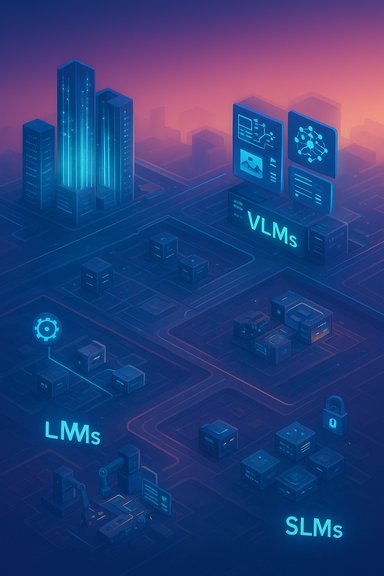
Today’s AI landscape is dominated in headlines by chatty large language models, but the real technical picture looks more like a city of specialized districts—each architecture solving a distinct engineering problem and each deserving its own design, tooling, and risk model.
The last three years have pushed a handful of model architectures from research curiosities into production-grade infrastructure. These are not incremental variants of the same idea: they are architectural solutions to distinct engineering trade‑offs—scale vs. cost, perception vs. reasoning, autonomy vs. control, and local privacy vs. cloud capability. The five families every AI engineer should understand are:
Commercial product choices reflect these trade‑offs: enterprises rely on large hosted LLMs for complex reasoning tasks, researchers and cloud providers push MoE designs to expand quality without linear compute increases, device vendors and privacy‑sensitive applications invest in SLMs for offline capabilities, and a rising class of agentic systems (LAMs) attempt to move from “suggest” to “do.” Industry reporting and vendor rollouts in 2024–2025 confirm that these choices are being made at scale across consumer and enterprise stacks.
LLMs are the baseline building block for modern assistants because they are general-purpose and straightforward to integrate via APIs or self‑hosting.
Mixtral (Mixtral 8x7B) is a practical MoE example that uses 8 experts of ~7B each and routes two experts per token, yielding a model with tens of billions of parameters accessible during training but with a per‑token compute budget comparable to a much smaller dense model. Mistral’s documentation and several engineering posts describe this trade‑off and the real‑world runtime behaviors.
Microsoft’s Phi‑3 family, Meta’s Llama 3.2 1B/3B releases, and Google’s Gemma family demonstrate the practical push toward capable, deployable SLMs. Phi‑3 technical reports and Meta and Google model cards emphasize on‑device performance and quantized variants that enable local inference.
Pragmatic adoption means understanding the trade‑offs: where extra capacity buys accuracy, when sparsity helps and when it hurts, what it means to let models act autonomously, and how to make on‑device intelligence actually usable. This is an architectural conversation as much as it is a model one—one that will determine which systems are safe, cost‑effective, and reliable when they run at scale. The engineering work ahead is not just training bigger models; it’s building the orchestration, observability, and governance that make those models trustworthy in production.
Source: MarkTechPost https://www.marktechpost.com/2025/12/12/5-ai-model-architectures-every-ai-engineer-should-know/
 Overview
The last three years have pushed a handful of model architectures from research curiosities into production-grade infrastructure. These are not incremental variants of the same idea: they are architectural solutions to distinct engineering trade‑offs—scale vs. cost, perception vs. reasoning, autonomy vs. control, and local privacy vs. cloud capability. The five families every AI engineer should understand are:- Large Language Models (LLMs) — the text-first transformer stacks powering assistants and search.
- Vision‑Language Models (VLMs) — multimodal models that fuse visual encoders with language decoders for image understanding, OCR, and multimodal reasoning.
- Mixture of Experts (MoE) — sparse, high‑capacity models that activate a subset of parameters per token to reduce runtime cost.
- Large Action Models (LAMs) — agentic models that convert intent into multi‑step actions on computers, the web, or robotic stacks.
- Small Language Models (SLMs) — compact, highly optimized models intended for on‑device and edge deployment.
Background: Why architecture still matters
The transformer revolution made a single design pattern — attention + residual blocks — the baseline for many capabilities. But at the systems level, engineering decisions still dominate outcomes: inference latency, cost per token, memory footprint, multi‑modal integration, robustness under adversarial inputs, and the safety envelope for autonomous actions.Commercial product choices reflect these trade‑offs: enterprises rely on large hosted LLMs for complex reasoning tasks, researchers and cloud providers push MoE designs to expand quality without linear compute increases, device vendors and privacy‑sensitive applications invest in SLMs for offline capabilities, and a rising class of agentic systems (LAMs) attempt to move from “suggest” to “do.” Industry reporting and vendor rollouts in 2024–2025 confirm that these choices are being made at scale across consumer and enterprise stacks.
Large Language Models (LLMs): The versatile substrate
What they are and how they work
Large Language Models are decoder‑style (or encoder‑decoder) transformer networks trained on massive text corpora. Inputs are tokenized, embedded, passed through stacked attention and feed‑forward layers, and decoded back into text. Their power comes from scale, data diversity, and alignment/fine‑tuning steps that shape behavior for chat, summarization, code generation, and retrieval‑augmented workflows.LLMs are the baseline building block for modern assistants because they are general-purpose and straightforward to integrate via APIs or self‑hosting.
Why LLMs still dominate product design
- Generality: A single LLM can be repurposed for summarization, code generation, and knowledge extraction with prompt engineering or light tuning.
- Tooling and ecosystem: Rich ecosystems (vector stores, RAG patterns, agent runtimes) exist around LLMs — making them a fast path from prototype to production.
- Scale of investment: Major cloud vendors and independent labs continuously improve LLM tooling, lowering operational friction.
Risks and hard limits
- Hallucination and provenance: LLMs produce plausible but incorrect content; for high‑stakes use you must architect provenance, grounding, and human‑in‑the‑loop checkpoints.
- Cost and latency: Running frontier LLMs in production can be expensive; batching, caching, and access control are essential.
- Regulatory and privacy concerns: Sending sensitive data to third‑party LLMs requires contractual non‑training guarantees and careful DLP.
Vision‑Language Models (VLMs): Giving language models “sight”
Architecture in brief
VLMs combine a visual encoder (CNN, ViT, or specialized image backbone) with a text encoder/decoder. The two modalities are fused either by projecting vision features into the LLM’s embedding space or via a multimodal processor that cross‑attends across image and text tokens. Examples of modern VLMs include research projects and product models that let language models reason about images, documents, and video.The practical payoff
- Zero‑shot vision tasks: Unlike narrowly trained CV classifiers, VLMs can perform many vision tasks (captioning, OCR, VQA, diagram reasoning) without task‑specific retraining—simply by following natural language instructions. This is the key engineering leverage: fewer bespoke pipelines and more general tooling.
- Multimodal RAG and documents: VLMs paired with retrieval pipelines convert mixed documents (images + text + tables) into conversational interfaces and searchable knowledge bases.
Current limitations
- Vision fidelity and long‑context images: VLMs can miss layout nuances, misread dense tables, or fail on small fonts without specialized OCR preprocessing.
- Dataset bias and safety: Image datasets introduce unique safety vectors (privacy, identity, copyrighted content). Production systems must combine moderation and provenance controls.
- Performance and cost: Multimodal processing requires heavier preprocessing and sometimes GPU‑accelerated vision encoders.
When to pick a VLM
Choose a VLM when your use case requires natural language interaction with visual content—customer support with screenshots, automated document processing, or multimodal assistants that must reason about images rather than just run a separate CV pipeline.Mixture of Experts (MoE): More brainpower for fewer FLOPs
The core idea
Mixture of Experts architectures keep the transformer attention stack intact but replace the dense feed‑forward (FFN) blocks with a pool of smaller FFN “experts.” A routing network (the router) selects a subset of experts (Top‑K) per token, so each token is processed by only a few experts rather than the entire parameter set. This produces sparse activation: very large total parameter counts, but much lower compute per token.Mixtral (Mixtral 8x7B) is a practical MoE example that uses 8 experts of ~7B each and routes two experts per token, yielding a model with tens of billions of parameters accessible during training but with a per‑token compute budget comparable to a much smaller dense model. Mistral’s documentation and several engineering posts describe this trade‑off and the real‑world runtime behaviors.
Why engineers choose MoE
- Capacity without runtime blowup: MoE lets you add parameter capacity (and thus representational power) without proportionally increasing inference FLOPs.
- Cost efficiency: For a given quality target, an MoE can be cheaper to serve than a dense model with equivalent effective capacity—especially when batched appropriately.
- Specialization: Experts can learn to specialize for language subdomains (math, code, multilingual reasoning), improving performance on diverse tasks.
The pitfalls and operational costs
- Routing complexity: Building a reliable router that avoids load imbalance and token dropping is non‑trivial; researchers propose many fixes (capacity losses, expert choice routing).
- Batching and latency sensitivity: MoE efficiency often depends on large batches to fully utilize experts; single‑request, low‑latency scenarios can lose benefits.
- Sparsity-inference overheads: Memory access patterns, sharded experts across devices, and cross‑device communication can reduce the real speed gains if not engineered carefully.
- Tooling immaturity: Running MoE in production requires careful runtime engineering; only some inference stacks (TensorRT‑LLM, vLLM enhancements) provided early MoE acceleration.
Practical takeaways
- Use MoE when you need a quality jump that is infeasible with dense scaling under your cost constraints.
- Prototype with representative latency profiles; MoE can outperform dense models in throughput but underperform for single‑shot low‑latency requests.
- Invest in expert balancing and observability: monitor per‑expert utilization and model behavior across inputs.
Large Action Models (LAMs): From suggestion to execution
What are LAMs?
Large Action Models embed the ability to plan and execute actions—on a desktop, in web apps, or against APIs—rather than only produce text instructions. LAMs combine perception, intent recognition, planning, memory, and execution primitives into an agentic pipeline that carries out multi‑step tasks autonomously.Representative implementations
- Anthropic’s “computer use” tool: a capability that lets Claude interact with a sandboxed desktop (screenshots, mouse, keyboard) and execute tasks programmatically. The tool exposes structured actions (screenshot, click, type) and requires a safe, containerized environment to reduce risks. Anthropic’s documentation frames this as a tool for automating UI tasks while stressing security and containment measures.
- Microsoft’s UFO (UI‑Focused Agent): a research framework and demo that maps GUI controls into an agentic stack with an AppAgent and ActAgent to navigate Windows applications. UFO demonstrates promising success rates on multi‑app tasks by combining visual and control metadata to execute complex flows.
- Rabbit R1 and agent playgrounds: device vendors and startups are shipping early LAMs to let users teach agents to navigate web interfaces and complete workflows; reporting shows both experimental successes and clear failure modes.
Why LAMs matter now
LAMs are the first models that turn language into reliable side‑effects—booking, filing, provisioning, or triaging. For enterprises, they promise automation across legacy GUIs without bespoke API integrations. For end users, they promise a future where a single assistant can orchestrate a task across calendar, email, and CRM.Hard safety constraints
- Privilege and containment: Any production LAM must operate in principled isolation—sandboxed VMs or ephemeral sessions with least privilege. Anthropic explicitly recommends containerized environments and warns about prompt injection risks.
- Audit trails and reversibility: Actions must be logged, reversible when possible, and auditable; when a LAM touches sensitive systems, human approval gates are required.
- Security surface area: Exposing mouse/keyboard and screenshots to an agent enlarges the attack surface; deploy only with hardened runtime controls and defined escalation policies.
When to adopt LAMs
Adopt LAMs in low‑risk, high‑value automation where human oversight is easy to retain (e.g., internal process automation, desktop testing, repetitive admin tasks). For customer‑facing or critical operational actions, require multi‑stage verification or stick to semi‑automated assistants.Small Language Models (SLMs): Local, private, and inexpensive
What defines an SLM
Small Language Models are compact transformer models designed to run on constrained hardware (phones, edge devices, IoT modules). They use careful architecture choices, quantization, tokenization optimizations, and alignment so they can perform useful language tasks locally without cloud dependency.Microsoft’s Phi‑3 family, Meta’s Llama 3.2 1B/3B releases, and Google’s Gemma family demonstrate the practical push toward capable, deployable SLMs. Phi‑3 technical reports and Meta and Google model cards emphasize on‑device performance and quantized variants that enable local inference.
Why SLMs are strategic
- Privacy: On‑device models keep sensitive data local and sidestep many regulatory concerns about data exfiltration.
- Latency and offline resilience: Local inference avoids network latency and continues to work when connectivity is limited.
- Cost control: For massively distributed endpoints (mobile apps, kiosks), SLMs eliminate per‑request cloud costs and simplify scale economics.
Engineering approaches that make SLMs practical
- Aggressive quantization (4‑bit/8‑bit) and quantization‑aware training to preserve quality.
- Context window engineering: Many SLMs trade context length for capability; meta offerings show creative compromises (128k token contexts in small models for specific Llama 3.2 variants).
- Distillation and dataset engineering: Carefully curated pretraining data and instruction tuning yield better in‑class performance for a given parameter budget (Microsoft’s Phi‑3 reports emphasize dataset design).
Where SLMs should be used
- Mobile assistants that handle private user data (notes, messages).
- Edge analytics for telemetry summarization.
- Low‑latency local agents (voice assistants, offline translators, safety monitors).
Cross‑cutting engineering and governance guidance
How to pick the right architecture for a project
- Define the failure mode you need to avoid (hallucination? data leakage? latency spike?.
- Map the dominant constraint: latency, cost, privacy, capability.
- Choose the architecture that optimizes for that constraint and design mitigations for secondary risks.
- If you need broad, general reasoning and are okay with cloud calls: LLM (+ retrieval + RAG).
- If you need vision + language understanding: VLM with OCR and layout extraction as pre‑processing.
- If you need higher quality without linear cost: MoE (but verify latency on single requests).
- If you need the model to act in the world: LAM with auditing, sandboxes, and strict privileges.
- If you must run offline/edge: SLM, using quantization and distillation.
Five deployment best practices
- Treat model outputs as drafts: require verification for high‑stakes decisions.
- Build logging and provenance for every action—especially for LAMs where actions have side effects.
- Run safety checks and red‑team tests focused on your UI/API surface, not just generic benchmarks.
- Budget for observability and per‑expert telemetry with MoE deployments to detect imbalance.
- Keep a model‑agnostic fallback plan and human‑in‑the‑loop escalation path.
Critical analysis: strengths, blind spots, and where the market is headed
Notable strengths across architectures
- Structural efficiency: MoE delivers a compelling path to more capacity without proportional increases in per‑token compute; Mixtral demonstrates this in practice.
- Multimodal realism: VLMs have drastically simplified many vision tasks by absorbing them into a single multimodal pipeline, enabling powerful zero‑shot capabilities.
- On‑device democratization: SLMs mean AI no longer requires always‑on cloud calls, lowering access friction and improving privacy.
- Agentic automation: LAMs are the most direct route to automation that touches legacy systems without bespoke integrations—hugely practical for enterprises with lots of GUI‑first processes.
Persistent and emerging blind spots
- Operational complexity: Advanced architectures require correspondingly advanced runtimes; MoE and LAMs demand orchestration that many stacks still lack.
- Safety at scale: Agentic systems increase attack surfaces (prompt injection, credential misuse) in ways classical LLMs do not.
- Unclear portability: Models tuned for specific hardware or co‑engineered stacks (GPU rack topologies, vendor kernels) may not be portable without re‑engineering.
- Vendor marketing vs. reproducibility: Parameter and performance claims can be inconsistent across marketing, blogs, and independent benchmarks—treat headline numbers with skepticism and require reproduction on your workloads.
Practical checklist for engineering teams
- For a pilot: pick a single metric (latency, cost per session, or false‑positive rate), gather representative inputs, and run an A/B with a dense LLM baseline.
- For LAMs: require a dedicated sandbox, privilege model, and replayable audit logs before any production rollout.
- For MoE: run end‑to‑end profiling with realistic single‑user latency budgets; measure expert utilization and engineer fallback routes for hot experts.
- For SLMs: measure quality under the target quantization scheme and validate in‑field battery/cpu/thermal conditions.
- Document data‑use policies and contractual non‑training guarantees where customer data is involved.
Conclusion
The next era of useful AI will not be decided by a single model family but by how well engineering teams match architectures to constraints. LLMs remain the most flexible tool for many jobs, but VLMs, MoEs, LAMs, and SLMs each solve a supremely practical slice of the problem space: vision, high capacity at low runtime cost, action and automation, and local/private deployment respectively.Pragmatic adoption means understanding the trade‑offs: where extra capacity buys accuracy, when sparsity helps and when it hurts, what it means to let models act autonomously, and how to make on‑device intelligence actually usable. This is an architectural conversation as much as it is a model one—one that will determine which systems are safe, cost‑effective, and reliable when they run at scale. The engineering work ahead is not just training bigger models; it’s building the orchestration, observability, and governance that make those models trustworthy in production.
Source: MarkTechPost https://www.marktechpost.com/2025/12/12/5-ai-model-architectures-every-ai-engineer-should-know/
