

Nebius’ Token Factory arrives as a bold gambit in the intensifying AI cloud race, promising enterprises an end-to-end platform to run and govern open-source and custom large language models (LLMs) at production scale while directly challenging industry giants such as Microsoft Azure, Amazon Web Services, and Google Cloud Platform.
Nebius unveiled Token Factory in an official announcement dated November 5, 2025, positioning the product as the next evolution of its AI platform and a direct alternative to proprietary model endpoints offered by hyperscalers. The company, headquartered in Amsterdam and publicly listed on a major U.S. exchange, has expanded rapidly after spinning out from a previous corporate structure and has since grown its footprint across the United States, Europe, and Israel. Nebius’ recent commercial momentum includes a major multi-year GPU infrastructure agreement with a global cloud company announced in September 2025 and public filings indicating substantial capital raises to scale its data center footprint.
Token Factory is marketed as a production-ready inference platform that combines high-throughput inference, post-training tooling, and enterprise governance into a single managed offering. Nebius says the platform supports over 60 open-source models — spanning text, code, and vision — while offering enterprise features such as fine-grained access control, single sign-on (SSO), data residency options, and a 99.9% service-level objective for availability. These claims and product details are presented as the company’s official specifications; independent verification of real-world performance remains essential for any prospective customer.
This stack is designed for two complementary goals: efficient large-scale training and latency-sensitive inference. Nebius emphasizes using custom-designed racks and ODM chassis to reduce total cost of ownership (TCO) while maintaining a hyperscale operational model.
This positioning resonates with companies prioritizing:
From a market perspective, Nebius is not trying to outspend hyperscalers in every domain. Instead, it is focusing on a narrower segment: high-density GPU infrastructure and managed inference for open and custom models — a niche where specialized cloud providers can meaningfully differentiate on TCO and performance.
Suggested proof-of-concept (PoC) benchmark steps:
This environment creates both opportunities and headwinds for Nebius:
However, the difference between compelling vendor narratives and operational reality hinges on independent validation. Nebius’ performance claims — sub-second latency at hyperscale, 99.9% uptime, and dramatic inference cost reductions — are achievable in particular configurations, but enterprises must insist on proof through rigorous PoCs, audited compliance documentation, and contractual protections.
Token Factory will likely attract teams looking to escape opaque pricing and limits of closed model endpoints while retaining the convenience of managed services. For Nebius, the strategic challenge is execution at scale: proving consistent, verifiable performance across global regions, maintaining hardware supply, and building enterprise trust through transparent audits and robust support.
The platform’s arrival intensifies competition in the AI cloud market and gives enterprises more leverage. The eventual winners in this round will be vendors that can credibly combine scale, predictable economics, and trustworthy governance — and demonstrate those qualities under the scrutiny of real-world production workloads.
Source: Moneycontrol https://www.moneycontrol.com/techno...-the-ai-cloud-race-article-13663713.html/amp/
 Background
Nebius unveiled Token Factory in an official announcement dated November 5, 2025, positioning the product as the next evolution of its AI platform and a direct alternative to proprietary model endpoints offered by hyperscalers. The company, headquartered in Amsterdam and publicly listed on a major U.S. exchange, has expanded rapidly after spinning out from a previous corporate structure and has since grown its footprint across the United States, Europe, and Israel. Nebius’ recent commercial momentum includes a major multi-year GPU infrastructure agreement with a global cloud company announced in September 2025 and public filings indicating substantial capital raises to scale its data center footprint.Token Factory is marketed as a production-ready inference platform that combines high-throughput inference, post-training tooling, and enterprise governance into a single managed offering. Nebius says the platform supports over 60 open-source models — spanning text, code, and vision — while offering enterprise features such as fine-grained access control, single sign-on (SSO), data residency options, and a 99.9% service-level objective for availability. These claims and product details are presented as the company’s official specifications; independent verification of real-world performance remains essential for any prospective customer.
What Nebius Token Factory claims to be
A single platform for the full model lifecycle
Token Factory is designed to unify the model lifecycle — from fine-tuning and distillation to deployment and governance — on Nebius’ AI-native infrastructure. The product pitch emphasizes:- High-performance inference tuned for production latency and throughput.
- Post-training pipelines that include LoRA and full-model fine-tuning, distillation, and model optimization.
- Enterprise governance features: Teams and Access Management, SSO, project isolation, unified billing, and audit trails.
- Open model support and migration paths, including OpenAI-compatible APIs to lower friction for customers moving from closed endpoints.
Scale, latency and uptime: vendor benchmarks
Nebius advertises production characteristics framed for enterprise SLAs:- Sub-second latency for inference.
- Autoscaling throughput capable of handling workloads that Nebius describes as “hundreds of millions of requests per minute.”
- 99.9% uptime for dedicated endpoints with guaranteed performance isolation.
Security and compliance posture
The Nebius product materials assert enterprise-grade compliance and security features, including:- Zero-retention inference options in EU or US datacenters for strict data residency needs.
- Certifications cited include SOC 2 Type II, HIPAA-readiness, ISO 27001, and ISO 27799 (medical/healthcare information security).
- Access control and auditability aimed at regulated industries.
Technical architecture and hardware choices
Full-stack, GPU-first infrastructure
Token Factory runs on Nebius’ AI-optimized cloud that blends custom server chassis, high-bandwidth networking, and NVIDIA accelerators. The platform marketing highlights support for modern NVIDIA GPUs — including H100, H200, the HGX and NVL form factors, and newer GB200-class devices — connected by InfiniBand fabric and orchestrated via Kubernetes or Slurm where appropriate.This stack is designed for two complementary goals: efficient large-scale training and latency-sensitive inference. Nebius emphasizes using custom-designed racks and ODM chassis to reduce total cost of ownership (TCO) while maintaining a hyperscale operational model.
Model optimization: distillation and token economics
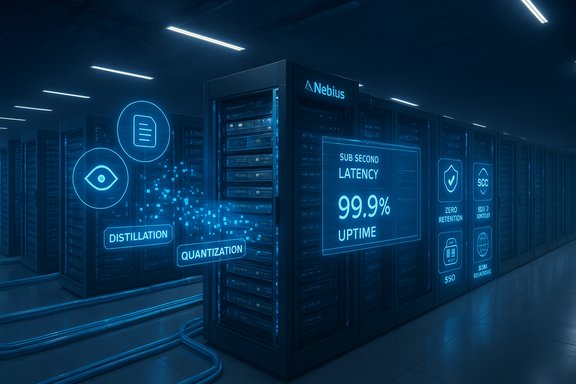
A core part of the Token Factory value proposition is converting raw model weights into production-ready assets through:- Distillation and quantization to shrink compute and memory footprint.
- Latency-oriented optimization that targets sub-second response times for inference.
- Transparent token accounting that reports cost-per-token and optimizes pipelines to reduce inference expense — Nebius claims up to 70% reductions in inference cost through these techniques, depending on workload and model.
Why Nebius believes it can compete with hyperscalers
Open models and the economics of choice
Nebius’ strategic bet is straightforward: enterprises want choice, performance, and predictable economics when running LLM-driven services. By supporting a broad catalog of open-source models and providing tools to fine-tune and optimize them at scale, Token Factory aims to reduce reliance on single-vendor model APIs where vendor rate limits, pricing, and opaque policies sometimes create operational friction.This positioning resonates with companies prioritizing:
- Data control and on-premises-like governance while still leveraging cloud economics.
- Cost predictability through transparent token metrics and model optimization.
- Model customization for vertical-specific capabilities and IP protection.
Infrastructure muscle backed by commercial deals and funding
Nebius’ commercial footprint has expanded rapidly. The company has publicly disclosed large infrastructure contracts and capital-raising activities intended to scale GPU capacity and data center builds. These developments underpin its ability to offer high-capacity inference endpoints and to compete on both price and scale.From a market perspective, Nebius is not trying to outspend hyperscalers in every domain. Instead, it is focusing on a narrower segment: high-density GPU infrastructure and managed inference for open and custom models — a niche where specialized cloud providers can meaningfully differentiate on TCO and performance.
How Token Factory stacks up against the big three
Direct competition vectors
Hyperscalers such as Microsoft Azure, AWS, and Google Cloud provide fully managed model endpoints, MLOps toolchains, and proprietary models plus open-model support. Token Factory competes along several axes:- Model freedom: strong support for open-source models and migration paths away from proprietary APIs.
- Performance per dollar: claimed efficiency gains via hardware customization and software optimization.
- Enterprise governance: built-in access controls, SSO, and compliance features configured for regulated industries.
- Data residency and zero-retention: important for customers in healthcare, finance, and government.
Where hyperscalers still have advantages
Despite Token Factory’s promise, the hyperscalers maintain several durable strengths:- Vast global networks and CDN footprints for ultra-low-latency global delivery.
- Mature enterprise contracts, procurement channels, and long-term hybrid-cloud integrations.
- Deep integrations with developer ecosystems and enterprise software stacks.
- Proprietary large models and extensive fine-tuned vertical models that many customers already use.
Enterprise adoption scenarios and use cases
Token Factory is positioned to address a wide range of LLM-driven workloads:- Customer-facing conversational AI that requires sub-second responses and strict data controls.
- Vertical-specific LLMs for healthcare, legal, finance, and manufacturing where domain tuning and data residency matter.
- Embedding and search services that process high QPS (queries-per-second) and benefit from throughput autoscaling.
- Code generation and developer tooling where latency and determinism affect developer experience.
- Vision-and-language models for multimodal applications combining image and text inference at scale.
Validating vendor claims — what to test
Nebius makes bold, measurable claims: sub-second latency at massive scale, 99.9% uptime, autoscaling to hundreds of millions of requests per minute, and large inference cost reductions after optimization. These are the most critical items to validate before committing mission-critical workloads.Suggested proof-of-concept (PoC) benchmark steps:
- Define representative workloads — latency SLO, request distribution, payload sizes, concurrency.
- Run end-to-end latency tests from customer locations to Token Factory endpoints under both cold and warm start conditions.
- Load test throughput to verify autoscaling behavior and sustained performance across peak windows.
- Measure cost-per-token on real workloads before and after optimization (distillation/quantization).
- Verify security posture — request SOC 2 Type II reports, evidence of ISO certifications, and HIPAA attestation where applicable.
- Test failover and DR — confirm recovery time objectives and maintenance procedures.
- Audit data handling — confirm zero-retention policies with legal and technical proof: logs, retention windows, and access audit trails.
Risks, limitations and cautionary notes
Vendor claims vs. real-world complexity
Many of Token Factory’s headline metrics are vendor-provided. Marketing numbers are useful signposts, but they require independent validation. Latency and throughput are heavily dependent on the model chosen, request payloads, and network pathing from end users to the datacenter.Supply chain and hardware dependence
Nebius’ model depends on access to state-of-the-art NVIDIA GPUs and custom rack designs. Continued access to hardware and the ability to scale will be influenced by global GPU supply dynamics, vendor relationships with NVIDIA, and geopolitical pressures that affect hardware procurement and data center construction.Geopolitics and corporate lineage
Nebius traces its origins to a division of a larger regional tech company and later became independent. Any historical or geopolitical baggage can become a commercial or regulatory issue for customers operating in sensitive sectors or regulated markets. Enterprises should complete a thorough vendor risk assessment that covers ownership, data flows, and regulatory exposures.Integration and vendor lock-in
Although Token Factory touts OpenAI-compatible APIs and open-model support, moving large LLM workloads between providers still entails non-trivial migration costs: model artifact formats, fine-tuning pipelines, telemetry integrations, and compliance artifacts differ. Enterprises must weigh the benefits of model freedom against the operational costs of switching providers.Compliance and third-party audits
Claims of SOC 2 Type II, ISO 27001, HIPAA-readiness and similar certifications are meaningful only when supported by current audit reports and scope definitions. Organizations in regulated industries should require copies of audit reports and confirm the certifications’ scope matches intended usage.Competitive landscape: more than just the hyperscalers
Token Factory enters a competitive field that includes both hyperscalers and specialized AI-cloud providers. Established GPU cloud players and neocloud providers have been capturing a share of the high-density AI infrastructure market. Additionally, several AI-native platforms and orchestration vendors offer tooling that overlaps with Token Factory’s capabilities, including model serving, optimization, and governance.This environment creates both opportunities and headwinds for Nebius:
- A crowded market validates demand for managed inference and model governance.
- Differentiation will depend on demonstrable performance, price/performance, and enterprise trust.
- Partnerships with chip vendors, enterprise software providers, and channel partners will accelerate adoption if executed well.
Practical evaluation checklist for IT leaders
Enterprises should consider a structured evaluation track when assessing Token Factory as part of their AI infrastructure strategy:- Business fit: Map Token Factory capabilities to concrete business outcomes and cost targets.
- Technical fit: Confirm support for required model families, frameworks (PyTorch, TensorFlow), and deployment formats.
- Performance validation: Execute PoC tests for latency, throughput, autoscaling, and cold-start characteristics.
- Security audit: Request current compliance evidence and run joint tabletop exercises on breach scenarios.
- Data governance: Validate zero-retention options, data residency choices, and audit logging granularity.
- Cost modeling: Compare TCO against hyperscaler alternatives, including egress, storage, and sustained GPU usage.
- Operational runbook: Define incident response, maintenance windows, and support SLAs; test escalation paths.
- Legal review: Confirm contract terms for uptime credits, IP ownership of fine-tuned models, and exit clauses.
- Migration plan: Create a phased migration approach with rollback options and rewrite/sandbox layers for client-facing services.
- Executive sponsorship: Secure organizational support for governance, change management, and ongoing investment.
Business implications and market signal
Token Factory’s launch signals three important trends in the AI cloud segment:- Open models continue to go mainstream. Enterprises increasingly prefer model freedom combined with governance, rather than closed APIs alone.
- Infrastructure specialization matters. Companies building AI at scale value providers who optimize entire stacks — hardware, network fabric, orchestration and tooling — rather than stitching generic cloud services together.
- Market consolidation and partnerships will accelerate. Large commercial agreements and capital raises among specialized AI cloud providers indicate industry consolidation and intense competition for capacity and long-term enterprise contracts.
Conclusion
Nebius’ Token Factory is a full-throated attempt to carve out a position in the AI cloud race by offering an opinionated platform for inference at scale, prioritizing open models, production governance, and hardware-optimized economics. The offering directly addresses the growing enterprise appetite for custom, private, and cost-predictable LLM deployments.However, the difference between compelling vendor narratives and operational reality hinges on independent validation. Nebius’ performance claims — sub-second latency at hyperscale, 99.9% uptime, and dramatic inference cost reductions — are achievable in particular configurations, but enterprises must insist on proof through rigorous PoCs, audited compliance documentation, and contractual protections.
Token Factory will likely attract teams looking to escape opaque pricing and limits of closed model endpoints while retaining the convenience of managed services. For Nebius, the strategic challenge is execution at scale: proving consistent, verifiable performance across global regions, maintaining hardware supply, and building enterprise trust through transparent audits and robust support.
The platform’s arrival intensifies competition in the AI cloud market and gives enterprises more leverage. The eventual winners in this round will be vendors that can credibly combine scale, predictable economics, and trustworthy governance — and demonstrate those qualities under the scrutiny of real-world production workloads.
Source: Moneycontrol https://www.moneycontrol.com/techno...-the-ai-cloud-race-article-13663713.html/amp/
