

Nebius this week unveiled a production-grade “Open AI Platform” — marketed as Nebius Token Factory — a full‑stack inference and model‑lifecycle product pitched as an enterprise alternative to hyperscaler AI services and designed to host, fine‑tune and run open‑weight models at scale.
Nebius is an AI‑infrastructure company that emerged from the international operations of a larger search‑engine group and has since re‑positioned itself as a vertically integrated “neocloud” provider: custom rack and chassis designs, validated NVIDIA GPU stacks, and a software layer targeting the machine‑learning lifecycle. The company has grown rapidly, raising capital and expanding data‑center capacity in Europe, Israel and the United States. Nebius’s recent commercial momentum includes a multibillion‑dollar capacity agreement with Microsoft that has amplified attention on the company’s products and strategy. Nebius describes Token Factory as the evolution of its earlier Nebius AI Studio — now re‑engineered for enterprise readiness with governance, access controls and production SLAs built in by design. The product launch takes place at a moment when many enterprises want to run high‑scale inference on open‑source models rather than being locked into single‑vendor, proprietary endpoints. Nebius positions Token Factory to meet that demand with features that emphasize portability, predictable costs and regulatory controls.
However, the launch is not a panacea. Several important claims are workload‑dependent, and synthetic benchmarks do not replace real‑world validation. The company’s simultaneous role as a hyperscaler supplier and market competitor introduces procurement complexity that must be resolved contractually. Enterprises and regulators will rightly insist on independent audits, pilot‑based verification and clear contractual exit paths before redirecting mission‑critical inference traffic.
For IT leaders and procurement teams, Token Factory offers a new, pragmatic option in a maturing AI infrastructure market: not an automatic replacement for established clouds, but a competitive tool in the enterprise playbook — particularly for regulated workloads, cost‑sensitive inference and organizations that prioritize open‑model portability.
Nebius’s Token Factory confirms a broader market shift: inference is becoming a distinct, mission‑critical engineering problem with its own economics, governance needs and vendor landscape. The launch will accelerate choices for enterprises and push hyperscalers to broaden both their open‑model support and sovereign execution options. The net effect should be more vendor choice and better procurement leverage for buyers — provided they insist on measurable, contractually enforceable outcomes and independent verification of performance and governance claims.
Source: LIVE Today Latest Technology Fresh News IT Tech Business Varindia LIVE Today Latest Technology Fresh News IT Tech Business Varindia
 Background
Nebius is an AI‑infrastructure company that emerged from the international operations of a larger search‑engine group and has since re‑positioned itself as a vertically integrated “neocloud” provider: custom rack and chassis designs, validated NVIDIA GPU stacks, and a software layer targeting the machine‑learning lifecycle. The company has grown rapidly, raising capital and expanding data‑center capacity in Europe, Israel and the United States. Nebius’s recent commercial momentum includes a multibillion‑dollar capacity agreement with Microsoft that has amplified attention on the company’s products and strategy. Nebius describes Token Factory as the evolution of its earlier Nebius AI Studio — now re‑engineered for enterprise readiness with governance, access controls and production SLAs built in by design. The product launch takes place at a moment when many enterprises want to run high‑scale inference on open‑source models rather than being locked into single‑vendor, proprietary endpoints. Nebius positions Token Factory to meet that demand with features that emphasize portability, predictable costs and regulatory controls. What Nebius Token Factory Claims to Deliver
Core product promises
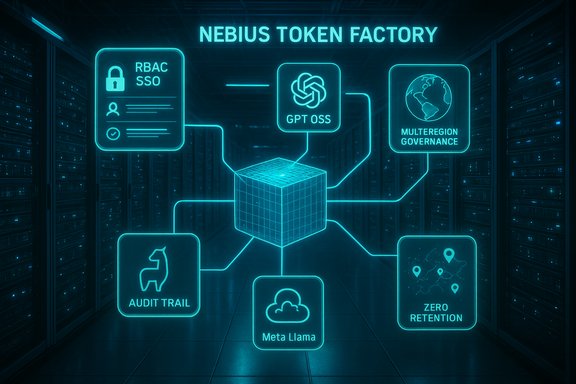
Nebius frames Token Factory around a handful of headline capabilities:- Open‑model support — compatibility with the major open‑weight families, with Nebius stating support for 60+ open‑source models at launch (examples cited include DeepSeek, GPT‑OSS, Meta Llama, NVIDIA Nemotron and Qwen).
- Production‑grade inference — an inference‑first architecture promising sub‑second latency, autoscaling throughput and a 99.9% uptime SLA.
- Model lifecycle tooling — integrated post‑training pipelines for LoRA and full‑model fine‑tuning, distillation, one‑click promotion from staging to production, and token‑level observability/billing.
- Enterprise governance and compliance — team workspaces, SSO, RBAC, audit trails and regionally segregated “zero‑retention” inference endpoints intended to support regulated workloads.
- OpenAI‑compatible APIs — endpoints and SDKs designed to ease migration away from proprietary APIs.
Technical infrastructure and performance claims
Nebius advertises a tightly integrated hardware/software stack built for inference density and efficiency: validated NVIDIA GB‑class topologies, rack‑scale networking where needed for very large models, and MLPerf‑level performance submissions. The company has highlighted vendor certifications and benchmark submissions as independent indicators of throughput and integration with recent NVIDIA architectures. These technical signals are intended to reassure enterprise buyers about raw capacity and engineering maturity.Verifying the Key Claims: What’s Confirmed and What Needs Validation
The launch materials and press coverage present measurable claims that procurement teams can and should verify before entering production contracts. Independent reporting and Nebius’s own announcements provide corroboration on several load‑bearing points, but some marketing metrics remain workload‑specific and therefore require customer pilots.- Nebius publicly announced Token Factory and positions it as the successor to Nebius AI Studio; press releases and company newsroom posts confirm availability and feature set.
- Multiple independent outlets reported that Token Factory supports a broad set of open models and lists specific families as supported; these reports are consistent with Nebius product pages.
- Nebius has published MLPerf Inference submissions and referenced NVIDIA partner programs (Exemplar/Partner status) to substantiate performance claims; MLPerf entries and NVIDIA programs are public artifacts buyers can inspect. That said, synthetic benchmarks are not a substitute for realistic, application‑level testing and will not predict tail‑latency or token‑cost outcomes under your specific prompt distributions.
- Any headline latency or cost reduction claims (for example, statements like “up to 70% lower inference cost” or specific multipliers) are inherently workload dependent. Buyers should demand representative pilots that mirror production prompt rates, concurrency, context window sizes and tail‑latency targets. If numerical multipliers are used to justify procurement decisions, insist on contractually binding acceptance criteria tied to real workloads.
- Contractual SLAs must be explicit: define percentile latency numbers (p50, p95, p99), uptime windows, remedies, and compute preemption rules. Marketing SLAs (e.g., “99.9% uptime”) require operational definitions and penalties in writing.
Strategic Context: Why This Matters for Microsoft, AWS and the Hyperscalers
Nebius’s Token Factory launch has both cooperative and competitive implications for hyperscalers.- Nebius recently signed a large capacity agreement with Microsoft (publicly reported in the billions), which validates Nebius’s scale as a supplier of GPU capacity. At the same time, Token Factory positions Nebius as a competitor in inference hosting and model management — an unusual dual role that raises both market and governance questions.
- Hyperscalers have entrenched advantages: global footprints, deep service integrations (identity, storage, networking), and longstanding enterprise contracts. Against those strengths, Nebius’s play is a focused value proposition: open‑model freedom, portability away from proprietary endpoints, predictable token economics, and specialized SLAs for inference. This differentiation is attractive for regulated sectors and cost‑sensitive, high‑QPS inference workloads.
- The practical market outcome is likely to be hybrid: many customers will combine hyperscaler services for training, storage and integrated enterprise workloads, and a specialized inference provider for latency‑sensitive or cost‑predictable inference. Nebius explicitly pitches Token Factory for that role.
Strengths: Why Token Factory Could Win Customers
- Open‑model freedom — With broad support for open‑weight families and OpenAI‑compatible APIs, customers can experiment with model families and keep migration options open. This reduces vendor lock‑in risk when compared to proprietary endpoints.
- Production focus — Nebius emphasizes operational guarantees (SLAs, observability, governance) rather than research‑only offerings. For teams moving models to mission‑critical services, that operational packaging matters.
- Potential cost efficiency — Nebius’s hardware density and inference optimizations can deliver competitive tokens‑per‑dollar economics on many workloads, especially where the hyperscaler overhead or integration cost becomes material. These benefits are plausible and are commonly cited by neocloud providers. Nevertheless, the real test of cost savings is a representative pilot.
- Regional governance controls — Zero‑retention endpoints and localized data handling are features that can unlock regulated workloads that hyperscalers have sometimes struggled to adapt to quickly. This can be decisive in financial services, healthcare and public sector procurement.
Risks and Red Flags: What Buyers and Observers Should Watch
- Dual‑role supplier risk
Nebius’s role as both a supplier to hyperscalers (notably Microsoft) and as a competitor raises procurement questions: will allocation priorities or SKU assignments favor hyperscaler partners during capacity pressure? Public reporting confirms the capacity agreement, but operational details are not public and matter for enterprise resilience planning. Buyers should request contractual carve‑outs and clarity about resource assignment in peak events. - Geopolitical and governance scrutiny
Nebius’s corporate heritage and rapid international expansion make governance a plausible concern for some national buyers. Organizations with strict threat models will require independently verifiable assurances — staff vetting, localized control planes, independent audits and cryptographic controls. Nebius’s marketing cites compliance frameworks (SOC 2, ISO 27001, HIPAA readiness), but buyers should request audit artifacts and third‑party attestations. - Benchmark vs. production gap
MLPerf and vendor‑submitted benchmarks are useful engineering signals but do not guarantee production latency, tail‑latency, or cost per token for long‑context, high‑concurrency LLM use cases. Independent pilots and acceptance testing against representative workloads are essential. - Vendor lock‑in in a new form
Paradoxically, highly optimized stacks that improve cost and latency may embed vendor‑specific runtime optimizations and observability metadata that are hard to export. Request exportability and migration guarantees for both model artifacts and observability/billing metadata. - Assertions in marketing that are hard to verify publicly
Claims about precise cost multipliers or latency reduction percentages are workload dependent and should be labeled unverified until validated by customer pilots or independent audits. Nebius’s launch materials and early press coverage include testimonials and figures that are useful starting points but not contract‑grade evidence.
Practical Procurement Checklist: How to Evaluate Token Factory (or Any Inference Provider)
- Run a short, representative pilot that mirrors production prompt patterns (context length, concurrency, tail requests).
- Validate SLA definitions in the contract — require P50/P95/P99 latency numbers, uptime definitions, and remedies.
- Request third‑party audit artifacts (SOC 2 Type II, ISO 27001, penetration test reports).
- Test model portability: export your fine‑tuned weights and associated metadata; confirm behavior parity when redeployed elsewhere.
- Insist on transparent token accounting and a reproducible cost model that breaks down compute, storage, networking and ingress/egress.
- Confirm allocation and priority rules if the provider has large hyperscaler customers; require explicit clauses on resource reservation and fair access.
Market Impact and Likely Competitive Responses
Nebius’s Token Factory is unlikely to instantly unseat hyperscalers, but it will intensify competition in inference economics and open‑model support. Hyperscalers are likely to respond in three predictable ways:- Expand open‑model catalogs and price flexibility to blunt the economic edge of specialist inference providers.
- Advance sovereign/local execution and on‑prem integrations to capture regulated workloads.
- Emphasize integration depth (identity, storage, networking, support bundles) as a differentiator that specialist providers must interoperate with to win large enterprise deals.
Technical Deep Dive (What IT and Engineering Teams Should Probe)
Model and runtime compatibility
- Confirm tokenizer parity and numeric equivalence when models are converted or quantized. Small differences in tokenization or numerical behavior can change downstream outputs nontrivially. Ask for a migration playbook for each supported model family.
Latency and throughput engineering
- Request percentile latency breakdowns under sustained load. Insist on tail‑latency targets and test for headroom under bursty traffic patterns. Evaluate how autoscaling reacts to sudden demand spikes and what cold‑start behavior looks like for large context models.
Security and data handling
- Verify zero‑retention endpoint implementations in region‑specific datacenters. Ask for forensic deletion proofs and audit trails for model artifacts and customer data. Confirm whether keys can be customer‑owned and whether encryption in transit and at rest meet your regulatory needs.
Operational observability
- Examine token‑level billing and observability exports. Confirm log formats, retention policies and compatibility with existing SIEMs and APM tools. Exportability of observability metadata is an often‑overlooked migration cost.
Final Assessment
Nebius Token Factory is a credible, well‑packaged step toward giving enterprises a production‑ready path for open‑model inference. The product’s strengths are its enterprise packaging — governance, SLAs, fine‑tuning pipelines — and its clear commitment to open‑model portability and predictable token economics. These characteristics answer a pressing market need: how to run open models at scale without re‑creating hyperscaler complexity.However, the launch is not a panacea. Several important claims are workload‑dependent, and synthetic benchmarks do not replace real‑world validation. The company’s simultaneous role as a hyperscaler supplier and market competitor introduces procurement complexity that must be resolved contractually. Enterprises and regulators will rightly insist on independent audits, pilot‑based verification and clear contractual exit paths before redirecting mission‑critical inference traffic.
For IT leaders and procurement teams, Token Factory offers a new, pragmatic option in a maturing AI infrastructure market: not an automatic replacement for established clouds, but a competitive tool in the enterprise playbook — particularly for regulated workloads, cost‑sensitive inference and organizations that prioritize open‑model portability.
Nebius’s Token Factory confirms a broader market shift: inference is becoming a distinct, mission‑critical engineering problem with its own economics, governance needs and vendor landscape. The launch will accelerate choices for enterprises and push hyperscalers to broaden both their open‑model support and sovereign execution options. The net effect should be more vendor choice and better procurement leverage for buyers — provided they insist on measurable, contractually enforceable outcomes and independent verification of performance and governance claims.
Source: LIVE Today Latest Technology Fresh News IT Tech Business Varindia LIVE Today Latest Technology Fresh News IT Tech Business Varindia
