

Nebius’s Token Factory is the latest, and arguably most calculated, salvo in the unfolding competition for enterprise AI inference: a single platform that promises freedom from hyperscaler lock‑in, turnkey production inference at scale, and the operational guarantees large customers demand — all delivered from a rapidly expanding “neocloud” that only months ago signed a multi‑billion dollar supply deal with Microsoft.
Nebius unveiled Nebius Token Factory as a production‑grade inference platform designed around open‑source and custom models. The company positions the product as an end‑to‑end solution combining high‑performance inference, post‑training tooling (fine‑tuning, LoRA, model promotion pipelines), and enterprise governance (SSO, RBAC, audit trails, and region‑specific data‑retention controls), while promising sub‑second latency, autoscaling throughput, and a 99.9% uptime SLA for demanding, high‑QPS workloads. The launch arrives at a politically and commercially charged moment. Nebius, now an Amsterdam‑headquartered AI‑infrastructure company formed from parts of Yandex following a 2024 restructuring, has simultaneously deepened its role as supplier to hyperscalers and declared itself a direct competitor to them. Earlier this year it announced a multi‑year capacity agreement with Microsoft valued at an initial $17.4 billion — with options that could push the total to roughly $19.4 billion — to supply GPU infrastructure from a new Vineland, New Jersey campus. That deal both validates Nebius’ scale and creates an unusual dynamic: Nebius will supply Microsoft the compute used to run models while also offering a hosted stack that competes with Azure AI Foundry and Amazon Bedrock.
Microsoft’s deal to secure external capacity from Nebius underscores the hyperscalers’ need to balance owned builds with third‑party supply when demand and time‑to‑market matter. That same deal demonstrates the practical complementarity and tension: Nebius is both partner and competitor.
Key validation steps enterprises should demand:
Yet the launch is not an automatic death knell for Azure AI Foundry or Amazon Bedrock. Hyperscalers retain unmatched reach, integration, and depth of enterprise services. Token Factory’s most likely near‑term success scenarios are hybrid and vertical: customers with strict data‑residency needs, cost‑sensitive inference workloads, or teams committed to open models and portability will find Token Factory attractive. Enterprises should insist on pilots, measurable SLA mapping, and clear contractual protections before redirecting mission‑critical traffic.
Nebius’s dual role — major supplier to Microsoft and direct competitor in the inference stack — will be watched closely. The outcome depends heavily on the commercial details buried under headline numbers and on the company’s ability to consistently deliver the efficiency and reliability it claims at true production scale.
Nebius has put a bold bet into the market: that the next phase of enterprise AI will prize model freedom and predictable inference economics over a single integrated cloud stack. The wager is sensible and timed to take advantage of an industry scrambling for capacity and options — but the real test will be whether Token Factory turns pilot wins into durable enterprise contracts and whether the company can deliver those contracts without the very vendor‑specific tradeoffs enterprises seek to avoid.
Source: Techloy Nebius Launches Token Factory Platform to Challenge Microsoft and Amazon
 Overview
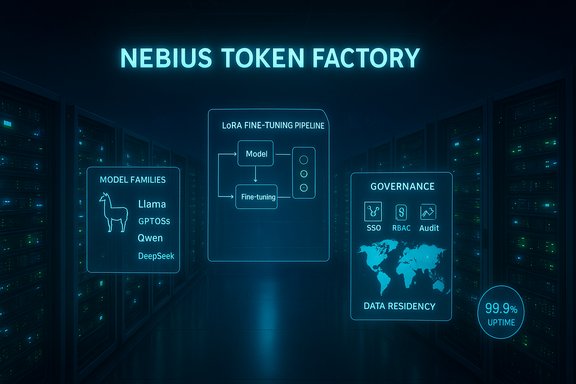
Nebius unveiled Nebius Token Factory as a production‑grade inference platform designed around open‑source and custom models. The company positions the product as an end‑to‑end solution combining high‑performance inference, post‑training tooling (fine‑tuning, LoRA, model promotion pipelines), and enterprise governance (SSO, RBAC, audit trails, and region‑specific data‑retention controls), while promising sub‑second latency, autoscaling throughput, and a 99.9% uptime SLA for demanding, high‑QPS workloads. The launch arrives at a politically and commercially charged moment. Nebius, now an Amsterdam‑headquartered AI‑infrastructure company formed from parts of Yandex following a 2024 restructuring, has simultaneously deepened its role as supplier to hyperscalers and declared itself a direct competitor to them. Earlier this year it announced a multi‑year capacity agreement with Microsoft valued at an initial $17.4 billion — with options that could push the total to roughly $19.4 billion — to supply GPU infrastructure from a new Vineland, New Jersey campus. That deal both validates Nebius’ scale and creates an unusual dynamic: Nebius will supply Microsoft the compute used to run models while also offering a hosted stack that competes with Azure AI Foundry and Amazon Bedrock. Background: Nebius, the neocloud model, and the open‑model moment
From Yandex offshoot to neocloud contender
Nebius traces its corporate heritage to the international elements of Yandex that were spun out and rebranded in 2024. Since then the company has raised capital, accelerated data‑center builds, and marketed itself as a horizontally integrated AI cloud operator: proprietary rack and chassis designs, validated NVIDIA hardware stacks, and an orchestration layer built for model lifecycle operations. That history matters because it explains both Nebius’s technical focus and the skepticism some buyers might bring to geopolitical and supply‑chain questions.Why “neoclouds” matter now
A visible market shift has emerged: enterprises and startups are increasingly treating model inference as a distinct, repeatable operational problem that requires specialized orchestration and hardware. Hyperscalers (Microsoft, Amazon, Google) dominate training and provide model catalogs, but the economics and governance of running inference — predictable cost per token, latency SLAs, and regional data‑retention policies — have created demand for alternative suppliers that can optimize hardware density, specialized GPU types, and tailored SLAs more rapidly. Specialist providers such as CoreWeave, Together AI, Fireworks, Baseten, and Replicate have shown that high‑density GPU infra can be assembled and put into production faster than the multi‑year hyperscaler build cycle. These startups also stress developer ergonomics: autoscaling, low latency, and easy model portability.What Token Factory actually offers — feature breakdown
Nebius sells Token Factory as a single governed platform for production inference. The headline capabilities it advertises are worth unbundling:- Support for major open‑weight models and customers’ own models
- Named support across families such as DeepSeek, OpenAI’s GPT‑OSS, Meta Llama, NVIDIA Nemotron, and Qwen, with compatibility for “60+ open‑source models” at launch.
- Inference‑first architecture
- Hardware and software optimized for high concurrency, low tail‑latency, and rack‑scale NVLink/GB‑class topologies where needed for very large models.
- Production engineering and operational guarantees
- Autoscaling throughput, sub‑second latency claims for many workloads, and a 99.9% availability target even at very high requests‑per‑minute volumes.
- Model lifecycle tooling
- Post‑training pipelines (LoRA and full‑model fine‑tuning), one‑click promotion from staging to production endpoints, token‑level billing/observability, and OpenAI‑compatible APIs to ease migration from proprietary endpoints.
- Fine‑grained governance
- Workspaces, SSO integrations, RBAC, audit trails, and “zero‑retention” regional inference endpoints for regulated workloads.
SEO‑friendly snapshot: why enterprises will care about Token Factory
- Open‑source model freedom: ability to experiment across model families (Llama, DeepSeek, Qwen, GPT‑OSS) and select the best accuracy/cost tradeoff.
- Production readiness: SLAs, autoscaling, and observability designed for real apps rather than ad‑hoc research workloads.
- Cost control: potential for improved tokens‑per‑dollar through hardware optimization and high utilization.
- Exit and portability: Open APIs and compatibility to make migration away from proprietary endpoints easier.
How Token Factory stacks up against Azure AI Foundry and Amazon Bedrock
Hyperscalers’ advantages
Microsoft and Amazon control global data center footprints, broad enterprise contracts, and a massive integration surface — from identity and networking to monitoring and compliance. Azure and AWS provide deeply integrated ecosystems (Active Directory, Azure Arc, S3/Blob storage, managed networking) that make it trivial for large enterprises to add AI capabilities to existing workloads.Microsoft’s deal to secure external capacity from Nebius underscores the hyperscalers’ need to balance owned builds with third‑party supply when demand and time‑to‑market matter. That same deal demonstrates the practical complementarity and tension: Nebius is both partner and competitor.
Where Token Factory may win
- Model freedom and portability. Token Factory’s focus on open weights and OpenAI‑compatible APIs gives customers immediate bargaining power and easier exit paths.
- Dedicated inference SLAs at scale. For organisations where consistent latency and predictable availability are business‑critical, a platform designed specifically for inference could simplify operations.
- Faster, potentially cheaper, specialized capacity. Neoclouds can sometimes provision rack‑scale GPU farms and density‑optimized designs faster than hyperscalers can build new regions, which matters in months‑long capacity crunches.
Where risks remain
- Ecosystem lock‑in vs. hyperscaler breadth. Even if Token Factory offers superior inference economics, customers must still integrate with the broader stack (data stores, identity, CI/CD). Those integrations cost time and lock teams into certain operational patterns.
- Global footprint and redundancy. Hyperscalers provide multi‑region resilience and global peering at a scale that’s hard to replicate quickly.
- Maturity of tooling for complex production use cases. Features such as multi‑tenant isolation at extreme scale, granular billing across sprawling organizations, and regulatory audit readiness are nontrivial engineering problems that hyperscalers have spent years solving.
The commercial paradox: supplying and competing with Microsoft
Nebius’s five‑year capacity deal with Microsoft — reported at an initial $17.4 billion and potentially rising to around $19.4 billion — is a headline‑grabbing validation of Nebius’ capacity and financial runway. The contract will provide Nebius revenue and likely help fund the Vineland, New Jersey campus build‑out. At the same time, Nebius is positioning Token Factory as a direct alternative to some of Microsoft’s offerings, including Azure AI Foundry. That dual role raises pragmatic questions for enterprise buyers and regulators:- Contractual carve‑outs and priority access. Will Nebius designate certain GPU pools or SKUs to Microsoft with special placement or priority? The public summaries do not disclose exclusivity, allocation triggers, or failover remedies — key procurement details for a hyperscaler customer.
- Operational transparency. Enterprises should ask whether Nebius‑sourced capacity will be visible in Azure’s control plane and what guarantees (software, telemetry, bills) will match Azure’s native offerings.
- Regulatory posture. Nebius’s lineage and international footprint mean some buyers — particularly in regulated industries or markets with geopolitical scrutiny — will want clear evidence of governance, personnel vetting, and local control.
Ecosystem dynamics: startups, hyperscalers, and the cost of GPUs
The AI inference market is not a two‑player game. A cohort of specialized vendors is pursuing developer‑first, low‑latency offerings optimized for open models:- Fireworks emphasizes fast inference and developer experience with serverless and on‑demand deployments and claims enterprise customers that saw marked latency improvements.
- Baseten provides tight autoscaling controls, can scale to zero, and offers a production path from prototyping to dedicated deployments.
- Together AI markets itself as a production platform for open weights with SLA commitments and integrated fine‑tuning endpoints.
- Replicate and others focus on accessible model serving and marketplace models for rapid experimentation (public docs and community examples show developer‑friendly APIs).
Technical validation: what’s provable and what needs customer pilots
Nebius highlights engineering achievements — MLPerf submissions for NVL72/GB‑class systems and claims of Exemplar Cloud recognition from NVIDIA — that validate hardware integration and benchmark performance under specific, synthetic test conditions. Those results are valuable, but benchmarks do not substitute for representative, customer‑specific load tests.Key validation steps enterprises should demand:
- Ask for reproducible benchmark harnesses and test commands to re‑run MLPerf‑style evaluations under your workload.
- Run integrated pilot workloads that measure tail latency, cold‑start behavior, and token‑per‑dollar economics under representative traffic patterns.
- Require contractual SLAs that map to business impact (not just uptime percentages): e.g., latency percentiles, incident response timelines, and escalation rights.
Security, governance, and compliance: the non‑functional checklist
Token Factory’s “zero‑retention endpoints” and region‑specific controls are designed to appeal to regulated industries. But buyers should request and validate:- Data residency and auditability: proof of physical region enforcement, key custody, and audit logs.
- Cryptographic controls: support for customer‑managed keys (BYOK) and HSM integration to limit extrajudicial access risks.
- Personnel and supply‑chain assurances: background checks, access control, and third‑party audits for on‑site staff and firmware supply chains.
Practical guidance for procurement and IT architects
- Run a short proof‑of‑concept targeting the exact production workload (same model family, prompts, and QPS).
- Measure latency p99/p999 and cold‑start behavior under bursty traffic.
- Request a SKU and placement list: what GPU families (H100, H200, GB200 variants) are available, and what happens if a particular SKU is out of stock?
- Insist on price transparency and a reproducible cost model that breaks down compute, storage, networking, and ingress/egress.
- Negotiate contractual exit clauses and data portability commitments — if you accept “open model” freedom, confirm you can export your fine‑tuned artifacts and associated metadata on demand.
Strengths and where Token Factory could matter most
- Escape route from proprietary endpoints. For organizations that need to avoid vendor lock‑in — whether for cost, compliance, or strategy — Token Factory’s open model posture is valuable.
- Production‑grade inference with operational guarantees. Many open‑model hosting offerings focus on dev/test; Token Factory is packaged for enterprise production.
- Complementary to hyperscalers in hybrid scenarios. Nebius’s ability to act both as supplier and competitor means customers could design multi‑cloud strategies that place training and large‑scale R&D on hyperscalers, while routing predictable inference workloads to a specialized provider for cost efficiency.
Risks, caveats, and unverifiable claims
- Vendor testimonials and advertised multipliers (e.g., “26× cost reductions”) are workload‑specific marketing claims and should be validated in pilots.
- Deal details with Microsoft — headline values ($17.4B, up to $19.4B) are accurate in public reporting, but the operational mechanics (allocation priority, exact SKUs reserved, and termination remedies) are not publicly disclosed and matter materially. Buyers and investors should treat the headline totals as directional, not exhaustive.
- Regulatory and geopolitical scrutiny: Nebius’s origin story means some national customers will request deeper assurances on data handling, staff vetting, and control plane localization.
- Supply‑chain concentration: heavy dependency on NVIDIA’s GPU roadmaps and supply pipeline remains an industry‑wide structural risk.
What this means for the market
The Nebius Token Factory launch is a useful reminder that the AI infrastructure market is maturing beyond single‑vendor narratives. Enterprises now have three complementary levers:- Use hyperscalers for integrated, cross‑product solutions and global scale.
- Use neoclouds for specialized, cost‑efficient, and SLA‑driven inference capacity.
- Use startup platforms (Baseten, Together, Fireworks, Replicate) for developer‑centric, feature‑rich deployment paths and rapid experimentation.
Final assessment: pragmatic progress, not instant disruption
Nebius Token Factory is a credible, well‑packaged product for enterprises that want open‑model freedom with production-grade SLAs. The platform’s promise of supporting dozens of models and delivering sub‑second inference with 99.9% uptime answers a real market need: how to run open models at scale without recreating hyperscaler complexity.Yet the launch is not an automatic death knell for Azure AI Foundry or Amazon Bedrock. Hyperscalers retain unmatched reach, integration, and depth of enterprise services. Token Factory’s most likely near‑term success scenarios are hybrid and vertical: customers with strict data‑residency needs, cost‑sensitive inference workloads, or teams committed to open models and portability will find Token Factory attractive. Enterprises should insist on pilots, measurable SLA mapping, and clear contractual protections before redirecting mission‑critical traffic.
Nebius’s dual role — major supplier to Microsoft and direct competitor in the inference stack — will be watched closely. The outcome depends heavily on the commercial details buried under headline numbers and on the company’s ability to consistently deliver the efficiency and reliability it claims at true production scale.
Nebius has put a bold bet into the market: that the next phase of enterprise AI will prize model freedom and predictable inference economics over a single integrated cloud stack. The wager is sensible and timed to take advantage of an industry scrambling for capacity and options — but the real test will be whether Token Factory turns pilot wins into durable enterprise contracts and whether the company can deliver those contracts without the very vendor‑specific tradeoffs enterprises seek to avoid.
Source: Techloy Nebius Launches Token Factory Platform to Challenge Microsoft and Amazon
