

Three decades into a career that built corporate stages and choreographed hundreds of human moments, Munich event veteran Dominik Markoč published an unscripted, public conversation with an artificial intelligence assistant that does something rare: it refuses to be purely reassuring or purely alarmist. The dialogue — framed as both a practical experiment and a provocation — argues that the logistics of event work are already becoming automated, while the craft of event design must be protected and elevated. The project, surfaced as a standalone initiative and accompanied by ready-to-use AI prompt tools, reframes the debate for event professionals: automation will strip away tasks that never defined the role, leaving a smaller but more creative, interpersonal, and high-stakes core where human judgement is indispensable.
Event production has always blended project management, vendor coordination, and a good measure of improvisation. For decades, technological advances — from spreadsheets to event-management platforms and mobile check-in — have shifted the time spent on different parts of the job. What Markoč has done is make that transition explicit and public: he sat down with a high-capability AI assistant (the Claude family of models) and let the machine—and his own reactions—speak in plain language.
The experiment is bound up with clear, contemporary AI realities. The AI model used represents one of the leading commercial LLMs in early 2026 and offers an extended context capacity and new agentic features that make long, procedural tasks more tractable for automation. At the same time, the same technology has shown real-world fragilities over the past year — from occasional factual errors in professional contexts to intermittent service outages under heavy demand. The juxtaposition is instructive: the tools are powerful, but brittle in different and important ways.
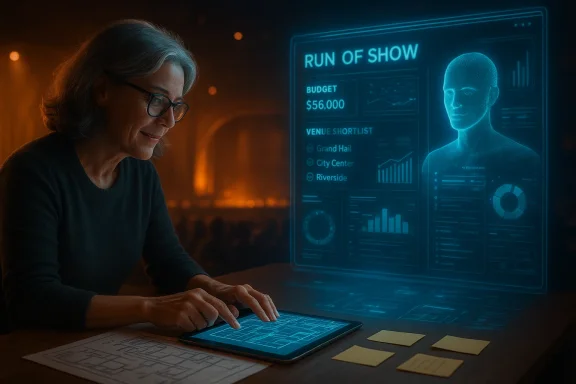
What the published dialogue makes plain is not a forecast of wholesale replacement. Instead, it is a roadmap for reconfiguring responsibilities: what event professionals should stop doing, what they should retain, and where to invest in new skills. The project also ships practical artifacts — a set of AI prompt tools that serve as starter templates for venue research, budget drafting, run-of-show generation, and similar operational tasks. Those artifacts are explicitly framed as experiments: starting points, not playbooks.
For event professionals, the choice is not binary. It is a disciplined transformation: less time on the repetitive, more time on the resonant. Learn to use prompts and copilots; insist on documented verification; preserve and pass on tacit craft; and build a narrative practice that technology amplifies rather than replaces. The future of events will not be about deleting roles; it will be about redefining them — and about preserving the human heart of experiences that, by definition, must be felt.
Source: citybuzz - Event Professional Publishes Unfiltered AI Dialogue on Industry's Future - citybuzz
 Background and overview
Event production has always blended project management, vendor coordination, and a good measure of improvisation. For decades, technological advances — from spreadsheets to event-management platforms and mobile check-in — have shifted the time spent on different parts of the job. What Markoč has done is make that transition explicit and public: he sat down with a high-capability AI assistant (the Claude family of models) and let the machine—and his own reactions—speak in plain language.The experiment is bound up with clear, contemporary AI realities. The AI model used represents one of the leading commercial LLMs in early 2026 and offers an extended context capacity and new agentic features that make long, procedural tasks more tractable for automation. At the same time, the same technology has shown real-world fragilities over the past year — from occasional factual errors in professional contexts to intermittent service outages under heavy demand. The juxtaposition is instructive: the tools are powerful, but brittle in different and important ways.
What the published dialogue makes plain is not a forecast of wholesale replacement. Instead, it is a roadmap for reconfiguring responsibilities: what event professionals should stop doing, what they should retain, and where to invest in new skills. The project also ships practical artifacts — a set of AI prompt tools that serve as starter templates for venue research, budget drafting, run-of-show generation, and similar operational tasks. Those artifacts are explicitly framed as experiments: starting points, not playbooks.
Why this conversation matters now
AI is no longer an abstract force whispered about at conferences. Since late 2024 and into 2025–26, models with larger context windows, agent orchestration, and improved tool-integration have moved from demos into production tooling used by marketing teams, legal shops, finance desks — and event planners.- Low-friction automation now exists for time-consuming, repeatable tasks: vendor comparison, initial budget drafts, schedules, and templated communications.
- New model capabilities allow a single session to reason across complex documents, combine different data sources, and produce multi-hour plans that previously required human synthesis.
- Commercial availability of advanced models and integrations with office tools has accelerated adoption by knowledge workers, bringing the question to the event profession’s front door.
The dialogue: two quotes that sum up the tension
Two short lines from the conversation crystallize the trade-off at the heart of the project.- From the AI: “AI frees you from the part that never defined you anyway — administering. What remains is what you actually set out for.”
- From Markoč: “AI offers tools — but no goosebumps!”
What AI already does better for events
The dialogue, and the accompanying prompt tools, highlight specific operational domains where AI routinely outperforms the manual baseline.- Venue research and shortlisting. AI can parse large volumes of web data, extract availability windows, summarize capacity and tech specs, and present a ranked short-list in minutes rather than hours.
- Budget modeling and variants. Given unit costs, headcounts, and vendor quotes, a capable model can create scenario-driven budgets, calculate break-evens, and propose cost-saving permutations.
- Schedule generation and optimization. From high-level agendas to minute-by-minute run sheets, AI can produce schedules, highlight conflicts, and suggest contingency buffers.
- Call and document drafting. Request-for-proposal templates, vendor briefings, and attendee communications are routine text that AI generates quickly and consistently.
- Data synthesis and reporting. Post-event surveys, NPS calculations, engagement heatmaps (from digital tools), and executive summaries can be produced, distilled, and visualized far faster with automated assistance.
What humans still (and will continue to) do best
The project is clear-eyed about where human skill matters most. Automation can prepare the scaffolding — but the scaffolding is not the building.- Sensory judgment and atmosphere. Choosing lighting, sound textures, and non-verbal cues that make a space feel "right" remains a deeply human sensibility, often driven by tacit knowledge and embodied experience.
- Reading a room and improvisation. The ability to sense tension, spot disengaged pockets of attendees, or move a speaker off-script to restore momentum is context-rich and requires on-the-ground emotional intelligence.
- Trust-building with clients and stakeholders. Long-term relationships are based on credibility, emotional nuance, and accountability — things clients value in ways that rarely reduce cleanly to metrics.
- Creative storytelling and dramaturgy. Designing a narrative arc for an event that aligns brand, content, and attendees’ experience is creative work that includes intuition and risk-taking.
- Ethical judgement and risk assessment. Decisions about inclusivity, safety, and data-protection require normative judgement that must be defensible and human-centered.
Strengths of Markoč’s approach
Several elements make the initiative constructive rather than alarmist.- Transparency. Publishing the unedited dialogue invites peer review and reduces the chance that the conversation will be spun into a promotional claim or a sanitized PR case.
- Practical tooling. The inclusion of prompt tools converts philosophy into practice. Rather than abstract warnings, the project offers tangible starting points for adoption.
- Realistic balance. The conversation does not exaggerate either threat or promise. It acknowledges automation’s gains while insisting on a human-centered core.
- Industry humility. By choosing to examine its own field publicly, the agency demonstrates an operational humility that can catalyze sector-wide learning.
Risks, limitations, and red flags
No technology rollout is without hazards. The dialogue’s openness is helpful precisely because it exposes areas where event teams must be prudent.- Hallucinations and factual errors. Language models occasionally invent plausible-sounding but false details. In professional contexts that rely on contractual accuracy, such errors carry real legal and reputational risk.
- Service reliability and outages. Models and hosted services experience downtime under peak demand. Relying on real-time model access for mission-critical event operations without fallback plans is risky.
- Data privacy and compliance. Events touch sensitive personal data (attendee lists, dietary restrictions, VIP details). Sending that data to third-party models without contractual guarantees and privacy safeguards can violate GDPR and other laws.
- Commoditization of baseline services. As automated tools handle the admin baseline, price pressure may compress margins for smaller agencies that cannot differentiate on experience design.
- Tacit knowledge erosion. If junior staff offload effort to AI before internalizing core practices, teams risk losing institutional memory and the informal heuristics that make them resilient under pressure.
- Bias and exclusion. Algorithmic outputs reflect training data. Venue shortlists, speaker suggestions, or accessibility assessments generated without careful prompts can reproduce systemic biases.
- Security and misuse. Powerful models can be repurposed for harmful activities; operators must consider secure access, rate limits, and misuse monitoring.
A pragmatic roadmap for integrating AI into event practice
Event teams who want to adopt AI responsibly can follow a compact, sequential plan.- Inventory and map tasks. List everything you do for an event and tag tasks as Repeatable / Creative / High-Risk. Start automation pilots on Repeatable tasks.
- Pilot with low-risk workloads. Test prompt tools for vendor shortlisting, initial budgets, and draft communications; never use generated content without human verification.
- Define human-in-the-loop gates. For each automated step, designate who verifies outputs and what checks they perform (e.g., prices, contractual terms, legal clauses, inclusivity checks).
- Establish data handling rules. Classify attendee and vendor data, and create rules about what can and cannot be shared with cloud models. Prefer anonymized inputs when possible.
- Create fallback procedures. Document manual processes and offline backups (local run sheets, phone trees, printed contact lists) for when services are unavailable.
- Train staff on prompt literacy. Teach teams how to craft prompts, examine model confidence, ask for step-by-step reasoning, and verify sources.
- Track outcomes and iteratively refine. Measure time saved, errors produced, and client satisfaction. Keep a “lessons learned” log after each event.
- Negotiate vendor SLAs and contracts. When you integrate a model via a provider, secure terms that address uptime guarantees, security, and data residency where required.
- Communicate transparently with clients. Explain the role of AI in your workflows and emphasize where human oversight is retained.
- Invest in differentiating skills. Shift hiring and training toward experience design, dramaturgy, and stakeholder facilitation.
Operational guardrails — what to require from AI outputs
When you accept AI-generated drafts or analyses, insist on the following before any public or contractual use:- Explicit source attribution. If the model cites facts or vendor claims, require the human verifier to confirm original sources and record them.
- Confidence and uncertainty markers. Treat model outputs as provisional: ask the model to list assumptions, confidence levels, and known unknowns.
- Red-team checks. For high‑visibility events, have a separate reviewer attempt to find errors in budgets, logistics, and legal phrasing.
- Ethics and accessibility audit. Validate that design decisions meet accessibility standards and avoid discriminatory assumptions.
- Retention and deletion policies. Keep minimum required logs and abide by data minimization principles.
Practical prompts and use-cases (categories to adopt today)
The published toolkit that accompanied the dialogue grouped practical prompts into discrete categories. Adapted as principles rather than verbatim instructions, these categories are the fastest routes to immediate gains:- Venue discovery and comparison. Supply attendee profile, event format, and AV needs; ask the model to generate a ranked shortlist and a checklist of follow-up questions for each venue.
- Budget scenarios. Provide unit costs and attendee assumptions; request multiple budget variants with contingency buffers and cost-per-attendee breakdowns.
- Run-of-show generation. Give session lengths, speaker bios, and goals; ask for a minute-by-minute run sheet, with signals for cue points and contingency timings.
- Vendor outreach drafts. Request templated RFPs and negotiation scripts that you can edit for tone and legal specifics.
- Risk checklists. Ask for an event-specific risk assessment covering crowd management, medical responses, and digital‑security threats.
- Post-event reporting. Aggregate survey inputs and digital engagement metrics into an executive summary with suggested follow-ups.
- Accessibility planning. Generate checklists for physical accessibility, captioning, interpreters, and sensory considerations.
- Sustainability scoring. Run a draft sustainability assessment based on supplier emissions, material use, and catering choices.
Business-model implications and the skills to invest in
If administrative layers become software-assisted, the market will reward distinct human strengths. Agencies and in-house teams should consider strategic shifts:- Price for outcomes, not admin. Move from line-item pricing for coordination toward packages priced by narrative impact, experience metrics, and business outcomes.
- Differentiate on design and facilitation. Invest in dramaturgy, facilitation training, and sensory design to create replicable creative IP.
- Offer hybrid services. Combine automated efficiency for baseline work with premium, human-led offerings for high-touch moments (VIP experiences, bespoke staging, narrative arcs).
- Build knowledge management. Preserve tacit knowledge by documenting case studies, decision rationales, and "why" notes that AI cannot capture.
Ethics, regulation, and industry-wide practices
The event industry touches personal data, cross-jurisdictional contracts, and public safety. That elevates the need for shared standards.- Industry codes of conduct. Associations and trade bodies should publish guidelines for acceptable AI use in event planning, including data handling and transparency.
- Vendor certification. Prefer providers that commit to auditable privacy practices, explainability features, and robust uptime SLAs.
- Client consent models. For events that collect biometric or other sensitive inputs (e.g., facial tracking, emotion analytics), require explicit, opt-in consent and provide clear opt-out mechanisms.
- Regulatory compliance. Ensure all AI integrations meet applicable data-protection law requirements (e.g., GDPR) and sector-specific obligations.
Conclusion — a call to thoughtful adoption
Published as both a provocation and a playbook, the unfiltered dialogue between an experienced event designer and a high-capability AI does more than speculate: it demonstrates a path forward. The immediate implication is operational: automate what can be automated, but do so with human verification, ethical guardrails, and robust fallbacks. The strategic implication is equally profound: the business of events will increasingly reward those who can design meaningful experiences — the moments that produce goosebumps, not invoices.For event professionals, the choice is not binary. It is a disciplined transformation: less time on the repetitive, more time on the resonant. Learn to use prompts and copilots; insist on documented verification; preserve and pass on tacit craft; and build a narrative practice that technology amplifies rather than replaces. The future of events will not be about deleting roles; it will be about redefining them — and about preserving the human heart of experiences that, by definition, must be felt.
Source: citybuzz - Event Professional Publishes Unfiltered AI Dialogue on Industry's Future - citybuzz
