

With the dust settling on the Windows 11 refresh cycle, the PC market’s next commercial battleground is clear: turning a rapidly growing installed base of AI-capable PCs into sustained, measurable everyday use. Recent market trackers show that a large and growing share of European PCs sold in 2025 included on-device AI acceleration; vendors and distributors now see the channel — resellers, integrators and service partners — as the crucial bridge between hardware capability and real customer outcomes. What follows is an in‑depth look at the current state of AI-capable devices, why the channel matters, where adoption is fragile, and practical playbooks partners can use to convert hardware sales into productivity wins for SMEs, education and enterprise customers.
AI-capable PCs — machines equipped with neural processing units (NPUs) or equivalent on-device accelerators — went from niche to mainstream in vendor messaging during 2024–2025. That transition was accelerated by a more prosaic force: the end‑of‑support cycle for Windows 10. Many organisations faced hard choices about legacy fleets and made procurement decisions that happened to favour Windows 11‑ready, AI‑capable models.
AI‑capable PCs are not a magic wand; they are tools. When channel partners build the scaffolding — sound pilots, clear governance and practical training — those tools can free teachers, accelerate SME productivity and create a new class of managed services that rewards partners for real outcomes rather than slogans. The industry has the raw materials in place; success now belongs to those who translate capability into consistent, measurable value.
Source: Computer Weekly Acer: Channel can help drive greater AI PC adoption | Microscope
 Background: where we are now
AI-capable PCs — machines equipped with neural processing units (NPUs) or equivalent on-device accelerators — went from niche to mainstream in vendor messaging during 2024–2025. That transition was accelerated by a more prosaic force: the end‑of‑support cycle for Windows 10. Many organisations faced hard choices about legacy fleets and made procurement decisions that happened to favour Windows 11‑ready, AI‑capable models.- Market trackers reported that AI-capable systems accounted for a large and rising share of distribution sales in Europe through 2025 (figures reported in the high‑30s to mid‑40s percent range across different samples and weeks).
- Analyst houses emphasised that much of the shift was driven by refresh cycles and OS eligibility rather than a sudden surge of user demand for generative AI features.
- Microsoft’s Windows 10 support ended in the autumn of 2025, creating a clear migration deadline that made hardware replacement unavoidable for many organisations.
Overview: what “AI-capable PC” means in 2025
What’s in scope: NPUs, Copilot+ and on-device inference
An AI-capable PC is more than a marketing badge. Practically, it means:- A silicon stack that includes an NPU or dedicated AI accelerator designed to run inference locally (measured in TOPS or similar performance metrics).
- Firmware and driver support to expose acceleration to the OS and applications.
- Integration with platform agents and productivity tooling (for example, out‑of‑the‑box hooks into system assistants or vendor agent software).
Why hardware readiness isn’t the same as adoption
Hardware capability is necessary but not sufficient. For organisations to reap benefits, three things must happen:- Software has to be able to exploit NPUs at scale (drivers, model delivery, management).
- End users must learn how to incorporate AI features into workflows (training and change management).
- IT and procurement must agree on governance, data protection and lifecycle implications (privacy, patching, trade‑in programmes).
The channel’s opportunity: why resellers and integrators matter
The installed-base advantage
The major strategic advantage for channel partners is the installed base. Millions of recently purchased PCs in Europe already have AI capability. For resellers this means:- A lower marginal cost to convert customers into AI users: many organisations will not need immediate replacement hardware if the devices already exist.
- The ability to shift the conversation from “buy this PC” to “run a pilot and measure outcomes” — a more consultative, higher‑margin sale.
- A clear entry point for managed services: training, governance, imaging, Copilot integration, and lifecycle management.
Channel roles that move the needle
Channel partners can adopt specific roles that materially increase adoption:- Pilot integrator: design, deploy and measure role‑based pilots (sales, legal, support) with clear KPIs.
- Adoption trainer: deliver targeted, role-based training and micro‑learning to move users from curiosity to habit.
- Governance enabler: create and deploy policies for data boundaries, prompt governance and secure local model use.
- Lifecycle manager: offer bundling (trade‑in, refurbishment, financing) to lower acquisition cost and address sustainability concerns.
Education and SMEs: special cases with outsized impact
Education: digital literacy and the ethical dimension
Schools and universities are both heavy device consumers and incubators of future workplace behaviour. In education contexts:- AI tools can personalise learning and reduce administrative load, but only if teachers and staff are trained to use them properly.
- Digital literacy for students must include how to use AI responsibly — data literacy, critical thinking and evaluation of model outputs.
- AI should augment teaching rather than replace it: when applied correctly, tools free teacher time for higher‑value interaction and give clearer insights into student progress.
SMEs: pragmatic pilots, not feature lists
SMEs represent the largest practical market but are typically time‑poor and cost sensitive. Effective channel plays here:- Run short pilot projects focused on clearly measurable tasks (e.g., automating invoice triage, meeting summarisation, or customer email drafting).
- Use lightweight, role‑specific ROI metrics (time saved per week, reduction in manual steps, faster ticket resolution).
- Offer managed subscriptions that bundle training, Copilot seat enablement and a clear exit or scale path.
Strengths: what’s working in favour of AI PC adoption
- A large and improving installed base. Distribution trackers show a meaningful share of units shipped in 2025 were AI‑capable — creating a foundation to build on.
- Platform momentum. Microsoft, silicon vendors and ISVs are aligning roadmaps: operating system hooks, Copilot integrations and SDKs are maturing.
- Channel readiness. Many partners already offer migration services for Windows 11 and can extend those engagements to include AI pilots and managed Copilot rollouts.
- Role-specific productivity opportunities. Certain use cases (transcription, meeting summarisation, knowledge recall) are low‑risk, high‑value entry points for on‑device AI.
Risks and friction points: where adoption can stall
1. Metrics volatility and differing tracker numbers
Analyst trackers use different methodologies (sell‑in vs sell‑through, sample panels, distribution vs retail). As a result, headline figures for AI‑capable PC share vary week‑to‑week and by vendor sample. Treat any single percentage as directional and use multiple data points when sizing opportunity.2. Software maturity and meaningful use cases
NPUs are useful only when applications and model distribution take advantage of them. Many enterprise workloads remain cloud‑first; translating cloud‑based gains to local inferencing requires engineering effort and vendor support.3. Cost, battery and thermal trade-offs
Adding NPUs and higher performance components can increase BOM cost and affect battery life and thermal behaviour. For price‑sensitive buyers, these trade‑offs can limit the appetite for premium Copilot+ SKUs.4. Environmental and reputational risk
A rush to replace hardware to “get AI” will attract scrutiny. Partners must include refurbishment and secure data‑wiping programmes to minimise e‑waste and regulatory risk.5. Governance and security complexity
Deploying local models or broad Copilot usage without strict governance increases data leakage risk. Organisations need clear policies, logging, and model provenance controls before scaling AI features.Practical, channel‑centric playbook to accelerate adoption
Below are concrete, sequential steps channel partners can apply to turn AI-capable hardware into measured customer value.- Inventory and segmentation
- Run a compatibility scan across customer fleets: label devices as Windows 11‑ready, upgradeable with firmware, or replacement required.
- Segment users by role and AI-value potential (e.g., legal, sales, contact centres, content teams).
- Design measured pilots
- Choose 2–3 high‑value micro‑use cases per customer.
- Define KPIs: minutes saved per task, error reduction, tickets closed, or content production volume.
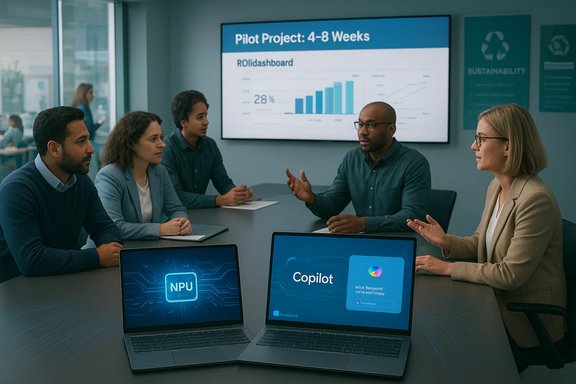
- Run pilots for 4–8 weeks and collect both quantitative and qualitative feedback.
- Bundle services with hardware offers
- Provide “pilot to production” bundles: imaging, app compatibility testing, Copilot seat enablement, and training.
- Offer financing and trade‑in options to lower upfront cost.
- Build adoption training and change management
- Deliver role‑based micro‑training (10–20 minute modules) and embed in Teams or LMS.
- Create adoption champions inside customer organisations and schedule regular show‑and‑tell sessions.
- Lock in governance and lifecycle plans
- Deliver a governance checklist: data boundaries, retention, prompt logging and remediation workflows.
- Offer long‑term lifecycle commitments: driver updates, NPU firmware patches and certified refurbishment.
- Measure, iterate and scale
- Use pilot results to create a replicable playbook and ROI template.
- Move from pilot to staged rollout only when KPIs meet agreed thresholds.
Technical buying checklist for partners and customers
When evaluating AI‑capable devices or designing pilot programmes, use this checklist to separate marketing from measurable capability:- Is the device Windows 11‑ready and supported for enterprise imaging?
- NPU performance: TOPS rating or vendor performance claims; is there independent benchmarking for target workloads?
- Memory and storage baseline for AI workloads (model caching, inference buffers).
- Battery and thermal benchmarks for representative AI tasks.
- Driver and firmware support policy: Does the OEM commit to NPU driver updates for the device lifecycle?
- Management and security: TPM 2.0, Secure Boot, MDM support and enterprise update channels.
- Copilot and agent integration: is the device preconfigured for Copilot provisioning and license activation?
- Sustainability options: trade‑in, certified refurbished programmes and secure data‑wipe processes.
Education playbook: how to put students and teachers first
- Start with teacher enablement, not student rollout. Teachers who are confident with AI tools create better outcomes for students.
- Integrate AI literacy into curricula: data ethics, prompt design, bias awareness and critical evaluation of outputs.
- Protect student data by default — prefer local inference for sensitive workloads and document consent and data flows clearly.
- Measure outcomes that matter in education: reduced grading time, improved formative feedback, and personalised learning pathways.
Economics and pricing: how to avoid a value gap
AI-capable hardware often carries a premium. To manage economics:- Use trade‑in and refurbished SKUs to create affordable upgrade paths for budget‑constrained customers.
- Bundle Copilot seat licensing with services to reduce procurement friction and make ROI visible.
- Offer staged financing and pilot credits that let customers see measurable savings before committing to fleetwide purchases.
Final assessment: realistic optimism, measured execution
The combination of a large installed base of AI‑capable devices and maturing platform hooks is a genuine industry inflection point. But hardware availability does not equal adoption. The next phase — turning capability into routine use — will be decided by execution across three areas:- Practical pilots with measurable KPIs, not one‑off demos.
- Channel partners that offer bundled services (training, governance, lifecycle) rather than pure hardware plays.
- Vendors and ISVs that ship realistic, secure model delivery and management tools for on‑device inference.
AI‑capable PCs are not a magic wand; they are tools. When channel partners build the scaffolding — sound pilots, clear governance and practical training — those tools can free teachers, accelerate SME productivity and create a new class of managed services that rewards partners for real outcomes rather than slogans. The industry has the raw materials in place; success now belongs to those who translate capability into consistent, measurable value.
Source: Computer Weekly Acer: Channel can help drive greater AI PC adoption | Microscope
