

Accounting teams that once treated artificial intelligence as a distant experiment are now running AI-powered copilots and agentic workflows as part of everyday client work — and the early evidence suggests meaningful time savings, broader client coverage and a shift in what firms bill for, even as governance and data-protection questions move to the top of boardroom agendas.
The accounting profession sits at the intersection of repetitive, rules-driven tasks and high-value judgment work — an ideal match for the current generation of generative AI and workflow automation. Over the last 18 months vendors have embedded AI into mainstream products, platforms and ERP suites; at the same time, academic research and practitioner surveys are beginning to quantify what was previously anecdotal: AI is shifting time away from manual entry and toward client advisory, and it is enabling firms to support more clients per staff hour while reducing month‑end cycle times.
Two parallel trends matter for firms planning adoption. First, everyday AI — features embedded in familiar products such as Microsoft 365 Copilot, Xero’s Hubdoc/reconciliation tools and NetSuite’s analytics/AI connectors — is lowering the barrier to entry for small and medium-sized practices. These tools are primarily used as drafting assistants, extraction engines and time-savers in routine flows.
Second, agentic AI — multi-step agents that can plan, call services, retrieve documents and propose actions — is emerging rapidly and will reshape workflows where multi-step reasoning and orchestration are required (for example, end-to-end bookkeeping automation, complex reconciliations and multi-party due diligence). Gartner explicitly flagged multiagent systems and domain-specific language models as among the top strategic technology trends for 2026, underscoring that the industry’s future deployments will increasingly focus on orchestrated agent architectures and domain-tuned models.
Benefits:
Benefits:
At the same time, the path from pilot to production requires discipline. Firms should treat vendor claims as hypotheses to be tested on their own books, insist on tenant‑grade protections and provenance, and embed human sign‑offs wherever client or regulatory risk exists. Gartner’s 2026 technology themes — multiagent systems, domain-specific models, confidential computing and digital provenance — provide a strategic framing for these investments: the next wave of accounting automation will succeed only if it is built with traceability, security and domain context at its core.
For accounting leaders the immediate priorities are clear: pilot fast but small, measure rigorously, protect data vigorously, and train teams to supervise agents rather than simply rely on them. Firms that combine practical pilots with robust governance will convert AI’s productivity boosts into sustainable advisory growth — while preserving the professional accountability that defines the trusted‑advisor role.
Source: IT Brief Australia https://itbrief.com.au/story/ai-tools-reshape-accounting-workflows-client-work/
 Background / Overview
The accounting profession sits at the intersection of repetitive, rules-driven tasks and high-value judgment work — an ideal match for the current generation of generative AI and workflow automation. Over the last 18 months vendors have embedded AI into mainstream products, platforms and ERP suites; at the same time, academic research and practitioner surveys are beginning to quantify what was previously anecdotal: AI is shifting time away from manual entry and toward client advisory, and it is enabling firms to support more clients per staff hour while reducing month‑end cycle times. Two parallel trends matter for firms planning adoption. First, everyday AI — features embedded in familiar products such as Microsoft 365 Copilot, Xero’s Hubdoc/reconciliation tools and NetSuite’s analytics/AI connectors — is lowering the barrier to entry for small and medium-sized practices. These tools are primarily used as drafting assistants, extraction engines and time-savers in routine flows.
Second, agentic AI — multi-step agents that can plan, call services, retrieve documents and propose actions — is emerging rapidly and will reshape workflows where multi-step reasoning and orchestration are required (for example, end-to-end bookkeeping automation, complex reconciliations and multi-party due diligence). Gartner explicitly flagged multiagent systems and domain-specific language models as among the top strategic technology trends for 2026, underscoring that the industry’s future deployments will increasingly focus on orchestrated agent architectures and domain-tuned models.
What the evidence says: measurable productivity gains — and caveats
Researchers and practitioners are no longer relying only on case studies. The Stanford working paper "Human + AI in Accounting: Early Evidence from the Field" draws on a 277-accountant survey and field data from dozens of small and mid-sized firms. Its headline findings are striking and align closely with practitioner reporting:- General ledger granularity increased by roughly 12% for AI users, which indicates more detailed bookkeeping and richer reporting.
- Users reported 4 hours saved per week on data entry, and the field data showed a 7.5–8.5 day reduction in month‑end close on average for adopters.
- The study associates AI use with a 55% increase in clients supported per week and a 21% improvement in billable-hour capture in certain cohorts.
Strengths of the evidence
- The Stanford paper combines survey responses with platform logs and field data, which provides internal triangulation rather than pure self-reporting.
- Practitioner events and adoption playbooks report repeatable, low-friction pilots (AP automation, invoice capture, automated commentary) that translate well to measurable KPIs such as hours saved and error reduction.
Limits and verification needs
- Vendor-reported accuracy figures (for reconciliation or posting automation) are often based on controlled datasets; firms should pilot on representative historical data and insist on event-level audit trails and reproducible acceptance criteria.
- AI errors have real consequences in regulated activities (tax positions, signed attestations). Early field experiments show that AI outputs require supervised review and that error modes must be modeled and estimated before letting agents write back to ledgers.
Everyday tools and how practices use them
Accountants are using AI in ways that enhance existing workflows rather than replacing them outright. Three practical categories dominate today’s deployments.1) Embedded productivity copilots
Microsoft’s strategy — integrating Copilot into Word, Excel, Outlook, Teams and the Copilot Studio builder — has made enterprise‑grade copilots accessible to many firms. Copilot for Microsoft 365 is designed to respect tenant isolation and has commercial data protection promises that reduce the risk of customer data being used to train public models. Firms commonly use these copilots for meeting summaries, drafting client letters, prompt‑assisted spreadsheet formulas, and first‑draft narratives — tasks that free time for review and advisory work.Benefits:
- Faster drafting, consistent tone across client communication, and automated meeting notes.
- Integration with existing document stores and Microsoft Graph simplifies grounding and provenance.
- Default use of consumer chat interfaces without enterprise controls risks data leakage; tenant‑grounded offerings should be preferred.
2) Document capture and ledger overlays
Vendors such as Xero and third‑party capture tools (Hubdoc, Dext, AutoEntry) have long used ML for OCR and reconciliation suggestions; newer agentic overlays like Artifact and purpose-built bookkeeping platforms are pushing these capabilities further. Xero’s public roadmap and product releases show conversation-facing assistants and smarter reconciliation suggestions that reduce manual categorization and speed month‑end reconciliations. NetSuite and Oracle have introduced AI connectors and analytics warehouses that provide natural-language analytics and agent connectors to expose system-of-record data to purpose-built AI tools.Benefits:
- Large reductions in manual data entry and exception handling for high-volume transaction environments.
- Overlay approaches preserve existing ERP systems while enabling automation gains without a rip-and-replace migration.
- Assertions of near‑perfect accuracy must be validated on each firm’s dataset; integration connectors must be configured with least‑privilege access and strong logging.
3) Drafting, research and client communications
Public LLMs and enterprise versions (ChatGPT Enterprise, Anthropic/Claude, Google Gemini) are used for tone, draft letters, procedural documents and research summaries. Users appreciate the ability to soften tone, standardize templates, and translate complex accounting findings into accessible client guidance. But the use of public endpoints remains controversial for PII or regulated client work; many firms adopt internal, non‑training or tenant-isolated services instead.Agentic AI and the coming workflow transformation
Agentic systems — collections of specialized agents that can take actions, call services and iterate — are the architecture most likely to change how accounting work is structured. Practitioners and analysts expect multiagent systems and domain-specific language models to become mainstream choices for workflows that require planning, evidence retrieval and orchestration across multiple systems. Gartner’s 2026 trends explicitly highlight multiagent systems and DSLMs as strategic priorities.What agentic AI enables
- End-to-end bookkeeping agents that propose journal entries, create audit trails and pause for human sign-off.
- Orchestrated due-diligence agents that collect documents, extract facts, identify exceptions and summarize risks for reviewer sign‑off.
- Workflow agents that triage invoices, route approvals, and manage exception ladders without manual intervention until a confidence threshold is breached.
Early adopter patterns
- Smaller practices often move faster because they have fewer approval gates and can leverage packaged solutions; larger firms adopt guarded‑copilot strategies and invest in governance, internal models and non‑training contracts. PwC’s early internal integrations and ‘client‑zero’ experiments are illustrative: firms that deploy first internally build muscle around governance and risk management before rolling pilots outward.
Supervision, “agent bosses” and the new skill mix
Agentic workflows change staff roles: they create demand for "agent bosses" — generalists who can supervise agents, validate outputs and manage exceptions — while also raising the value of experienced subject-matter experts who can test and interrogate AI outputs. The net effect is less about replacing experience and more about changing how experience is applied. Practitioner commentary highlights that senior staff often bring essential skepticism and testing habits that complement AI oversight, while younger staff may be more comfortable with tools but must be trained to question outputs critically.Governance, security and professional responsibility
Adopting AI at scale in accounting is a governance challenge as much as a technical one. The industry conversation has shifted from “can AI help?” to “how do we adopt responsibly?” The practical checklist firms are using repeats across vendor playbooks and regulator guidance:- Inventory and whitelist: Maintain a registry of approved tools and block uncontrolled endpoints for client PII.
- Tenant-grade endpoints and non-training guarantees: Prefer enterprise products that contractually limit training on customer data or provide tenant isolation (for example, Microsoft’s commercial-data protection for Copilot).
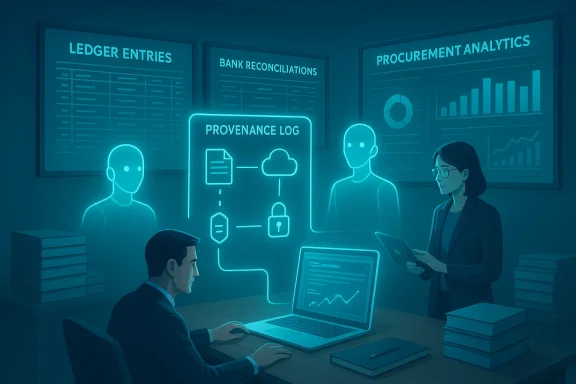
- Event-level provenance: Require that every automated decision links back to the source document with confidence scores and an immutable log for audit.
- Pilot, measure, scale: Run short, time-boxed pilots in shadow mode and measure hours saved, verification edits required, exception rates and client satisfaction. If vendor claims cannot be reproduced, do not scale blindly.
- Contracts and data protections: Insist on non‑training clauses, data residency controls, and clear deletion/exit rights in agreements.
A practical adoption playbook for accounting firms
Below is a condensed roadmap that reflects what practitioners are actually doing and what the research recommends.- Conduct a workflow audit: map repetitive tasks, time per task, error rates and client turnaround baseline metrics.
- Inventory current systems and embedded AI: list Microsoft 365 subscriptions, ERPs, connectors and any third‑party capture tools; prefer embedded, tenant‑grounded features when possible.
- Choose a tight pilot: pick a high-volume, low-risk process (AP capture for a supplier cohort, bank reconciliation for a sample of clients, or automated client onboarding). Run in shadow mode for 30–60 days.
- Measure clearly: hours saved, human edits required, exception rate, time to final close and client satisfaction. Tie these KPIs to billing and staffing projections.
- Embed governance and human sign-off: mandate human approval for client-facing outputs, instrument logs and set failure SLAs.
- Upskill staff: teach prompt literacy, model‑risk awareness and agent‑supervision skills; create internal champions who can translate AI outputs into defensible deliverables.
Vendor landscape and claims — what to believe and what to test
The market now contains several classes of vendors:- Platform incumbents (Microsoft, Oracle NetSuite, Xero): embedding copilots, connectors and analytics into core productivity and ERP layers. These vendors emphasize tenant isolation, enterprise contracts and production-grade connectors. Microsoft’s Copilot Studio and Oracle’s AI Database with in‑database agent capabilities reflect this push to provide secure, managed agent platforms.
- Overlay and automation specialists (Artifact AI, Botkeeper, Digits): offering ledger overlays, reconciliation agents and bookkeeping automation that leave the underlying ERP intact while automating ingestion and posting. These vendors often publish impressive accuracy and ROI figures; firms should require pilot validation on representative histories.
- Extraction and document-understanding providers (Azure AI Document Intelligence, DataSnipper, Hubdoc): focused on the capture layer, they are essential for turning unstructured documents into ledger entries. Large professional services firms have used these capabilities to convert tax and multi-page forms into structured pipelines.
- Niche audit and research copilots (Bloomberg Tax AI Assistant, Fieldguide, AuditFile): built for attest and research contexts with explicit citation or evidence features. Audit-grade tools are optimizing for defensible citations, immutable evidence chains and regulator acceptance.
- Reproduce vendor accuracy claims on at least three representative clients.
- Verify that connectors use least-privilege authentication and that logs are immutable.
- Confirm contractual protections on non-training, data deletion and residency.
- Pilot human-in-the-loop gates for any write‑back or payment automation.
Workforce impact: job shapes, upskilling, and pricing
AI is not a simple job-replacement technology for accounting firms. Instead, early adopters report role reshaping:- Routine transaction processing shrinks as a share of work, while advisory, analysis and quality assurance grow. The Stanford study documents time reallocation away from data entry toward higher‑value tasks.
- Firms can support more clients per person, changing utilization metrics and forcing a rethink of pricing: fixed-fee advisory models and value-based pricing will become more common as automation reduces low-value hours.
- Upskilling priorities should include prompt engineering, agent supervision, model-risk testing, and a renewed emphasis on professional skepticism. Senior staff bring vital testing habits and domain judgment; younger staff bring tool fluency — both are required.
Risks and where regulators and professional bodies must act
As AI moves from drafting text into systems that take actions, regulators and professional bodies must define minimum expectations around provenance, disclosure and professional responsibility. Key regulatory and public-protection issues include:- Liability allocation when an AI-generated position (tax, audit, payroll) causes harm. Professional responsibility cannot be offloaded simply because an algorithm produced a draft.
- Data residency and geopatriation implications for cross-border client data, especially when sovereign clouds or local hosting are required by clients or regulators. Gartner’s geopatriation trend signals increased pressure for local processing.
- Standards for auditability: regulators should expect immutable evidence chains that show source documents, model inputs and reviewer sign‑offs for any automated attest or filing.
Conclusion: practical optimism with disciplined governance
The early field evidence and industry reporting converge on a clear theme: AI is already delivering measurable operational value in accounting, from faster reconciliations to richer reporting and more client-facing advisory time. The gains documented in independent research (time savings, more clients supported, quicker month‑ends) are real and repeatable when pilots are well scoped and governed.At the same time, the path from pilot to production requires discipline. Firms should treat vendor claims as hypotheses to be tested on their own books, insist on tenant‑grade protections and provenance, and embed human sign‑offs wherever client or regulatory risk exists. Gartner’s 2026 technology themes — multiagent systems, domain-specific models, confidential computing and digital provenance — provide a strategic framing for these investments: the next wave of accounting automation will succeed only if it is built with traceability, security and domain context at its core.
For accounting leaders the immediate priorities are clear: pilot fast but small, measure rigorously, protect data vigorously, and train teams to supervise agents rather than simply rely on them. Firms that combine practical pilots with robust governance will convert AI’s productivity boosts into sustainable advisory growth — while preserving the professional accountability that defines the trusted‑advisor role.
Source: IT Brief Australia https://itbrief.com.au/story/ai-tools-reshape-accounting-workflows-client-work/


