

The labor market is not retreating from AI — it’s rotating into a new shape, and LinkedIn’s data-driven view from Davos makes one thing clear: the fastest-growing jobs right now are those that either teach AI, build the infrastructure that runs it, or translate it into business value, while human skills like curiosity and communication are becoming the critical differentiators for career resilience.
Over the last two years the skill requirements attached to many roles have already shifted dramatically; LinkedIn reports that the types of skills necessary for a given role have changed by more than 25% in recent years and expects that skill composition could shift by roughly 70% by 2030 as AI tools and workflows spread. That same research finds more than 1.3 million net new AI‑related jobs appearing on LinkedIn between 2023 and 2025, and over 600,000 net new data‑center jobs created as organizations expand the physical infrastructure to run models at scale.
Those headline numbers are worth repeating because they directly contradict a simple narrative you may have heard: AI will only take jobs away. Instead, the data show significant job creation in new categories, increased demand for hybrid roles, and a strong premium for people who can combine technical fluency with human capabilities. Independent reporting and industry commentators have amplified the same pattern: growth in AI engineering and training roles, rising creator‑economy work, and an appetite for trades and first‑line roles that support AI infrastructure.
This article synthesizes the Davos interview with LinkedIn’s CEO, data from LinkedIn’s January 2026 labor market report, and independent analysis to give practical, evidence‑based guidance: which jobs are expanding, which are most at risk, what hiring managers are looking for, and exactly how professionals can future‑proof their careers in the AI era.
Tips for using content as your professional resume:
Source: The Singju Post The Fastest-Growing Jobs in the AI Era - How to Prepare w/ Ryan Roslansky (Transcript)
 Background / Overview
Over the last two years the skill requirements attached to many roles have already shifted dramatically; LinkedIn reports that the types of skills necessary for a given role have changed by more than 25% in recent years and expects that skill composition could shift by roughly 70% by 2030 as AI tools and workflows spread. That same research finds more than 1.3 million net new AI‑related jobs appearing on LinkedIn between 2023 and 2025, and over 600,000 net new data‑center jobs created as organizations expand the physical infrastructure to run models at scale.Those headline numbers are worth repeating because they directly contradict a simple narrative you may have heard: AI will only take jobs away. Instead, the data show significant job creation in new categories, increased demand for hybrid roles, and a strong premium for people who can combine technical fluency with human capabilities. Independent reporting and industry commentators have amplified the same pattern: growth in AI engineering and training roles, rising creator‑economy work, and an appetite for trades and first‑line roles that support AI infrastructure.
This article synthesizes the Davos interview with LinkedIn’s CEO, data from LinkedIn’s January 2026 labor market report, and independent analysis to give practical, evidence‑based guidance: which jobs are expanding, which are most at risk, what hiring managers are looking for, and exactly how professionals can future‑proof their careers in the AI era.
The data story: what LinkedIn actually found
Jobs being created right now
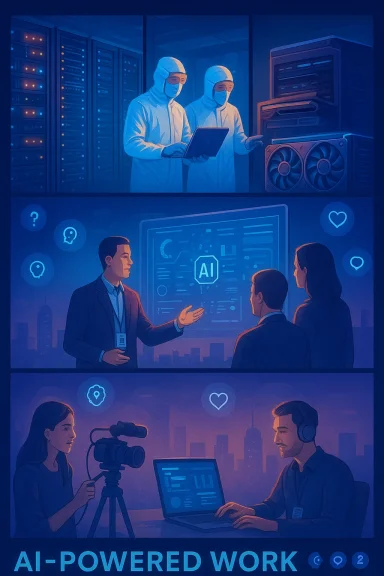
LinkedIn’s labor‑market analysis identifies three broad classes of roles that have surged:- AI training and evaluation roles (Data Annotators / Annotators): Humans are still required to evaluate, label, and fine‑tune model outputs. These jobs scale with model deployment and domain coverage.
- Data‑center and infrastructure roles: The physical backbone for model training and inference — data‑center technicians, facilities engineers, operations roles — expanded rapidly as cloud providers and hyperscalers invested heavily in capacity. LinkedIn counts hundreds of thousands of net new data‑center roles across the past year.
- Forward‑deployed engineers (and related integrator roles): These professionals sit at the intersection of business and AI — embedded with product, marketing, or operations teams to make AI deliver measurable business outcomes. They combine domain knowledge with the technical fluency to deploy and maintain AI solutions.
Where hiring is slow — and why AI isn’t the primary culprit
While LinkedIn reports that hiring has cooled in many advanced economies (largely tied to macroeconomic conditions and interest‑rate dynamics), the slowdown is not concentrated in AI‑exposed roles alone. Entry‑level hiring has declined roughly in step with broader hiring contractions, and LinkedIn’s analysis attributes the slump primarily to macro factors, not AI-driven elimination. In short: AI is reshaping the composition of work, but it is not the primary driver of the current hiring drought.The fastest‑growing roles — what they do, and how to prepare
Below are the roles LinkedIn and industry observers identify as the fastest‑growing or most in‑demand — along with actionable steps to get ready for them.1. Data Annotator / AI Evaluator
What they do:- Label and review model outputs, evaluate accuracy and appropriateness, and provide domain‑specific feedback that becomes training data.
- Work can range from simple tagging tasks to expert review (for example, a cardiologist assessing medical outputs).
- Models improve with curated, expert‑validated data; this creates sustained demand for human evaluators across languages and specialties.
- Practice structured evaluation: learn annotation tools (Labelbox, Scale, Prodigy), understand common datasets (COCO, SQuAD variants), and get comfortable documenting edge cases.
- For domain experts: explore micro‑task platforms and vendor pipelines that engage professional annotators.
- Build a portfolio of labeled samples or evaluations you’ve completed.
2. Data‑center technician / facilities / infrastructure roles
What they do:- Install, maintain, and scale physical compute: servers, cooling, networking, power management.
- Ensure uptime, efficiency, and compliance for facilities running intensive AI workloads.
- AI growth requires more power, more racks, and more specialized skill in AI hardware operations — these are jobs that must exist where the electricity and racks are.
- Technical certifications (electrical safety, HVAC basics, datacenter operations) help.
- Learn the basics of server hardware, networking, and the requirements of GPU/accelerator cooling and power.
- Consider apprenticeship or trade programs mapped to data‑center operations.
3. Forward‑deployed engineer / AI integrator
What they do:- Translate business needs into AI projects, embed into product teams, and ensure AI delivers measurable returns.
- Coach non‑technical teams on prompt design, model selection, and safe deployment.
- Deploying AI is as much about change management and product integration as it is about model accuracy. Companies need people who speak both languages.
- Build cross‑functional experience: product management, data engineering, and hands‑on prompt engineering are excellent starting points.
- Demonstrate outcomes: publish case studies showing measurable improvement, not just prototypes.
- Learn governance basics (privacy, auditability, performance monitoring).
4. Creators and content professionals
What they do:- Produce subject‑specific content that attracts, educates, and converts audiences.
- Manage channels, analytics, and content monetization strategies.
- Content has become an important hiring vector; companies increasingly hire creators to amplify product and marketing efforts, and many professionals monetize content as a primary income.
- Post consistently and strategically on professional platforms; your posts can function as long‑form portfolio pieces.
- Learn channel mechanics (video, short‑form, SEO, analytics) and demonstrate measurable audience growth or campaign impact.
- Treat your content as a product: test formats, analyze metrics, iterate.
Jobs likely to be most impacted (and how to pivot)
AI excels at certain tasks—summarizing, translating, rewriting, basic classification—and roles dominated by repetitive, narrowly defined tasks are the most exposed. Examples include:- Purely transactional content rewriting and some translation roles.
- Routine administrative tasks that can be templated and automated.
- Narrow data‑entry jobs without domain context or judgment.
The Five Cs: the human skills that matter more than ever
Roslansky distilled a simple, practical set of human skills that employers are prioritizing — the “Five Cs”: Curiosity, Courage, Creativity, Compassion, and Communication. He argues these are not soft extras but core capabilities that are teachable and measurable over time. In the AI era, these skills enable professionals to:- Identify opportunities where AI can amplify work (curiosity).
- Take calculated risks and prototype new workflows (courage).
- Design novel solutions and ask better questions (creativity).
- Work ethically and collaboratively in diverse teams (compassion).
- Make complex work legible to stakeholders (communication).
- Curiosity: run monthly “skill sprints” where you learn and apply one new tool.
- Courage: publish an experiment or report publicly to get feedback.
- Creativity: practice problem reframing workshops with peers.
- Compassion: participate in cross‑functional shadowing to understand other roles.
- Communication: turn a complex technical result into a one‑minute explainer video.
How LinkedIn (and your profile) have become a hiring signal
One striking takeaway from the Davos conversation is this: recruiters increasingly assess candidates by the content they publish — posts, threads, project notes — not just by school or job title. Short, regular posts that demonstrate domain knowledge act as a modern portfolio and often shorten hiring cycles. LinkedIn’s data and recruiter anecdotes suggest that strong content can materially influence hiring outcomes.Tips for using content as your professional resume:
- Post case studies that show impact (metrics > process).
- Share micro‑teaching sessions that demonstrate depth (e.g., walkthroughs of a model or a campaign).
- Keep formats scannable: short paragraphs, bullets, and an explicit call to action.
- Use content to showcase both technical and human skills: how you navigated tradeoffs, led stakeholders, or learned from mistakes.
A practical 6‑month career sprint (step‑by‑step)
- Inventory & prioritize: list current tasks and rank them by how automatable they appear.
- Skill triage (0–3 months): pick one AI skill + one human skill to develop. Example: learn prompt engineering + public speaking.
- Small projects (3–4 months): deliver two measurable projects that show application (a model prompt library; a public workshop).
- Publish & network (months 4–6): publish results on LinkedIn, connect to relevant hiring managers, and apply to three forward‑deployed or integrator roles.
- Iterate: collect feedback, adjust focus, and plan the next 6‑month sprint.
For employers: how to hire and retain talent in this rotation
- Shift to skills‑based hiring: write job descriptions centered on demonstrable outcomes and skill tests, not only degrees.
- Invest in internal mobility: create forward‑deployed pathways for product, marketing, and domain teams to adopt AI specialists.
- Treat AI upskilling as operational: embed 30‑ to 90‑minute learning modules in the flow of work (microlearning).
- Value creators: hire in‑house creators and reward content that generates measurable business outcomes.
Risks, caveats, and the claims you should scrutinize
There are legitimate reasons to be cautious in interpreting the data and interviews:- The claim that “50% of college graduates this year will graduate unemployed or underemployed,” as quoted during the Davos conversation and circulated on social posts, is striking. We were unable to locate a direct, independently verifiable source that confirms that precise 50% figure in public labor statistics; it appears to be an assertion made in the interview rather than a headline stat from a major government dataset. Treat it as a strong cautionary claim rather than a settled fact.
- LinkedIn’s labor‑market analysis is a powerful lens but it reflects LinkedIn membership and activity; while the platform is large and representative in many markets, it is not identical to full‑economy measures (for example, sectors with lower LinkedIn usage may be under‑represented). Use LinkedIn’s signals alongside government employment data and sector studies to get a complete picture.
- Not all jobs called “AI jobs” require a PhD or heavy math background. The new roles are varied — from high‑skill AI engineers to platform jobs like annotators and integrators. When you see headlines about “AI jobs,” dial in on the role definition and required competencies before making career or hiring decisions.
Quick checklist: what to add to your LinkedIn profile this month
- Add one AI‑relevant skill you’ve practiced (e.g., prompt engineering, model evaluation).
- Publish one post that demonstrates domain expertise with measurable outcomes.
- If you’ve done any annotation, dataset work, deployment, or creator projects, list them as project entries with links and short metrics.
- Connect with three forward‑deployed or AI integrator practitioners and request a 15‑minute informational chat.
Conclusion: a practical, human‑centered roadmap
The AI era will be remembered not for a single event but for a long reallocation of skills and roles. LinkedIn’s data makes the shift unmistakable: substantial net job creation tied to AI infrastructure, training, and integration; explosive growth in creators and founder activity; and a premium on human skills that machines cannot substitute easily. If you’re planning for the next three to five years, the priorities are straightforward and actionable:- Learn AI literacy (not necessarily to become an engineer, but to use AI effectively).
- Invest in the Five Cs — curiosity, courage, creativity, compassion, communication — and practice them in public.
- Rebuild your career as a sequence of short skill sprints, with concrete projects and public artifacts that demonstrate impact.
Source: The Singju Post The Fastest-Growing Jobs in the AI Era - How to Prepare w/ Ryan Roslansky (Transcript)
