

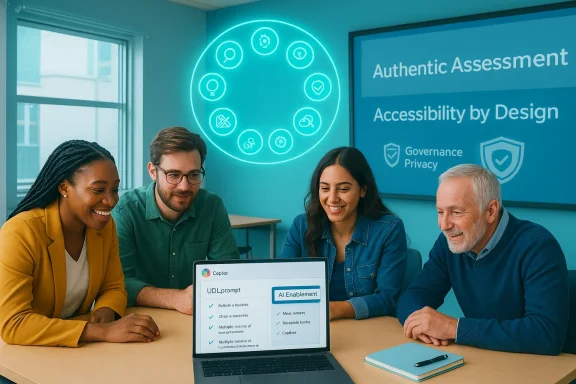
City Colleges of Chicago’s upcoming “AI in 45” workshop promises a compact, practice-oriented briefing for faculty that pairs an AI Enablement framework with hands-on use of Microsoft Copilot and free generative-AI tools—framing adoption explicitly through accessibility (Universal Design for Learning) and academic-integrity safeguards.
The session description published by City Colleges of Chicago presents three tightly coupled goals: introduce an AI Enablement Manifesto and its nine guiding principles, show how generative AI can be applied to real work rather than toy demos, and give faculty immediately actionable techniques to design authentic assessments and accessible content using Microsoft Copilot and free GenAI tools. The event is positioned as a practical, 45‑minute faculty workshop with hands‑on activities and demonstrable classroom applications.
“Enablement” in education has become shorthand for moving beyond novelty toward operational adoption—teaching educators how to integrate tools into real workflows while preserving pedagogy, fairness, and student agency. Outside the CCC announcement, multiple higher‑ed centers, research bodies, and education vendors are already aligning training and governance programs to the same mix of pedagogy + tool practice + oversight, arguing that professional development must pair skills, governance, and assessment redesign for AI to produce sustained benefit.
But attending faculty should arrive with concrete expectations and questions:
Source: colleges.ccc.edu AI in 45 Workshop: AI Enablement in Practice: Applying Generative AI Through the 9 Principles - CCC
 Background / Overview
The session description published by City Colleges of Chicago presents three tightly coupled goals: introduce an AI Enablement Manifesto and its nine guiding principles, show how generative AI can be applied to real work rather than toy demos, and give faculty immediately actionable techniques to design authentic assessments and accessible content using Microsoft Copilot and free GenAI tools. The event is positioned as a practical, 45‑minute faculty workshop with hands‑on activities and demonstrable classroom applications.“Enablement” in education has become shorthand for moving beyond novelty toward operational adoption—teaching educators how to integrate tools into real workflows while preserving pedagogy, fairness, and student agency. Outside the CCC announcement, multiple higher‑ed centers, research bodies, and education vendors are already aligning training and governance programs to the same mix of pedagogy + tool practice + oversight, arguing that professional development must pair skills, governance, and assessment redesign for AI to produce sustained benefit.
What the workshop promises (short summary)
- Introduce the AI Enablement Manifesto and nine principles as a conceptual frame for adoption.
- Demonstrate practical strategies to integrate generative AI into teaching using Microsoft Copilot and free tools, with an emphasis on transforming real work.
- Align AI practices with Universal Design for Learning (UDL) so accessibility and inclusive design govern how AI is used in classroom materials.
- Hands‑on activities to design authentic assessments and produce accessible content faculty can use immediately.
Why the framing matters: enablement, not novelty
From demos to work that matters
Many campus AI trainings focus on demos (generate a quiz, rewrite a paragraph). The language used by CCC—transform real work—signals a different aim: show faculty how AI can reshape the tasks educators already perform (designing rubrics, creating differentiated practice, accelerating administrative feedback loops) rather than simply illustrating flashy outputs. This mirrors guidance from instructional‑design research and practitioner reports which argue adoption succeeds when tools address clear pain points and when faculty retain control over learning design.The nine principles: pragmatic governance + pedagogy
The event references an AI Enablement Manifesto with nine principles. I could not locate a single, canonical public document titled “AI Enablement Manifesto” with an authoritative list of nine principles on major policy or vendor sites, which suggests the manifesto referenced may be a workshop‑specific framework or an internal synthesis rather than a widely circulated standard. That does not reduce its pedagogical value, but faculty and administrators should treat it as a contextual framework and ask for the full text and operational definitions when attending. Flag: verify the manifesto text with the workshop organizers for precise wording and obligations.Evidence and independent context: what other institutions are doing
- Microsoft’s education outreach positions Copilot as a productivity assistant for teachers that can help with lesson planning, differentiated content, and translation—explicitly recommending checks for accuropriateness and showing how Copilot can be combined with UDL‑style prompts for accessibility. Microsoft guidance includes practical examples for lesson analysis and iterations that align with the workshop’s stated aims.
- CAST (the primary UDL organization) and multiple universities have run workshops linking Generative AI + UDL, arguing that AI can amplify inclusive practices by producing multiple formats, supporting personalization, and scaffolding diverse learners—provided accessibility and ethics are baked into design. CAST also runs advisory boards and training programs explicitly connecting AI with UDL principles.www.cast.org/resources/course/prek-12-artificial-intelligence-for-udl-self-directed-august-2025/)
- Institutional case studies show the operational choices needed for scale: Brisbane Catholic Education’s Copilot rollout (reported internally) claimed substantial teacher time savings when paired with governance and training; other colleges have set up AI task groups to centralize policy and procurement while piloting classroom uses. These pragmatic roadmaps stress central governance, staged pilots, and vendor contract safeguards.
Practical, classroom‑ready strategies the workshop should (and likely will) teach
Below I translate the session promises into concrete practices any faculty member can apply immediately. These are the kinds of techniques the workshop description signals and that independent guidance validates.1) Treat AI outputs as draft material — require process evidence
- Require staged submissions: outlines, AI‑assisted drafts, revision memos, final submission. This keeps cognitive work visible and traces student reasoning.
- Ask students to submit prompt logs or short annotations describing whicion were AI‑generated, what prompts were used, and what verification steps they took. Prompt logs convert AI use into a teachable skill rather than a hidden shortcut.
2) Design authentic assessments that AI can’t fully automate
- Create assessments that require:
- local, dataset‑bound analysis (e.g., projects using campus data),
- staged collaboration with peer review, or
- oral defenses of AI‑assisted work.
These force students to perform judgment and domain‑specific reasoning that generic models cannot replicate.
3) Use Copilot and free GenAI tools purposefully for differentiation and accessibility
- Use Copilot to generate multiple reading levels, language translations, or scaffolded prompts aligned with UDL goals; bw to check for nuance and bias. Microsoft’s educator guidance shows specific prompts and document upload workflows to generate UDL‑aligned suggestions.
4) Build verification workflows into grading rubrics
- Add rubric items that assess students’ ability to:
- identify hallucinations or factual errors,
- document source verification steps, and
- explain edits they made to AI drafes a measure of editing skill, not just output quality.
5) Prioritize accessibility from day one
- When AI generates alternative formats (audio, simplified text, captions), validate them with assistive‑technology experts or disability services. CAST and other UDL resources emphasize co‑design with learners to ensure outputs are genuinely usable.
Governance, procurement, and vendor risk — what the workshop should cover (and why it matters)
Vendor risk and contractual safeguards
- Insist on contractual clauses that address: no implicit retraining on institutional data, data deletion/portability, audit logs, and clear SLAs for privacy and uptime. University case studies repeatedly show vendor claims must be contractually enforced, not simply accepted.
Centralized procurement with local flexibility
- Create standardized, approved tool lists (Copilot for enterprise accounts, vetted open‑source tools) and allow faculty to use them under clear guidance. This limits shadow IT and protects student data while enabling experimentation.
Observability and logging
- Capture usage metrics and prompt logs in ways that preserve privacy but allow administrators to monitor adoption, spot misuse, and evaluate learning impact. Observability helps leadership move from anecdote to evidence.
Strengths: why the CCC approach has merit
- Concise, applied format: A 45‑minute workshop with hands‑on tasks lowers the barrier for busy faculty to try techniques and gain immediate return. Short, focused PD is more likely to be adopted than long, theoretical sessions.
- UDL emphasis: Explicitly tying AI practicese with accessibility, which is both ethically and legally important. CAST and universities have shown this combination reduces the chance that AI simply replicates inequitable practices.
- Tool realism: Using Microsoft Copilot alongside free GenAI tools prepares faculty for the mixed tool environments students will actually encounter in workplaces. Practical, vendor‑aware training helps close the gap between experiment and scale.
Risks and limits: what the workshop must not overpromise
- Manifesto provenance and operational clarity
- The event references an “AI Enablement Manifesto” with nine principles but does not publish it in the event listing. Faculty should ask for the manifesto text and a one‑page operational checklist to ensure the principles translate into classroom rules and assessment changes. Unverified claims about the manifesto should be treated as workshop framing until the text is provided.
- Hallucinations and factual accuracy
- Generative models can produce plausible but incorrect content. Workshops must stress verification workflows and require students/faculty to cite independent, primary sources. Failure to do so weakens learning outcomes and risks disseminating misinformation.
- Equity of access
- Not all learners have equal device or broadband access. Institutionally centered tools can widen gaps if remote learners can’t use the same toolset. Pilot strategies must include device‑loan programs or in‑lab access.
- Vendor lock‑in and sustainability
- Heavy reliance on proprietary platforms without exportable logs and data portability clauses can create long‑term procurement debts. Institutions should demand exportability and plan for vendor exit strategies.
- Assessment validity
- If institutions don’t redesign assessments, AI can produce a superficial bump in output quality without improving deeper learning. Assessment redesign is essential and time‑consuming; a single workshop cannot replace iterative course redesign.
A disciplined, 7‑step classroom adoption blueprint (practical checklist)
- Define the pedagogical pain point you want AI to address (e.g., provide faster formative feedback, produce accessible materials, scale practice opportunities).
- Select approved tools and align account provisioning through campus IT (Copilot via institution account for data protections; vetted free tools for experimentation).
- Design one authentic assessment redesigned for process visibility (staged submission + oral defense + prompt logs).
- Create explicit verification expectations and rubric items for AI evaluation (fact‑checking, source citatale).
- Pilot with a small instructor cohort and collect qualitative and quantitative data (student experience, time saved, learning outcomes).
- Engage disability services to review AI‑generated accessible materials and tweak prompts for real usefulness.
- Centralize governance: define procurement rules, privacy clauses, logging standards, and a review cadence (e.g., quarterly).
Classroom prompt templates and UDL patterns (practical examples)
- Lesson analysis for UDL (instructor prompt template): “You are an instructional designer specializing in Universal Design for Learning. Analyze the attached lesson plan and provide two suggestions to increase options for representation, two suggestions for offering multiple means of engagement, and two suggestions to reduce barriers to expression. Prioritize low‑cost, quick‑implement changes and flag any that require assistive technology review.” Microsoft publishes sample prompts and workflows to embed file context in Copilot requests; such patterns help ground AI responses in the actual course content.ps://www.microsoft.com/en-us/education/blog/2024/08/5-ways-copilot-can-help-you-start-the-school-year/)
- Prompt for differentiated practice: “Generate threof this lab assignment: one novice level with step‑by‑step hints, one intermediate, and one challenge variant. For each, provide a checklist of competencies students must show and an example student response.” Pair the output with rubric items that evaluate skill demonstration rather than mere completion.
Measuring impact: short, medium, long term indicators
- Short term (1–3 months): faculty time saved on preparation, number of accessible materials produced, faculty satisfaction with tool outputs.
- Medium term (3–12 months): measurable shifts in student formative performance, fidelity of prompt logs and process documentation, equity metrics for tool access.
- Long term (1+ year): changes in course pass rates attributable to redesigns, employer feedback on graduates’ AI‑augmented literacy, institutional cost/benefit for tool licensing.
Final assessment: what CCC’s workshop adds — and what to request at the session
City Colleges of Chicago’s “AI in 45” frames the right three priorities: enablement (practical how‑to), inclusion (UDL), and integrity (authentic assessment). That alignment reflects promising practice seen in other campus pilots and sector guidance.But attending faculty should arrive with concrete expectations and questions:
- Ask for the full text of the AI Enablement Manifesto and the explicit nine principles so you can evaluate operational implications.
- Request sample rubrics and prompt‑log templates you can immediately copy into your course LMS.
- Clarify institutional procurement and privacy rules for Copilot and third‑party tools. Who signs contracts? Where are logs stored? Is there a student‑data avoidance policy?
Conclusion
The “AI in 45” workshop is the kind of concise, practical professional development that campuses need right now: it promises to pair a principled enablement framework with immediate classroom practice, all framed by Universal Design for Learning and academic‑integrity safeguards. To convert that promise into durable change, faculty and administrators should use the session to extract operational artifacts—the manifesto text, rubrics, prompt logs, procurement rules—and commit to a pilot‑to‑policy path that includes verification, accessibility checks, and governance. When short, applied training is combined with centralized governance and assessment redesign, generative AI can move from disruptive novelty to a measured, inclusive pedagogical tool; when it is not, the obvious risks—hallucinations, inequitable access, vendor lock‑in—are the predictable consequences. The workshop is a good step; the real work is in the follow‑through.Source: colleges.ccc.edu AI in 45 Workshop: AI Enablement in Practice: Applying Generative AI Through the 9 Principles - CCC
