

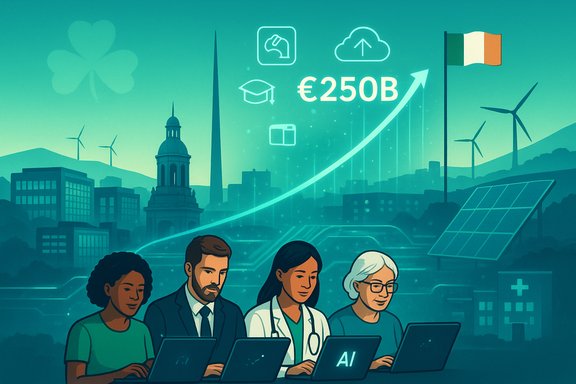
Catherine Doyle’s blunt framing of artificial intelligence as “a real opportunity” for Ireland — not a distant threat — now sits alongside hard numbers and national programmes that together make that claim hard to ignore: a Trinity College Dublin study, produced with Microsoft Ireland, projects AI could add at least €250 billion to Irish GDP by 2035, while Microsoft’s own Work Trend Index shows huge pressure on worker time that generative AI tools promise to relieve.
Catherine Doyle, General Manager of Microsoft Ireland, has foregrounded three linked messages in recent public remarks and interviews: AI can be a transformational national economic lever, it can restore time and productivity to overwhelmed workers, and widespread, inclusive skilling is essential if benefits are to be shared. Those themes appear in Microsoft’s Irish press materials and in the AI Economy in Ireland 2025 report produced by Trinity Business School in collaboration with Microsoft Ireland. These claims land in a concrete policy and business context. Ireland continues to host a dense cluster of hyperscale data centres and multinational cloud operations that make it both a logical testbed for AI deployment and a country facing consequential trade‑offs around infrastructure, energy and governance. The country’s government and industry stakeholders are already wrestling with questions about regulation, public-sector readiness and equitable access to skills. Independent reporting has documented both the upside of a concentrated tech ecosystem and the strains it creates on the local power grid.
Risks to watch:
Source: The Gloss Magazine Catching Up With The CEO: Catherine Doyle, Microsoft Ireland - The Gloss Magazine
 Background
Catherine Doyle, General Manager of Microsoft Ireland, has foregrounded three linked messages in recent public remarks and interviews: AI can be a transformational national economic lever, it can restore time and productivity to overwhelmed workers, and widespread, inclusive skilling is essential if benefits are to be shared. Those themes appear in Microsoft’s Irish press materials and in the AI Economy in Ireland 2025 report produced by Trinity Business School in collaboration with Microsoft Ireland. These claims land in a concrete policy and business context. Ireland continues to host a dense cluster of hyperscale data centres and multinational cloud operations that make it both a logical testbed for AI deployment and a country facing consequential trade‑offs around infrastructure, energy and governance. The country’s government and industry stakeholders are already wrestling with questions about regulation, public-sector readiness and equitable access to skills. Independent reporting has documented both the upside of a concentrated tech ecosystem and the strains it creates on the local power grid. What the numbers say: the €250 billion projection and what it actually means
The headline: €250 billion to GDP by 2035
The Trinity Centre for Digital Business and Analytics report — the AI Economy in Ireland 2025 — states that AI adoption could contribute at least €250 billion to Ireland’s GDP by 2035, with an additional upside of roughly €60 billion under scenarios with stronger policy support and broader adoption. That projection comes from modelling that links adoption trajectories, productivity gains and sectoral diffusion of AI.How to read the figure critically
- Scale and timing matter. The €250 billion is a projected cumulative uplift by 2035, not an immediate annual gain. Comparing baseline and AI-enhanced scenarios requires careful attention to assumptions about adoption speed, policy, and workforce transitions.
- Distribution matters. Trinity’s analysis warns explicitly that SMEs and the public sector risk being left behind — the report finds large firms lead adoption while SMEs trail, and only a small share of public organisations currently have formal AI policies. That means headline GDP gains could concentrate in specific sectors unless targeted measures are taken.
- Model risk. All macro projections rely on assumptions about productivity spillovers and regulatory environments. The downside scenario — slower adoption, weak governance or constrained infrastructure — would materially reduce the upside.
The workplace pressure point: why AI looks like a practical remedy now
The problem: workers don’t have enough time
Microsoft’s 2025 Work Trend Index, based on a 31,000‑person Edelman Data x Intelligence survey and Microsoft 365 telemetry, shows a striking human problem: roughly 80% of knowledge workers report lacking enough time or energy to complete their work properly. Employees are interrupted frequently, digital “noise” is rising, and many feel their workday has become fragmented and chaotic. Those findings underpin Microsoft’s argument that AI — if deployed responsibly — can restore capacity.Why that creates an opening for Copilot-style tools
Generative AI assistants and digital labour aim to remove repetitive, low‑value tasks (summarising, triaging inboxes, drafting routine documents), letting humans focus on higher‑value and creative work. Microsoft’s Copilot family — Microsoft 365 Copilot, GitHub Copilot, and consumer Copilot experiences — are positioned precisely to plug that gap inside familiar productivity flows. The Work Trend Index frames this as the rise of “Frontier Firms” that combine human talent and agentic AI to expand capacity.The nuance: productivity gains are not automatic
- AI will produce drafts, summaries and suggestions — but outputs still need verification, especially in regulated or safety‑critical settings.
- Early pilots often report novelty effects that inflate perceived time‑savings; durable gains require instrumentation, telemetry and role‑by‑role measurement.
- Governance is a precondition: shadow AI (employees using public tools without controls) introduces data‑leak and compliance risks that can erode gains. Trinity and Microsoft both highlight the persistence of “shadow AI culture,” underlining the governance imperative.
Skilling at scale: Skill Up Ireland and Microsoft’s national approach
What Skill Up Ireland actually is
Microsoft Ireland’s Skill Up Ireland bundles several programmes aimed at broad AI literacy and role‑based training: Dream Space for schools, adult learning pathways including a “Career Essentials Certificate in Generative AI,” and community-based Skill‑Up-A‑Thons delivered through local hubs in partnership with organisations like Fastrack into IT. The content is available free, and Microsoft positions the programme as aligned with Ireland’s National AI Strategy. The objective is explicit: widen access to AI skills so adoption doesn’t entrench inequality.Strengths of the approach
- Scale & recognition: Microsoft brings curriculum design, industry certificates and distribution reach, which can rapidly scale baseline AI fluency.
- Role-based pathways: Offering short, recognisable credentials helps bridge the gap between awareness and usable workplace skills.
- Public‑private fit: The programme is designed to complement government targets and existing education initiatives, which helps with legitimacy and coordination.
Limits and risks
- Credential value vs. job readiness: Industry micro‑certificates can signal intent, but employers still need to design role changes and training time into work plans for skills to stick.
- Access gaps remain: Uptake skews by role, age and gender in many markets; without targeted outreach, the same digital divides reappear.
- Vendor lock‑in concerns: When vendor‑led skilling couples closely with a single ecosystem, public planners must ensure open standards and transferable credentials. These are not fatal issues, but they require policy attention.
Real‑world Irish use cases: startups, health and civic examples
Prodensus: freight and logistics use case
Prodensus, a Kilkenny‑based startup, is an illustrative success story: it leverages Azure and Azure OpenAI to automate freight procurement, data cleaning and emissions reporting for logistics customers. Microsoft’s publicity materials describe measurable cost and emissions reductions for early customers and point to Microsoft for Startups support as a growth lever. This is an example of AI enabling SMEs to scale domain expertise and export services globally.FoodCloud and other social enterprises
The interview excerpt references FoodCloud as a beneficiary of Microsoft‑backed scaling, but a direct, recent Microsoft‑led case study connecting FoodCloud to Microsoft AI programmes is not readily locatable in public releases at the time of writing. FoodCloud is an established Irish social enterprise that digitises surplus food donation logistics; it has benefited from tech partnerships in the past, but any specific AI‑scale collaboration attributed to Microsoft in Catherine Doyle’s interview should be treated as plausible but not independently verified here. That claim should be followed up with Microsoft Ireland or FoodCloud for confirmation. (Flagged as unverifiable in public records consulted.Healthcare: St James’ Hospital and clinical workflows
The interview cites St James’ Hospital in Dublin as an example of operational modernisation that freed clinicians to spend more time on patient care. Microsoft and its Nuance/Dragon Medical family have publicised NHS and other health‑system pilots where ambient clinical capture and AI summarisation reduce clinician documentation time, but a specific public case study naming St James’ and quantifying outcomes was not found in the sources consulted for this piece. Large healthcare pilots do exist and are credible, but this particular hospital linkage should be treated as plausible and consistent with Microsoft’s healthcare deployments rather than as a fully verified case study without further primary confirmation.The workforce transition: job creation, displacement and reskilling
Catherine Doyle’s pragmatic view — “some jobs will change and new jobs will be created” — echoes mainstream economic thinking about general‑purpose technologies. Microsoft and Trinity both emphasise the need for re‑imagining job roles and for training to ensure talent for critical jobs exists. That is consistent with broader labour forecasts projecting both displacement of routine tasks and growth in AI‑adjacent roles (prompt engineers, model auditors, AI governance specialists). Key considerations for organisations:- Map tasks, not jobs. Identify routine tasks that AI can automate and preserve human tasks that rely on judgment, relationship‑building and domain expertise.
- Invest in transition training. Short, role‑specific learning pathways plus on‑the‑job coaching are essential.
- Create new career ladders. Roles such as “AI steward”, “agent supervisor” or “data provenance officer” will need career structures and compensation parity.
Microsoft Ireland’s strategy: opportunity, market power and strategic risk
Microsoft’s public posture is straightforward: embed AI into the products users already rely on (Office, Teams, GitHub) and provide cloud infrastructure and governance tools that enterprises can trust. That is a powerful GTM (go‑to‑market) strategy — it combines distribution, tooling and enterprise credibility. However, it also concentrates influence and raises legitimate questions about competition, standards and governance. Independent analysis of Microsoft’s AI pivot describes deliberate cannibalisation of legacy products and high capital allocation to AI infrastructure; these strategic choices create both advantage and execution risk.Risks to watch:
- Infrastructure & energy: Concentrated AI compute growth increases electricity demand; Ireland has already faced grid stress and procurement pauses for data‑centre builds. National energy policy must be aligned with AI infrastructure planning.
- Governance & shadow AI: The Trinity report and other studies highlight widespread unauthorized AI use inside organisations; unmanaged use creates regulatory and data security risks.
- Concentration & lock‑in: Embedding agentic AI into a single productivity stack raises switching costs and limits competitive choices unless the ecosystem embraces model‑choice, open standards and interoperability.
Policy and corporate recommendations for maximising societal benefit
For government and regulators
- Prioritise a national AI infrastructure plan that balances economic competitiveness with grid stability and renewable energy targets.
- Fund and accredit transferable credentials for AI skills so public and private training stack without vendor lock‑in.
- Require procurement contracts for public services to include auditability, provenance and human‑in‑the‑loop safeguards for AI outputs.
For business leaders and IT teams
- Treat AI adoption as a process of organisational redesign, not a licensing decision: allocate time for training, pilot scalable use cases, and instrument outcomes.
- Build governance early: tenant controls, non‑training guarantees, and documented prompt/audit trails should be standard.
- Measure net productivity: combine telemetry, independent time‑and‑motion studies and staff surveys to verify durable gains beyond the pilot novelty.
For workers and educators
- Focus on role‑adjacent skills: AI literacy, data provenance awareness, and domain expertise combined with human skills (judgment, ethics, stakeholder management) will be durable assets.
- Use national resources such as Skill Up Ireland as a launchpad, but insist on employer time and supportive on‑the‑job pathways so credentials convert into promotions and role redesigns.
Strengths, weaknesses and a sober verdict
Strengths
- The combination of Trinity College’s academic modelling and Microsoft’s telemetry‑backed workplace research creates a strong, evidence‑based narrative about AI’s potential economic and productivity impact in Ireland.
- Microsoft Ireland’s skilling programmes are well‑designed to reach a broad audience and align with national strategy goals.
- Real commercial cases (e.g., Prodensus) demonstrate domain‑specific AI gains that go beyond generic productivity slogans.
Weaknesses and risks
- Macro projections depend on a set of optimistic adoption and policy assumptions; they are achievable but not automatic.
- Infrastructure constraints (notably energy) and the governance gap created by shadow AI are material operational risks that require public‑private coordination.
- Some case claims referenced in executive interviews (for example, specific FoodCloud or St James’ Hospital modernisation outcomes) are either not publicly documented in detail or require direct verification from the named institutions. Those items should be treated as illustrative rather than definitive until a primary case study or evaluation is published. (Flagged as unverifiable in public records consulted.
Practical next steps for Irish leaders who want to convert projections into reality
- Establish a national “AI adoption scoreboard” that tracks adoption across sectors, SME participation, public‑sector policy readiness and measurable productivity outcomes.
- Fund regional skilling hubs that deliver recognised credentials, employer‑backed apprenticeships and small‑business grants to implement AI in defensible, governed pilots.
- Tie energy and infrastructure planning to projected AI compute demand with legally binding renewable and resilience targets.
- Insist on transparent procurement clauses for public-sector AI projects: audit logs, human sign‑off for legal records, and model‑choice guarantees.
Conclusion
Catherine Doyle’s argument that AI is an “opportunity, not just a threat” rests on several verifiable foundations: a credible academic projection from Trinity College Dublin, workplace telemetry showing chronic time and attention pressures, and a national skilling push through Microsoft’s Skill Up Ireland. Those pillars — economic potential, demand for capacity restoration, and skilling at scale — form a coherent case for ambitious but disciplined AI adoption in Ireland. The caveat is clear: large macro gains require sustained public policy, robust governance to close the shadow‑AI gap, and energy planning that keeps infrastructure growth sustainable. Where Microsoft and the Irish public sector act together to skilling, governance and infrastructure, the projected gains become realistic. Where coordination lapses, the same technologies threaten to concentrate benefits or introduce new systemic risks. The next decade will therefore be a policy and execution test, not just a technology one — and Ireland’s choices now will determine whether the €250 billion projection becomes a national achievement or a missed opportunity.Source: The Gloss Magazine Catching Up With The CEO: Catherine Doyle, Microsoft Ireland - The Gloss Magazine
