

About 805,000 students finished college in the Philippines in academic year 2023–2024, and Ascendion executives in Makati are arguing that AI will not erase their first jobs so much as move the first rung higher. That distinction matters because the offshore technology and services model that helped absorb Filipino graduates for two decades is being rebuilt around agents, copilots, and platform-led delivery. The optimistic version is that fresh graduates become faster, better-supported workers. The less comfortable version is that many of the tasks that once taught beginners how work works are exactly the tasks AI is now built to consume.
The most important sentence in the AI labor debate is not “AI will replace jobs.” It is “AI will replace the training ground.” Entry-level work has always contained a bargain: employers tolerate lower productivity because cheap beginner labor handles repeatable tasks while graduates learn judgment, domain language, escalation paths, and the politics of production systems.
AI changes that bargain. The more routine the task, the easier it is to automate, summarize, route, draft, test, or pre-fill. But routine work is also where graduates historically learned the difference between a classroom answer and a client answer.
That is why Vaibhav Vora’s argument lands with both force and ambiguity. As Ascendion’s chief technology officer, he is selling the move from AI pilots to production, and he is doing it in a market where young workers are asking whether production still needs them. His answer is yes — but not as they are.
The entry-level role, in his telling, is being “remodeled.” That is a softer word than displaced, and it is not necessarily wrong. It is also not a guarantee that the same number of people will get through the door.
His explanation is not that companies lack AI tools. It is that they lack production discipline. In boardrooms and innovation labs, AI has become easy to demo and hard to operationalize: a chatbot here, a code assistant there, a proof of concept that never survives integration with compliance, data quality, legacy software, procurement, and real customer workflows.
This is where Ascendion wants to place itself. The company calls itself AI-native and platform-driven, and its in-house AAVA system is presented as more than a wrapper around a model. It is pitched as a way to run AI agents across the software development life cycle — design, coding, testing, deployment, modernization, and support — instead of applying AI to isolated tasks.
That platform story is increasingly the story every services company wants to tell. The old offshore model sold people. The new model sells people plus automation plus measurable velocity. The customer no longer just asks how many engineers are available in Manila, Bengaluru, or Cebu. The customer asks how much work can be taken out of the process before the staffing plan is even written.
But Vora’s defense is stronger than a slogan. Modernization may be old, but the method is changing. Ascendion points to examples where AI agents reverse-engineer legacy code, compress testing cycles, and reduce the cost of large rebuilds. The company has promoted cases involving bank modernization at a fraction of traditional cost and faster delivery timelines.
The exact numbers deserve the usual skepticism applied to vendor case studies. They are selected examples, not labor-market forecasts. But they still reveal the economics clients are buying: fewer hours per unit of work, faster cycle times, more visibility into engineering activity, and a workforce whose value is measured by what it can orchestrate rather than what it can manually grind through.
That matters for graduates because services firms are not charities designed to preserve the old ladder. If AI reduces the amount of human effort needed for migration, testing, documentation, analysis, and support, the industry will not hire beginners merely because beginners need practice. It will hire them when they can contribute inside the new machine.
Those jobs trained workers in corporate rhythm. They taught service-level agreements, ticket queues, scripts, escalation, quality monitoring, accent neutrality, client systems, and the invisible discipline of doing standardized work at scale. From there, some workers moved into team leadership, analytics, project management, software engineering, cybersecurity, cloud operations, or product support.
AI attacks precisely the standardized layer. In customer service, it can summarize caller history, recommend responses, surface account details, detect sentiment, translate, classify intent, and generate follow-up notes. In software delivery, it can draft boilerplate, write tests, document APIs, search codebases, and help modernize old systems. In content work, it can produce first drafts at a speed that has already damaged freelance writing markets.
The Philippines therefore faces a sharper version of the global question. If AI removes the simple work, how do new workers become skilled enough to do the complex work? A country cannot build an AI-ready workforce by assuming everyone starts at intermediate level.
That is the best case for AI in service work. Nobody loves forcing a customer to repeat information while an agent jumps between old screens. Nobody should romanticize the drudgery of swivel-chair integration, where the human being functions as middleware because enterprise systems do not talk to one another.
If AI gives agents context, reduces handle time, and lowers frustration, the job can become better. The worker spends less energy hunting for data and more energy solving the customer’s problem. The customer gets a faster resolution. The employer gets productivity.
But the same example contains the harder implication. If calls take one-tenth of the time, the system has created capacity. That capacity can be used to improve service, absorb growth, reduce overtime, expand scope, or cut staffing. Which outcome occurs is not determined by the model; it is determined by management, demand, contracts, and cost pressure.
Executives often talk about AI as augmentation because augmentation is what they can defend publicly. It is also often accurate at the level of the individual worker. A customer service agent with better context is augmented. A developer with an AI testing assistant is augmented. A junior analyst who can query data in natural language is augmented.
At the level of the operating model, however, augmentation can still mean fewer hires. If every employee can do more, the company may need fewer employees to hit the same output. If growth is strong, hiring can continue. If the client mandate is cost reduction, productivity becomes a headcount story even when nobody says the word replacement.
That is why the global capability center example is telling. Vora described meeting a GCC leader under pressure from headquarters to cut costs. AI was the mechanism for delivering savings while moving people into higher-impact work. Both halves can be true, but workers live in the gap between them.
That is sensible advice. It is also a higher bar than the old entry-level bargain. A graduate once could enter a process-heavy role, learn the domain, and gradually acquire technical depth. Now employers increasingly want the graduate to show up with enough abstraction, data literacy, and tool fluency to supervise automation from day one.
There is a class dimension here that the industry does not like to dwell on. Students with better universities, better internet access, stronger English training, paid bootcamps, current hardware, and time to experiment with AI tools will adapt faster. Students who worked through college, shared devices, or studied in under-resourced programs may be told to reskill for a rung they were never given a fair chance to reach.
The phrase “learn prompt engineering” also risks underselling the challenge. Prompting is not magic wording. In serious work, it means knowing the domain well enough to ask for the right output, constrain the model, check the answer, protect sensitive data, and understand when confidence is fake. That is not a beginner trick. It is judgment wearing a new interface.
AI coding agents are another turn of that wheel, but they are different in tone. They do not just automate a known command; they produce plausible work product. That makes them powerful and dangerous. A junior developer can move faster, but can also generate larger mistakes with greater confidence.
This is why the “fresh graduates are fastest to adopt tools” argument has limits. Young hires may be less attached to old workflows and more comfortable with copilots. But enterprise engineering is not a speedrun through a tutorial. It is dependency management, security review, testing discipline, regulatory context, maintainability, and the humility to know that legacy code is often ugly because the business is ugly.
AI can help modernize old systems, including the COBOL-era and mainframe-adjacent worlds that still haunt banks, insurers, airlines, governments, and logistics firms. Yet modernization is not only translation from one language to another. It is archaeology. It requires understanding why a rule exists, which downstream system depends on it, and what breaks when an apparently redundant path disappears.
That kind of work can create jobs for young engineers — but not if companies treat AI output as a substitute for mentorship. A graduate paired with strong reviewers and good internal platforms can grow quickly. A graduate left to accept model suggestions without context becomes a liability at machine speed.
If the agent sees a neat summary instead of the messy customer history, does the agent learn the system or merely trust the summary? If AI recommends the next best action, does the worker understand the policy logic or just click the workflow? If supervisors evaluate productivity through AI-mediated dashboards, do they notice when judgment is improving or only when handle time falls?
The old model was often exhausting and unfair, but it exposed workers to volume. Volume matters. You learn edge cases by seeing many cases. You learn customer psychology by hearing the same confusion expressed 50 different ways. You learn process failure by watching where the script breaks.
AI can accelerate that learning if designed intentionally. It can show why a recommendation was made, compare cases, simulate calls, and coach workers. But if designed only for efficiency, it will turn the beginner into an operator of a black box — faster than before, but less able to grow beyond it.
Roehrig’s argument that the backlog of undone modernization work may exceed the work automated away is plausible. Many organizations have postponed core upgrades for years because they were too risky, too expensive, or too disruptive. If AI lowers the cost of modernization, new projects may become viable.
But “may” is doing a lot of work. The jobs created by modernization do not automatically appear in the same city, at the same skill level, for the same graduates whose entry-level tasks disappeared. Labor markets are not hydraulic systems where displaced effort flows neatly into higher-value work.
This is where governments, universities, and industry groups need more than reskilling slogans. They need apprenticeship models that assume AI is present from the beginning. They need curricula that combine fundamentals with tool use, and internships where students work on real workflows under supervision rather than collect certificates for generic AI literacy.
The Commission on Higher Education number — roughly 805,000 graduates in one academic year — is not just a statistic. It is a pipeline. If the receiving end of that pipeline narrows, the social consequences will be broader than one company’s hiring plan.
But the graduate advantage is no longer that they are inexpensive hands for repetitive tasks. It is adaptability. Employers will prize workers who can learn a domain quickly, use AI without being fooled by it, communicate clearly, and move between technical and business contexts.
That means the humanities-versus-STEM argument is due for retirement. Analytical reasoning matters. Writing matters. Statistics matter. Systems thinking matters. Domain curiosity matters. The worker who can ask a precise question, evaluate an answer, and explain the risk to a nontechnical manager will be more valuable than the worker who merely knows which button launches a model.
This is also why “just learn Python” is necessary but insufficient. Python is a useful tool because it teaches computational thinking and opens doors to automation, data work, and AI experimentation. But a graduate who knows Python syntax without understanding data quality, business process, or security constraints will still struggle in production environments.
That normalization will make AI literacy less exotic and more mandatory. A graduate entering a GCC or BPO environment may not be asked whether they “use AI” any more than they are asked whether they use email. The assumption will be that AI is part of the workflow, governed by company policy, monitored by security, and measured through productivity metrics.
For IT administrators, that creates a different set of pressures. They must manage data access, identity, audit trails, model permissions, endpoint security, and user training. A poorly governed copilot can leak sensitive information, amplify bad data, or create compliance headaches. A well-governed one can reduce toil and improve service quality.
The graduate caught in this environment needs to understand not only how to ask the machine for help, but when the machine should not be asked at all. That is a security skill, an ethics skill, and a workplace survival skill. The beginner who pastes customer data into the wrong tool is not future-ready; they are a breach report waiting to happen.
Near the close of the debate, the concrete lessons are less dramatic than the headlines but more useful:
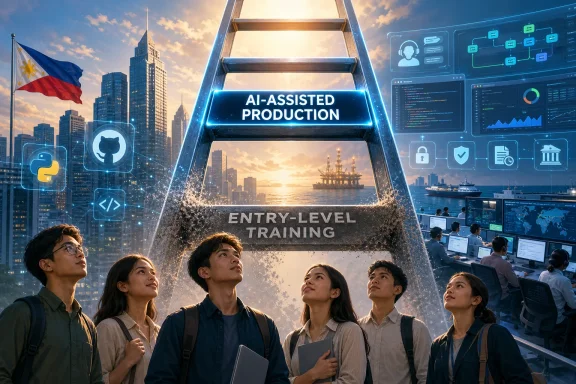 The First Job Is Becoming a Second Job
The most important sentence in the AI labor debate is not “AI will replace jobs.” It is “AI will replace the training ground.” Entry-level work has always contained a bargain: employers tolerate lower productivity because cheap beginner labor handles repeatable tasks while graduates learn judgment, domain language, escalation paths, and the politics of production systems.AI changes that bargain. The more routine the task, the easier it is to automate, summarize, route, draft, test, or pre-fill. But routine work is also where graduates historically learned the difference between a classroom answer and a client answer.
That is why Vaibhav Vora’s argument lands with both force and ambiguity. As Ascendion’s chief technology officer, he is selling the move from AI pilots to production, and he is doing it in a market where young workers are asking whether production still needs them. His answer is yes — but not as they are.
The entry-level role, in his telling, is being “remodeled.” That is a softer word than displaced, and it is not necessarily wrong. It is also not a guarantee that the same number of people will get through the door.
Pilot Purgatory Has Become the New Enterprise Excuse
Vora’s diagnosis begins with a familiar enterprise contradiction: companies keep spending more on technology without getting proportional gains in productivity. McKinsey has described the U.S. pattern as roughly 8 percent annual growth in technology spending since 2022 against labor productivity growth closer to 2 percent, while acknowledging that the relationship is not tidy. Vora says the pattern extends beyond the United States into Europe and Asia-Pacific, including the Philippines.His explanation is not that companies lack AI tools. It is that they lack production discipline. In boardrooms and innovation labs, AI has become easy to demo and hard to operationalize: a chatbot here, a code assistant there, a proof of concept that never survives integration with compliance, data quality, legacy software, procurement, and real customer workflows.
This is where Ascendion wants to place itself. The company calls itself AI-native and platform-driven, and its in-house AAVA system is presented as more than a wrapper around a model. It is pitched as a way to run AI agents across the software development life cycle — design, coding, testing, deployment, modernization, and support — instead of applying AI to isolated tasks.
That platform story is increasingly the story every services company wants to tell. The old offshore model sold people. The new model sells people plus automation plus measurable velocity. The customer no longer just asks how many engineers are available in Manila, Bengaluru, or Cebu. The customer asks how much work can be taken out of the process before the staffing plan is even written.
Ascendion’s Pitch Is Also the Industry’s Tell
It is tempting to dismiss the “pilot to production” argument as vendor positioning, because modernization is what firms like Ascendion already sell. Every services company has a slide showing legacy systems, trapped budgets, slow delivery, and a miraculous operating model that turns backlog into business value. The vocabulary changes; the invoice remains.But Vora’s defense is stronger than a slogan. Modernization may be old, but the method is changing. Ascendion points to examples where AI agents reverse-engineer legacy code, compress testing cycles, and reduce the cost of large rebuilds. The company has promoted cases involving bank modernization at a fraction of traditional cost and faster delivery timelines.
The exact numbers deserve the usual skepticism applied to vendor case studies. They are selected examples, not labor-market forecasts. But they still reveal the economics clients are buying: fewer hours per unit of work, faster cycle times, more visibility into engineering activity, and a workforce whose value is measured by what it can orchestrate rather than what it can manually grind through.
That matters for graduates because services firms are not charities designed to preserve the old ladder. If AI reduces the amount of human effort needed for migration, testing, documentation, analysis, and support, the industry will not hire beginners merely because beginners need practice. It will hire them when they can contribute inside the new machine.
The Philippines Is Not a Side Market in This Debate
The Philippines is exposed to this shift because it became very good at the last one. Business process outsourcing, shared services, and global capability centers helped turn English fluency, service culture, and a young workforce into a durable export engine. For many graduates, the first job was not glamorous, but it was legible: customer support, technical help desk, QA testing, reporting, content work, back-office processing.Those jobs trained workers in corporate rhythm. They taught service-level agreements, ticket queues, scripts, escalation, quality monitoring, accent neutrality, client systems, and the invisible discipline of doing standardized work at scale. From there, some workers moved into team leadership, analytics, project management, software engineering, cybersecurity, cloud operations, or product support.
AI attacks precisely the standardized layer. In customer service, it can summarize caller history, recommend responses, surface account details, detect sentiment, translate, classify intent, and generate follow-up notes. In software delivery, it can draft boilerplate, write tests, document APIs, search codebases, and help modernize old systems. In content work, it can produce first drafts at a speed that has already damaged freelance writing markets.
The Philippines therefore faces a sharper version of the global question. If AI removes the simple work, how do new workers become skilled enough to do the complex work? A country cannot build an AI-ready workforce by assuming everyone starts at intermediate level.
The Call Center Example Cuts Both Ways
Vora’s clearest example is a customer service operation in the Philippines where the average call reportedly fell from 20 minutes to two or three minutes after AI tools were introduced. He says headcount did not decline. Agents were not replaced; they were equipped with a unified view of caller history and preferences that previously required searching across roughly 10 systems.That is the best case for AI in service work. Nobody loves forcing a customer to repeat information while an agent jumps between old screens. Nobody should romanticize the drudgery of swivel-chair integration, where the human being functions as middleware because enterprise systems do not talk to one another.
If AI gives agents context, reduces handle time, and lowers frustration, the job can become better. The worker spends less energy hunting for data and more energy solving the customer’s problem. The customer gets a faster resolution. The employer gets productivity.
But the same example contains the harder implication. If calls take one-tenth of the time, the system has created capacity. That capacity can be used to improve service, absorb growth, reduce overtime, expand scope, or cut staffing. Which outcome occurs is not determined by the model; it is determined by management, demand, contracts, and cost pressure.
“No Replacement” Is a Statement of Intent, Not a Law of Economics
Vora says Ascendion is not about job replacement. Paul Roehrig, the company’s chief strategy and marketing officer, is more blunt: people can see that the same work may require fewer hands, and that may be true. The tension between those two statements is the real story.Executives often talk about AI as augmentation because augmentation is what they can defend publicly. It is also often accurate at the level of the individual worker. A customer service agent with better context is augmented. A developer with an AI testing assistant is augmented. A junior analyst who can query data in natural language is augmented.
At the level of the operating model, however, augmentation can still mean fewer hires. If every employee can do more, the company may need fewer employees to hit the same output. If growth is strong, hiring can continue. If the client mandate is cost reduction, productivity becomes a headcount story even when nobody says the word replacement.
That is why the global capability center example is telling. Vora described meeting a GCC leader under pressure from headquarters to cut costs. AI was the mechanism for delivering savings while moving people into higher-impact work. Both halves can be true, but workers live in the gap between them.
The New Graduate Is Being Asked to Arrive Pre-Remodeled
The most practical part of Vora’s advice is also the most revealing. He tells young people, including his own university-bound son, to build strong fundamentals, learn analytical reasoning, move toward Python, develop data science grounding, and become fluent with tools such as Claude and Microsoft Copilot. In other words: do not merely learn to code; learn to work with systems that code, summarize, test, and reason probabilistically.That is sensible advice. It is also a higher bar than the old entry-level bargain. A graduate once could enter a process-heavy role, learn the domain, and gradually acquire technical depth. Now employers increasingly want the graduate to show up with enough abstraction, data literacy, and tool fluency to supervise automation from day one.
There is a class dimension here that the industry does not like to dwell on. Students with better universities, better internet access, stronger English training, paid bootcamps, current hardware, and time to experiment with AI tools will adapt faster. Students who worked through college, shared devices, or studied in under-resourced programs may be told to reskill for a rung they were never given a fair chance to reach.
The phrase “learn prompt engineering” also risks underselling the challenge. Prompting is not magic wording. In serious work, it means knowing the domain well enough to ask for the right output, constrain the model, check the answer, protect sensitive data, and understand when confidence is fake. That is not a beginner trick. It is judgment wearing a new interface.
Software Engineering Is Becoming More Supervised and Less Forgiving
For WindowsForum readers, the software side of this shift should feel familiar. Developers have spent decades automating away their own lower-level tasks. Compilers, frameworks, package managers, cloud platforms, CI/CD pipelines, infrastructure as code, and low-code tools all changed what counted as entry-level competence.AI coding agents are another turn of that wheel, but they are different in tone. They do not just automate a known command; they produce plausible work product. That makes them powerful and dangerous. A junior developer can move faster, but can also generate larger mistakes with greater confidence.
This is why the “fresh graduates are fastest to adopt tools” argument has limits. Young hires may be less attached to old workflows and more comfortable with copilots. But enterprise engineering is not a speedrun through a tutorial. It is dependency management, security review, testing discipline, regulatory context, maintainability, and the humility to know that legacy code is often ugly because the business is ugly.
AI can help modernize old systems, including the COBOL-era and mainframe-adjacent worlds that still haunt banks, insurers, airlines, governments, and logistics firms. Yet modernization is not only translation from one language to another. It is archaeology. It requires understanding why a rule exists, which downstream system depends on it, and what breaks when an apparently redundant path disappears.
That kind of work can create jobs for young engineers — but not if companies treat AI output as a substitute for mentorship. A graduate paired with strong reviewers and good internal platforms can grow quickly. A graduate left to accept model suggestions without context becomes a liability at machine speed.
The BPO Training Ladder Is Losing Its Lower Steps
The same danger appears outside software. Customer service roles used to teach workers how products fail, how customers describe problems, how policies collide with reality, and how systems encode business decisions. AI can remove some pain from that work, but it can also hide the raw material from which expertise is built.If the agent sees a neat summary instead of the messy customer history, does the agent learn the system or merely trust the summary? If AI recommends the next best action, does the worker understand the policy logic or just click the workflow? If supervisors evaluate productivity through AI-mediated dashboards, do they notice when judgment is improving or only when handle time falls?
The old model was often exhausting and unfair, but it exposed workers to volume. Volume matters. You learn edge cases by seeing many cases. You learn customer psychology by hearing the same confusion expressed 50 different ways. You learn process failure by watching where the script breaks.
AI can accelerate that learning if designed intentionally. It can show why a recommendation was made, compare cases, simulate calls, and coach workers. But if designed only for efficiency, it will turn the beginner into an operator of a black box — faster than before, but less able to grow beyond it.
The Vendor Promise Needs a Public Policy Counterweight
Ascendion’s position is not cynical. Companies like it are responding to real client demand. Enterprise technology estates are full of technical debt, duplicated systems, fragile integrations, manual testing, old code, and documentation nobody trusts. There is more work to do than there are people available to do it the old way.Roehrig’s argument that the backlog of undone modernization work may exceed the work automated away is plausible. Many organizations have postponed core upgrades for years because they were too risky, too expensive, or too disruptive. If AI lowers the cost of modernization, new projects may become viable.
But “may” is doing a lot of work. The jobs created by modernization do not automatically appear in the same city, at the same skill level, for the same graduates whose entry-level tasks disappeared. Labor markets are not hydraulic systems where displaced effort flows neatly into higher-value work.
This is where governments, universities, and industry groups need more than reskilling slogans. They need apprenticeship models that assume AI is present from the beginning. They need curricula that combine fundamentals with tool use, and internships where students work on real workflows under supervision rather than collect certificates for generic AI literacy.
The Commission on Higher Education number — roughly 805,000 graduates in one academic year — is not just a statistic. It is a pipeline. If the receiving end of that pipeline narrows, the social consequences will be broader than one company’s hiring plan.
The Fresh Graduate Still Has an Edge, but It Is Not Cheapness
There is a hopeful reading of this moment: fresh graduates may be better suited to AI-era work than mid-career employees whose value is tied to old processes. Vora says his early-career program, called 10X, relies heavily on entry-level employees, and that some of the strongest performers are recent graduates. That tracks with a broader pattern in technology adoption. People who have not yet built habits around old tools can sometimes leapfrog.But the graduate advantage is no longer that they are inexpensive hands for repetitive tasks. It is adaptability. Employers will prize workers who can learn a domain quickly, use AI without being fooled by it, communicate clearly, and move between technical and business contexts.
That means the humanities-versus-STEM argument is due for retirement. Analytical reasoning matters. Writing matters. Statistics matter. Systems thinking matters. Domain curiosity matters. The worker who can ask a precise question, evaluate an answer, and explain the risk to a nontechnical manager will be more valuable than the worker who merely knows which button launches a model.
This is also why “just learn Python” is necessary but insufficient. Python is a useful tool because it teaches computational thinking and opens doors to automation, data work, and AI experimentation. But a graduate who knows Python syntax without understanding data quality, business process, or security constraints will still struggle in production environments.
Windows, Copilots, and the Normalization of AI at Work
For the Windows ecosystem, the graduate labor story is inseparable from the software environment workers will inherit. Microsoft Copilot, GitHub Copilot, Azure AI services, Power Platform, Teams integrations, and Windows-based enterprise tooling are turning AI from a special project into an ambient layer of daily work. The office suite, the IDE, the ticketing workflow, and the endpoint are all becoming places where AI suggestions appear.That normalization will make AI literacy less exotic and more mandatory. A graduate entering a GCC or BPO environment may not be asked whether they “use AI” any more than they are asked whether they use email. The assumption will be that AI is part of the workflow, governed by company policy, monitored by security, and measured through productivity metrics.
For IT administrators, that creates a different set of pressures. They must manage data access, identity, audit trails, model permissions, endpoint security, and user training. A poorly governed copilot can leak sensitive information, amplify bad data, or create compliance headaches. A well-governed one can reduce toil and improve service quality.
The graduate caught in this environment needs to understand not only how to ask the machine for help, but when the machine should not be asked at all. That is a security skill, an ethics skill, and a workplace survival skill. The beginner who pastes customer data into the wrong tool is not future-ready; they are a breach report waiting to happen.
The Rung Has Moved, and the Map Is Uneven
The most honest way to frame the shift is that the first rung has moved higher. It has not disappeared everywhere. It has not moved equally in every sector. But enough of the old beginner workload is being compressed that graduates need a different preparation path.Near the close of the debate, the concrete lessons are less dramatic than the headlines but more useful:
- Graduates entering technology, BPO, or GCC roles should treat AI fluency as basic workplace literacy rather than a specialist credential.
- Employers that remove routine tasks need to replace them with deliberate training, mentoring, simulations, and supervised exposure to real edge cases.
- Universities should teach fundamentals, data reasoning, writing, and domain problem-solving alongside current AI tools, because tool interfaces will change faster than judgment.
- IT teams should assume AI adoption is already happening inside workflows and build governance around identity, data access, logging, and acceptable use.
- Policymakers should track entry-level hiring quality, not just employment totals, because a labor market can look stable while its training ladder weakens.
References
- Primary source: The Manila Times
Published: 2026-06-27T16:50:26.704415
AI from pilot to production: What happens to the fresh graduate? | The Manila Times
ABOUT 805,000 students finished college in 2023-2024, according to the Commission on Higher Education. Some have spent the past year looking for work that is not there. So when I sat down with Vaibhav Vora, chief technology officer of Ascendion, at its Makati office this week, that was the... www.manilatimes.net
