

AI is creeping into TVs in ways that make the phrase “factory reset” feel less like a clean slate and more like a polite suggestion—and the recent Microsoft Copilot episode on LG’s webOS shows why many of these AI additions will be difficult to fully remove from the devices we own. ://www.theverge.com/news/847685/lg-copilot-web-app-delete)
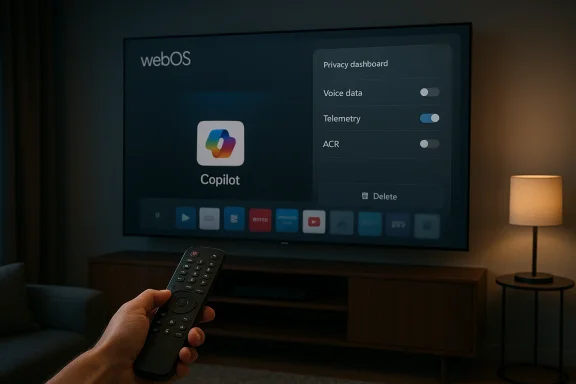
In mid-December, owners of LG webOS televisions discovered a new tile labeled Copilot had appeared on their home screens after a routine firmware-over-the-air (FOTA) update. For many users the tile behaved like an app but—critically—could be hidden rather than uninstalled, and in some cases it reappeared after a factory reset. That combination created the perception that a third-party AI assistant had been pld hardware with no durable opt-out.
LG later clarified the Copilot shortcut launches Microsoft’s web-based Copilot interface in the TV browser (not a native, always-running local service) and pledged to add a delete option following user backlash. That concession calmed some users but left open important questions about packaging, telemetry, and broader design choices. Independent coverage and community investigations corroborated the sequence of events and emphasized that the real problem was not necessarily Copilot’s capability but how it arrived.
From an OEM perspective, a pinned AI tile on the home ribbon is low-friction distribution: it guarantees visibility and usage metrics that justify partnerships. From a consumer perspective, that same placement looks like a preinstalled, attention-harvesting default. The incentives are clear: platform owners monetize attention; cloud partners want scale; and long-term device owners want control. When incentives are misaligned, user trust erodes fast.
Why this matters to TV buyers: when the companies building the models and running the clouds are spending hundreds of billions on infrastructure, distribution matters. Partnering with TV OEMs is one way to turn that infrastructure investment into consumer usage and recurring revenue. That financial backdrop helps explain why AI tiles and assistant shortcuts are likely to proliferate across living-room devices—even in the face of user pushback.
The Copilot episode may not immediately trigger enforcement, but it’s a clear red flag: if vendors stoning privileged partner features without clear consent, regulators and advocacy groups will take notice—and manufacturers that default to transparency will be better positioned to avoid s.
Source: Pocket-lint Why AI in smart TVs is something we’re not always going to be able to delete
 Background: the Copilot surprise and why it mattered
In mid-December, owners of LG webOS televisions discovered a new tile labeled Copilot had appeared on their home screens after a routine firmware-over-the-air (FOTA) update. For many users the tile behaved like an app but—critically—could be hidden rather than uninstalled, and in some cases it reappeared after a factory reset. That combination created the perception that a third-party AI assistant had been pld hardware with no durable opt-out.LG later clarified the Copilot shortcut launches Microsoft’s web-based Copilot interface in the TV browser (not a native, always-running local service) and pledged to add a delete option following user backlash. That concession calmed some users but left open important questions about packaging, telemetry, and broader design choices. Independent coverage and community investigations corroborated the sequence of events and emphasized that the real problem was not necessarily Copilot’s capability but how it arrived.
Overview: why this episode is a bellwether for TV AI
Smart TVs have evolved from passive display devices into networked platforms: they receive firmware updates, run apps, gate camera and microphone access, and increasingly surface cloud AI experiences. That evolution yields benefits—better picture and audio processing, smarter discovery, accessibility aids—but it also raises three persistent tensions:- Ownership vs. platform control: consumers reasonably expect to control what runs on their purchased devices.
- Convenience vs. consent: default-on or hard-to-remove features shift consent from explicit to implicit.
- Features vs. telemetry: AI sells best when it has context—context that often requires data collection and sharing.
The technical anatomy: web shortcut, system package, or firmware-baked tile?
Understanding why some TV additions feel unremovable requires a quick taxonomy of how software can appear on a TV:- User-installed app (store download) — typically removable via the app manager.
- System/privileged package — installed outside the user app sandbox; UI may only allow hiding or disabling.
- Firmware-baked component — included in the FOTA image and restored by factory reset unless the manufacturer changes the firmware image.
What manufacturers are actually doing (and why)
Major TV OEMs and platform partners are racing to make screens “AI-capable” because the return—engagement, subscription upsells, ecosystem lock-in—is large. Samsung, for example, publicly integrated Microsoft Copilot across 2025 TVs and monitors as part of its Samsung Vision AI strategy, advertising features such as on-device upscaling, adaptive sound, and a Copilot entry in the homescreen experience. Microsoft and Samsung documented voice activation flows and QR-based account sign-in to enable personalization. Those are not hypothetical roadmaps—they are product strategies deployed at scale.From an OEM perspective, a pinned AI tile on the home ribbon is low-friction distribution: it guarantees visibility and usage metrics that justify partnerships. From a consumer perspective, that same placement looks like a preinstalled, attention-harvesting default. The incentives are clear: platform owners monetize attention; cloud partners want scale; and long-term device owners want control. When incentives are misaligned, user trust erodes fast.
AI features that genuinely improve TV experience
Not all AI on TVs is cosmetic or invasive. There are real features that many users appreciate and that can be implemented with privacy-conscious defaults:- AI upscaling: improves older or lower-resolution video by sharpening edges and restoring detail.
- Adaptive picture and ambient-aware brightness: scene-by-scene color and contrast adjustments and room-light adaptation.
- Adaptive sound / dialog enhancement: separates speech from background music and raises vocal clarity when needed.
- **On-screen search and ional queries that return watch suggestions or contextual cards.
- Accessibility features: real-time language translation, clearer closed captions, and voice-driven navigation.
The money behind “AI everywhere”: why this trend won’t fade
The AI push on consumer hardware is not an accident; it’s funded by enormous infrastructure spending and strategic priorities at the hyperscalers. Recent analyst reporting (Goldman Sachs Research and other market commentators) places consensus estimates for hyperscaler capex on AI infrastructure in the vicinity of more than $500 billion for 2026—numbers that reflect massive investments in data centers, GPUs, networking, storage, and software integration. That scale of investment gives cloud vendors both the capability and the commercial incentive to seed AI services across partner hardware ecosystems. Expect OEMs to keep surfacing AI features in TVs to maintain perceived relevance and to tap partner investments.Why this matters to TV buyers: when the companies building the models and running the clouds are spending hundreds of billions on infrastructure, distribution matters. Partnering with TV OEMs is one way to turn that infrastructure investment into consumer usage and recurring revenue. That financial backdrop helps explain why AI tiles and assistant shortcuts are likely to proliferate across living-room devices—even in the face of user pushback.
Privacy and telemetry: the unavoidable trade-offs
The core privacy concern with on-device AI assistants is telemetry—what gets s and under what consent model. Even when a TV just launches a web-based assistant, using the assistant can transmit:- query text or audio,
- device identifiers,
- app usage and contextual metadata (what’s currently on screen),
- ACR signals (recognizing what’s playing),
- account linkage data.
What privacy-respecting defaults would look like
- Off-by-default AI tiles: show an icon only after the user opts in to assistant functionality.
- Clear “delete” flow: uninstall or permanently remove the shortcut and any associated data without requiring firmware hacks.
- Granular privacy dashboard: one place to see and control ACR, voice data, and third-party sharing.
- Audit logs and retention transparency: clear timelines for how long audio and transcripts are stored and who can access them.
Regulatory angle: when “undeletable” becomes a legal risk
Regulators and consumer protection agencies are increasingly interested in devpost-sale changes that materially alter product function. Practices that bury opt-outs, restore features after resets, or materially increase data collection without explicit renewed consent can attract complaints under consumer protection and privacy statutes. In jurisdictions with robust privtyle regimes), opaque consent and profiling pose particular risks.The Copilot episode may not immediately trigger enforcement, but it’s a clear red flag: if vendors stoning privileged partner features without clear consent, regulators and advocacy groups will take notice—and manufacturers that default to transparency will be better positioned to avoid s.
Practical advice for TV owners and buyers
If you’re concerned about AI features appearing on your TV, here ou can take today:- Review privacy settings during setup and opt out of interest-based advertising and Automatic Content Recossible.
- Hide the offending tile and disable AI features in settings if an uninstall option is not available—this reduces immediate visibility while you seek a permanent fix.
- Consider using an external streaming device (Roku, Apple TV, Shield/Android TV dongle) to make the TV function as a simple display and push the smart platform to hardware you control.
- Isolate the TV on a guest VLAN or separate Wi‑Fi SSID to limit cross-device telemetry and reduce lateral data flows.
- Delay optional firmware updates on secondary or older sets until you’ve checked community reports and vendor release notes.
- If you’re disturbed by an unsolicited AI feature, contact vendor support and register your complaint—mass feedback matters and has already prompted LG to promise a deletion option.
Critical analysis: strengths, weaknesses, and long-term risks
AI on TVs is not inherently bad. When designed thoughtfully, AI features can:- improve accessibility for viewers with hearing or vision impairments,
- reduce friction in content discovery,
- enhance perceived picture and sound quality without the user needing to fiddle with complex menus.
- Poor change communication: many users reported no advance notice or explanatory release notes for the Copilot push. That undermines trust.
- Opaque packaging: firmware-baked or privileged tiles circumvent expected uninstall flows; that’s a UX and product-governance problem.
- Default telemetry assumptions: when features are added wi consent, users reasonably assume data is being collected by default.
- Consumer churn and brand damage: annoyed buyers may avoid updates or switch to alternative brands or external streamers.
- Regulatory intervention: a pattern of non-removable partner preloads could invite enforcement or new consumer-rights requirements.
- Security and auditing gaps: system-level provisioning complicates independent security review and makes forensic analysis harder.
What good looks like: concrete vendor commitments that would restore trust
If OEMs want AI to be widely accepted on the living-room screen, they should adopt a few clear commitments:- **Transparent update n call out UI changes, partner integrations, and data-flow impacts.
- Guaranteed uninstallability for non-essential partner features, or at least a persistent “disable and remove” flow that survives factory resets.
- Privacy-first defaults, with AI assistants off until a user explicitly enables them and with obvious in-menu toggles for ACR and voice data.
- Independent audits or third-party transparency reports that detail telemetry endpoints and retention policies.
Conclusion: AI in TVs is useful — but control is the real product
The Copilot-on-LG episode is a small but telling example of a larger pattern: vendors and cloud partners will continue to bake AI into living-room devices because the economic incentives are massive and the feature wins are real. But distribution mechanics matter as much as capability. A helpful assistant that can’t be meaningfully removed, or that arrives without clear consent, destroys the very trust it needs to thriv sane response is to demand clarity: clear uninstall options, privacy-first defaults, and transparent telemetry disclosures. For manufacturers and cloud partners, the strategic response is equally clear: earn the right to be in the living room by respecting user agency. Otherwise, consumers will vote with their remotes—hiding tiles, isolating devices, delaying updates, or choosing external streamers—and regulators will eventually write rules that remove vendor discretion entirely. The technology’s promise is real; the product design that delivers it must make choice the baseline, not the exception.Source: Pocket-lint Why AI in smart TVs is something we’re not always going to be able to delete
