

Classrooms across the globe are filling with artificial intelligence tools at a pace that has teachers and administrators scrambling to translate policy into practice, raising urgent questions about learning, equity, privacy, and the very shape of assessment.
The arrival of generative AI and large language models into day‑to‑day education has been rapid and multifaceted. What began as research demos and niche tutor apps is now an ecosystem that includes enterprise copilots for teachers and admins, consumer chatbots students use directly, integrated reading‑assessment tools, and domain‑specific tutors embedded in learning platforms. Multiple district pilots, union‑backed training initiatives, and national surveys through 2024–2025 show broad uptake among post‑secondary students and growing adoption in K–12 settings.
These tools are changing routine workflows: lesson‑plan drafting, formative quiz generation, reading fluency checks, administrative summaries, and on‑demand tutoring are now commonly cited classroom uses. The immediate appeal to educators is tangible — time savings, scaleable differentiation, and rapid formative feedback — but those gains come paired with persistent and complex risks that schools are only beginning to manage.
Practical implication: assessment must capture the process — drafts, annotated reasoning, staged deliverables, and oral defenses — not merely the final artifact.
A prominent and debated piece of early research — a preprint examining neural and behavioral differences when people use LLMs for writing tasks — suggested measurable short‑term differences in neural connectivity and ownership of work. The authors characterize the results as preliminary and urge caution; the study has been influential in reframing cognitive‑risk conversations but is not yet a final word on long‑term, population‑level effects. Policymakers should treat such neuroscience findings as signals that merit follow‑up longitudinal research, not as immediate proof for sweeping bans.
Policy imperative: pair any AI strategy with a clearly funded plan for connectivity, device access, and low‑bandwidth alternatives.
Educators’ concerns are real and actionable: redesign assignments to reward process, invest in short practical teacher training, secure education‑grade contracts that protect student data, and pilot deliberately before scaling. Those steps will determine whether classrooms of the future use AI to deepen learning and inclusion — or whether they allow quick convenience to hollow out the habits that make learning durable.
Source: Menafn.com Educators Voice Concern as AI Quickly Enters Classrooms
 Background
The arrival of generative AI and large language models into day‑to‑day education has been rapid and multifaceted. What began as research demos and niche tutor apps is now an ecosystem that includes enterprise copilots for teachers and admins, consumer chatbots students use directly, integrated reading‑assessment tools, and domain‑specific tutors embedded in learning platforms. Multiple district pilots, union‑backed training initiatives, and national surveys through 2024–2025 show broad uptake among post‑secondary students and growing adoption in K–12 settings.These tools are changing routine workflows: lesson‑plan drafting, formative quiz generation, reading fluency checks, administrative summaries, and on‑demand tutoring are now commonly cited classroom uses. The immediate appeal to educators is tangible — time savings, scaleable differentiation, and rapid formative feedback — but those gains come paired with persistent and complex risks that schools are only beginning to manage.
Why educators are worried: core concerns unpacked
Cognitive shortcutting and learning atrophy
A growing body of classroom reports and early lab studies indicate a worrying pattern: when students routinely outsource reasoning or drafting to AI, some forms of active learning — especially retrieval practice, iterative revision, and ownership of work — can weaken. Experimental work that measured neural engagement during writing tasks suggests differential activation when participants used LLM assistance vs. working unaided or with search tools. Those results are preliminary but consistent with teacher anecdotes that “just Chat it” shortcuts replace effortful study. Educators warn that unless assignments are restructured to reward process (not only polished final products), AI will hollow out key practice opportunities.Practical implication: assessment must capture the process — drafts, annotated reasoning, staged deliverables, and oral defenses — not merely the final artifact.
Academic integrity redefined
Generative AI blurs traditional definitions of plagiarism and authorship. Teachers report submissions that are superficially coherent and stylistically polished but lack verifiable provenance or authorial reflection. Detection tools exist but are imperfect and produce both false positives and false negatives, making policing an unreliable sole strategy. Consequently, many institutions are shifting away from blanket bans toward policies that emphasize disclosure, process‑based assessment, and taught competencies for evaluating AI output.Hallucinations, misinformation and trust
Generative models produce fluent, plausible text but do not guarantee factual accuracy. In classrooms where correctness matters — science, civics, mathematics — uncritical acceptance of an AI answer can introduce or propagate errors. Teachers must therefore teach verification habits: cross‑checking primary sources, demanding citations, and treating AI output as drafts rather than authoritative statements. Systems that provide citation‑aware outputs still require students to evaluate source quality and context.Emotional dependency and safety risks
Beyond academic use, some students interact with chatbots as companions. Surveys show a nontrivial share of teens using chatbots for emotional support, which raises mental‑health and safety concerns. There have been regulatory probes and legal cases where chatbot interactions with minors drew scrutiny for safety failures. Schools and platform teams must consider age gating, crisis response design, and limits on companion‑style features for minors.Data privacy, vendor lock‑in, and procurement hazards
When districts adopt third‑party AI or enterprise copilots, student data handling becomes a core risk. Contract language about training‑use, retention, deletion rights, and telemetry access determines whether institutions retain control over sensitive inputs. Centralized procurement reduces vendor‑by‑vendor chaos but increases reliance on a few large companies — a trade‑off that must be managed through explicit contract terms, audit rights, and clear admin controls.The upside: realistic, replicable benefits
AI’s most consistent classroom contributions are practical, incremental, and pedagogical when coupled with teacher oversight.- Time and workload reduction: Automating routine tasks (parent letters, meeting summaries, grading rubrics) can reclaim hours weekly for teachers. Several pilots report meaningful time savings that teachers redirect to student‑facing work.
- Scalable differentiation: AI can generate multiple practice variants and explain concepts at different reading levels, making personalized practice feasible in large classes.
- Faster formative cycles: Automated scoring and item generation compress feedback cycles and enable targeted remediation at scale.
- Accessibility and inclusion: Translation, plain‑language summaries, audio renditions and multimodal outputs can support English‑language learners and students with special needs.
- Workplace‑relevant literacies: Teaching students how to prompt, verify, and ethically use AI builds transferable job skills and civic competencies.
Evidence and contested findings
While many institutions report positive operational outcomes, some headline claims in press summaries lack transparent methodology and should be treated cautiously. Aggregated statistics about adoption vary widely by sample, region, and question phrasing; a single global percentage is misleading without context. Likewise, isolated trial claims of precise exam‑score gains or exact per‑student time savings often lack publicly available evaluation data and peer review. Readers should demand original studies or institutionally released reports before treating numeric claims as definitive.A prominent and debated piece of early research — a preprint examining neural and behavioral differences when people use LLMs for writing tasks — suggested measurable short‑term differences in neural connectivity and ownership of work. The authors characterize the results as preliminary and urge caution; the study has been influential in reframing cognitive‑risk conversations but is not yet a final word on long‑term, population‑level effects. Policymakers should treat such neuroscience findings as signals that merit follow‑up longitudinal research, not as immediate proof for sweeping bans.
How districts and institutions are responding (policy and practice)
From bans to managed adoption
Early institutional reactions ranged from outright bans to ad‑hoc restrictions. Over time, effective practice has shifted toward managed adoption models: central procurement of education‑grade contracts, phased teacher‑led pilots, mandatory disclosure rules for AI use in assignments, and assessment redesigns that privilege process evidence. Phased rollouts — pilot with teachers, extend to older students under tight rules, then scale with policy and infrastructure in place — are now the recommended path.Teacher training: the readiness gap
Large numbers of educators reported no formal AI training as recently as 2024–2025. Where training exists, the most effective professional development is short, practical, and task‑oriented: focused modules on prompt design, hallucination checks, privacy settings, and pedagogical redesign for process‑based assessment. Peer networks and repositories of AI‑aware rubrics and lesson templates also accelerate adoption with fewer harms. Districts that make training optional or superficial will likely see integrity and equity problems rise.Contract terms and procurement guardrails
Procurement must include explicit non‑training clauses (or clearly defined training use), deletion and retention rights, vendor audit access, and measurable telemetry commitments. Districts should insist that student data submitted to vendor platforms not be used to train public models unless explicitly agreed and compensated, and administrators must verify that tenant controls work as advertised.Technical and governance recommendations for IT and school leaders
- Audit and pilot before scale: start with small teacher volunteer groups, collect telemetry and error reports, and evaluate pedagogical value before broad enablement.
- Enforce least‑privilege connectors: disable web connectors and cross‑app permissions by default; only enable them where business cases are explicit and audited.
- Require admin parity and audit trails: ensure voice transcripts, memory artifacts, and automation logs are tenant‑controlled, exportable, and removable.
- Redesign assessment: require staged submissions, annotated drafts, and in‑person defense for high‑stakes work.
- Integrate AI literacy into curriculum: teach verification, source evaluation, and ethical use as classroom outcomes, not just adjunct workshops.
Case studies and pilots: what’s worked so far
- District pilots that pair teacher training with enterprise tools show measurable time savings on administrative tasks and faster formative feedback cycles. Examples include diverse deployments where Copilot‑style tools helped teachers reclaim planning time for student engagement.
- Large reading‑assessment pilots integrating AI have compressed feedback cycles, enabling targeted remediation at scale; reported gains are promising but require independent replication for firm conclusions.
- Regionally tailored rollouts — such as phased programs in Canadian boards and targeted pilot groups in Australia and the U.S. — highlight the value of teacher‑led experimentation and staged policy development.
Equity, access and the digital divide
AI’s promise to democratize access to high‑quality explanations and practice is genuine, but the technology risks widening existing gaps unless connectivity, devices, and equitable provisioning are addressed. National internet penetration and household access remain crucial constraints in many regions; without deliberate investment in infrastructure and device loan programs, AI-enabled learning will create two‑tier classrooms. Some secondary reports cite national penetration figures that require independent verification; caution is warranted before treating headline percentages as settled fact.Policy imperative: pair any AI strategy with a clearly funded plan for connectivity, device access, and low‑bandwidth alternatives.
Practical checklist for educators (quick, implementable steps)
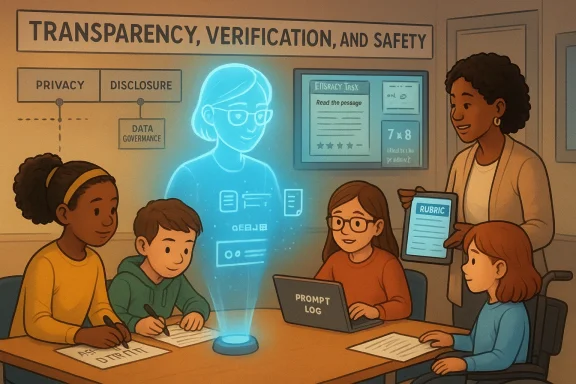
- Require students to submit annotated drafts, prompt logs, or reflective notes explaining how they used AI.
- Teach a short module on prompt literacy and verification: how to check claims, what counts as a credible source, and how to spot hallucinations.
- Use AI for low‑risk automation first: lesson skeletons, parent letters, practice quizzes — then evaluate pedagogy before moving to tutoring or assessment automation.
- Establish a transparent classroom policy: what tools are allowed, how disclosure should occur, and what constitutes acceptable collaboration.
- Connect with peers and vendor partners to demand education‑grade contracts with clear data protections.
Open questions and research priorities
- Longitudinal learning outcomes: does routine, scaffolded AI use improve retention and higher‑order thinking over multiple years, or does it favor surface‑level performance? Early studies are suggestive but not definitive.
- Best‑practice assessment design: which combinations of process evaluation (drafts, oral exams, in‑class labs) preserve learning while permitting AI assistance? Early district models provide templates but need broader validation.
- Companion chatbots and safety: what regulatory and design standards reliably prevent emotional dependency and crisis‑exacerbating interactions with minors? Regulatory inquiries and legal cases make clear this is an urgent area for independent evaluation.
Conclusion
AI is neither a magic bullet nor a looming apocalypse for education; it is a powerful amplifier of existing pedagogical choices. Where schools pair thoughtful governance, teacher training, assessment redesign, and equitable infrastructure with AI tools, the technology can deliver measurable efficiencies and personalized supports. Where governance lags, assessment incentives are misaligned, or access is unequal, AI risks accelerating cognitive shortcutting, integrity erosion, and inequity. The choice facing districts is not whether to adopt AI — adoption is already happening — but how to do it so that learning, safety, and equity come first.Educators’ concerns are real and actionable: redesign assignments to reward process, invest in short practical teacher training, secure education‑grade contracts that protect student data, and pilot deliberately before scaling. Those steps will determine whether classrooms of the future use AI to deepen learning and inclusion — or whether they allow quick convenience to hollow out the habits that make learning durable.
Source: Menafn.com Educators Voice Concern as AI Quickly Enters Classrooms
