

The memory shortage driven by the AI datacenter boom has suddenly turned a long-running industry assumption on its head: cheap, spec-heavy smartphones and aggressively priced PCs are about to get more expensive, and in some cases less capable, as suppliers reallocate wafer capacity to high‑margin HBM and enterprise DRAM. IDC’s analyst team warns that 2026 may mark “the end of an era” for abundant consumer memory, with meaningful increases in average selling prices (ASPs) and downside scenarios that could shrink unit volumes across smartphones and personal computers.
The memory market is built on wafer starts, process nodes, packaging capacity and the competing demands of many different end markets. In 2024–2025 the single largest demand shock has come from the build‑out of AI infrastructure: hyperscalers and AI hardware suppliers need enormous volumes of high‑performance memory — especially High‑Bandwidth Memory (HBM) and large DDR5 stacks for servers — and they are paying premiums and committing multi‑year contracts to secure supply.
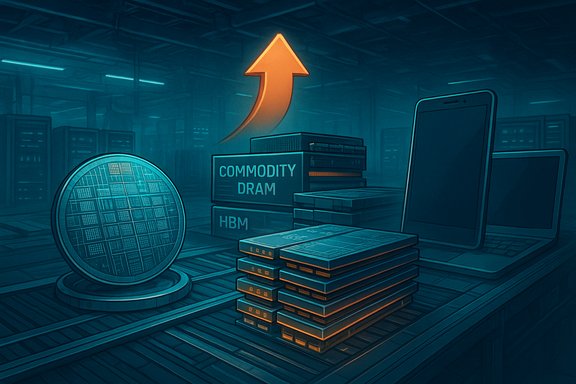
That structural shift is not a short seasonal blip. Reallocating capacity toward HBM and enterprise DRAM reduces the wafer real estate available for commodity DRAM and client‑grade NAND, tightening the mass‑market supply of LPDDR (smartphone RAM), DDR5 (PCs) and mainstream NVMe SSD components. The result is higher contract and spot prices that quickly transmit to OEM bills of materials (BOMs) and retail device prices.
Source: Inbox.lv The End of the Era of Cheap Smartphones and Computers
 Background / Overview
The memory market is built on wafer starts, process nodes, packaging capacity and the competing demands of many different end markets. In 2024–2025 the single largest demand shock has come from the build‑out of AI infrastructure: hyperscalers and AI hardware suppliers need enormous volumes of high‑performance memory — especially High‑Bandwidth Memory (HBM) and large DDR5 stacks for servers — and they are paying premiums and committing multi‑year contracts to secure supply.That structural shift is not a short seasonal blip. Reallocating capacity toward HBM and enterprise DRAM reduces the wafer real estate available for commodity DRAM and client‑grade NAND, tightening the mass‑market supply of LPDDR (smartphone RAM), DDR5 (PCs) and mainstream NVMe SSD components. The result is higher contract and spot prices that quickly transmit to OEM bills of materials (BOMs) and retail device prices.
- Memory classes matter: HBM (for accelerators) consumes more wafer area per effective GB than commodity DDR, and suppliers have limited advanced packaging slots.
- Short‑to‑medium term capacity is inflexible: fabs and packaging lines take quarters to years to retool and ramp.
- Margin signals drive allocation: higher margins for enterprise/HBM lead suppliers to prioritize those buyers when capacity is tight.
What IDC and Other Trackers Actually Say
IDC published a detailed market note assessing downside scenarios for 2026, and the numbers are stark but specific:- IDC’s downside scenarios show the global smartphone market could contract by 2.9% (moderate) to 5.2% (pessimistic) in 2026, with smartphone ASPs rising 3–5% (moderate) or 6–8% (pessimistic). IDC emphasizes that price pressure will be disproportionately higher in low‑end segments where memory makes up a larger share of BOM.
- For PCs, IDC models a downside contraction of 4.9% (moderate) to 8.9% (pessimistic), with PC ASPs under the downside scenarios rising 4–6% (moderate) or 6–8% (pessimistic). IDC also reports that major PC vendors are signaling contract resets and 15–20% list‑price changes for specific SKUs in 2026 as OEMs grapple with BOM inflation.
Note on conflicting figures in early reporting
Some secondary reports and local news items have published higher smartphone price‑increase figures (for example, claims that entry‑level phones could rise by 15–20% and premium phones by 10–15%). Those larger percentages are not present in IDC’s own published ranges for smartphone ASPs; IDC’s official ASP range is 3–8% across moderate/pessimistic scenarios, while the 15–20% figure in many articles more directly matches PC vendor‑level signals about specific contract resets and prebuilt PC BOMs rather than a universal smartphone ASP outlook. Treat those higher smartphone figures as either extrapolations, local market anecdotes, or reporting mismatches unless explicitly confirmed by IDC or a primary OEM.Technical Drivers: Why AI Eats Memory That Used to Feed the Mass Market
HBM vs. commodity DRAM
- HBM delivers very high bandwidth and is packaged in stacked TSV modules; one HBM stack consumes wafer and packaging capacity that could otherwise produce many dies of commodity DDR or LPDDR used in phones and PCs. Suppliers have limited advanced packaging capacity and finite clean‑room wafer starts, so shifting allocation to HBM shifts supply away from mainstream DRAM.
New uses of smartphone‑class memory in servers
- Server and accelerator designs are increasingly interested in LPDDR5X and other low‑power, high‑density memory to meet AI inference needs. When server demand begins to bid on traditionally “phone” memory types — or when GPUs and AI SoCs adopt designs that pull LPDDR into datacenter use — pressure spreads through the entire memory pyramid. Analyst coverage has raised this alarm repeatedly.
Lead times and capital intensity
- Building new fab capacity and packaging lines is multibillion‑dollar capital expenditure that takes several years from ground‑breaking to production yield. That means any rebalancing of supply is slow; short‑term reallocation is accomplished through vendor prioritization rather than instant capacity expansion.
Impact: Smartphones — not all segments are equal
Smartphone manufacturers face two blunt choices when BOM cost jumps: raise prices or cut specs (or a combination of both). But the pain is not evenly distributed.- Low‑end and midrange Android vendors (the thin‑margin, volume‑focused players) are the most exposed. Memory can represent 15–20% of BOM in a midrange phone and even more in the ultra‑low end, meaning memory inflation bites directly into already thin margins. OEMs that can’t absorb the cost will have to pass it to buyers or reduce RAM/flash configurations. IDC flags the low‑end as the worst hit.
- Premium vendors such as Apple and Samsung are structurally hedged by cash reserves and forward supply agreements, but they are not immune. IDC expects some premium models to hold back on expanding RAM (for example, staying at 12GB rather than moving to 16GB) to avoid even higher retail prices.
- Insider leaks and tipsters (South Korean leakers like Lanzuk / yeux1122) have suggested manufacturers may discontinue 16GB variants or reintroduce lower‑RAM (4GB) base models in 2026. Those claims have proliferated across media outlets, and they illustrate plausible tactical responses from OEMs — but they remain unverified leaks until confirmed by OEM roadmaps or official supply contracts. Treat them as plausible but speculative.
- Reversion or stagnation in RAM growth: 16GB may become less common across flagships, and midrange phones could see RAM teams consolidate around 6–8GB rather than adding headroom.
- Longer replacement cycles in price‑sensitive markets: buyers delay upgrades if price jumps wipe out usual refresh economics.
- Shifting product mixes: some vendors may intentionally push higher‑ASP devices (to preserve margins) and reduce low‑margin SKUs.
Impact: PCs and the Windows refresh cycle
PCs face a particularly hazardous confluence of events: the memory squeeze coincides with the post‑Windows‑10 replacement wave and the marketing push for AI‑capable “Copilot+” PCs, which require higher RAM baselines (16GB is increasingly the minimum for on‑device AI features). That timing magnifies the pain.- IDC’s downside scenarios show potential PC shipment contractions up to 8.9% in a pessimistic case, and PC ASPs rising in the 4–8% range for the two downside scenarios. Major OEMs are already signaling 15–20% list movements for specific SKUs as they renegotiate contracts and manage allocations — a level of BOM disruption that can force either price increases or spec compromises for consumer and commercial models.
- System integrators and DIY builders will be hit by higher retail module prices and thinning SKU availability; some vendors have already limited standalone module sales to protect OEM channel supply. These dynamics benefit the largest OEMs that can buy forward or bundle parts into prebuilt systems — a structural advantage in stressed markets.
- Replacement costs for Windows‑era upgrades could spike, straining refresh budgets.
- Soldered‑RAM laptops become especially risky purchases: if you cannot upgrade later, buying to future‑proof is more expensive.
- Enterprise procurement should consider staged buys, longer lead times, and allocation commitments to hedge risk.
Micron’s Crucial exit: a watershed moment
Micron publicly announced it will wind down consumer shipments under the Crucial brand by February 2026, explicitly citing the reallocation of production to enterprise/HBM offerings. That move removes a major retail‑facing supplier from the consumer channel and materially reduces aftermarket and DIY liquidity for RAM and SSDs. Reuters, The Verge, Tom’s Hardware and other outlets reported the pivot, noting its symbolic and practical significance for hobbyists and smaller OEMs. Why this matters:- Competition and channel thinning: fewer consumer‑grade suppliers reduce SKU diversity and may keep retail prices elevated longer.
- Warranty/support caveats: Micron will continue to service sold products, but future refreshes and availability will be constrained.
- Market signaling: the strategic move signals how profitable enterprise/HBM demand is, and it creates an incentive for other suppliers to reallocate capacity unless publicly constrained.
How OEMs and vendors are likely to respond
- Spec trade‑offs: OEMs can reduce base memory or flash on low‑end SKUs and offer paid upgrade paths (placing the upgrade burden on buyers).
- Price increases: some vendors will pass costs through to consumers; larger OEMs can absorb or smooth increases across product families.
- SKU rationalization: fewer distinct SKUs reduces procurement complexity and inventory fragmentation when parts are scarce.
- Short‑term promotions to move channel inventory ahead of further price rises: vendors may use marketing levers to smooth demand timing.
What consumers, builders and IT buyers should do now
- If you must buy and your device is soldered, buy for the future: choose higher RAM/storage now because upgrades may be impossible or expensive later.
- For PC builders: consider DDR4 platforms where compatible, lock in supplies when possible, and watch module speed/timing trade‑offs to find lower‑cost options that meet performance needs.
- For consumers weighing smartphone purchases: prioritize a realistic RAM baseline for how you use the phone — a cheap device with too little RAM will feel slow sooner if OS and app requirements increase.
- For enterprises and IT procurement:
- Audit fleet memory and storage needs now.
- Stage procurement and negotiate allocation commitments with suppliers.
- Consider refurbishment and certified used devices as bridge strategies.
- Instrument p95/p99 memory telemetry for long‑running agents and cloud‑connected features.
The software angle: efficiency returns to the conversation
A recurring theme in internal industry analysis is that the memory crunch exposes a decade of software complacency. Large cross‑platform stacks, Electron/WebView‑based clients and always‑on AI agents have increased per‑device memory requirements. The market shock creates renewed incentives for engineering teams to prioritize memory efficiency, modularity, and smaller model formats.- Efficiency measures that matter:
- Avoid duplicate browser engines across apps; prefer shared WebView instances where appropriate.
- Adopt memory‑regression tooling in CI to catch growth early.
- Offer clear user controls to disable persistent background AI agents.
- Explore quantization/pruning/offloading to cloud when on‑device costs are prohibitive.
Risks, unknowns and what could change the picture
- Fab ramps and public policy: large fab investments (new fabs, reshoring subsidies) and packaging capacity additions can expand supply — but they take years. Announced capacity plans are the key indicators to watch.
- Demand re‑balancing: if hyperscaler demand slows or contracts, suppliers could redirect capacity back to consumer markets, easing prices. However, the transition back is not instantaneous; inventory cycles and contract commitments slow the rebound.
- Vendor tactics and hedging: large OEMs with multi‑year supply deals will fare better; smaller brands and white‑box makers are most at risk of margin pressure or disappearance.
- Unverified leaks vs. official roadmaps: claims that 16GB phones will disappear or that cheap phones will uniformly jump 15–20% are plausible under extreme scenarios but remain speculative unless confirmed by OEMs or validated by primary market trackers. Treat tipster claims as early signals, not definitive fact.
A pragmatic checklist for buyers and IT leaders
- Inventory: classify devices by upgradeability and Windows 11 eligibility; prioritize mission‑critical replacements.
- Hedge: consider early purchases for essentials where RAM/SSD upgrades are critical.
- Contract: require allocation and portability clauses where possible in procurement contracts.
- Optimize: identify and remediate memory leaks; remove unnecessary always‑on agents.
- Monitor: follow DRAM/NAND contract indices, supplier earnings calls, and public fab timelines.
Conclusion
The industry’s pivot toward AI compute has real and measurable consequences for everyday devices. IDC’s analysis — supported by multiple trade trackers and corroborated by corporate moves like Micron’s exit from the Crucial consumer line — paints a cohesive picture: memory and flash that used to be cheap and plentiful may remain expensive and constrained through 2026, forcing price increases, SKU rationalization and spec trade‑offs across the smartphone and PC markets. Consumers and IT buyers face tough choices: buy sooner and larger, delay non‑essential purchases, or accept reduced specifications. At the same time, the squeeze creates an important corrective: if software vendors and platform teams embrace efficiency and procurement teams demand resilience and portability, the industry can emerge stronger and less wasteful. The near term will be bumpy; the longer‑term resolution depends on factory investments, demand repricing, and whether engineering culture decides efficiency is worth the effort.Source: Inbox.lv The End of the Era of Cheap Smartphones and Computers
