

Enterprise networks are not broadly ready for AI traffic in 2026, because AI adoption is moving faster than network modernization, with Cisco reporting that only 15 percent of organizations have networks fully flexible enough to support AI at scale. That is the uncomfortable answer behind a deceptively simple infrastructure question. As Spiceworks argues in its latest networking analysis, the problem is no longer whether companies will use Microsoft Copilot, ChatGPT Enterprise, coding copilots, AI meeting assistants, and autonomous agents. The problem is whether the network can survive them becoming normal.
The old enterprise networking story was about connecting people to applications. The new one is about mediating a constantly shifting conversation among users, SaaS platforms, private data, cloud APIs, inference services, and increasingly independent agents. That makes AI less like another app rollout and more like a new traffic class arriving before most organizations have agreed what to call it.
For years, enterprise networks were judged by a familiar checklist: uptime, throughput, site coverage, VPN reliability, Wi-Fi density, and acceptable performance for the core business applications. Those metrics still matter, but AI makes them insufficient. A chatbot that takes eight seconds to answer may look like an application issue to the user, a SaaS issue to the service desk, and an invisible non-event to a legacy monitoring platform.
That gap is where the next round of enterprise pain will live. Training workloads are the easy part to understand because they are visibly hungry: high-volume, sustained, latency-sensitive traffic between compute clusters, storage, and model infrastructure. Inference is trickier because it looks smaller at first, then spreads everywhere.
The AI assistant in Outlook, the summarizer in Teams, the code helper in Visual Studio Code, the agent calling a CRM API, and the internal search bot grounding its answer in SharePoint all create traffic patterns that do not resemble the old client-server world. They are bursty, encrypted, cloud-heavy, context-rich, and often chained across multiple services. A single user prompt can become a sequence of retrieval, authentication, policy, model, logging, and response events.
That is why IDC’s Taranvir Singh, quoted by Spiceworks, frames the network as part of the AI stack rather than a basic connectivity pipe. The phrase matters. If the network is part of the AI stack, then it becomes part of the product experience, the security boundary, and the operational control plane.
This is a substantial mental shift for IT. Nobody asks whether the switching fabric is part of the HR system. But in the AI era, network behavior can shape whether a digital assistant feels instant or sluggish, whether sensitive data is routed through controlled paths or opaque ones, and whether an agent can complete a workflow without timing out halfway through a business process.
Cisco and Foundry’s projection, cited by Spiceworks, that AI could triple enterprise network traffic within three years should get attention in every CIO planning cycle. So should Gartner’s forecast that worldwide AI spending will rise 47 percent in 2026 to $2.59 trillion. Those are not background statistics; they are signals that the experimental phase is colliding with production infrastructure.
Yet a tripling of traffic does not mean every office needs three times the internet circuit. It means traffic will become less predictable. It means a larger share of business activity will depend on real-time calls to AI services. It means more encrypted flows to cloud endpoints that look ordinary from the outside but carry very different business importance.
Deepu Komati of HCL America, also quoted by Spiceworks, makes the stronger operational point: bottlenecks increasingly come from latency, congestion, inefficient routing, and API dependencies rather than bandwidth alone. That should sound familiar to anyone who lived through the early SaaS migration. The first instinct was to backhaul traffic through a central data center because that was where security controls lived. The second instinct, after users complained, was to let cloud traffic break out locally and then rebuild security around the new reality.
AI is setting up a similar correction, but with less patience from users. A slow ERP screen annoys people. A slow AI assistant trains them not to use the assistant. A slow autonomous agent breaks the promise of autonomy entirely.
Microsoft’s own documentation for Microsoft 365 Copilot says Copilot experiences are deeply integrated with Microsoft 365 applications and often use the same network connections and endpoints as Microsoft 365 apps. That is good news for deployment simplicity, but it complicates visibility. If AI rides the same road as the rest of Microsoft 365, IT needs better instruments than “the road is open.”
The same applies beyond Microsoft. OpenAI’s enterprise materials emphasize administrative controls, SSO, encryption, compliance posture, and privacy protections for ChatGPT Enterprise and related business offerings. Those controls are necessary, but they do not make the network problem disappear. They shift the problem toward governance: which users are allowed to access which AI services, from where, under what inspection model, with what data-loss protections, and with what performance expectations.
This is where AI traffic becomes politically awkward inside enterprises. Business units see productivity tools. Security teams see new exfiltration paths. Network teams see opaque encrypted flows with unpredictable fan-out. Developers see APIs that speed delivery until rate limits, routing delays, or identity failures turn into production incidents.
The old distinction between sanctioned and shadow IT also gets blurrier. A user pasting data into a consumer chatbot is one problem. A department buying an approved AI SaaS tool that quietly invokes third-party model APIs is another. The latter may be official enough to pass procurement but still invisible enough to surprise infrastructure teams.
A pilot can survive on enthusiasm, manual troubleshooting, and a small group of users who tolerate rough edges. Production cannot. Once AI becomes embedded in sales, legal, HR, development, customer support, and finance, every performance issue becomes a business-process issue.
This is the lesson many organizations learned with video conferencing. A few executives on video calls were manageable. A whole company on Teams or Zoom during the pandemic was an architectural referendum. Wi-Fi design, home broadband, VPN concentrators, split tunneling, QoS, endpoint performance, and cloud peering all suddenly mattered.
AI will not repeat that story exactly, but it rhymes. Meeting assistants, live transcription, real-time summarization, retrieval-augmented enterprise search, coding agents, and workflow automation all add more interactive dependency on cloud services. The demand does not arrive as one giant migration weekend. It arrives as dozens of features toggled on inside tools the enterprise already owns.
That makes the readiness gap easy to underestimate. A CIO may believe the company is “using AI” because licenses have been purchased and adoption dashboards are rising. A network architect may see something different: no end-to-end observability, no clear classification of AI flows, no policy for routing model traffic, and no agreement on whether latency-sensitive AI services should receive preferential treatment.
That perception matters because AI tools are often sold on flow. A developer expects a coding assistant to keep pace with a train of thought. A service representative expects an AI helper to retrieve an answer before the customer loses patience. An executive expects an agent to summarize, schedule, draft, and act without requiring babysitting.
Milliseconds can matter in aggregate. A model call may be only one segment of the path, but the user experiences the whole chain: authentication, prompt submission, data retrieval, content filtering, inference, post-processing, logging, and response delivery. Any weak link can make the AI feel unreliable.
The enterprise network therefore becomes part of the AI product’s latency budget. This does not mean every packet deserves gold-plated treatment. It means organizations need to understand which AI interactions are business-critical, which are convenience features, and which are experimental toys.
That distinction will be difficult. The same AI platform may support all three categories. A meeting summary might be nice to have in one department and a compliance artifact in another. A code assistant might be a productivity boost for one team and part of a regulated software-delivery pipeline for another.
That tension is not theoretical. AI prompts can contain sensitive data, source code, customer records, legal strategy, credentials, or internal architecture details. AI responses can include hallucinated facts, policy-violating content, or synthesized data that users mistakenly treat as authoritative. Security teams have every reason to want visibility and enforcement.
But if every AI interaction is forced through brittle chokepoints, users will find alternatives. They will use personal accounts, unsanctioned tools, mobile networks, browser extensions, or copy-paste workflows that leave fewer traces. In that sense, poor AI network architecture can create the very shadow behavior security teams are trying to prevent.
The better answer is not to choose between performance and governance. It is to build policy-aware paths that recognize identity, application, data sensitivity, and destination. That is what Singh is getting at when he talks about identity-based authorization, policy enforcement, and optimization at scale.
The phrase zero trust has been stretched thin by vendors, but AI gives it renewed practical meaning. The network should not merely know that a user is connected. It should understand whether that user, device, application, and data context are permitted to invoke a given AI service, and whether that interaction should be logged, blocked, routed differently, or inspected more deeply.
Komati’s recommendation, reported by Spiceworks, is to build end-to-end observability across users, networks, cloud platforms, APIs, and AI applications. That is the right direction and a heavy lift. It asks network teams to correlate telemetry that has traditionally lived in separate tools and separate organizational kingdoms.
The packet counter must meet the application trace. The security log must meet the SaaS admin console. The identity event must meet the user-experience metric. Without that correlation, AI troubleshooting becomes a blame game among vendors and internal teams.
This matters even more for agentic AI. A simple chatbot produces a prompt and a response. An agent may make multiple calls, invoke tools, retrieve files, update records, and wait for external systems. If it fails, the cause may be a network timeout, a permissions issue, a rate limit, a malformed API response, a blocked endpoint, or a security policy doing exactly what it was configured to do.
Enterprises do not need perfect observability on day one. They do need a plan that treats AI interactions as traceable business transactions rather than mysterious web sessions. Otherwise, they will discover production dependencies only after users complain that the magic stopped working.
This is why the wide-area network deserves renewed attention. AI workloads span public clouds, data centers, branch offices, remote users, and edge environments. Enterprise Management Associates, cited by Spiceworks, argues that networks will make or break enterprise AI investments, especially as workloads stretch across public clouds, data centers, and the enterprise edge.
The edge is particularly interesting because it offers both promise and complexity. Some AI tasks can be pushed closer to users, devices, factories, stores, hospitals, or vehicles. That can reduce latency and limit unnecessary data movement. But edge AI also creates management, security, and lifecycle challenges that many enterprises are not prepared to absorb.
The WAN design question becomes less about hub-and-spoke versus direct internet access and more about intent. Which AI services should take the shortest path to a cloud region? Which data should stay local? Which workloads justify private connectivity? Which interactions require inspection at a central point, and which can be governed through distributed controls?
These are not purely technical decisions. They involve cost, risk, user experience, vendor lock-in, data residency, and operational maturity. A network architecture that works for a law firm may not work for a manufacturer. A hospital’s AI traffic profile will not look like a software company’s.
This is where retrieval-augmented generation stops being an architecture diagram and becomes a network concern. Every retrieval step adds dependency on identity, permission checks, indexing, data freshness, and transport. The model may be hosted in one place, the data in another, and the user somewhere else entirely.
Prompt gravity follows the data that makes the answer useful. If the data is fragmented and permissions are messy, the AI assistant will either underperform or overreach. If the network path is slow or unreliable, the assistant’s intelligence will appear worse than it is.
This is especially relevant for Microsoft 365 Copilot deployments. Microsoft has repeatedly emphasized that Copilot works through Microsoft Graph and respects existing permissions. That design is essential, but it also means poor information governance becomes newly visible. Overshared files, stale groups, messy SharePoint sites, and inconsistent labels are not just compliance problems; they become answer-quality and exposure problems.
Network teams cannot fix data governance alone. But they will be dragged into the consequences when AI systems traverse that data estate in real time. The network will be blamed for delays that originate in indexing, permissions, API throttling, or content sprawl.
The modern network engineer is expected to understand cloud routing, identity-aware access, API behavior, telemetry pipelines, automation, segmentation, encryption, SaaS performance, and increasingly AI-assisted operations. That is a long way from configuring VLANs and keeping branch routers alive. The old skills still matter, but they are no longer enough.
There is also an organizational skills gap. Network, security, platform, DevOps, data, and AI teams often operate with different incentives and different dashboards. AI punishes that separation. A production agentic workflow may depend on all of them at once.
Komati’s advice that networking, security, data, and AI teams plan together is the kind of obvious recommendation that remains difficult in practice. Budgets are separate. Tooling is separate. Outage bridges are reactive. Architecture boards often arrive too late, after a department has already bought the AI tool and promised productivity gains.
The companies that handle AI networking well will not be the ones with the most glamorous infrastructure diagrams. They will be the ones that build operating models where network architecture is part of AI deployment planning from the beginning, not an escalation path after rollout.
Some of that tooling will be useful. Networks are too complex for human operators to manually correlate every signal at scale. AI-assisted operations can help detect anomalies, predict congestion, recommend policy changes, and summarize incidents. In a large environment, the difference between an alert storm and a useful diagnosis is not cosmetic.
But enterprises should be wary of buying “AI-ready” as a sticker. The useful question is not whether a platform mentions AI. It is whether the platform helps express business intent: this traffic matters, this data is sensitive, this user is allowed, this region is required, this latency target is meaningful, this failure mode is unacceptable.
Intent is what separates modernization from spending. Without it, organizations will add bandwidth, deploy new appliances, subscribe to new dashboards, and still fail to answer why an AI workflow broke. With it, they can prioritize architecture around the AI interactions that matter most.
This distinction will be especially important in budget conversations. AI spending is rising fast, but CFO patience is not infinite. If AI investments fail to produce durable returns, infrastructure teams will be asked why the expensive tools did not scale. A credible network plan must connect spending to business workflows, not abstract readiness.
That makes endpoint policy part of network readiness. Which browsers can access which AI services? Are personal AI accounts blocked or merely discouraged? Are plugins and extensions governed? Are DNS, proxy, and endpoint protection policies aligned? Are remote workers receiving the same AI performance and controls as office users?
The Windows estate also contains a great deal of the data AI wants to summarize, search, and act upon. Local files, synced OneDrive content, cached credentials, browser sessions, Teams chats, Outlook mailboxes, and enterprise apps all form part of the practical AI surface. Network readiness without endpoint governance is only half a plan.
Sysadmins will feel this before strategy teams do. They will get the tickets: Copilot cannot reach a service, ChatGPT Enterprise login fails through SSO, a coding assistant is slow on VPN, a meeting bot cannot join, an AI connector is blocked, a proxy breaks a WebSocket, or a security rule blocks an endpoint nobody documented. Each ticket will look small. Together they will describe the new baseline.
This is why AI networking cannot stay in the data-center lane. It touches Microsoft 365 administration, Entra ID, endpoint management, browser policy, DLP, SaaS governance, firewall rules, SD-WAN design, and user training. The “network” is now a distributed policy system that happens to move packets.
Many organizations cannot. That does not mean they should stop deploying AI. It means they should stop pretending AI readiness is achieved by adding licenses and hoping the network behaves. The pilots are already becoming production dependencies.
The uncomfortable part is that network modernization now competes with the shiny parts of AI budgets. Boards like model demos. Executives like assistant rollouts. Few people get excited about telemetry integration, segmentation design, private connectivity, routing policy, or proxy exceptions. But those are the mechanisms that turn AI from a demo into a dependable enterprise service.
There is a practical sequencing problem here. Organizations do not need to solve every possible AI network issue before letting users benefit from AI tools. They do need to identify the workflows where failure would matter and build stronger paths around them. A sales email assistant and an autonomous claims-processing agent do not deserve the same risk model.
That means readiness must be tiered. Some AI traffic can be best-effort. Some should be monitored. Some should be prioritized. Some should be blocked until governance catches up. The goal is not blanket acceleration; it is controlled acceleration.
The old enterprise networking story was about connecting people to applications. The new one is about mediating a constantly shifting conversation among users, SaaS platforms, private data, cloud APIs, inference services, and increasingly independent agents. That makes AI less like another app rollout and more like a new traffic class arriving before most organizations have agreed what to call it.
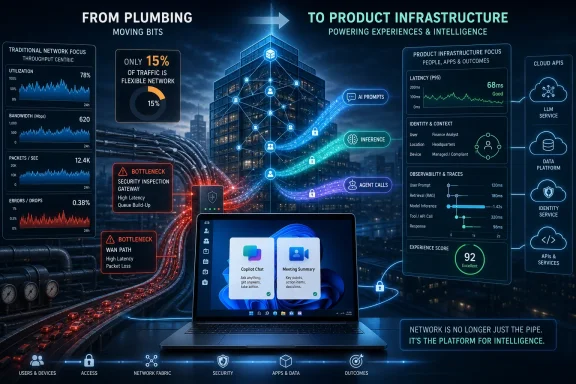 AI Turns the Network from Plumbing into Product Infrastructure
For years, enterprise networks were judged by a familiar checklist: uptime, throughput, site coverage, VPN reliability, Wi-Fi density, and acceptable performance for the core business applications. Those metrics still matter, but AI makes them insufficient. A chatbot that takes eight seconds to answer may look like an application issue to the user, a SaaS issue to the service desk, and an invisible non-event to a legacy monitoring platform.That gap is where the next round of enterprise pain will live. Training workloads are the easy part to understand because they are visibly hungry: high-volume, sustained, latency-sensitive traffic between compute clusters, storage, and model infrastructure. Inference is trickier because it looks smaller at first, then spreads everywhere.
The AI assistant in Outlook, the summarizer in Teams, the code helper in Visual Studio Code, the agent calling a CRM API, and the internal search bot grounding its answer in SharePoint all create traffic patterns that do not resemble the old client-server world. They are bursty, encrypted, cloud-heavy, context-rich, and often chained across multiple services. A single user prompt can become a sequence of retrieval, authentication, policy, model, logging, and response events.
That is why IDC’s Taranvir Singh, quoted by Spiceworks, frames the network as part of the AI stack rather than a basic connectivity pipe. The phrase matters. If the network is part of the AI stack, then it becomes part of the product experience, the security boundary, and the operational control plane.
This is a substantial mental shift for IT. Nobody asks whether the switching fabric is part of the HR system. But in the AI era, network behavior can shape whether a digital assistant feels instant or sluggish, whether sensitive data is routed through controlled paths or opaque ones, and whether an agent can complete a workflow without timing out halfway through a business process.
The Bandwidth Panic Is Too Simple
The most tempting response to AI traffic is to buy more capacity. That instinct is not wrong, but it is incomplete in the same way that buying a larger desk does not fix a bad filing system. AI increases demand for bandwidth, but the more interesting failure modes sit in latency, routing, inspection, identity, congestion, and visibility.Cisco and Foundry’s projection, cited by Spiceworks, that AI could triple enterprise network traffic within three years should get attention in every CIO planning cycle. So should Gartner’s forecast that worldwide AI spending will rise 47 percent in 2026 to $2.59 trillion. Those are not background statistics; they are signals that the experimental phase is colliding with production infrastructure.
Yet a tripling of traffic does not mean every office needs three times the internet circuit. It means traffic will become less predictable. It means a larger share of business activity will depend on real-time calls to AI services. It means more encrypted flows to cloud endpoints that look ordinary from the outside but carry very different business importance.
Deepu Komati of HCL America, also quoted by Spiceworks, makes the stronger operational point: bottlenecks increasingly come from latency, congestion, inefficient routing, and API dependencies rather than bandwidth alone. That should sound familiar to anyone who lived through the early SaaS migration. The first instinct was to backhaul traffic through a central data center because that was where security controls lived. The second instinct, after users complained, was to let cloud traffic break out locally and then rebuild security around the new reality.
AI is setting up a similar correction, but with less patience from users. A slow ERP screen annoys people. A slow AI assistant trains them not to use the assistant. A slow autonomous agent breaks the promise of autonomy entirely.
Copilots Make Shadow Traffic Look Official
The biggest AI networking problem may be that much of the traffic does not announce itself as AI traffic. It arrives through sanctioned SaaS applications, browser sessions, plugins, developer tools, meeting platforms, and embedded copilots. To the firewall, it may be HTTPS to a known cloud service. To the business, it may be a customer-support workflow now quietly dependent on a model call.Microsoft’s own documentation for Microsoft 365 Copilot says Copilot experiences are deeply integrated with Microsoft 365 applications and often use the same network connections and endpoints as Microsoft 365 apps. That is good news for deployment simplicity, but it complicates visibility. If AI rides the same road as the rest of Microsoft 365, IT needs better instruments than “the road is open.”
The same applies beyond Microsoft. OpenAI’s enterprise materials emphasize administrative controls, SSO, encryption, compliance posture, and privacy protections for ChatGPT Enterprise and related business offerings. Those controls are necessary, but they do not make the network problem disappear. They shift the problem toward governance: which users are allowed to access which AI services, from where, under what inspection model, with what data-loss protections, and with what performance expectations.
This is where AI traffic becomes politically awkward inside enterprises. Business units see productivity tools. Security teams see new exfiltration paths. Network teams see opaque encrypted flows with unpredictable fan-out. Developers see APIs that speed delivery until rate limits, routing delays, or identity failures turn into production incidents.
The old distinction between sanctioned and shadow IT also gets blurrier. A user pasting data into a consumer chatbot is one problem. A department buying an approved AI SaaS tool that quietly invokes third-party model APIs is another. The latter may be official enough to pass procurement but still invisible enough to surprise infrastructure teams.
Pilot Projects Hide Production-Scale Network Debt
McKinsey’s latest State of AI research found that 88 percent of organizations use AI in at least one business function, but also described a stubborn gap between adoption and scaled impact. Spiceworks notes the same tension: many organizations are still stuck in pilots or experimentation even as AI tools become part of everyday work. That mismatch is dangerous because pilots rarely reveal the full network bill.A pilot can survive on enthusiasm, manual troubleshooting, and a small group of users who tolerate rough edges. Production cannot. Once AI becomes embedded in sales, legal, HR, development, customer support, and finance, every performance issue becomes a business-process issue.
This is the lesson many organizations learned with video conferencing. A few executives on video calls were manageable. A whole company on Teams or Zoom during the pandemic was an architectural referendum. Wi-Fi design, home broadband, VPN concentrators, split tunneling, QoS, endpoint performance, and cloud peering all suddenly mattered.
AI will not repeat that story exactly, but it rhymes. Meeting assistants, live transcription, real-time summarization, retrieval-augmented enterprise search, coding agents, and workflow automation all add more interactive dependency on cloud services. The demand does not arrive as one giant migration weekend. It arrives as dozens of features toggled on inside tools the enterprise already owns.
That makes the readiness gap easy to underestimate. A CIO may believe the company is “using AI” because licenses have been purchased and adoption dashboards are rising. A network architect may see something different: no end-to-end observability, no clear classification of AI flows, no policy for routing model traffic, and no agreement on whether latency-sensitive AI services should receive preferential treatment.
Latency Becomes a User-Experience Budget
Network teams have long understood latency, but AI makes it more visible to non-network people. The reason is psychological as much as technical. When users interact with AI, they expect conversation. A slight delay in a file download is tolerable; a delay in a conversational loop feels like the system is thinking badly.That perception matters because AI tools are often sold on flow. A developer expects a coding assistant to keep pace with a train of thought. A service representative expects an AI helper to retrieve an answer before the customer loses patience. An executive expects an agent to summarize, schedule, draft, and act without requiring babysitting.
Milliseconds can matter in aggregate. A model call may be only one segment of the path, but the user experiences the whole chain: authentication, prompt submission, data retrieval, content filtering, inference, post-processing, logging, and response delivery. Any weak link can make the AI feel unreliable.
The enterprise network therefore becomes part of the AI product’s latency budget. This does not mean every packet deserves gold-plated treatment. It means organizations need to understand which AI interactions are business-critical, which are convenience features, and which are experimental toys.
That distinction will be difficult. The same AI platform may support all three categories. A meeting summary might be nice to have in one department and a compliance artifact in another. A code assistant might be a productivity boost for one team and part of a regulated software-delivery pipeline for another.
Security Inspection Can Become the Bottleneck It Was Meant to Prevent
AI traffic also lands in the middle of an unresolved enterprise security debate. For more than a decade, organizations have pushed traffic through secure web gateways, CASBs, proxies, DLP engines, and inspection points to regain control over cloud usage. AI increases the desire to inspect traffic while also increasing the penalty for slowing it down.That tension is not theoretical. AI prompts can contain sensitive data, source code, customer records, legal strategy, credentials, or internal architecture details. AI responses can include hallucinated facts, policy-violating content, or synthesized data that users mistakenly treat as authoritative. Security teams have every reason to want visibility and enforcement.
But if every AI interaction is forced through brittle chokepoints, users will find alternatives. They will use personal accounts, unsanctioned tools, mobile networks, browser extensions, or copy-paste workflows that leave fewer traces. In that sense, poor AI network architecture can create the very shadow behavior security teams are trying to prevent.
The better answer is not to choose between performance and governance. It is to build policy-aware paths that recognize identity, application, data sensitivity, and destination. That is what Singh is getting at when he talks about identity-based authorization, policy enforcement, and optimization at scale.
The phrase zero trust has been stretched thin by vendors, but AI gives it renewed practical meaning. The network should not merely know that a user is connected. It should understand whether that user, device, application, and data context are permitted to invoke a given AI service, and whether that interaction should be logged, blocked, routed differently, or inspected more deeply.
Observability Must Escape the Packet Counter
Traditional network monitoring can tell you whether a link is saturated, a device is down, or a path is unstable. That remains useful, but AI failures often show up as degraded experiences rather than clean outages. The user says Copilot is slow. The dashboard says Microsoft 365 is reachable. The model provider says its service is healthy. The truth is somewhere across identity, routing, proxy behavior, API latency, and application logic.Komati’s recommendation, reported by Spiceworks, is to build end-to-end observability across users, networks, cloud platforms, APIs, and AI applications. That is the right direction and a heavy lift. It asks network teams to correlate telemetry that has traditionally lived in separate tools and separate organizational kingdoms.
The packet counter must meet the application trace. The security log must meet the SaaS admin console. The identity event must meet the user-experience metric. Without that correlation, AI troubleshooting becomes a blame game among vendors and internal teams.
This matters even more for agentic AI. A simple chatbot produces a prompt and a response. An agent may make multiple calls, invoke tools, retrieve files, update records, and wait for external systems. If it fails, the cause may be a network timeout, a permissions issue, a rate limit, a malformed API response, a blocked endpoint, or a security policy doing exactly what it was configured to do.
Enterprises do not need perfect observability on day one. They do need a plan that treats AI interactions as traceable business transactions rather than mysterious web sessions. Otherwise, they will discover production dependencies only after users complain that the magic stopped working.
The WAN Is Back in the Spotlight
Cloud adoption was supposed to make location less important. AI is proving that location still matters, only differently. Where users sit, where data lives, where models run, where APIs terminate, and where security controls inspect traffic can all affect performance and compliance.This is why the wide-area network deserves renewed attention. AI workloads span public clouds, data centers, branch offices, remote users, and edge environments. Enterprise Management Associates, cited by Spiceworks, argues that networks will make or break enterprise AI investments, especially as workloads stretch across public clouds, data centers, and the enterprise edge.
The edge is particularly interesting because it offers both promise and complexity. Some AI tasks can be pushed closer to users, devices, factories, stores, hospitals, or vehicles. That can reduce latency and limit unnecessary data movement. But edge AI also creates management, security, and lifecycle challenges that many enterprises are not prepared to absorb.
The WAN design question becomes less about hub-and-spoke versus direct internet access and more about intent. Which AI services should take the shortest path to a cloud region? Which data should stay local? Which workloads justify private connectivity? Which interactions require inspection at a central point, and which can be governed through distributed controls?
These are not purely technical decisions. They involve cost, risk, user experience, vendor lock-in, data residency, and operational maturity. A network architecture that works for a law firm may not work for a manufacturer. A hospital’s AI traffic profile will not look like a software company’s.
Data Gravity Is Now Prompt Gravity
Enterprise AI does not merely move data; it asks questions of data. That changes the network equation. The value of an AI assistant depends on its ability to reach relevant context, and that context may be scattered across Microsoft 365, Salesforce, ServiceNow, GitHub, internal databases, data lakes, file shares, and custom applications.This is where retrieval-augmented generation stops being an architecture diagram and becomes a network concern. Every retrieval step adds dependency on identity, permission checks, indexing, data freshness, and transport. The model may be hosted in one place, the data in another, and the user somewhere else entirely.
Prompt gravity follows the data that makes the answer useful. If the data is fragmented and permissions are messy, the AI assistant will either underperform or overreach. If the network path is slow or unreliable, the assistant’s intelligence will appear worse than it is.
This is especially relevant for Microsoft 365 Copilot deployments. Microsoft has repeatedly emphasized that Copilot works through Microsoft Graph and respects existing permissions. That design is essential, but it also means poor information governance becomes newly visible. Overshared files, stale groups, messy SharePoint sites, and inconsistent labels are not just compliance problems; they become answer-quality and exposure problems.
Network teams cannot fix data governance alone. But they will be dragged into the consequences when AI systems traverse that data estate in real time. The network will be blamed for delays that originate in indexing, permissions, API throttling, or content sprawl.
The Skills Gap Is as Real as the Traffic Surge
IDC’s 2026 Worldwide AI in Networking Special Report, as summarized by Spiceworks, identifies security, automation, and networking skills as major reasons AI projects stall before production. That finding should surprise no one. AI-era networking demands fluency across domains that enterprises have spent years separating.The modern network engineer is expected to understand cloud routing, identity-aware access, API behavior, telemetry pipelines, automation, segmentation, encryption, SaaS performance, and increasingly AI-assisted operations. That is a long way from configuring VLANs and keeping branch routers alive. The old skills still matter, but they are no longer enough.
There is also an organizational skills gap. Network, security, platform, DevOps, data, and AI teams often operate with different incentives and different dashboards. AI punishes that separation. A production agentic workflow may depend on all of them at once.
Komati’s advice that networking, security, data, and AI teams plan together is the kind of obvious recommendation that remains difficult in practice. Budgets are separate. Tooling is separate. Outage bridges are reactive. Architecture boards often arrive too late, after a department has already bought the AI tool and promised productivity gains.
The companies that handle AI networking well will not be the ones with the most glamorous infrastructure diagrams. They will be the ones that build operating models where network architecture is part of AI deployment planning from the beginning, not an escalation path after rollout.
Vendors Will Sell Intelligence, but Enterprises Need Intent
Networking vendors are eager to position AI as both the problem and the solution. That is understandable. AI traffic creates demand for better switching, routing, observability, SD-WAN, data-center fabrics, security service edge platforms, and automation. It also gives vendors a reason to sell AI-powered network management tools that promise faster troubleshooting and self-optimizing infrastructure.Some of that tooling will be useful. Networks are too complex for human operators to manually correlate every signal at scale. AI-assisted operations can help detect anomalies, predict congestion, recommend policy changes, and summarize incidents. In a large environment, the difference between an alert storm and a useful diagnosis is not cosmetic.
But enterprises should be wary of buying “AI-ready” as a sticker. The useful question is not whether a platform mentions AI. It is whether the platform helps express business intent: this traffic matters, this data is sensitive, this user is allowed, this region is required, this latency target is meaningful, this failure mode is unacceptable.
Intent is what separates modernization from spending. Without it, organizations will add bandwidth, deploy new appliances, subscribe to new dashboards, and still fail to answer why an AI workflow broke. With it, they can prioritize architecture around the AI interactions that matter most.
This distinction will be especially important in budget conversations. AI spending is rising fast, but CFO patience is not infinite. If AI investments fail to produce durable returns, infrastructure teams will be asked why the expensive tools did not scale. A credible network plan must connect spending to business workflows, not abstract readiness.
The Windows Enterprise Has a Special Stake in This Shift
WindowsForum readers know this story is not limited to routers and cloud diagrams. The Windows endpoint remains where much of enterprise AI adoption becomes visible. Copilot in Microsoft 365, Copilot in Windows, Edge-based AI features, Teams intelligence, developer copilots, and third-party desktop agents all land in the user’s daily environment.That makes endpoint policy part of network readiness. Which browsers can access which AI services? Are personal AI accounts blocked or merely discouraged? Are plugins and extensions governed? Are DNS, proxy, and endpoint protection policies aligned? Are remote workers receiving the same AI performance and controls as office users?
The Windows estate also contains a great deal of the data AI wants to summarize, search, and act upon. Local files, synced OneDrive content, cached credentials, browser sessions, Teams chats, Outlook mailboxes, and enterprise apps all form part of the practical AI surface. Network readiness without endpoint governance is only half a plan.
Sysadmins will feel this before strategy teams do. They will get the tickets: Copilot cannot reach a service, ChatGPT Enterprise login fails through SSO, a coding assistant is slow on VPN, a meeting bot cannot join, an AI connector is blocked, a proxy breaks a WebSocket, or a security rule blocks an endpoint nobody documented. Each ticket will look small. Together they will describe the new baseline.
This is why AI networking cannot stay in the data-center lane. It touches Microsoft 365 administration, Entra ID, endpoint management, browser policy, DLP, SaaS governance, firewall rules, SD-WAN design, and user training. The “network” is now a distributed policy system that happens to move packets.
The Readiness Test Is Operational, Not Aspirational
Asking whether your network is ready for AI traffic should not produce a vendor scorecard alone. It should produce evidence. Can you identify AI traffic by application, user group, destination, and business process? Can you measure response-time degradation across the full path? Can you tell whether a failure came from the network, identity, proxy, SaaS provider, API dependency, or data source?Many organizations cannot. That does not mean they should stop deploying AI. It means they should stop pretending AI readiness is achieved by adding licenses and hoping the network behaves. The pilots are already becoming production dependencies.
The uncomfortable part is that network modernization now competes with the shiny parts of AI budgets. Boards like model demos. Executives like assistant rollouts. Few people get excited about telemetry integration, segmentation design, private connectivity, routing policy, or proxy exceptions. But those are the mechanisms that turn AI from a demo into a dependable enterprise service.
There is a practical sequencing problem here. Organizations do not need to solve every possible AI network issue before letting users benefit from AI tools. They do need to identify the workflows where failure would matter and build stronger paths around them. A sales email assistant and an autonomous claims-processing agent do not deserve the same risk model.
That means readiness must be tiered. Some AI traffic can be best-effort. Some should be monitored. Some should be prioritized. Some should be blocked until governance catches up. The goal is not blanket acceleration; it is controlled acceleration.
The AI Traffic Reckoning Starts with the Flows You Cannot See
The immediate lesson from the Spiceworks analysis is that AI networking is not a future concern hiding somewhere behind artificial general intelligence. It is already embedded in the tools enterprises are deploying now. The organizations that do best will be the ones that treat AI traffic as a first-class operational category before users force the issue.- Enterprises should assume AI traffic is already present in sanctioned SaaS tools, developer platforms, browser applications, meeting assistants, and third-party APIs.
- Network teams should prioritize end-to-end observability that connects user experience, identity, routing, security inspection, cloud APIs, and AI application behavior.
- More bandwidth may be necessary, but it will not fix latency, inefficient routing, proxy bottlenecks, weak segmentation, or poor data governance.
- Microsoft 365 Copilot and similar embedded assistants make AI traffic harder to separate from ordinary cloud productivity traffic, which raises the bar for policy-aware monitoring.
- Agentic AI will make failures harder to diagnose because one user request may trigger multiple application, data, and API interactions across hybrid environments.
- CIOs should fund network modernization as part of AI deployment, not as a cleanup project after pilots become business-critical systems.
