

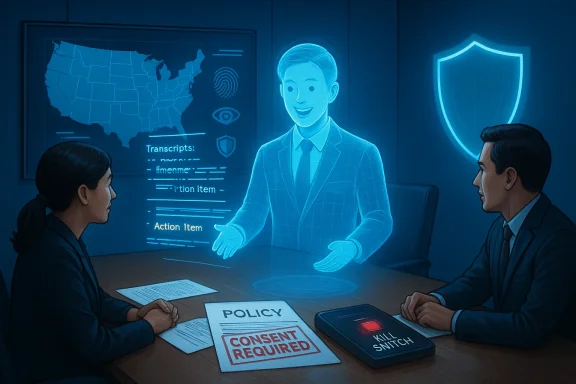
Employers are waking up to a new kind of workplace hazard: AI notetakers that keep listening after people have left, create searchable transcripts of casual or sensitive remarks, and then disseminate those records automatically — sometimes to the entire team.
AI notetakers — services that join virtual meetings, transcribe speech, extract action items, and surface summaries — arrived as convenience features meant to save time and preserve institutional knowledge. They promise searchable meeting records, faster onboarding, and fewer “did you get that?” follow-ups. In practice, however, those same features can turn ephemeral hallway gossip, off‑the‑record comments, and sensitive HR conversations into permanent, discoverable written records with legal and cultural consequences.
The tension is obvious: better documentation and inclusion on one hand; privacy, litigation, and workplace culture risks on the other. This article takes a look under the hood of the problem, verifies the latest claims and data, and lays out practical, technical, and policy‑level controls employers should consider before deploying meeting‑capture AI at scale. Where public claims or numbers are ambiguous or unverifiable, this article flags them and explains why.
Core technical capabilities that matter for employers:
Why that matters: improved participation can increase psychological safety, idea diversity, and ultimately team performance — outcomes HR leaders and people managers care about. But there are important caveats:
Key legal points for U.S. employers to consider:
Remember: a transcript is often discoverable evidence. Talk to counsel before deleting or altering records if litigation is reasonably foreseeable, because destruction of evidence can create separate legal exposure.
Notable strengths:
AI meeting assistants will reshape how organizations record and recall spoken work. The difference between a smooth transition and an HR crisis will not be the technology itself, but the policies, vendor controls, and cultural norms leaders put in place today. Start with a careful audit, give HR and legal a seat at the table, and treat meeting transcripts as what they are: written records that can last forever unless someone decides how they should live and who should see them.
Source: AOL.com https://www.aol.com/articles/ai-notetakers-creating-hr-nightmares-132955835.html
 Background
AI notetakers — services that join virtual meetings, transcribe speech, extract action items, and surface summaries — arrived as convenience features meant to save time and preserve institutional knowledge. They promise searchable meeting records, faster onboarding, and fewer “did you get that?” follow-ups. In practice, however, those same features can turn ephemeral hallway gossip, off‑the‑record comments, and sensitive HR conversations into permanent, discoverable written records with legal and cultural consequences.The tension is obvious: better documentation and inclusion on one hand; privacy, litigation, and workplace culture risks on the other. This article takes a look under the hood of the problem, verifies the latest claims and data, and lays out practical, technical, and policy‑level controls employers should consider before deploying meeting‑capture AI at scale. Where public claims or numbers are ambiguous or unverifiable, this article flags them and explains why.
What an “AI notetaker” actually does
AI notetakers span a spectrum from simple server‑side transcription to integrated meeting agents that (a) join calls as a participant, (b) record audio, (c) transcribe and speaker‑identify, and (d) produce summarized notes, action items, and searchable archives. Vendors include standalone players and features built into major ecosystems; some run everything in vendor clouds, others offer on‑prem or enterprise tenancy options.Core technical capabilities that matter for employers:
- Real‑time audio capture (joined bot or platform integration).
- Automatic speaker labeling and diarization.
- Natural language summarization and extraction of action items.
- Automatic distribution (emailing transcripts, posting summaries to team channels).
- Retention and indexing for search, discovery, and analytics.
- Option to train models on customer data (some vendors use meeting data to improve models unless contracts forbid it).
The upside: evidence matches the promise (but with caveats)
Not all consequences are negative. Vendor‑shared analyses indicate measurable behavioral changes when meetings are recorded and analyzed. Read AI — an AI meeting assistant vendor — published a dataset analysis asserting that the presence of AI in meetings correlates with greater participation by individual contributors, and that women spoke 9% more than men relative to representation when AI was present. The company and the academic collaborator framed this as a redistribution of conversational power and improved inclusivity.Why that matters: improved participation can increase psychological safety, idea diversity, and ultimately team performance — outcomes HR leaders and people managers care about. But there are important caveats:
- The Read AI analysis uses vendor‑owned data and automated classifiers; gender was inferred from names and role from self‑reported titles, which introduces classification error and sampling bias. The report itself discloses these limits. Treat vendor analytics as suggestive, not definitive.
- Benefits observed in aggregate do not erase the asymmetric harms when a single transcript captures a damaging private statement and is then widely shared. Several cautionary accounts and legal developments show how quickly the upside can flip into a compliance or litigation problem.
Real incidents and the legal headlines (what’s already happened)
A string of public incidents and legal challenges show the practical risks:- Reported cases where transcription bots continued recording after some attendees left a call, capturing post‑meeting remarks and sending transcripts to a broader audience — creating immediate HR crises. Major business press and newsletters have chronicled these mishaps and quoted employment counsel warning about the fallout.
- Lawsuits and investigations around popular transcription services alleging recording without adequate consent or proper disclosure to non‑subscribers. In 2025–2026, litigants claimed that automatic transcription features recorded participants who had not consented and that audio was later used for model training. Those legal actions underscore the data‑use and consent risks for both vendors and their enterprise customers.
- Commentary from employment counsel and major law firms that bots can fabricate or misattribute statements (through transcription errors or AI “hallucinations”), and that a generated transcript can become discoverable evidence in litigation.
The legal and regulatory landscape you must map
There is no single federal “meeting‑recording” law in the U.S. Instead, a mix of federal statutes, state consent rules, biometric privacy laws, labor law protections, and contract/employee‑policy constraints applies.Key legal points for U.S. employers to consider:
- Recording‑consent laws vary by state. A minority of states require all‑party consent for recording; many require only one‑party consent. That difference can transform the legality of an AI notetaker depending on where participants are located. Employers operating across state lines must map locations and consent rules.
- Biometric privacy laws — notably Illinois’ Biometric Information Privacy Act (BIPA) — may apply if vendor processing converts voice samples into voiceprints or other biometric identifiers. BIPA’s notice, consent, retention, and destruction rules have fueled large statutory‑damages class actions; voice data has been targeted in recent suits and enforcement. If your notetaker vendor uses or stores voiceprints, treat BIPA as a potential exposure.
- Labor and collective‑bargaining law. The National Labor Relations Board (NLRB) and its General Counsel have scrutinized electronic monitoring and recording policies. In bargaining contexts or where employees act in concert, recordings may be protected or the prohibition of recordings could unlawfully chill Section 7 activities. Conversely, in some contexts the NLRB has also recognized an employer’s legitimate business interest in limiting recordings that would chill candid internal communications. The practical takeaway is that blanket prohibitions or heavy‑handed discipline policies can themselves trigger labor law risk; craft narrow, well‑justified policies.
- Discoverability in litigation. Transcripts and recordings are data. If they exist, they can be subject to subpoena and discovery, which raises risks for whistleblowing, discrimination, and wrongful termination claims. Lawyers warn that an AI transcript that misattributes or “hallucinates” a statement could be used in evidence unless its provenance and accuracy are carefully controlled.
Governance: what an enterprise AI notetaker audit should look like
Before pressing “enable,” run a focused audit led jointly by HR, Legal, IT/Security, and Compliance. At minimum, the audit should answer the following questions:- What data is captured?
- Audio recordings, raw transcripts, summaries, derived metadata (speaker IDs, sentiment, action items).
- Where is data stored and for how long?
- Vendor cloud, customer‑controlled storage, region of storage, retention schedules.
- Who can access transcripts and how are they shared?
- Defaults for distribution (e.g., automatic emails to attendees or full team), admin access, export capabilities.
- What is the vendor’s data‑use policy?
- Explicit contractual commitments about model training, resale, or reuse of data.
- Does the vendor support enterprise controls?
- Single‑tenant deployment, enterprise keys, on‑prem or private cloud options, encryption at rest and in transit.
- What laws and labor rules apply across participant geographies?
- Map employees, remote participants, and recurring external attendees to state/provincial rules (consent, BIPA, union contexts).
- What is the incident and litigation posture?
- If an unwanted transcript is emailed, who is the escalation owner? Can the record be revoked or deleted? What is the preservation policy if litigation is threatened?
- What training and disclosure procedures will be used?
- How will you notify participants and document consent?
Practical policy controls HR and IT can adopt right away
Policy is the first line of defense. Below are practical controls that balance business value and risk — ordered by ease of implementation.- Mandatory disclosure and documented consent
- Require the meeting host to announce recording at the start and use explicit consent mechanisms (e.g., meeting invite language, recorded verbal acknowledgment, or a checkbox).
- Define where AI notetakers are permitted
- Prohibit use in one‑on‑one investigatory interviews, disciplinary meetings, or healthcare/benefits discussions unless HR/legal explicitly approves.
- Default to summaries, not verbatim distribution
- Avoid automatic distribution of full transcripts; prefer short AI summaries or action‑item lists that reduce verbatim exposure.
- Limit automatic dissemination
- Disable mass emailing of transcripts by default; require host approval before sharing beyond meeting participants.
- Implement a “kill switch” and host controls
- Ensure hosts can instantly stop recording and delete a transcript if the conversation turns sensitive.
- Retention and access controls
- Short retention windows, role‑based access, audit logs, and an explicit archival/deletion policy.
- Vendor contractual protections
- Prohibit vendor reuse of data for model training; require SOC2/ISO 27001 evidence; negotiate data location and deletion clauses.
- Training and culture
- Educate staff: recorded meetings equal written records. Train hosts on when to pause tools and when to request deletion.
- Incident playbook
- Designate legal/HR responders, communication templates, and swift remediation steps for unwanted disclosures.
Technology controls IT should require from vendors
When you evaluate vendors, insist on the following technical features in writing:- Enterprise tenancy and data separation (no co‑mingling of customer data).
- Contractual prohibition on model training from customer meetings, with audit rights.
- Customer‑controlled encryption keys (bring your own key) and regionally isolated storage.
- Granular access controls and log export (who accessed which transcript and when).
- Programmatic deletion API and confirmed deletion warranties.
- Configurable distribution defaults (host must approve sharing; no auto‑email to entire company).
- Real‑time host kill switch and session termination controls.
- Integrations with your DLP, CASB, and SOAR tools for automated detection of sensitive content (e.g., credit card numbers, Social Security numbers) and blocking of exports.
- Redaction options for sensitive PII or automatically detected confidential strings.
A recommended step‑by‑step rollout plan
- Stop, inventory, and map: Identify meetings currently being recorded and which teams are using notetakers. Document vendors and linkage to enterprise accounts.
- Legal and HR risk review: Run the cross‑functional audit outlined above and map state and sectoral legal exposures.
- Vendor due diligence: Require security questionnaires, contractual model‑training prohibitions, and deletion APIs.
- Policy drafting: Create use‑cases where AI is allowed, disclosure templates, retention rules, and approval workflows for sensitive meeting types.
- Pilot with controls: Run a small, controlled pilot with a consented team, strict retention, and host kill switches enabled.
- Training and communications: Train hosts and participants, update meeting invite templates, and add a standard recording disclosure line to invites.
- Scale with monitoring: Add DLP/CASB integration to watch for leaks, audit access logs, and measure adoption/impact.
- Reassess quarterly: Technology and law evolve quickly; reassess governance work and vendor commitments every three months.
Example policy language (plain English, HR friendly)
- “This meeting will be recorded and transcribed by [vendor/tool]. A transcript and AI‑generated summary may be stored in [location] for [X days] and accessed by [roles]. If you do not consent, please inform the host or remove yourself from the meeting.”
- “AI notetakers are prohibited during (a) individual investigatory interviews, (b) disciplinary meetings, and (c) meetings discussing health or benefits information, unless HR approval is obtained in advance.”
- “Hosts have the right to stop and delete any recording immediately if the conversation becomes sensitive.”
What to do when something goes wrong
If a transcript is misshared, delete and contain the record if possible, notify affected parties, and escalate to Legal and HR immediately. Preserve forensic logs (who accessed the file, when, and by whom) and prepare a communications plan that balances transparency with legal counsel. Employers who act quickly, transparently, and consistently are in the strongest position to mitigate reputational and legal harm.Remember: a transcript is often discoverable evidence. Talk to counsel before deleting or altering records if litigation is reasonably foreseeable, because destruction of evidence can create separate legal exposure.
Balancing innovation and caution: final analysis
AI notetakers are neither inherently dangerous nor inherently benign. They are tools — and, like any powerful tool, they require governance, technical controls, and cultural adoption to yield net positive outcomes.Notable strengths:
- Increased meeting accessibility and inclusion in some vendor analyses — individual contributors can speak more and be heard.
- Better institutional memory: searchable meeting records, faster onboarding, and clearer action tracking when controls are in place.
- Legal exposure from state recording statutes, biometric laws, and labor protections if consent and use are not carefully managed.
- Privacy and security risks when vendors retain or train on meeting audio without explicit contractual constraints.
- Cultural damage and chilling effects if employees feel “permanently recorded” and stop speaking candidly — an outcome antithetical to the collaboration goals such tools are meant to enable.
Checklist: 12 concrete next steps for IT & HR (actionable)
- Inventory current meeting‑capture tools and linked accounts.
- Pause any features that automatically email transcripts to broad groups.
- Run a cross‑functional legal/HR/IT audit of vendor contracts and data flows.
- Require vendor attestation: no model training on customer data without written consent.
- Implement host kill‑switch and session termination controls.
- Set default retention to the shortest practical window and require host approval for longer retention.
- Add explicit recording disclosure to calendar invites and meeting starts.
- Create a policy prohibiting AI notetakers in specified sensitive meeting types.
- Integrate transcripts with DLP/CASB to block exports containing regulated data.
- Train hosts and employees on expectations and consent.
- Test incident response: simulate an accidental transcript leak and follow the playbook.
- Reassess vendors and policies every quarter.
AI meeting assistants will reshape how organizations record and recall spoken work. The difference between a smooth transition and an HR crisis will not be the technology itself, but the policies, vendor controls, and cultural norms leaders put in place today. Start with a careful audit, give HR and legal a seat at the table, and treat meeting transcripts as what they are: written records that can last forever unless someone decides how they should live and who should see them.
Source: AOL.com https://www.aol.com/articles/ai-notetakers-creating-hr-nightmares-132955835.html
