

Bosses across industries are quietly turning to a familiar management lever—cash—to get wary employees to use generative AI, rolling out bonus pools, spot cash awards, and small prize schemes tied to measurable actions like Copilot prompts as a short‑term tactic to overcome resistance, measure adoption, and lock in productivity gains.
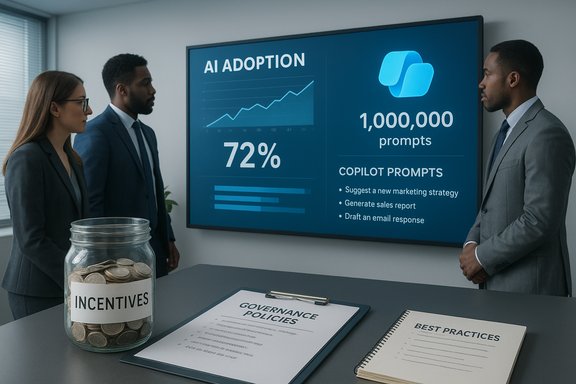
The last 18 months have seen two parallel trends collide: massive corporate investment in generative‑AI platforms and a surprisingly uneven, sometimes secretive, uptake among front‑line knowledge workers. Companies have spent billions on enterprise copilots, custom agents and cloud capacity, but getting every team to actually use those tools in ways that are safe, auditable and productive has proved harder than the boardroom pitch. That human gap has spawned a set of incentive experiments — from one‑off spot payments to firmwide incentive pools — designed explicitly to move behavior, not just install software. The most headline‑grabbing example came from UK law firm Shoosmiths, which publicly tied a £1 million bonus pot to a firm goal of one million Microsoft Copilot prompts in its financial year — an approach designed to make adoption measurable and transparent while rewarding broad participation. Shoosmiths says the target is achievable if each colleague uses Copilot roughly four times per working day, and the initiative is part of the firm’s wider collegiate bonus pool and training push. Multiple legal and business outlets reported the plan, and the firm published details of the target and governance around it.
Strengths:
Cash incentives can jump‑start an AI rollout — but they must be a component of a broader talent strategy that prioritizes governance, equitable reskilling, and quality controls. Incentives without those anchors risk delivering short‑term visibility and long‑term organizational harm.
Source: Bloomberg.com https://www.bloomberg.com/news/arti...s-spot-cash-for-workers/?srnd=homepage-europe
 Background / Overview
The last 18 months have seen two parallel trends collide: massive corporate investment in generative‑AI platforms and a surprisingly uneven, sometimes secretive, uptake among front‑line knowledge workers. Companies have spent billions on enterprise copilots, custom agents and cloud capacity, but getting every team to actually use those tools in ways that are safe, auditable and productive has proved harder than the boardroom pitch. That human gap has spawned a set of incentive experiments — from one‑off spot payments to firmwide incentive pools — designed explicitly to move behavior, not just install software. The most headline‑grabbing example came from UK law firm Shoosmiths, which publicly tied a £1 million bonus pot to a firm goal of one million Microsoft Copilot prompts in its financial year — an approach designed to make adoption measurable and transparent while rewarding broad participation. Shoosmiths says the target is achievable if each colleague uses Copilot roughly four times per working day, and the initiative is part of the firm’s wider collegiate bonus pool and training push. Multiple legal and business outlets reported the plan, and the firm published details of the target and governance around it. Why employers are paying workers to use AI
The basic drivers
- Companies have large sunk investments in enterprise AI licenses, integrations, and engineering. If those licenses sit idle, the business case weakens and the CFO’s patience runs out. Paying to drive usage is a way to protect that investment and force measurement.
- Management wants clear, auditable signals of adoption. Usage metrics (prompts, active users, sessions) let leaders convert a fuzzy transformation objective into a quantifiable KPI that can be tracked and tied to compensation or team rewards. Enterprise portals and Copilot analytics make that possible.
- There’s a behavioural barrier: employees fear job loss, worry about accuracy and legal risk, or simply lack time and guidance to experiment. Cash incentives make the choice explicit and reduce the friction of trying the tools. HEC Paris’s research on “shadow adoption” shows employees sometimes use AI secretly because disclosure can lower perceived effort; structured incentives aim to replace secrecy with transparent adoption.
- Incentives accelerate the creation of a critical mass (network effect) where best practices, prompt libraries and internal templates diffuse quickly across teams, making the tool more useful for everyone and increasing ROI.
Tactical reasons incentives are attractive now
- Rapid vendor integration: Copilot‑style assistants are embedded into daily apps (email, docs, spreadsheets), so small increases in use can produce outsized productivity gains for billable professionals.
- Measurable outcomes: Modern analytics provide feature‑level telemetry, letting firms attribute time saved and adjust training.
- Competitive signal: Public incentive programs declare intent — they tell clients and competitors the firm is serious about innovation and will deploy AI at scale.
What the evidence shows about employee behaviour and risks
Shadow adoption and the disclosure problem
Research from HEC Paris documents shadow adoption — employees using ChatGPT or similar models without telling managers because disclosure sometimes reduces perceived effort or credit. The core paradox: AI‑assisted work can be rated higher in quality, but when managers know AI was used they may judge the employee’s effort more harshly, creating an incentive to hide usage. That gap helps explain why employers are moving from passive policy to active incentives and monitoring: they want adoption that’s auditable, not concealed.Labour‑market impacts and entry‑level risk
Large‑scale analyses suggest the distributional consequences are real and early. New research using ADP payroll data and other labor datasets finds notable declines in entry‑level hires and roles most exposed to generative AI tasks — customer service, junior coding and routine office tasks — even as experienced workers retain or grow their roles. This empirical signal helps explain why junior staff and support teams are suspicious when management celebrates AI adoption: their ladder of on‑the‑job learning is threatened.Public attitudes toward paying for AI‑assisted work
Behavioral studies show a social dynamic that complicates incentives: people sometimes penalize workers who rely on AI, reducing compensation or esteem for AI‑assisted performance. That dynamic means incentive programs must be carefully framed to reward outcomes and responsible use, not just raw usage statistics. Otherwise, firms risk sending mixed signals: “Use AI, but don’t tell anyone.”How these incentive programs actually work (mechanics and metrics)
Common incentive models
- Firmwide bonus pools tied to an aggregate metric: a single target (e.g., 1 million prompts) unlocks a shared pool to be distributed across eligible employees, as Shoosmiths has done. This encourages collective momentum rather than individual competition.
- Spot cash awards: small, immediate payments for completing AI‑training modules, attending workshops, or submitting validated AI use cases.
- Point systems and gamification: accumulation of points for verified prompts, peer‑reviewed use cases or contribution to an internal template library, redeemable for merchandise or rewards.
- Team bonus pools: managers allocate a portion of team bonus budgets to measured AI adoption and documented business impact.
What companies count and why it matters
- Usage counts: prompts, sessions, features used (summarization, code assist).
- Outcome metrics: hours saved, faster client turnarounds, reduced error rates.
- Quality controls: manual peer audits, client feedback, or random sample reviews to avoid gaming.
Risks and downsides employers are still discovering
1) Gaming the metric and hollow adoption
If managers reward quantity (number of prompts) rather than quality (verified impact), employees will optimize the metric rather than business value. That can produce ritualized prompt use that offers little real productivity improvement and bloats telemetry without benefit. Several industry governance guides warn against single‑metric dependency for this reason.2) Privacy, IP and regulatory exposure
Many prompts include client data or sensitive company information. Storing prompt logs and telemetry without strict access controls, retention limits, and legal review risks client confidentiality breaches and non‑compliance with data protection regimes. Law firms and regulated companies have special obligations; incentive schemes that encourage use without governance raise immediate legal red flags.3) Employee surveillance and trust erosion
Even well‑intentioned telemetry can be perceived as intrusive. Employees who feel they’re being monitored for the wrong reasons may respond with lower morale, attrition, or covert workarounds (shadow adoption). Transparency and clear boundaries on what is collected, who sees it, and how it’s used are essential to preserve trust.4) Unequal access and a two‑tier workforce
Early adopters, higher earners, and teams with capacity to experiment capture the initial productivity gains. That can create a virtuous loop for them and a vicious loop for others who lack access to tools, time, or training — reinforcing inequality inside the firm. Companies need intentional equity measures to avoid creating a two‑tier workforce.5) Overreliance and hallucination risk
Incentives that reward speed over verification can encourage overreliance on AI outputs. If AI hallucinations make their way into client work, reputational and legal consequences follow. Metrics must include checks for human review and validation thresholds.What good programs look like: governance, learning and fairness
Designing incentives that produce durable value requires more than cash. The most defensible programs combine four elements:- Governance: Formal policies on permitted data, logging rules, retention windows, and role‑based access to telemetry. Make audit trails read‑only for HR and legal until policies are agreed.
- Quality assurance: Require a proportion of AI‑assisted outputs to pass human review and capture client feedback before reward eligibility.
- Equitable access to training: Fund paid learning hours, cohort learning, and mentor‑led projects so adoption isn’t an unpaid side gig for employees who are already time‑poor.
- Transparent communications: Publish how incentives are measured, how logs are used, and what protections exist. Include employee input in metric design and pilot before scaling.
A practical five‑point checklist for HR and IT
- Define metrics by role (not a single firmwide metric). Differentiate client‑facing lawyers from internal operations teams.
- Prefer validated outcomes (hours saved, error reduction) over raw prompt counts where possible.
- Limit content capture: retain only aggregated metrics unless content is necessary and appropriately redacted.
- Create reskilling pathways tied to career progression (micro‑credentials, apprenticeships).
- Run a privacy and regulatory impact assessment before any reward goes live.
What managers and employees should know
For managers
- Use incentives to signal priorities not to coerce. Pair rewards with mentorship and measurable reskilling.
- Calibrate expectations by role and region; what makes sense for a partner’s desk may not for a paralegal.
- Monitor quality and include human review gates.
For employees
- Document AI‑assisted work: keep versioned drafts and validation notes that show how you checked outputs.
- Ask for clarity on telemetry, retention, and whether prompt logs include client identifiers.
- Treat AI skills as a marketable competency: build a portfolio of documented, audited AI use cases that demonstrate impact.
The bigger picture: incentives are a short‑term lever for a long‑term people problem
Cash carrots are efficient at changing short‑term behaviour and breaking inertia, but they are not a substitute for the deeper work firms must do: redesigning entry roles, rebuilding apprenticeship ladders, funding inclusive training, and embedding human oversight. Empirical labor data suggests AI is already shifting the distribution of early‑career opportunities; incentives that accelerate usage without addressing career pathways risk amplifying long‑run inequality. Policy makers and industry groups also have roles: standardized AI‑fluency microcredentials, public funding for apprenticeships, and rules on transparency for AI systems used in hiring and performance evaluation can level the playing field.Case study: Shoosmiths — design choices and open questions
Shoosmiths’ public target (1m Copilot prompts → £1m pool) shows a few design strengths: it’s collective, it’s measurable, and it’s paired with training and internal roles such as innovation leads. Those features reduce head‑to‑head competition and create shared incentives for knowledge sharing. However, important questions remain:- How will quality be assessed? Prompts alone do not guarantee client value.
- What privacy safeguards are in place for prompt logs that may contain client context?
- Will the firm tie coaching and apprenticeship roles to compensate for any lost on‑the‑job learning opportunities for juniors?
Practical roadmap for organizations considering incentives
- Pilot first: run a 12‑week pilot with a single business line, combining a modest reward with strict privacy guardrails and human‑review checks.
- Measure both adoption and outcomes: track prompts and downstream client outcomes or time‑savings.
- Make incentives conditional on completion of role‑based validation and a peer audit.
- Publish anonymized dashboards to employees about progress and privacy protections.
- Iterate and broaden access only after audits show improvements in quality and no compliance exposure.
Final assessment — strengths, risks and verdict
The move to offer bonus pools and spot cash is neither inherently cynical nor wholly benign. It is a pragmatic response to a pragmatic problem: how to translate expensive AI infrastructure into everyday workflows when people are cautious, time‑poor, and rightly concerned about career impacts.Strengths:
- Rapidly increases transparent adoption and builds skill awareness.
- Converts tacit experimentation into auditable behaviour that can be coached.
- Creates early data to justify continued investment or to pivot programs that fail to deliver.
- Poorly designed incentives encourage metric optimization over business impact.
- Privacy, IP, and compliance exposures mount if telemetry isn’t tightly governed.
- It can accelerate inequality if reskilling and apprenticeship are not funded.
Cash incentives can jump‑start an AI rollout — but they must be a component of a broader talent strategy that prioritizes governance, equitable reskilling, and quality controls. Incentives without those anchors risk delivering short‑term visibility and long‑term organizational harm.
Conclusion
The growing use of bonus pools, spot cash, and gamified point systems to spur AI adoption reflects a hard lesson: buying technology is the easy part; changing behaviour is not. Short‑term monetary nudges can be effective if they are thoughtfully designed — tied to validated outcomes, wrapped in privacy and audit controls, and paired with funded upskilling for those most at risk. Absent that holistic approach, incentives may produce headlines and telemetry without the durable worker skills or client value firms say they want. The smarter path treats AI adoption as a people transformation first and a technology rollout second — and uses incentives only as one tool in a broader, accountable program.Source: Bloomberg.com https://www.bloomberg.com/news/arti...s-spot-cash-for-workers/?srnd=homepage-europe
