

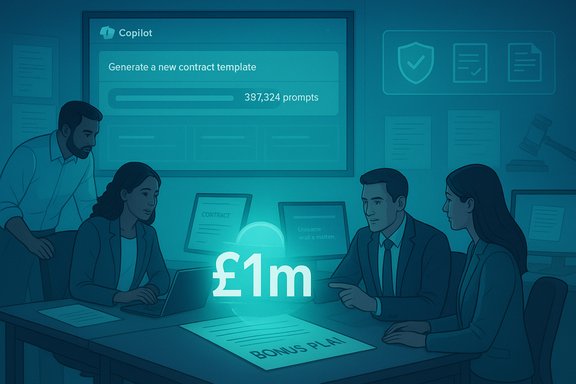
Shoosmiths has confirmed a landmark — and controversial — experiment in behaviour-led AI adoption: staff have been offered an extra £1 million into the firmwide bonus pool tied to a collective target of one million Microsoft Copilot prompts, and industry reporting indicates the firm reached that Copilot milestone ahead of schedule, triggering the additional money for distribution across eligible employees.
Shoosmiths’ incentive was first announced in April 2025 as a deliberate, measurable nudge to normalise enterprise Copilot use across a large, geographically-distributed law firm. The mechanics were simple and auditable on paper: if colleagues collectively logged one million prompts into the Microsoft Copilot instance provisioned by the firm during the financial year, Shoosmiths would add £1 million to the multi‑million collegial bonus pool available to staff (partners and business services directors were encouraged to use Copilot but excluded from the reward distribution). Shoosmiths framed the programme as habit-building rather than mechanistic counting: the firm paired the numeric target with training, internal “innovation leads,” monthly usage dashboards, a knowledge hub for shared prompts/templates, and clear governance messaging that Copilot should not be used for work requiring legal judgment or as a substitute for supervised legal advice. According to company materials, the million‑prompt target equated to only a few Copilot interactions per colleague per day (the firm calculated around four uses per person per working day). Industry coverage of the initiative emphasised two facts that matter for any assessment: (1) Shoosmiths’ novel step to tie a firmwide cash incentive directly to everyday AI use made the firm an early test case in the UK legal market; and (2) the approach was explicitly collective — the reward unlocked a shared pool rather than individual spot bonuses — which changes how behavioural dynamics play out at scale.
Independent, contemporaneous confirmation of the precise timing and accounting (for example, a Shoosmiths press release explicitly announcing the milestone-reached date and distribution mechanics) appears limited in the public domain at the time of writing. Shoosmiths’ own communications confirm the incentive’s design and intent, but a firm-published statement explicitly documenting the moment the target was reached and the operational details of payment is not easily found in widely syndicated press materials. Due to that gap, the claim that the firm has already “handed out” or “deposited” the cash should be treated as reported by industry outlets but with caution until firm-level confirmation (board minutes or a clear press statement) is located. Key verifiable facts:
For leaders planning similar programmes, the central advice is straightforward:
Shoosmiths’ experiment will be worth watching for the next 12–24 months for concrete evidence of whether incentivised adoption yields sustained client value, or whether the risks identified — gaming, deskilling, compliance gaps — materialise. For IT, HR and legal operations teams contemplating similar programmes, the test is simple: can you design a reward that is outcome‑centric, governed, and apprenticeship‑preserving? If the answer is “yes,” the carrot can accelerate transformation; if the answer is “no,” the carrot will likely obscure the problems you need to fix.
Source: Legal Cheek Shoosmiths drops £1 million into bonus pot after staff hit AI prompt target - Legal Cheek
 Background / Overview
Shoosmiths’ incentive was first announced in April 2025 as a deliberate, measurable nudge to normalise enterprise Copilot use across a large, geographically-distributed law firm. The mechanics were simple and auditable on paper: if colleagues collectively logged one million prompts into the Microsoft Copilot instance provisioned by the firm during the financial year, Shoosmiths would add £1 million to the multi‑million collegial bonus pool available to staff (partners and business services directors were encouraged to use Copilot but excluded from the reward distribution). Shoosmiths framed the programme as habit-building rather than mechanistic counting: the firm paired the numeric target with training, internal “innovation leads,” monthly usage dashboards, a knowledge hub for shared prompts/templates, and clear governance messaging that Copilot should not be used for work requiring legal judgment or as a substitute for supervised legal advice. According to company materials, the million‑prompt target equated to only a few Copilot interactions per colleague per day (the firm calculated around four uses per person per working day). Industry coverage of the initiative emphasised two facts that matter for any assessment: (1) Shoosmiths’ novel step to tie a firmwide cash incentive directly to everyday AI use made the firm an early test case in the UK legal market; and (2) the approach was explicitly collective — the reward unlocked a shared pool rather than individual spot bonuses — which changes how behavioural dynamics play out at scale. What actually happened: the reported milestone and verification caveats
Public reporting from Legal Cheek and internal industry roundups state that Shoosmiths “dropped” the £1 million into its bonus pool after staff collectively hit the one‑million Copilot prompts target — reportedly more than four months ahead of schedule. That report forms the primary public claim that the firm has already reached the goal and made the funding available for the new financial year, subject to meeting core financial metrics.Independent, contemporaneous confirmation of the precise timing and accounting (for example, a Shoosmiths press release explicitly announcing the milestone-reached date and distribution mechanics) appears limited in the public domain at the time of writing. Shoosmiths’ own communications confirm the incentive’s design and intent, but a firm-published statement explicitly documenting the moment the target was reached and the operational details of payment is not easily found in widely syndicated press materials. Due to that gap, the claim that the firm has already “handed out” or “deposited” the cash should be treated as reported by industry outlets but with caution until firm-level confirmation (board minutes or a clear press statement) is located. Key verifiable facts:
- The programme and its design (1m prompts → £1m pool) are corroborated by Shoosmiths’ own announcement and multiple independent outlets.
- Industry reporting (Legal Cheek and others) documents that the target was reached more quickly than expected and that the firm intends to make the funds available subject to standard financial gating, but the public record of a detailed settlement or distribution timeline is thin.
Why Shoosmiths and other firms are paying employees to use AI
The behavioural problem behind enterprise AI spend
Large organisations buy enterprise copilots and agent tooling, but licences and integrations alone don’t create routine, safe adoption. The human barriers are behavioural — employees fear accuracy problems, worry about confidentiality, don’t see the immediate time return, or simply default to familiar workflows. Incentives reduce the activation cost of trying a new tool and create measurable signals for leadership. Shoosmiths’ approach follows a growing corporate playbook: make adoption auditable, pair it with training, and create social proof with leaderboards and peer sharing.The CFO case: protecting a costly investment
Copilot licences, tenant integration, security reviews, and configuration are not free. Paying to accelerate safe, tenant-bound usage helps protect those license investments and gives finance teams auditable KPIs to justify continued spend. Counting prompts is cheap and instrumentable, which makes it tempting as an initial signal — but it’s an imperfect proxy for client value.Cultural and strategic signalling
Publicly tying bonuses to AI use signals to clients, competitors and the market that a firm positions itself as an innovator. That signal is often as valuable as short-term efficiency gains: it helps recruitment, reinforces a culture of experimentation and can generate PR advantages. Shoosmiths clearly styled the programme as both a staff incentive and a reputational play.Practical benefits observed and promised by Shoosmiths
Shoosmiths and its staff report concrete, modestly scoped benefits from Copilot in daily workflows:- Administrative efficiency — tidying emails, formatting briefs, preparing meeting notes.
- Summarisation and triage — rapid condensation of long documents and emails to accelerate partner review.
- Ideation and drafting help — producing first drafts or templates that lawyers then verify and refine.
- Meeting management — converting transcripts into action items and short-form minutes.
The design tension: measurable metrics vs meaningful outcomes
One of the clearest design challenges with incentive programmes like Shoosmiths’ is the tension between metrics that are easy to measure (prompt counts) and metrics that actually represent business value (hours saved, reduced rework, client satisfaction). Counting prompts is auditable and simple; measuring validated, peer-reviewed time savings is harder but far more durable.- If programmes reward raw counts, they invite superficial interactions and gaming.
- If programmes reward validated outcomes, they drive higher-quality change but require human verification and a heavier administration burden.
Risks and unintended consequences — what to watch for
1. Metric gaming and hollow adoption
When cash equals prompts, some users will optimise the metric rather than outcomes (short, low-value prompts; repeated trivial interactions). That produces vanity metrics that look good on dashboards but deliver little client or productivity value. Well-documented cautionary case studies show this pattern across industries.2. Data leakage and confidentiality
Incentivised use increases the volume of inputs to managed AI endpoints. Unless strict redaction rules, tenant boundaries, and DLP are enforced, confidential client information can leak to model providers or external services. Conditioning rewards on compliance training and limiting rewards to sanctioned tenant-based Copilot instances reduces but does not eliminate this risk.3. Deskilling and shrinking apprenticeship
In law firms, repetitive drafting and document review are the crucible of junior learning. Rapid automation of those tasks without deliberate replacement training opportunities risks hollowing apprenticeship ladders. If junior lawyers are paid to rely on Copilot for first-drafts rather than being taught drafting fundamentals, the firm might save money now and pay for a weaker talent pipeline later.4. Surveillance, morale and perceived coercion
Even voluntary reward programmes can feel coercive if managers treat metrics as proxies for effort or if telemetry is poorly governed. Employees may view prompt monitoring as surveillance; if usage numbers affect evaluations or promotion decisions, trust can rapidly erode. Anonymised dashboards and clear separation between incentive telemetry and performance management are essential mitigations.5. Regulatory and professional exposure
Legal practice is regulated. If Copilot outputs seep into client advice or court filings without proper supervision, firms risk disciplinary action and reputational harm. Regulators expect auditable governance and human oversight where professional judgment is involved. Incentives must be explicitly forbidden for regulated decision-making tasks without formal, documented human validation.What good programme design looks like (a practical playbook)
The evidence from multiple pilots, academic work on “shadow adoption,” and industry commentary yields a repeatable, cautious playbook for HR, IT and legal ops when tying rewards to AI use.- Define objective precisely (not just “use AI”):
- Target high-impact, low-risk workflows (summaries, admin, template drafting).
- Set outcome-oriented KPIs: validated hours saved, rate of template reuse, or reduction in partner review time.
- Pilot before you scale:
- Run a 6–12 week sandbox with a small, representative cohort.
- Instrument both usage telemetry (prompts) and impact metrics (time saved validated by managers).
- Make rewards conditional on governance and training:
- Require completion of data-handling and hallucination-detection modules before telemetry counts toward the bonus.
- Restrict rewards to sanctioned tenant Copilot instances and deny credit for public model usage.
- Reward reuse and diffusion, not raw volume:
- Incentivise creation of reusable templates and verified prompt libraries adopted by multiple teams.
- Run judged “best reusable prompt/template” competitions rather than pure volume contests.
- Protect apprenticeship and career pathways:
- Reinvest a portion of automation savings into funded rotations, mentoring, and structured drafting assignments that develop judgment.
- Create verification roles (AI verifiers, knowledge managers) to retain on-the-job learning.
- Separate telemetry from performance management:
- Use anonymised dashboards for leadership; link incentives to population-level goals rather than individual surveillance metrics.
- Require explicit consent for any individual-level monitoring that might be used for HR decisions.
- Monitor distributional effects:
- Track hiring, promotion, attrition across cohorts to detect early signals of unequal benefits or harm to entry-level roles.
- Audit and document:
- Keep exportable prompt/response logs, model versioning metadata, and a complete audit trail to satisfy regulators and clients if contested.
Legal profession specifics: how regulators change the calculus
The legal sector’s duties — client confidentiality, privilege, and a duty of competence — mean that AI incentives must be more conservative than in many other industries. Regulators have already signalled scrutiny:- Authorisation and sanctioning of AI-driven legal services requires named supervisory solicitors and explicit human oversight.
- Courts and disciplinary bodies have begun penalising unverified AI-generated citations or submissions.
Reading the market: why Shoosmiths’ move matters beyond the headline
Shoosmiths’ programme matters not because it invented a new management lever — many firms run gamified adoption programmes — but because a major national law firm publicly tied a meaningful part of a firmwide bonus to everyday AI activity and paired it with training and governance messaging. That combination creates a real-world experiment with industry-level externalities:- It accelerates the diffusion of Copilot skills among lawyers who might otherwise resist.
- It tests whether collective incentives produce sustainable changes in workflow and client outcomes.
- It provides a visible case for competitors and clients to evaluate whether the productivity and quality claims tied to copilots are deliverable and defensible in a regulated environment.
How to evaluate whether the Shoosmiths experiment “worked”
Stakeholders should judge the programme against three pillars:- Quality and compliance (did Copilot assistance lead to fewer errors, or more human verification work?
- Talent and learning (did junior staff retain or improve drafting competence, or did the automation remove training touchpoints?
- Measured client value (did validated time-savings translate into faster delivery, clearer client outcomes, or higher client satisfaction?
- Average partner time spent reviewing AI-assisted drafts (before and after).
- Rate of reusable prompt/template adoption across at least three teams.
- Number of compliance incidents or near-misses traceable to Copilot usage.
- Attrition or promotion rates among entry‑level cohorts over 12–24 months.
Verdict and practical takeaway for IT, HR and firm leaders
Shoosmiths’ incentive is an urgent, instructive case study. It exposes both the upside — rapid habit formation, clearer telemetry, and an applied culture of experimentation — and the downsides — perverse incentives, data risks, and apprenticeship erosion.For leaders planning similar programmes, the central advice is straightforward:
- Use cash as an accelerant, not as a substitute for governance, training, and role redesign.
- Tie rewards to validated outcomes and reuse metrics wherever possible.
- Design safeguards that preserve training pathways, protect client data, and separate telemetry from individual performance management.
Final note on verification and reporting
The programme itself — a one‑million Copilot prompt target unlocking a £1 million bonus pot — is well-documented in Shoosmiths’ announcement and widely reported. Reports that Shoosmiths’ staff reached the target more than four months ahead of schedule and that the firm made the additional funds available are present in industry reporting provided to this publication. Readers should note that, at the time of publication, direct firm-level confirmation of the precise timing and mechanics of cash distribution (for example, a dated press release stating when the target was reached and exactly how the payout will be processed) is not as prominent in the public record as the announcement itself; that gap has been flagged in this piece to avoid overstating the available public evidence.Shoosmiths’ experiment will be worth watching for the next 12–24 months for concrete evidence of whether incentivised adoption yields sustained client value, or whether the risks identified — gaming, deskilling, compliance gaps — materialise. For IT, HR and legal operations teams contemplating similar programmes, the test is simple: can you design a reward that is outcome‑centric, governed, and apprenticeship‑preserving? If the answer is “yes,” the carrot can accelerate transformation; if the answer is “no,” the carrot will likely obscure the problems you need to fix.
Source: Legal Cheek Shoosmiths drops £1 million into bonus pot after staff hit AI prompt target - Legal Cheek
