

In June 2026, John M. Fuchko III argued that higher education leaders should treat artificial intelligence less as a tool to be adopted or banned than as a force that tests what colleges believe learning is for. His essay lands because it refuses the easiest answers. The real AI fight on campus is not about plagiarism detectors, chatbot licenses, or whether professors can still assign essays. It is about whether institutions can defend the slow, difficult formation of judgment in a culture increasingly optimized for instant output.
The first wave of generative AI anxiety in higher education was understandable, and also too small. ChatGPT arrived in public view in late 2022, and within weeks faculty were swapping stories about suspiciously polished essays, invented citations, and students who could no longer explain the work submitted under their names. The academic-integrity crisis was real, but it was never the whole story.
Fuchko’s argument begins from a more durable premise: AI in higher education is a “conundrum, a contradiction, and competition.” That formulation matters because it resists the administrative instinct to turn every hard thing into a policy memo. AI is not just another classroom technology, like the learning management system or the lecture-capture camera. It is a general-purpose outsourcing machine for language, synthesis, planning, coding, and increasingly multimodal production.
That means colleges are not merely deciding whether students may use AI. They are deciding which parts of intellectual work must remain visible, effortful, and human if a degree is to mean anything at all. A university can allow AI-assisted brainstorming and still insist that students learn to write. It can deploy AI tutors and still demand that future nurses, accountants, engineers, teachers, and lawyers internalize knowledge they cannot simply look up under pressure.
The mistake is to frame the matter as “innovation versus tradition.” The harder truth is that both sides are right about something. AI can widen access, personalize support, accelerate research, and help overextended institutions analyze information they already possess. It can also flatten learning into completion, reward students for passing as competent, and tempt colleges into mistaking operational efficiency for educational purpose.
That question may sound lofty in a sector accustomed to budget models, enrollment funnels, accreditation rubrics, and workforce dashboards. Yet it is exactly the question AI forces back into the room. If the goal of college is only to produce acceptable outputs, then generative AI is not a threat. It is a productivity layer. If the goal is to cultivate durable capacity — judgment, integrity, resilience, disciplined attention, factual command, moral reasoning — then the output is only evidence of a process, not a substitute for it.
Fuchko’s military analogy is useful here. Officer training is not merely the transfer of information. It combines classroom instruction, field exercises, physical demands, mistakes, stress, repetition, and judgment under uncertainty. The point is not simply that cadets know things; it is that they become the kind of people who can act responsibly when the map is incomplete.
Higher education has often been uncomfortable saying this plainly. Institutions advertise career outcomes, research impact, social mobility, and student experience, but they tend to use softer language around character. AI makes the evasions harder to sustain. A graduate who can prompt a model to produce a plausible memo is not the same as a graduate who can think through the problem, detect the missing premise, challenge the assumption, and take responsibility for the recommendation.
This is where the AI debate becomes uncomfortable for both techno-optimists and faculty traditionalists. It is not enough to say students must “use AI ethically.” Nor is it enough to say they must “do their own work,” as if the pre-AI classroom were a golden age of intrinsic motivation and deep reading. Institutions need to identify the parts of learning where assistance is legitimate, the parts where assistance is corrosive, and the developmental reasons for drawing that line.
The analogy to The Matrix is apt because it captures the fantasy at the heart of the AI learning pitch. If Neo can learn kung fu by download, why should a student slog through drafts, problem sets, failed proofs, lab notebooks, or close reading? The answer is that human learning is not just access to information. It is the formation of mental structure through effort, feedback, correction, and memory.
That is why the phrase “AI literacy” can become slippery. At its best, it means students understand model limitations, bias, hallucination, privacy risks, data provenance, and the changing role of AI in professional work. At its worst, it becomes institutional surrender dressed as sophistication: students are “AI literate” because they know which button produces a cleaner paragraph.
The danger is not that AI will make students lazy in some new and unprecedented way. The danger is that it will let institutions stop noticing the difference between performed competence and actual competence. If an assignment can be completed by a model with minimal student understanding, the problem is not only student misconduct. It is assignment design, assessment design, and possibly program design.
That does not mean every course must retreat to blue books and oral exams. It does mean colleges must become more intentional about where the learning happens. If the learning outcome is written argument, students may need to show notes, drafts, revisions, source evaluation, and live defense. If the learning outcome is coding, students may need to explain architecture, debug unfamiliar failures, and reason through tradeoffs without a copilot doing the hard part. If the learning outcome is professional judgment, students may need simulations in which the model is a resource but not the decision-maker.
AI presses directly on that second curriculum. A student who uses a chatbot to polish a cover letter may be learning a workplace norm. A student who uses the same system to fabricate reading reflections may be learning concealment. The tool is not morally identical in every context, but neither is it morally neutral in use.
Fuchko’s insistence on formation is therefore not nostalgia. It is risk management for the human layer of higher education. Colleges have spent years telling families, employers, and policymakers that degrees signal more than seat time. They signal persistence, competence, judgment, and some degree of trustworthiness. If AI breaks the connection between student work and student capability, the credential itself becomes more fragile.
This is not an abstract reputational concern. Employers already face a noisy hiring environment in which applicants can generate tailored resumes, polished writing samples, and plausible technical explanations at scale. Graduate programs and licensing bodies face similar pressures. The more AI can simulate competence, the more valuable verified competence becomes.
That should push colleges away from performative AI policy and toward more authentic demonstrations of learning. A transcript full of letter grades may be less persuasive in an AI-saturated world than a record of supervised practice, oral defense, applied projects, clinical evaluation, lab performance, fieldwork, or portfolios with process evidence. Ironically, AI may make some older forms of assessment feel newly modern because they restore a direct relationship between learner and performance.
The reason is simple: AI changes the bargain among them. Students want preparation for a labor market where AI tools are already embedded in office suites, search products, coding environments, customer-service workflows, and analytics platforms. Faculty want academic standards that do not collapse into surveillance or endless suspicion. Employers want graduates who can use AI without becoming dependent on it. IT and security teams want tools that do not leak institutional data into opaque systems. Trustees and presidents want relevance without scandal.
That is a governance problem, not just a teaching problem. Many institutions still treat AI as a syllabus-level matter, delegating decisions to individual instructors. That flexibility is necessary, but insufficient. Students then encounter a patchwork: AI banned in one course, encouraged in another, required in a third, and vaguely discouraged in a fourth. The result is confusion masquerading as academic freedom.
A serious institutional response should not produce one rule for every assignment. It should produce a shared vocabulary. Students should know the difference between AI as tutor, AI as editor, AI as source finder, AI as calculator, AI as co-author, and AI as substitute performer. Faculty should be supported in designing assignments that specify those distinctions. Administrators should resist the temptation to solve a pedagogical problem by buying a platform and calling it strategy.
The missing stakeholder in many AI conversations is the future public. Colleges educate people who will make decisions about law, medicine, finance, infrastructure, defense, public administration, journalism, education, and science. If those graduates learn that plausible output is good enough, the cost will not stay on campus.
Privacy is the obvious example. AI systems can ingest prompts, documents, student records, advising notes, assessment data, and behavioral signals. Even when vendors promise protections, institutions need to ask what data is being processed, where it goes, how long it persists, who can audit it, and whether students and employees have meaningful alternatives. A college that would never casually publish a student’s advising record should be cautious about feeding sensitive institutional context into systems it does not fully control.
Bias is another familiar but unresolved problem. AI systems reflect training data, design choices, deployment contexts, and user assumptions. In higher education, biased systems can affect admissions, advising, grading support, financial-aid communications, student-risk scoring, hiring, and discipline. The old institutional habit of treating software outputs as objective becomes more dangerous when the software speaks in fluent prose.
Then there is surveillance. AI-enabled proctoring, engagement tracking, authorship detection, and predictive analytics can turn the campus into a suspicion machine. Some monitoring may be defensible in limited contexts, particularly where licensure or safety is at stake. But a college that responds to AI misuse by normalizing intrusive oversight risks damaging the trust on which learning depends.
The military example in Fuchko’s essay carries a sharper edge. AI in warfare is not campus policy, but it illustrates the stakes of delegating judgment to machines. Universities are among the few institutions capable of convening engineers, ethicists, lawyers, historians, computer scientists, theologians, social scientists, and practitioners around such questions. If they reduce AI education to employability training, they abandon one of their comparative advantages.
But workforce readiness cannot mean dependence readiness. Employers do not need graduates who can paste vague prompts into a chatbot and accept the result. They need people who can use AI to extend expertise, not conceal its absence. That distinction should become central to curriculum design.
The same is true inside institutions. AI can help staff summarize reports, draft routine communications, analyze calendar patterns, improve accessibility workflows, and prototype training materials. Fuchko’s own examples are practical rather than utopian: he uses AI to analyze reports, answer short questions, evaluate how his time aligns with strategic priorities, and help produce case studies. The key phrase is his reminder that he checks the work.
That habit is the line between augmentation and abdication. In professional settings, AI often produces a first draft of thought. The danger comes when the first draft becomes the final judgment because everyone is busy, the prose sounds confident, and the spreadsheet looks official. Higher education should be teaching students how to interrogate AI outputs, not merely how to generate them.
This is especially important for first-generation students, adult learners, and students from under-resourced schools. AI could become a powerful equalizer if it provides tutoring, writing support, language assistance, study planning, and feedback that students otherwise could not access. It could also widen gaps if wealthier students get guided, high-quality AI integration while others are left with free tools, weak instruction, and punitive enforcement.
That is not a strategy. It is a transfer of institutional risk onto individual instructors.
Faculty need time, training, and design support. Instructional designers need authority and resources. IT teams need to be brought into academic conversations before tools proliferate through shadow adoption. Libraries need a central role because AI literacy overlaps with information literacy, source evaluation, copyright, and scholarly practice. Legal and compliance teams need to be involved without turning the whole enterprise into a fear-driven paperwork exercise.
The faculty role also deserves protection. If AI becomes a pretext for automating feedback, standardizing course shells, reducing instructor autonomy, or replacing human mentoring with cheaper software, the educational promise will curdle quickly. Students do not merely need content delivery. They need expert attention, challenge, encouragement, and correction from people who can see what a model cannot.
This does not mean every traditional practice deserves preservation. Some lectures are bad. Some assignments are stale. Some feedback is too slow to be useful. AI can expose weak pedagogy by making it easier for students to bypass it. The answer is not to defend every old method; it is to defend the human purposes those methods were supposed to serve.
A map begins with distinctions. Which learning outcomes require unaided performance? Which permit AI assistance with disclosure? Which require students to use AI because the profession now demands it? Which uses are prohibited because they substitute for the learning itself? Without those distinctions, AI policy becomes either empty aspiration or arbitrary enforcement.
A map also includes sequence. First-year students may need more constrained environments because they are still building foundational habits. Advanced students may need more realistic AI-integrated work because they are preparing for professional contexts. Graduate and professional programs may need discipline-specific rules tied to licensure, ethics, and public safety. One policy cannot do all of this work.
Finally, a map includes evidence. Institutions should study how AI affects learning, retention, equity, workload, student confidence, academic integrity, and employer satisfaction. They should not outsource the answer to vendor white papers or assume that adoption equals success. The relevant question is not whether AI is being used. It is whether students are learning more deeply, demonstrating competence more reliably, and leaving with stronger judgment.
That matters for governance. A college can ban a chatbot by name and still find AI embedded in the software students and staff open every morning. Microsoft Copilot, Gemini features, AI writing assistants, transcription tools, slide generators, and code completion systems blur the line between ordinary productivity software and generative assistance. The “AI policy” becomes less enforceable when AI is not a destination but a feature.
This is where IT professionals become central to the educational mission. Identity management, data-loss prevention, tenant configuration, logging, retention, access controls, vendor review, and user training are no longer back-office concerns. They shape what kinds of AI use are possible, safe, auditable, and aligned with institutional values.
Colleges that treat AI as a faculty problem will miss this layer. Colleges that treat it only as an IT problem will miss the learning layer. The institutions that fare best will connect the two, recognizing that platform defaults can quietly become pedagogy.
Friction is part of education. A student learning mathematics should sometimes struggle without a calculator. A writer should sometimes face the blank page. A future physician should memorize things that cannot wait for retrieval. A historian should sit with primary sources long enough to notice what a summary misses. A programmer should debug enough broken code to develop intuition.
The task is to decide which friction is pedagogically necessary. AI should remove needless barriers, not all barriers. It should help students access material, practice skills, receive feedback, and extend their capabilities. It should not routinely remove the cognitive work that creates capability in the first place.
That distinction will vary by discipline. In composition, AI may be useful for critique after a student has drafted an argument. In statistics, it may help explain errors after a student attempts the problem. In computer science, it may be appropriate in advanced courses that mirror professional workflows but restricted in early courses where students must build fundamentals. In ethics, it may serve as an object of critique rather than a writing partner.
The common thread is transparency. Students should not have to guess whether they are violating invisible norms. Faculty should not have to police ambiguous behavior with unreliable detection tools. Institutions should normalize disclosure, process documentation, and assignment-specific AI expectations.
No, not every efficiency is educationally healthy. No, not every vendor claim should be accepted. No, not every student demand for convenience should define the curriculum. No, not every task that can be automated should be automated. No, a degree cannot become a certificate of prompt management and still mean what institutions say it means.
This is difficult because colleges are under pressure. Enrollment challenges, budget constraints, public skepticism, political scrutiny, and workforce demands all push leaders toward visible modernization. AI offers an unusually attractive promise: better service, lower cost, personalized learning, happier students, more efficient staff, and market relevance. Some of that promise is real. Some of it is sales copy.
Leadership means distinguishing between the two while the market is moving. It means creating room for experimentation without surrendering standards. It means admitting uncertainty without drifting. It means telling students that the institution will prepare them for an AI-shaped world while also requiring them to develop capacities AI can imitate but not possess.
Fuchko’s essay is valuable because it does not pretend the president’s office can solve AI through edict. It frames leadership as disciplined questioning. That may sound modest, but in the current environment it is a serious act. The right questions slow down bad decisions and make better decisions accountable to purpose.
The immediate work is concrete:
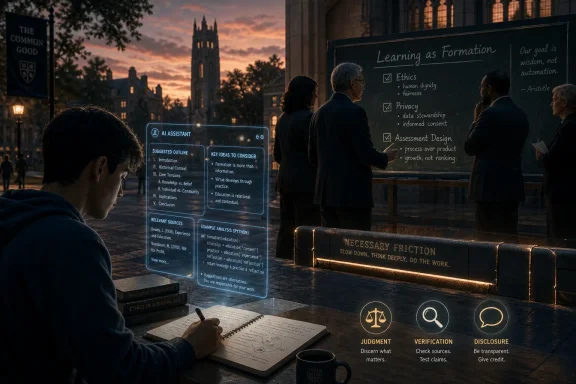 The Campus AI Debate Has Outgrown the Cheating Panic
The first wave of generative AI anxiety in higher education was understandable, and also too small. ChatGPT arrived in public view in late 2022, and within weeks faculty were swapping stories about suspiciously polished essays, invented citations, and students who could no longer explain the work submitted under their names. The academic-integrity crisis was real, but it was never the whole story.Fuchko’s argument begins from a more durable premise: AI in higher education is a “conundrum, a contradiction, and competition.” That formulation matters because it resists the administrative instinct to turn every hard thing into a policy memo. AI is not just another classroom technology, like the learning management system or the lecture-capture camera. It is a general-purpose outsourcing machine for language, synthesis, planning, coding, and increasingly multimodal production.
That means colleges are not merely deciding whether students may use AI. They are deciding which parts of intellectual work must remain visible, effortful, and human if a degree is to mean anything at all. A university can allow AI-assisted brainstorming and still insist that students learn to write. It can deploy AI tutors and still demand that future nurses, accountants, engineers, teachers, and lawyers internalize knowledge they cannot simply look up under pressure.
The mistake is to frame the matter as “innovation versus tradition.” The harder truth is that both sides are right about something. AI can widen access, personalize support, accelerate research, and help overextended institutions analyze information they already possess. It can also flatten learning into completion, reward students for passing as competent, and tempt colleges into mistaking operational efficiency for educational purpose.
Fuchko Puts Formation Back at the Center
The most important move in Fuchko’s essay is not technical. It is anthropological. He asks what higher education is forming: a person, a worker, a knower, a citizen, or something else entirely.That question may sound lofty in a sector accustomed to budget models, enrollment funnels, accreditation rubrics, and workforce dashboards. Yet it is exactly the question AI forces back into the room. If the goal of college is only to produce acceptable outputs, then generative AI is not a threat. It is a productivity layer. If the goal is to cultivate durable capacity — judgment, integrity, resilience, disciplined attention, factual command, moral reasoning — then the output is only evidence of a process, not a substitute for it.
Fuchko’s military analogy is useful here. Officer training is not merely the transfer of information. It combines classroom instruction, field exercises, physical demands, mistakes, stress, repetition, and judgment under uncertainty. The point is not simply that cadets know things; it is that they become the kind of people who can act responsibly when the map is incomplete.
Higher education has often been uncomfortable saying this plainly. Institutions advertise career outcomes, research impact, social mobility, and student experience, but they tend to use softer language around character. AI makes the evasions harder to sustain. A graduate who can prompt a model to produce a plausible memo is not the same as a graduate who can think through the problem, detect the missing premise, challenge the assumption, and take responsibility for the recommendation.
This is where the AI debate becomes uncomfortable for both techno-optimists and faculty traditionalists. It is not enough to say students must “use AI ethically.” Nor is it enough to say they must “do their own work,” as if the pre-AI classroom were a golden age of intrinsic motivation and deep reading. Institutions need to identify the parts of learning where assistance is legitimate, the parts where assistance is corrosive, and the developmental reasons for drawing that line.
The Shortcut Economy Is Now Built Into the Interface
Fuchko’s discussion of the “average student” is blunt because it has to be. Students often take shortcuts. That was true before AI. It was true when papers were purchased, when homework files circulated, when online quizzes were crowdsourced, and when students skimmed rather than read. Generative AI did not invent academic evasion; it made evasion cheaper, faster, and harder to distinguish from legitimate help.The analogy to The Matrix is apt because it captures the fantasy at the heart of the AI learning pitch. If Neo can learn kung fu by download, why should a student slog through drafts, problem sets, failed proofs, lab notebooks, or close reading? The answer is that human learning is not just access to information. It is the formation of mental structure through effort, feedback, correction, and memory.
That is why the phrase “AI literacy” can become slippery. At its best, it means students understand model limitations, bias, hallucination, privacy risks, data provenance, and the changing role of AI in professional work. At its worst, it becomes institutional surrender dressed as sophistication: students are “AI literate” because they know which button produces a cleaner paragraph.
The danger is not that AI will make students lazy in some new and unprecedented way. The danger is that it will let institutions stop noticing the difference between performed competence and actual competence. If an assignment can be completed by a model with minimal student understanding, the problem is not only student misconduct. It is assignment design, assessment design, and possibly program design.
That does not mean every course must retreat to blue books and oral exams. It does mean colleges must become more intentional about where the learning happens. If the learning outcome is written argument, students may need to show notes, drafts, revisions, source evaluation, and live defense. If the learning outcome is coding, students may need to explain architecture, debug unfamiliar failures, and reason through tradeoffs without a copilot doing the hard part. If the learning outcome is professional judgment, students may need simulations in which the model is a resource but not the decision-maker.
AI Makes the Hidden Curriculum Impossible to Ignore
Every college has two curricula. One is printed in catalogs and syllabi. The other is absorbed through habits: how to meet deadlines, how to argue honestly, how to recover from failure, how to collaborate, how to respect evidence, how to tell the truth when no one is watching.AI presses directly on that second curriculum. A student who uses a chatbot to polish a cover letter may be learning a workplace norm. A student who uses the same system to fabricate reading reflections may be learning concealment. The tool is not morally identical in every context, but neither is it morally neutral in use.
Fuchko’s insistence on formation is therefore not nostalgia. It is risk management for the human layer of higher education. Colleges have spent years telling families, employers, and policymakers that degrees signal more than seat time. They signal persistence, competence, judgment, and some degree of trustworthiness. If AI breaks the connection between student work and student capability, the credential itself becomes more fragile.
This is not an abstract reputational concern. Employers already face a noisy hiring environment in which applicants can generate tailored resumes, polished writing samples, and plausible technical explanations at scale. Graduate programs and licensing bodies face similar pressures. The more AI can simulate competence, the more valuable verified competence becomes.
That should push colleges away from performative AI policy and toward more authentic demonstrations of learning. A transcript full of letter grades may be less persuasive in an AI-saturated world than a record of supervised practice, oral defense, applied projects, clinical evaluation, lab performance, fieldwork, or portfolios with process evidence. Ironically, AI may make some older forms of assessment feel newly modern because they restore a direct relationship between learner and performance.
The Stakeholder Table Is Wider Than the Vendor Demo
Fuchko is also right to widen the cast of characters. AI policy cannot be left to presidents, provosts, CIOs, and edtech vendors. Faculty, students, staff, alumni, governing boards, donors, employers, accreditors, community partners, and professional bodies all have legitimate stakes in the answer.The reason is simple: AI changes the bargain among them. Students want preparation for a labor market where AI tools are already embedded in office suites, search products, coding environments, customer-service workflows, and analytics platforms. Faculty want academic standards that do not collapse into surveillance or endless suspicion. Employers want graduates who can use AI without becoming dependent on it. IT and security teams want tools that do not leak institutional data into opaque systems. Trustees and presidents want relevance without scandal.
That is a governance problem, not just a teaching problem. Many institutions still treat AI as a syllabus-level matter, delegating decisions to individual instructors. That flexibility is necessary, but insufficient. Students then encounter a patchwork: AI banned in one course, encouraged in another, required in a third, and vaguely discouraged in a fourth. The result is confusion masquerading as academic freedom.
A serious institutional response should not produce one rule for every assignment. It should produce a shared vocabulary. Students should know the difference between AI as tutor, AI as editor, AI as source finder, AI as calculator, AI as co-author, and AI as substitute performer. Faculty should be supported in designing assignments that specify those distinctions. Administrators should resist the temptation to solve a pedagogical problem by buying a platform and calling it strategy.
The missing stakeholder in many AI conversations is the future public. Colleges educate people who will make decisions about law, medicine, finance, infrastructure, defense, public administration, journalism, education, and science. If those graduates learn that plausible output is good enough, the cost will not stay on campus.
The Ethics Layer Is Not Decorative
There is a revealing moment in Fuchko’s essay when he argues that philosophers, faith leaders, and others outside the usual technology conversation may deserve “primacy of place.” In a sector that often equates innovation with procurement, that claim is quietly radical. It says AI governance is not merely about acceptable use. It is about institutional conscience.Privacy is the obvious example. AI systems can ingest prompts, documents, student records, advising notes, assessment data, and behavioral signals. Even when vendors promise protections, institutions need to ask what data is being processed, where it goes, how long it persists, who can audit it, and whether students and employees have meaningful alternatives. A college that would never casually publish a student’s advising record should be cautious about feeding sensitive institutional context into systems it does not fully control.
Bias is another familiar but unresolved problem. AI systems reflect training data, design choices, deployment contexts, and user assumptions. In higher education, biased systems can affect admissions, advising, grading support, financial-aid communications, student-risk scoring, hiring, and discipline. The old institutional habit of treating software outputs as objective becomes more dangerous when the software speaks in fluent prose.
Then there is surveillance. AI-enabled proctoring, engagement tracking, authorship detection, and predictive analytics can turn the campus into a suspicion machine. Some monitoring may be defensible in limited contexts, particularly where licensure or safety is at stake. But a college that responds to AI misuse by normalizing intrusive oversight risks damaging the trust on which learning depends.
The military example in Fuchko’s essay carries a sharper edge. AI in warfare is not campus policy, but it illustrates the stakes of delegating judgment to machines. Universities are among the few institutions capable of convening engineers, ethicists, lawyers, historians, computer scientists, theologians, social scientists, and practitioners around such questions. If they reduce AI education to employability training, they abandon one of their comparative advantages.
The Workforce Argument Cuts Both Ways
The strongest case for AI adoption in higher education is not hype. It is realism. Graduates will enter workplaces where AI is part of ordinary productivity, and institutions that ignore that fact will underprepare them. A business student should understand AI-assisted analysis. A computer science student should know how code assistants change development. A communications student should be able to critique machine-generated copy. A teacher should know when AI tutoring helps and when it misleads.But workforce readiness cannot mean dependence readiness. Employers do not need graduates who can paste vague prompts into a chatbot and accept the result. They need people who can use AI to extend expertise, not conceal its absence. That distinction should become central to curriculum design.
The same is true inside institutions. AI can help staff summarize reports, draft routine communications, analyze calendar patterns, improve accessibility workflows, and prototype training materials. Fuchko’s own examples are practical rather than utopian: he uses AI to analyze reports, answer short questions, evaluate how his time aligns with strategic priorities, and help produce case studies. The key phrase is his reminder that he checks the work.
That habit is the line between augmentation and abdication. In professional settings, AI often produces a first draft of thought. The danger comes when the first draft becomes the final judgment because everyone is busy, the prose sounds confident, and the spreadsheet looks official. Higher education should be teaching students how to interrogate AI outputs, not merely how to generate them.
This is especially important for first-generation students, adult learners, and students from under-resourced schools. AI could become a powerful equalizer if it provides tutoring, writing support, language assistance, study planning, and feedback that students otherwise could not access. It could also widen gaps if wealthier students get guided, high-quality AI integration while others are left with free tools, weak instruction, and punitive enforcement.
Faculty Cannot Carry This Alone
One of the quiet failures of the AI rollout across higher education has been the assumption that faculty can absorb the disruption individually. Revise your syllabus. Redesign your assignments. Detect AI misuse. Teach AI literacy. Preserve rigor. Avoid false accusations. Learn the tools. Protect student privacy. Do all of this while maintaining research, advising, service, and ordinary teaching loads.That is not a strategy. It is a transfer of institutional risk onto individual instructors.
Faculty need time, training, and design support. Instructional designers need authority and resources. IT teams need to be brought into academic conversations before tools proliferate through shadow adoption. Libraries need a central role because AI literacy overlaps with information literacy, source evaluation, copyright, and scholarly practice. Legal and compliance teams need to be involved without turning the whole enterprise into a fear-driven paperwork exercise.
The faculty role also deserves protection. If AI becomes a pretext for automating feedback, standardizing course shells, reducing instructor autonomy, or replacing human mentoring with cheaper software, the educational promise will curdle quickly. Students do not merely need content delivery. They need expert attention, challenge, encouragement, and correction from people who can see what a model cannot.
This does not mean every traditional practice deserves preservation. Some lectures are bad. Some assignments are stale. Some feedback is too slow to be useful. AI can expose weak pedagogy by making it easier for students to bypass it. The answer is not to defend every old method; it is to defend the human purposes those methods were supposed to serve.
The Map Matters More Than the Compass
Fuchko writes that saying “we want AI-literate graduates” is a compass without a map. That may be the essay’s most practical insight. Almost every college can now produce a statement about responsible AI. Far fewer can explain how that statement changes general education, major requirements, assessment, faculty development, procurement, student support, and institutional data governance.A map begins with distinctions. Which learning outcomes require unaided performance? Which permit AI assistance with disclosure? Which require students to use AI because the profession now demands it? Which uses are prohibited because they substitute for the learning itself? Without those distinctions, AI policy becomes either empty aspiration or arbitrary enforcement.
A map also includes sequence. First-year students may need more constrained environments because they are still building foundational habits. Advanced students may need more realistic AI-integrated work because they are preparing for professional contexts. Graduate and professional programs may need discipline-specific rules tied to licensure, ethics, and public safety. One policy cannot do all of this work.
Finally, a map includes evidence. Institutions should study how AI affects learning, retention, equity, workload, student confidence, academic integrity, and employer satisfaction. They should not outsource the answer to vendor white papers or assume that adoption equals success. The relevant question is not whether AI is being used. It is whether students are learning more deeply, demonstrating competence more reliably, and leaving with stronger judgment.
Microsoft, Google, OpenAI, and the Platform Future Are Already on Campus
For WindowsForum readers, there is a familiar platform story underneath the higher-ed debate. AI is not arriving only through standalone chatbots. It is being woven into Microsoft 365, Google Workspace, search, browsers, coding tools, note-taking apps, learning platforms, customer-relationship systems, and analytics dashboards. The adoption path is less like installing a new campus system and more like watching AI seep into every interface people already use.That matters for governance. A college can ban a chatbot by name and still find AI embedded in the software students and staff open every morning. Microsoft Copilot, Gemini features, AI writing assistants, transcription tools, slide generators, and code completion systems blur the line between ordinary productivity software and generative assistance. The “AI policy” becomes less enforceable when AI is not a destination but a feature.
This is where IT professionals become central to the educational mission. Identity management, data-loss prevention, tenant configuration, logging, retention, access controls, vendor review, and user training are no longer back-office concerns. They shape what kinds of AI use are possible, safe, auditable, and aligned with institutional values.
Colleges that treat AI as a faculty problem will miss this layer. Colleges that treat it only as an IT problem will miss the learning layer. The institutions that fare best will connect the two, recognizing that platform defaults can quietly become pedagogy.
The Answer Is Not a Ban, but It May Include Friction
There is a fashionable argument that because AI cannot be uninvented, resistance is futile. It is true that blanket bans are brittle. It does not follow that every friction point is reactionary.Friction is part of education. A student learning mathematics should sometimes struggle without a calculator. A writer should sometimes face the blank page. A future physician should memorize things that cannot wait for retrieval. A historian should sit with primary sources long enough to notice what a summary misses. A programmer should debug enough broken code to develop intuition.
The task is to decide which friction is pedagogically necessary. AI should remove needless barriers, not all barriers. It should help students access material, practice skills, receive feedback, and extend their capabilities. It should not routinely remove the cognitive work that creates capability in the first place.
That distinction will vary by discipline. In composition, AI may be useful for critique after a student has drafted an argument. In statistics, it may help explain errors after a student attempts the problem. In computer science, it may be appropriate in advanced courses that mirror professional workflows but restricted in early courses where students must build fundamentals. In ethics, it may serve as an object of critique rather than a writing partner.
The common thread is transparency. Students should not have to guess whether they are violating invisible norms. Faculty should not have to police ambiguous behavior with unreliable detection tools. Institutions should normalize disclosure, process documentation, and assignment-specific AI expectations.
The Fuchko Test Is Whether Leaders Can Still Say No
The most revealing AI question for higher education leaders may not be where they say yes. It may be where they are willing to say no.No, not every efficiency is educationally healthy. No, not every vendor claim should be accepted. No, not every student demand for convenience should define the curriculum. No, not every task that can be automated should be automated. No, a degree cannot become a certificate of prompt management and still mean what institutions say it means.
This is difficult because colleges are under pressure. Enrollment challenges, budget constraints, public skepticism, political scrutiny, and workforce demands all push leaders toward visible modernization. AI offers an unusually attractive promise: better service, lower cost, personalized learning, happier students, more efficient staff, and market relevance. Some of that promise is real. Some of it is sales copy.
Leadership means distinguishing between the two while the market is moving. It means creating room for experimentation without surrendering standards. It means admitting uncertainty without drifting. It means telling students that the institution will prepare them for an AI-shaped world while also requiring them to develop capacities AI can imitate but not possess.
Fuchko’s essay is valuable because it does not pretend the president’s office can solve AI through edict. It frames leadership as disciplined questioning. That may sound modest, but in the current environment it is a serious act. The right questions slow down bad decisions and make better decisions accountable to purpose.
The Questions Presidents Should Not Delegate Away
Fuchko offers questions rather than commandments, and that is the right form for the moment. Still, some answers are beginning to take shape. The institutions that navigate AI well will be those that connect policy to pedagogy, technology to ethics, and workforce preparation to human formation.The immediate work is concrete:
- Institutions should define which parts of learning require unaided student performance and which parts can responsibly include AI assistance.
- Faculty should receive real support for assessment redesign rather than being left to manage AI disruption course by course.
- Students should be taught to disclose, critique, and verify AI use instead of being pushed into a cat-and-mouse game around detection.
- IT and academic leaders should jointly govern AI tools because platform settings, data controls, and classroom norms now shape one another.
- Colleges should measure AI’s effect on learning and equity, not merely adoption rates or productivity gains.
- Leaders should include ethicists, employers, students, faculty, and community voices before vendor roadmaps become institutional strategy.
References
- Primary source: Capital Analytics Associates
Published: 2026-06-05T14:50:18.470425
AI in higher education: Questions every leader must ask - caa | Capital Analytics Associates
Dalton State College President John Fuchko offers a framework for navigating AI in higher education, exploring learning, ethics, stakeholder expectations, and institutional responsibility. capitalanalyticsassociates.com
- Related coverage: educause.edu
The Impact of AI on Work in Higher Education | EDUCAUSE
In recent years, the higher education community has been exploring how AI tools are impacting the ways we learn, work, and live. Focus has largely beewww.educause.edu
- Related coverage: coursera.org
AI in Higher Education: Strategic Guidance for University Leaders in 2026 | Coursera
New research reveals 95% of students and educators now use AI—but only 26% of institutions have formal policies in place. Here's how leaders can turn widespread adoption into strategic advantage. www.coursera.org
- Related coverage: events.educause.edu
- Related coverage: er.educause.edu
Three Years In: Reflections and Considerations for the Next Chapter of AI in Higher Education | EDUCAUSE Review
Artificial intelligence has the potential to transform higher education by connecting student experiences, improving operations, and enhancing outcomeer.educause.edu
