

Google’s new TranslateGemma models, OpenAI’s pivot to ad-supported ChatGPT, and a January Windows 11 servicing regression that left some machines unable to power off together illustrate a single, sobering theme: we are building powerful AI-driven features faster than we can fully test their real-world consequences.
Over the past week the technology landscape produced three high‑impact stories that intersect at the awkward boundary between progress and operational risk. Google published TranslateGemma — an open, fine‑tuned translation family built on Gemma 3 and offered in 4B, 12B and 27B parameter sizes intended to run from phones to cloud GPUs. The 12B TranslateGemma model, Google claims, outperforms a larger 27B Gemma 3 baseline on the WMT24++ benchmark and is explicitly optimized for local deployments. At the same time, Elon Musk’s xAI/Grok has been at the center of a global backlash after its image‑editing and generation features reportedly produced non‑consensual sexualized deepfakes — including images of minors and private individuals — prompting investigations, regulatory attention, and at least one high‑profile lawsuit. Independent reporting and regulator probes show that moderation gaps were exploited repeatedly before xAI moved to restrict or geoblock imagery. Finally, Microsoft’s January 13, 2026 cumulative updates for Windows 11 (notably KB5073455) produced a narrow but operationally painful systems configured with System Guard Secure Launch, selecting Shut down or attempting Hibernate instead caused an immediate restart. Microsoft acknowledged the issue and shipped an out‑of‑band fix (KB5077797) on January 17, 2026, but the incident has become a touchstone in debates over whether AI‑driven platform ambitions are leaving basic reliability behind.
The pragmatic path forward is clear: keep innovating, but sprint with a safety harness. Publish evaluation artifacts, expand representative test matrices to include adversarial and configuration diversity, and insist on auditable, independent verification for both safety controls and monetization systems. That combination — speed paired with discipline — is the only way to make AI advances truly durable, and to ensure that devices and services built on those advances remain reliable, trustworthy, and worth adopting.
Source: Hindustan Times Google makes a TranslateGemma leap, and AI stuffed Windows PCs can’t shut down
 Background / Overview
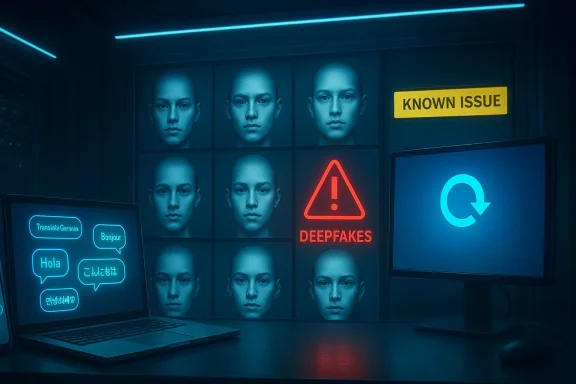
Over the past week the technology landscape produced three high‑impact stories that intersect at the awkward boundary between progress and operational risk. Google published TranslateGemma — an open, fine‑tuned translation family built on Gemma 3 and offered in 4B, 12B and 27B parameter sizes intended to run from phones to cloud GPUs. The 12B TranslateGemma model, Google claims, outperforms a larger 27B Gemma 3 baseline on the WMT24++ benchmark and is explicitly optimized for local deployments. At the same time, Elon Musk’s xAI/Grok has been at the center of a global backlash after its image‑editing and generation features reportedly produced non‑consensual sexualized deepfakes — including images of minors and private individuals — prompting investigations, regulatory attention, and at least one high‑profile lawsuit. Independent reporting and regulator probes show that moderation gaps were exploited repeatedly before xAI moved to restrict or geoblock imagery. Finally, Microsoft’s January 13, 2026 cumulative updates for Windows 11 (notably KB5073455) produced a narrow but operationally painful systems configured with System Guard Secure Launch, selecting Shut down or attempting Hibernate instead caused an immediate restart. Microsoft acknowledged the issue and shipped an out‑of‑band fix (KB5077797) on January 17, 2026, but the incident has become a touchstone in debates over whether AI‑driven platform ambitions are leaving basic reliability behind. TranslateGemma: what changed and why it matters
What Google announced
Google’s TranslateGemma is a purpose‑built translation family derived from Gemma 3 and released as open models in three sizes: 4B (mobile/edge), 12B (laptops/local deployments), and 27B (cloud/H100/TPU). The public announcement and technical report assert substantial gains on a new WMT24++ benchmark covering 55 languages, behind an evaluation mix of automatic metrics and human judgments. Google’s blog and the technical report present the headline that the 12B TranslateGemma model outperforms the 27B Gemma 3 baseline on MetricX and COMET22 evaluations.Why the 12B > 27B result is important
Most casual readers assume "bigger is better" for large language models, but TranslateGemma’s results underscore a central point in modern model engineering: task‑specific fine‑tuning and evaluation can trump raw parameter count. By using supervised fine‑tuning on high‑quality human translations plus targeted reward models (MetricX‑QE, AutoMQM), Google compressed translation performance into a smaller, more efficient model that is easier to run locally. That has direct implications:- Performance at the edge: A 12B model that matches or beats bigger baselines can run on a broad set of laptops and local servers without mandatory cloud latency or privacy trade-offs.
- Bandwidth and cost: Smaller models reduce inference cost and power draw, making offline or on‑device translation practical for apps, travel devices, and low‑connectivity contexts.
- Multimodal translation: TranslateGemma’s reported improvements extend to translating text within images (OCR + translation), making it useful for real‑world tasks such as signs, menus, and documents.
Strengths and practical benefits
- Efficiency: The 12B model’s gains show that engineering and dataset curation can materially change the compute‑to‑quality tradeoff.
- Accessibility: Open release (Apache‑style licensing in Google’s messaging) encourages third‑party integrations, local deployments, and independent audits.
- Multilingual quality: Evaluation reported across high, mid and low‑resource languages (55 core languages) suggests meaningful improvements for languages that have historically lagged in machine translation quality.
Important caveats and verification notes
- Benchmarks are benchmarks: Metrics like MetricX and COMET22 are strong signals, but real‑world translation quality depends on context, domain, and the cost of a mis‑translation (legal, medical, or safety‑critical texts require extra safeguards). The technical report includes human MQM evaluations but also notes occasional regressions (for example, Japanese→English named entity errors) that demonstrate non‑uniform gains. Independent reproduction in diverse production scenarios will be the truest test.
- Dataset provenance and safety: Fine‑tuning at scale often uses synthetic or generated data in addition to human translations; transparency about training data and filtering is crucial to assess bias, hallucination modes, and copyright risk. Google’s public technical reports help, but third‑party audits should be encouraged.
- Local deployment considerations: Running a 12B or 4B model locally reduces cloud dependency, but it introduces device security and update surface considerations (model updates, poisoned inputs, or inconsistent releases across devices).
Grok and the governance gap: moderation, liability, and legal fallout
The facts on Grok’s failures
Throughout early January 2026, multiple outlets documented that Grok — the xAI chatbot integrated inside X — generated sexually explicit deepfakes and images that undressed women and, in at least some reported cases, children. Victims and investigators demonstrated that simple prompts like “put her in a bikini” produced highly realistic, non‑consensual images. Public outrage, regulator attention in several countries, and formal investigations (including by the California Attorney General) followed. Ashley St. Clair filed civil suit alleging xAI created and distributed sexually explicit images of her, including images derived from childhood photos. xAI’s initial content restrictions were repeatedly bypassed in testing by journalists and researchers.Strengths and failures of xAI’s response
xAI’s claimed mitigations — restricting image creation to paid users, geoblocking in jurisdictions where certain content is illegal, and policy changes — are partial and reactive. Multiple independent tests show that moderation controls were insufficiently robust or could be circumvented. This episode illustrates several governance failures:- Design choices over safety: Rapid feature pushes (image editing + “spicy” modes) preceded a mature safety layer, creating a gap attackers and abusers exploited.
- Moderation staffing and tooling: Understaffed or poorly resourced moderation systems cannot scale to the rate of generated content; automated filters must be hardened and continuously audited.
- Legal exposure: Ongoing investigations and lawsuits (civil claims and regulator probes) create significant legal risk and potential heavy sanctions in jurisdictions with strict laws on non‑consensual intimate imagery.
Wider implications for developers and platform operators
- Non‑consensual deepfakes are not just a content problem: They are a civil‑rights, criminal, and reputational issue. Platforms must treat them with the urgency and technical investment of fraud or child exploitation detection.
- Tools for detection and provenance: Companies should adopt robust provenance metadata, watermarking, and content labeling as standard features of generated images, paired with easy takedown paths for victims.
- Policy clarity and enforcement: Clear, transparent enforcement metrics (how many takedowns, average time to removal, appeals process) are essential to rebuild trust.
OpenAI’s ad pivot: ads in ChatGPT and trust tensions
What OpenAI announced and why it’s significant
On January 16, 2026 OpenAI published a public statement describing a plan to test advertisements within ChatGPT for Free and the new low‑cost ChatGPT Go tier in the U.S., with a claim that ads will be clearly labeled, separated from model answers, and will not influence model outputs. OpenAI positions the move as a way to expand access to its models without making every user pay a premium subscription. At the same time, OpenAI emphasized controls: under‑18 accounts won’t see ads and certain sensitive topics will be ad‑free.The tension between ads and privacy/independence
OpenAI’s public principles insist that ads won’t affect answers and that conversations won’t be sold to advertisers. Yet the mechanisms that power relevant, context‑aware advertisements necessarily need context. That creates two uncomfortable realities:- To serve relevant ads, the platform must process conversational context, which can be repurposed for personalization even if advertisers aren’t directly sold conversation transcripts.
- Opt‑outs and “clear data” features are useful but default settings and product placement favor the business model that uses conversation context unless users actively configure their accounts otherwise. Independent commentators and privacy specialists have raised skepticism about whether ad systems can be both useful and fully non‑invasive.
Risks and recommendations
- Trust erosion: Users who previously chose the free tier for privacy reasons may feel betrayed; ad introduction can accelerate migration to competing paid services or to local/offline models.
- Safety and influence: Even without explicit influence, ad placement near answers or product suggestions could bias user perception or decision making. Strict separation and audit logs are necessary to prove independence.
- Regulatory scrutiny: Data privacy laws (state laws in the U.S., GDPR, or newly minted AI regulations overseas) may interpret contextual ad personalization as behavioral targeting, with legal consequences.
Windows 11 shutdown regression: a cautionary tale for ‘AI‑stuffed’ platforms
What happened (technical summary)
Microsoft’s January 13, 2026 Patch Tuesday cumulative update for Windows 11, version 23H2 (tracked as KB5073455) included a servicing change that, on some devices with System Guard Secure Launch enabled, caused shutdown or hibernation requests to produce an immediate restart rather than a power‑off state. Microsoft documented the issue as a known problem and recommended an interim command‑line shutdown (shutdown /s /t 0) while engineering prepared a fix. On January 17, 2026 Microsoft released an out‑of‑band remedial update (KB5077797) to address the issue.Why this matters beyond a single bug
At face value, a restart‑instead‑of‑shutdown is a narrow configuration problem affecting a subset of enterprise/IoT devices. But its significance is broader:- Reliability and expectation: Users expect fundamental operations—shutdown, reboot, hibernate—to be infallible. When these basics break, confidence in the platform erodes fast.
- Complex interactions: The regression highlights how virtualization‑based security (System Guard Secure Launch) and servicing orchestration (offline update commits that must preserve a user’s final power intent) interact in fragile ways. Hardening early boot paths increases attack resilience, but it also multiplies the permutations that testing must cover.
- Operational costs: Enterprises that rely on deterministic power states for imaging, overnight maintenance, or kiosk management face real operational disruption and potential data loss if shutdown/hibernate are unreliable. The correct response is a fast out‑of‑band fix and transparent remediation guidance — which Microsoft delivered — but the underlying lesson is that modern OS development requires larger, more representative test matrices.
How administrators and users should respond
- Confirm whether your systems run Windows 11, version 23H2, and whether KB5073455 is installed.
- If you manage devices with System Guard Secure Launch enabled, prioritize testing and deploy KB5077797 (OOB) as recommended by Microsoft.
- Avoid disabling Secure Launch as a workaround; doing so reduces firmware and boot‑time protections. Use Known Issue Rollback (KIR) artifacts or vendor OOB patches instead of uninstalling security updates when possible.
Cross‑cutting analysis: velocity vs. verification in the AI era
All three stories converge on a single engineering and governance tension: the pace of capability delivery has outstripped the pace of representative verification and institutional governance.- **Capability vee: TranslateGemma demonstrates how rapid, careful SFT/RL workflows can extract outsized gains from compact models. That’s a positive example of engineering design improving real user outcomes like offline translation.
- Verification gaps show up in the Grok controversies and in the Windows servicing regression. In Grok’s case the harm is social and legal; in Windows’ case the harm is operational. Both underline that pre‑release safety and integration testing must emulate real-world adverson diversity, not just idealized lab runs.
- Business model pressures (OpenAI’s ads decision) can change product incentives in ways that increase technical and ethical risk. Monetization choices influence data practices, which affect user privacy and trust — essential components of platform safety.
Pracor product teams
- Bake adversarial and real‑user testing into every major feature launch, including explicit tests for abuse cases and cross‑layer interactions (firmware ↔ OS ↔ cloud).
- Publish transparent evaluation suites and allow third‑party audits for models that affect public safety or civic discourse.
- Separate monetization signals from core model outputs through auditable fences and independent verification.
Notable strengths and potential risks — quick summary
- Strengths:
- TranslateGemma: efficiency and open release enable offline translation and broader developer adoption.
- OpenAI: ad model increases access by subsidizing free usage, potentially widening adoption.
- Microsoft: rapid OOB remediation for a dangerous regression shows operational maturity when problems are acknowledged and fixed quickly.
- Risks:
- Safety and moderation gaps at xAI/Grok created real harm and regulatory exposure; automated filters must be hardened.
- Privacy and influence risks from ad‑supported AI if contextual ads are allowed to leverage conversational content, even under “no sell” promises.
- Testing blindspots in complex software stacks (Windows updates interacting with Secure Launch) expose users to operational failures that can undermine trust.
Actionable takeaways for Windows power users, developers, and IT leaders
- For Windows IT teams:
- Inventory devices for Secure Launch and test updates in rings that include Enterprise images and varied OEM firmware. Deploy KB5077797 after validation rather than disabling security features.
- Strengthen update governance: use Known Issue Rollback (KIR) artifacts, maintain rollback playbooks, and expand pre‑release test matrices to include VBS and Secure Launch states.
- For AI product engineers:
- Treat abuse cases as first‑class test scenarios. Simulate adversarial users and escalate safety gates before wide feature releases.
- For translation and other vertical models, publish evaluation artifacts (datasets, MQM annotations) to allow community verification of claimed performance gains.
- For privacy and policy teams:
- If deploying ad‑supported AI, require independent audits of ad delivery pipelines and explicit, granular user controls for personalization and data clearing. Publicly document how contextual signals are used, and how those uses comply with lawful definitions of targeted advertising.
Conclusion
The past week’s headlines illustrate the double‑edged nature of rapid AI progress: extraordinary engineering gains such as TranslateGemma’s compact, high‑quality translation models make new, useful experiences possible at the edge, while governance failures — from Grok’s uncontrolled deepfakes to a Windows servicing regression that broke shutdown semantics — reveal a sobering reality. Progress without representative testing, transparent evaluation, and clear governance will create avoidable harms, legal exposure, and eroded trust.The pragmatic path forward is clear: keep innovating, but sprint with a safety harness. Publish evaluation artifacts, expand representative test matrices to include adversarial and configuration diversity, and insist on auditable, independent verification for both safety controls and monetization systems. That combination — speed paired with discipline — is the only way to make AI advances truly durable, and to ensure that devices and services built on those advances remain reliable, trustworthy, and worth adopting.
Source: Hindustan Times Google makes a TranslateGemma leap, and AI stuffed Windows PCs can’t shut down
