

HR leaders building an AI-ready early-career pipeline in 2026 must protect entry-level hiring, redesign junior work around skills and judgment, and make AI a supervised learning partner rather than a replacement for the messy apprenticeship through which future experts, managers, and leaders are formed. The core mistake would be to treat generative AI as a spreadsheet exercise in labor substitution. The harder, more strategic answer is that companies need to rebuild the first rung of the career ladder before automation kicks it away. If they fail, the cost will not show up only in graduate intake numbers; it will appear later as a shortage of people who understand customers, systems, politics, risk, and responsibility.
The fashionable enterprise AI story is still framed as productivity: fewer repetitive tasks, faster drafts, automated reports, self-service support, cheaper code, cleaner workflows. That framing is not wrong, but it is incomplete in the way that matters most to HR. Many of the tasks AI is best positioned to absorb are also the tasks through which early-career employees learn how an organization actually works.
The junior analyst cleaning data is not merely cleaning data. They are learning which numbers are trusted, which systems disagree, which stakeholder always asks the real question, and which dashboard is performative theater. The graduate recruiter drafting candidate notes is not merely summarizing interviews. They are learning what a hiring manager says they want, what the role really requires, and where bias or confusion enters the process.
This is why the early-career debate is more consequential than a standard workforce planning discussion. If AI removes low-level execution without replacing the developmental value of that execution, organizations may enjoy a short burst of efficiency while quietly hollowing out their future capability. The savings arrive immediately; the institutional damage arrives with a delay.
That delay is exactly what makes the issue dangerous. Boards can see headcount reduction this quarter. They cannot as easily see the missing middle managers of 2031, the underdeveloped product leads of 2034, or the security leaders who never learned how operational risk looks from the floor.
AI disrupts that bargain because it is strongest precisely where the old apprenticeship model began. Research summaries, first drafts, code fixes, ticket triage, meeting notes, knowledge-base updates, spreadsheet reconciliation, and routine customer communications are all obvious candidates for automation. Those tasks were never the whole job, but they were often the training ground for the whole career.
The worst response would be to preserve obsolete busywork for sentimental reasons. Nobody should defend copy-paste administration as a sacred rite of passage. But HR leaders need to distinguish between friction that wastes talent and friction that develops judgment.
A graduate should not spend weeks formatting slides because the organization has poor templates. A graduate probably should spend time defending a recommendation to a skeptical manager, watching an experienced colleague navigate a difficult client, or learning why a technically correct answer fails in a political organization. AI can remove the first kind of friction; removing the second kind would be self-harm.
This creates a problem for HR functions still optimized around static proxies. If job descriptions ask for degrees while the actual work requires fluency in prompting, workflow redesign, data judgment, model limitations, and human review, the hiring process will miss talent hiding in plain sight. Some of the most useful early-career candidates will be people who have already built small automations, hacked together internal tools, compared model outputs, or learned where AI breaks.
That experience may not sit neatly on a résumé. It may have happened in a bedroom, on a weekend, or inside an unofficial team workflow. In many companies, this kind of shadow AI is treated only as a governance problem. It is that, but it is also a talent signal.
The HR leader’s job is not to celebrate unmanaged tool use. It is to convert informal experimentation into visible capability, then wrap it in standards, supervision, and security. If early-career employees are already learning AI through practice, organizations should not pretend the only legitimate learning happens after procurement approves a platform.
An AI-ready junior employee does not simply “know AI.” That phrase is already too vague to be useful. What matters is whether they can frame a problem, test an output, spot hallucinated confidence, understand data sensitivity, explain a workflow, and ask when a human should override the system. Those are demonstrable skills, not decorations on a certificate.
This changes assessment. Hiring teams need work samples, scenario exercises, portfolio reviews, and structured conversations about how candidates have used AI tools in real contexts. They also need to ask better questions of internal employees. The person quietly automating a recurring report may be more useful to an AI transformation program than the person whose job title sounds more glamorous.
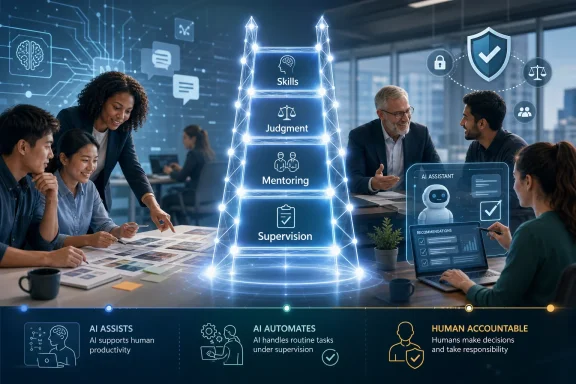
For early-career pipelines, this means progression should become less dependent on time served and more dependent on capability demonstrated. That does not mean throwing junior workers into complex tasks without support. It means building transparent ladders where employees can see which skills move them forward and where managers can see whether AI is accelerating learning or disguising gaps.
Early-career employees need something more concrete: a clear boundary between tasks AI can assist, tasks AI can automate under supervision, and tasks that remain fundamentally human. That boundary will vary by role, but the exercise itself is valuable. It forces managers to define what they actually expect humans to learn.
In a recruiting role, AI may draft outreach or summarize candidate profiles, but the human must still assess trust, motivation, culture fit, fairness, and context. In a finance role, AI may identify anomalies or generate commentary, but the human must understand materiality, incentives, and accountability. In a software role, AI may write code, but the human must still reason about architecture, maintainability, security, and user impact.
This boundary should appear in job descriptions, onboarding plans, learning objectives, and manager check-ins. If the organization cannot explain what AI should not do, it probably cannot explain what the early-career employee is there to become. That is not a technology problem. It is a failure of work design.
Work is not just information retrieval. It is interpretation under constraint. A model can explain a policy, but a mentor can explain why the policy is applied differently in two departments. A chatbot can generate a stakeholder map, but a senior colleague can tell you which stakeholder has no formal power and still controls the outcome.
This is why social pairing, mentoring, and team-based learning become more important in an AI-heavy workplace, not less. Early-career employees need to see how experienced workers think out loud, change their minds, handle ambiguity, and recover from mistakes. Those are not easily captured in a prompt window.
There is also a psychological dimension. Young workers entering an AI-saturated labor market are being asked to become fluent in tools that may appear to threaten their own employability. If companies want them to experiment, they need psychological safety. If they want them to challenge AI outputs, they need permission to be skeptical. If they want them to develop judgment, they need managers who reward questions rather than mere speed.
The quoted warning from IBM’s HR leadership is blunt: stop hiring at the entry level and the pipeline dries up within a few years. That is the part too many executives underweight. Capability is not something companies summon on demand after a transformation program starts to wobble. It is built through cohorts, managers, rotations, feedback, mistakes, and accumulated context.
For HR leaders, the lesson is not to copy IBM’s program mechanically. It is to copy the investment logic. Entry-level workers should not be treated as a disposable cost category because their current tasks look automatable. They should be treated as the raw material of future organizational competence.
This is especially relevant in technology, where the mythology of the lone expert obscures how expertise is actually formed. Senior engineers, architects, security specialists, product managers, and IT leaders do not emerge fully formed from certification programs. They develop by touching systems, breaking assumptions, working with users, and learning the difference between a clean technical answer and a workable organizational answer.
The answer is that the comparison is too narrow. A junior employee is not only a unit of present output. They are an option on future capability. They are a potential manager, product expert, customer interpreter, incident commander, compliance translator, sales engineer, or transformation lead. The value of that option compounds only if the organization keeps investing.
Boards understand this logic in other contexts. They invest in infrastructure before every workload exists. They fund R&D without knowing which experiment will commercialize. They maintain security capabilities whose value is clearest when disaster does not happen. Early-career talent deserves a similar treatment because it is infrastructure for human capability.
That does not mean HR should ask for sentimental immunity from efficiency pressure. It means HR should bring a more rigorous argument to the table. Which roles create future leadership supply? Which tasks are developmental rather than merely administrative? Which skills will be scarce in three years? Where does AI reduce the need for headcount, and where does it increase the need for human supervision, judgment, and redesign?
The boardroom conversation should not be “save the graduates.” It should be “protect the capability chain.” That is a harder argument to dismiss.
Cross-organizational ecosystems can expose young workers to different systems, cultures, constraints, and operating models. That matters because AI fluency without organizational literacy is brittle. A candidate who has only learned one company’s tooling may struggle when the workflow, data quality, compliance burden, or customer expectation changes.
Multifunctional pathways inside one organization can achieve a similar effect. Rotations across product, operations, customer support, data, HR, finance, or security help employees understand how work connects. That connective tissue is exactly where AI projects often fail. A workflow that looks efficient in one department can create risk or confusion in another.
Early specialization is tempting because it makes workforce planning neat. But neatness is not the same as resilience. In an AI-shaped labor market, the most valuable early-career employees may be those who can move across boundaries, translate between functions, and recognize when a technical answer is missing the organizational problem.
A junior employee can be highly motivated and still fail in a badly designed AI environment. If tools are unmanaged, policies are vague, managers are absent, and incentives reward speed over accuracy, AI use will become either reckless or performative. Conversely, a less experienced employee can develop quickly if the organization provides structured learning, safe experimentation, real feedback, and clear escalation paths.
This is where HR must push beyond training catalogs. AI readiness is not achieved by assigning a course and recording completion. It requires redesigning work so that learning happens in the flow of real tasks. It requires managers who know how to coach AI-assisted work, not just approve timesheets. It requires governance that protects the organization without suffocating experimentation.
For WindowsForum readers who live closer to IT operations than HR strategy, this should sound familiar. A tool rollout without process redesign becomes shelfware or chaos. The same is true of AI in early careers. Licenses do not create capability. Supervised use, standards, feedback, and operating discipline do.
The old model allowed development to happen almost accidentally. People learned because they were present, because work was manual, because meetings were in person, because senior colleagues had to explain things, and because information was harder to obtain. AI and hybrid work have weakened those accidental learning mechanisms. HR now has to make them intentional.
 The First Rung Is Becoming the Most Strategic Rung
The fashionable enterprise AI story is still framed as productivity: fewer repetitive tasks, faster drafts, automated reports, self-service support, cheaper code, cleaner workflows. That framing is not wrong, but it is incomplete in the way that matters most to HR. Many of the tasks AI is best positioned to absorb are also the tasks through which early-career employees learn how an organization actually works.The junior analyst cleaning data is not merely cleaning data. They are learning which numbers are trusted, which systems disagree, which stakeholder always asks the real question, and which dashboard is performative theater. The graduate recruiter drafting candidate notes is not merely summarizing interviews. They are learning what a hiring manager says they want, what the role really requires, and where bias or confusion enters the process.
This is why the early-career debate is more consequential than a standard workforce planning discussion. If AI removes low-level execution without replacing the developmental value of that execution, organizations may enjoy a short burst of efficiency while quietly hollowing out their future capability. The savings arrive immediately; the institutional damage arrives with a delay.
That delay is exactly what makes the issue dangerous. Boards can see headcount reduction this quarter. They cannot as easily see the missing middle managers of 2031, the underdeveloped product leads of 2034, or the security leaders who never learned how operational risk looks from the floor.
Automation Is Eating the Apprenticeship Model Before HR Has Rebuilt It
For decades, professional development rested on a crude but durable bargain. New workers took on smaller, more repetitive, lower-risk tasks, and in return they gained exposure to the organization’s language, constraints, people, and failure modes. The work was not always glamorous, but it had educational density.AI disrupts that bargain because it is strongest precisely where the old apprenticeship model began. Research summaries, first drafts, code fixes, ticket triage, meeting notes, knowledge-base updates, spreadsheet reconciliation, and routine customer communications are all obvious candidates for automation. Those tasks were never the whole job, but they were often the training ground for the whole career.
The worst response would be to preserve obsolete busywork for sentimental reasons. Nobody should defend copy-paste administration as a sacred rite of passage. But HR leaders need to distinguish between friction that wastes talent and friction that develops judgment.
A graduate should not spend weeks formatting slides because the organization has poor templates. A graduate probably should spend time defending a recommendation to a skeptical manager, watching an experienced colleague navigate a difficult client, or learning why a technically correct answer fails in a political organization. AI can remove the first kind of friction; removing the second kind would be self-harm.
Credentials Are Losing Their Monopoly on Talent Signals
One of the more important arguments in the UNLEASH analyst discussion is that the AI talent pipeline will not be fed by degrees alone. That is not an anti-education point. It is a recognition that AI capability is spreading faster through practice, experimentation, peer networks, tutorials, internal pilots, and shadow workflows than through formal credentialing systems.This creates a problem for HR functions still optimized around static proxies. If job descriptions ask for degrees while the actual work requires fluency in prompting, workflow redesign, data judgment, model limitations, and human review, the hiring process will miss talent hiding in plain sight. Some of the most useful early-career candidates will be people who have already built small automations, hacked together internal tools, compared model outputs, or learned where AI breaks.
That experience may not sit neatly on a résumé. It may have happened in a bedroom, on a weekend, or inside an unofficial team workflow. In many companies, this kind of shadow AI is treated only as a governance problem. It is that, but it is also a talent signal.
The HR leader’s job is not to celebrate unmanaged tool use. It is to convert informal experimentation into visible capability, then wrap it in standards, supervision, and security. If early-career employees are already learning AI through practice, organizations should not pretend the only legitimate learning happens after procurement approves a platform.
Skills-Based Hiring Is No Longer a Diversity Slogan
Skills-based hiring has been a popular HR phrase for years, often used in discussions about widening access beyond elite universities and traditional corporate pathways. AI gives the idea a sharper operational edge. The question is no longer just whether a degree requirement excludes good candidates; it is whether the degree requirement measures the wrong thing.An AI-ready junior employee does not simply “know AI.” That phrase is already too vague to be useful. What matters is whether they can frame a problem, test an output, spot hallucinated confidence, understand data sensitivity, explain a workflow, and ask when a human should override the system. Those are demonstrable skills, not decorations on a certificate.
This changes assessment. Hiring teams need work samples, scenario exercises, portfolio reviews, and structured conversations about how candidates have used AI tools in real contexts. They also need to ask better questions of internal employees. The person quietly automating a recurring report may be more useful to an AI transformation program than the person whose job title sounds more glamorous.
For early-career pipelines, this means progression should become less dependent on time served and more dependent on capability demonstrated. That does not mean throwing junior workers into complex tasks without support. It means building transparent ladders where employees can see which skills move them forward and where managers can see whether AI is accelerating learning or disguising gaps.
The Human-AI Boundary Has to Be Written Into the Job
One of the weakest features of many corporate AI strategies is their abstraction. Leaders say employees should “use AI responsibly,” “embrace augmentation,” or “focus on higher-value work.” These phrases sound plausible in a town hall and become useless at the desk.Early-career employees need something more concrete: a clear boundary between tasks AI can assist, tasks AI can automate under supervision, and tasks that remain fundamentally human. That boundary will vary by role, but the exercise itself is valuable. It forces managers to define what they actually expect humans to learn.
In a recruiting role, AI may draft outreach or summarize candidate profiles, but the human must still assess trust, motivation, culture fit, fairness, and context. In a finance role, AI may identify anomalies or generate commentary, but the human must understand materiality, incentives, and accountability. In a software role, AI may write code, but the human must still reason about architecture, maintainability, security, and user impact.
This boundary should appear in job descriptions, onboarding plans, learning objectives, and manager check-ins. If the organization cannot explain what AI should not do, it probably cannot explain what the early-career employee is there to become. That is not a technology problem. It is a failure of work design.
Mentoring Becomes More Important When Answers Become Instant
Generative AI gives junior employees a seductive new companion: always available, endlessly patient, and usually confident. For basic explanation and first-pass drafting, that is useful. But there is a developmental trap in replacing social learning with private prompting.Work is not just information retrieval. It is interpretation under constraint. A model can explain a policy, but a mentor can explain why the policy is applied differently in two departments. A chatbot can generate a stakeholder map, but a senior colleague can tell you which stakeholder has no formal power and still controls the outcome.
This is why social pairing, mentoring, and team-based learning become more important in an AI-heavy workplace, not less. Early-career employees need to see how experienced workers think out loud, change their minds, handle ambiguity, and recover from mistakes. Those are not easily captured in a prompt window.
There is also a psychological dimension. Young workers entering an AI-saturated labor market are being asked to become fluent in tools that may appear to threaten their own employability. If companies want them to experiment, they need psychological safety. If they want them to challenge AI outputs, they need permission to be skeptical. If they want them to develop judgment, they need managers who reward questions rather than mere speed.
IBM’s Counterintuitive Signal Matters Because It Rejects the Layoff Reflex
IBM’s recent positioning on entry-level hiring is notable because it runs against the lazy version of the AI narrative. The company has been publicly associated with AI-driven workforce restructuring in the past, which makes its renewed emphasis on entry-level hiring more interesting, not less. It suggests a recognition that automation cannot become the whole operating model.The quoted warning from IBM’s HR leadership is blunt: stop hiring at the entry level and the pipeline dries up within a few years. That is the part too many executives underweight. Capability is not something companies summon on demand after a transformation program starts to wobble. It is built through cohorts, managers, rotations, feedback, mistakes, and accumulated context.
For HR leaders, the lesson is not to copy IBM’s program mechanically. It is to copy the investment logic. Entry-level workers should not be treated as a disposable cost category because their current tasks look automatable. They should be treated as the raw material of future organizational competence.
This is especially relevant in technology, where the mythology of the lone expert obscures how expertise is actually formed. Senior engineers, architects, security specialists, product managers, and IT leaders do not emerge fully formed from certification programs. They develop by touching systems, breaking assumptions, working with users, and learning the difference between a clean technical answer and a workable organizational answer.
The Boardroom Needs a Different ROI Model for Early Careers
The reason this debate is difficult is that the anti-pipeline argument often sounds financially rational. If AI can perform a task faster and cheaper than a junior employee, why hire the junior employee? If a team can maintain output with fewer people, why preserve the old intake model?The answer is that the comparison is too narrow. A junior employee is not only a unit of present output. They are an option on future capability. They are a potential manager, product expert, customer interpreter, incident commander, compliance translator, sales engineer, or transformation lead. The value of that option compounds only if the organization keeps investing.
Boards understand this logic in other contexts. They invest in infrastructure before every workload exists. They fund R&D without knowing which experiment will commercialize. They maintain security capabilities whose value is clearest when disaster does not happen. Early-career talent deserves a similar treatment because it is infrastructure for human capability.
That does not mean HR should ask for sentimental immunity from efficiency pressure. It means HR should bring a more rigorous argument to the table. Which roles create future leadership supply? Which tasks are developmental rather than merely administrative? Which skills will be scarce in three years? Where does AI reduce the need for headcount, and where does it increase the need for human supervision, judgment, and redesign?
The boardroom conversation should not be “save the graduates.” It should be “protect the capability chain.” That is a harder argument to dismiss.
The New Pipeline Is Wider, Rotational, and Less Precious About Specialization
The UNLEASH analysts point toward two promising models: cross-organizational ecosystems and deep multifunctional pathways inside a single employer. Both are responses to the same reality. If AI changes tasks quickly, early-career employees need broader exposure before they specialize too narrowly.Cross-organizational ecosystems can expose young workers to different systems, cultures, constraints, and operating models. That matters because AI fluency without organizational literacy is brittle. A candidate who has only learned one company’s tooling may struggle when the workflow, data quality, compliance burden, or customer expectation changes.
Multifunctional pathways inside one organization can achieve a similar effect. Rotations across product, operations, customer support, data, HR, finance, or security help employees understand how work connects. That connective tissue is exactly where AI projects often fail. A workflow that looks efficient in one department can create risk or confusion in another.
Early specialization is tempting because it makes workforce planning neat. But neatness is not the same as resilience. In an AI-shaped labor market, the most valuable early-career employees may be those who can move across boundaries, translate between functions, and recognize when a technical answer is missing the organizational problem.
AI Readiness Is a Management Capability, Not an Employee Trait
Too many organizations talk about AI readiness as if it lives inside individual employees. Workers are ready or not ready. Gen Z is fluent or anxious. Managers are supportive or resistant. This framing misses the system.A junior employee can be highly motivated and still fail in a badly designed AI environment. If tools are unmanaged, policies are vague, managers are absent, and incentives reward speed over accuracy, AI use will become either reckless or performative. Conversely, a less experienced employee can develop quickly if the organization provides structured learning, safe experimentation, real feedback, and clear escalation paths.
This is where HR must push beyond training catalogs. AI readiness is not achieved by assigning a course and recording completion. It requires redesigning work so that learning happens in the flow of real tasks. It requires managers who know how to coach AI-assisted work, not just approve timesheets. It requires governance that protects the organization without suffocating experimentation.
For WindowsForum readers who live closer to IT operations than HR strategy, this should sound familiar. A tool rollout without process redesign becomes shelfware or chaos. The same is true of AI in early careers. Licenses do not create capability. Supervised use, standards, feedback, and operating discipline do.
The Early-Career Deal Has to Be Rewritten Before It Breaks
The practical answer for HR leaders is not to choose between AI and young workers. It is to rebuild the early-career deal so that AI removes waste while humans still gain experience, judgment, and confidence. That requires a more deliberate pipeline than the one many employers inherited.The old model allowed development to happen almost accidentally. People learned because they were present, because work was manual, because meetings were in person, because senior colleagues had to explain things, and because information was harder to obtain. AI and hybrid work have weakened those accidental learning mechanisms. HR now has to make them intentional.
- HR leaders should preserve entry-level intake where those roles feed future capability, even if some of the tasks inside those roles are automated.
- Early-career progression should be based on demonstrated skills, judgment, and adaptability rather than a simple count of years served.
- Hiring and internal mobility processes should treat informal AI experimentation as a signal to be assessed, governed, and developed.
- Every early-career role should define where AI assists, where it may automate, and where human accountability remains non-negotiable.
- Mentoring, social pairing, and manager coaching should expand as AI use expands, because private prompting cannot replace workplace judgment.
- Boards should evaluate early-career programs as long-term capability infrastructure, not as a discretionary cost center competing with automation.
References
- Primary source: unleash.ai
Published: 2026-06-22T09:23:30.407604
- Related coverage: itpro.com
Gartner warns that demand for AI skills across supply chains is outpacing talent availability | ChannelPro
The analyst firm reveals that demand for supply chain roles requiring AI expertise has surged by 387% since early 2023www.itpro.com - Related coverage: techcrunch.com
IBM will hire your entry-level talent in the age of AI | TechCrunch
IBM plans to triple its entry-level hiring in the U.S. in 2026, but these jobs will have different tasks than in previous years.techcrunch.com - Related coverage: naceweb.org

Advising for the AI Economy – Three Shifts Career Services Needs to Make
The irreplaceable value of career staff is found in their judgment, personal relationships, and the human capacity to help a student understand who they are becoming, not just where they are applying.
naceweb.org
