

Microsoft Clarity’s new analysis upends a simple volume-first view of web traffic: AI-driven referrals remain a tiny slice of visits today, but they are growing fast and — according to Clarity’s dataset — converting at substantially higher rates than traditional channels, a finding that should force publishers and advertisers to rethink attribution, measurement, and product design.
The conversation about how people discover content online has entered a new phase. Where the early web prized bookmarks and homepage visits, and the era of search made the query box the universal front door, a new discovery surface is emerging: AI assistants and large language models (LLMs) that synthesize information and, increasingly, provide links or citations back to publisher pages. Microsoft’s Clarity engineers analyzed activity across more than 1,200 publisher and news domains and reported that referrals from LLM-driven platforms grew roughly 155.6% over an eight‑month window, while remaining under 1% of overall traffic during that measurement period. At the same time, Clarity found LLM referrals converting at higher rates than search, social, or direct traffic. Those headline figures were amplified in industry commentary and trade press, which summarized Clarity’s point: AI referrals are small today, but they punch above their weight on conversion metrics — and publishers should treat this as an early signal, not an anomaly. Independent writeups of the Clarity study echo the numbers and emphasize the same pattern: rapid percentage growth from a very small base, with conversions concentrated in sign-ups and subscriptions rather than immediate e‑commerce purchases.
Source: MediaPost Waiting For Search, LLMs' Obvious Appeal
 Background
The conversation about how people discover content online has entered a new phase. Where the early web prized bookmarks and homepage visits, and the era of search made the query box the universal front door, a new discovery surface is emerging: AI assistants and large language models (LLMs) that synthesize information and, increasingly, provide links or citations back to publisher pages. Microsoft’s Clarity engineers analyzed activity across more than 1,200 publisher and news domains and reported that referrals from LLM-driven platforms grew roughly 155.6% over an eight‑month window, while remaining under 1% of overall traffic during that measurement period. At the same time, Clarity found LLM referrals converting at higher rates than search, social, or direct traffic. Those headline figures were amplified in industry commentary and trade press, which summarized Clarity’s point: AI referrals are small today, but they punch above their weight on conversion metrics — and publishers should treat this as an early signal, not an anomaly. Independent writeups of the Clarity study echo the numbers and emphasize the same pattern: rapid percentage growth from a very small base, with conversions concentrated in sign-ups and subscriptions rather than immediate e‑commerce purchases. Overview of the Clarity findings (what was reported)
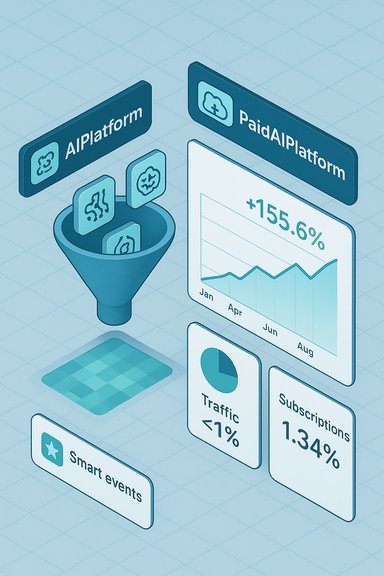
- AI-driven referrals (LLMs like ChatGPT, Copilot, Perplexity, Gemini) grew +155.6% over eight months across Clarity’s sample.
- Despite that growth, AI referrals remained <1% of total sessions in the sample.
- Measured with Clarity “smart events” over one month, conversion rates were reported as: Sign‑ups — LLMs 1.66% / Search 0.15% / Direct 0.13% / Social 0.46%; Subscriptions — LLMs 1.34% / Search 0.55% / Direct 0.41% / Social 0.37%.
- By provider, Copilot had the largest subscription uplift (reported as roughly 17× direct traffic and 15× search), Perplexity came in second (about 7×), and Gemini third (about 4× vs direct, 3× vs search). Clarity also reported that Perplexity and Gemini led sign-up conversion rates in the sample.
How Clarity measures AI referrals — method, scope, and limits
What Clarity’s tools do
Clarity added two dedicated channel groupings — AIPlatform (organic LLM referrals) and PaidAIPlatform (paid placements inside AI experiences) — so site owners can segment and compare behavior from AI-driven sources alongside traditional channels. The feature identifies referrals using known patterns and referrer headers when available, and integrates session recordings and heatmaps to let publishers inspect behavior on a per‑session basis.What to watch in the methodology
- Sample composition: Clarity’s dataset is drawn from sites that use Clarity (a free Microsoft analytics tool). The study focused on publisher and news domains (1,277 domains cited in the report), which matters because content publishers (subscriptions, registration walls) have different funnel shapes and KPIs than e‑commerce or SaaS sites. That vertical focus helps explain some of the conversion patterns but limits direct generalization to all web properties.
- Time window: Clarity compared eight months of referral growth and used one month of conversion snapshots measured via smart events. Short windows amplify percentage changes and can accentuate fast-moving phenomena.
- Attribution complexity: AI-driven discovery often produces dark or indirect referral paths — users copy/paste URLs from assistant responses or land through intermediary actions that analytics tools classify differently (e.g., Direct). Clarity’s classification mitigates this to some degree but cannot recover every implicit AI influence. Microsoft documentation explicitly warns that hidden sources can still appear as Direct sessions.
What this means for interpreting the reported multiples
Clarity’s multiples (e.g., Copilot converting at ~17× direct) are relative markers inside this dataset and should be read with care. They demonstrate a directional story — LLM referrals appear higher intent and more conversion friendly in the sample — but the absolute magnitude will vary by vertical, site design, the type of conversion tracked, and the accuracy of referral attribution.Cross‑checks and independent confirmation
Verifying a single vendor’s claim is essential before changing strategy. The Clarity findings have been reported and discussed broadly in trade press and analyst blogs, and multiple independent analyses point to a consistent pattern: AI referrals are growing and often show stronger engagement metrics even when they remain a small share of visits.- Trade summaries and marketing outlets reiterated the Clarity numbers and framed the essence of the finding — higher conversion rates from AI referrals despite low volume — matching the figures in Clarity’s blog post.
- Broader industry analysis and agency reports from 2025 show mixed results across verticals: some e‑commerce datasets have found ChatGPT referrals underperforming for immediate purchase metrics, while content-centric or high‑intent queries (legal, healthcare, B2B research) show stronger AI referral performance. Those differences indicate vertical heterogeneity rather than contradiction of Clarity’s core point.
Why AI‑referred traffic can convert better (the behavioral hypothesis)
Several plausible mechanisms explain why LLM referrals might show higher conversion rates on publisher sites:- Pre‑qualification by synthesis: LLMs synthesize answers and often filter noise, presenting a distilled, intent‑focused result. When an assistant returns a specific page as evidence, the user landing there is often already closer to a decision (e.g., read summary + register for full access). This reduces browsing friction and raises conversion probability.
- Task orientation: Users who ask assistants tend to be task‑oriented — asking for a direct recommendation, model comparison, or a concise answer — and therefore prefer quick, actionable outcomes (sign-up for a newsletter, subscribe for premium content). That intent profile differs from exploratory searchers who browse multiple comparison pages.
- Contextual nudges inside assistants: Some productivity assistants (like Copilot) are embedded in workflows and may serve users with higher purchase or subscription propensity — office workers and decision makers — amplifying the conversion lift relative to general search.
Strengths of the Clarity analysis
- Actionable segmentation: Clarity’s addition of AIPlatform and PaidAIPlatform channels gives publishers a practical way to measure and compare AI referrals against other sources on the same analytics platform. That operational capability matters more than a single headline.
- Behavioral analytics paired with referrals: Session recordings and heatmaps let publishers investigate how AI‑referred users behave, providing evidence beyond simple conversion rate ratios. This helps answer whether higher conversions are due to design, content depth, or user intent.
- Large sample of publisher sites: The multi‑hundred to low‑thousand domain sample (1,200+ domains) reduces the risk that Clarity’s findings are driven by an idiosyncratic outlier. It still focuses on content publishers, which is appropriate for subscription metrics.
Risks, measurement pitfalls, and things that could go wrong
- Attribution blindness and hidden AI influence: Many AI interactions produce indirect or copy/paste behavior that analytics tools classify as Direct. Any system that relies on referrer patterns will undercount the true influence of LLMs; conversely, misattribution can overstate direct LLM impact if the URL was scraped without context. Clarity’s docs explicitly call out this limitation.
- Small absolute volume and over‑extrapolation: Percentage growth figures from a small baseline (e.g., +155.6% off a <1% base) can give a misleading sense of immediate scale. Strategic plans founded only on growth rates risk over-investing before the channel materially contributes to total traffic.
- Vertical variance: Data from news and content publishers can’t be applied verbatim to retail, SaaS conversion funnels, or local businesses. Different buying cycles and intent profiles will change outcomes materially. Independent e‑commerce analyses have shown different performance patterns.
- Model drift, UI changes, and platform policy risk: LLM providers change ranking heuristics, citation practices, and UI affordances quickly. A platform can shift from showing a link to not showing it; that single change materially alters referral volumes overnight. Publishers are vulnerable to opaque product changes.
- Legal and licensing exposure: As assistants surface publisher content without conventional clickthroughs, legal and commercial disputes over content use and licensing remain active. That uncertainty creates risk for publishers who depend on predictable referral economics.
Practical recommendations for publishers and advertisers (measurable steps)
- Instrument AI referral channels now:
- Add Clarity’s AIPlatform/PaidAIPlatform segments and mirror them in other analytics platforms (custom channel groups) so you can compare behavior across tools. Microsoft provides documentation for these channel groups.
- Track downstream value, not just clicks:
- Measure time to conversion, pages per session, and lifetime value of AI‑referred users separately. Small volumes with high LTV are strategic even if traffic is tiny today.
- Build answer‑first content that still invites clicks:
- Lead with a concise, factual summary that an assistant can cite, then add deeper, interactive content or mid‑funnel hooks to convert readers who land via an AI referral. This balances appearing in syntheses with creating click incentives.
- Strengthen provenance and schema:
- Use clear metadata and structured data (FAQ, HowTo, article schema) so retrieval systems can parse and attribute your pages, and so citations surface your brand properly. Industry guidance shows schema improves machine readability and citation probability.
- Test monetization alignments:
- Explore partnerships, licensing or revenue‑share pilots with AI platforms where possible, while diversifying revenue so sudden platform policy changes don’t imperil your business model. Early experiments (from multiple vendors) suggest publisher compensation programs are possible but experimental.
- Prepare for attribution uncertainty:
- Log ancillary signals (e.g., query text if passed, landing page patterns) and use cohort studies to estimate the hidden AI influence that appears as Direct or Search in other tools. Consider server‑side experiments to trace the impact of assistant referrals more robustly.
For IT and platform owners: technical and security considerations
- Treat LLMs and agentic assistants as new endpoints in your telemetry architecture; they can bypass traditional click funnels and create new conversion paths. Add logging and event hooks to capture micro‑conversions that happen in the first page view.
- Audit content rendering: many agents still rely on crawlable, server‑rendered HTML for reliable extraction. If your primary site is heavy client‑side rendered (SPA frameworks without SSR), you may be invisible to some assistants.
- Harden against prompt injection and content integrity risks if you expose APIs or structured data intended for agent use. Ensure that any machine‑readable feeds include provenance metadata and integrity checks.
Strategic takeaways and editorial judgment
Clarity’s analysis is a credible early warning and a practical measurement advance: AI referrals are measurable today, they are growing rapidly from a small base, and where they appear in publisher contexts they often bring higher conversion propensity. These are three distinct claims and each has different operational consequences:- The measurement part (you can and should track AI referrals) is actionable right away via tools like Clarity and complementary analytics setups.
- The growth part (+155.6%) is real inside the sample studied, but should be contextualized: large percentage gains off a small base produce urgency but not immediate existential threat to legacy search.
- The conversion quality claim is meaningful for publishers whose KPI is sign‑ups/subscriptions, but less directly transferable to immediate commerce transactions. Expect vertical variance and be cautious about applying multipliers across industries.
Conclusion
Microsoft Clarity’s report — and the industry reaction it has provoked — reframes the search vs. AI discussion from raw volume to value per visit. For publishers and advertisers, the immediate assignment is clear: start measuring AI referrals properly, treat them as a distinct channel, and run experiments that link those sessions to the metrics that matter (LTV, retention, premium conversions). The technical and legal landscape will shift quickly; the right response combines tactical readiness (analytics, schema, content design) with strategic caution (diversified revenue, careful attribution). Clarity’s numbers are a call to action, not a prophecy: the next phase of discovery will be incremental and uneven, but those who adapt measurement-first will be best positioned to capture disproportionate value as AI-driven discovery scales.Source: MediaPost Waiting For Search, LLMs' Obvious Appeal
