

On June 21, 2026, Kalkine Media published three UK market pieces arguing that Sage, Kainos, Arm, Renishaw, RELX, and Experian are being pulled into the AI trade because infrastructure spending now reaches software, chips, engineering, data, and analytics. That framing is useful, but incomplete. The more interesting story for WindowsForum readers is not whether these companies deserve an “AI stock” label; it is how quickly the AI build-out has turned into a full-stack industrial story. The winners are no longer just model makers or GPU sellers — they are the firms that sit inside enterprise workflows, silicon roadmaps, measurement systems, identity checks, compliance pipelines, and the data fabric that IT departments already depend on.
For the first phase of the generative AI boom, the market narrative was almost cartoonishly physical: GPUs, power, cooling, racks, real estate, and hyperscale capital expenditure. That was not wrong. The first constraint was compute, and compute is built from metal, silicon, land, electricity, and supply contracts.
But the second phase is different. AI infrastructure now describes a chain of dependencies that runs from semiconductor design to accounting software, from metrology equipment to credit decisioning, and from legal databases to cloud implementation partners. The three Kalkine pieces capture that widening lens by grouping six UK-linked names across software, hardware, and data.
The risk is that “AI exposure” becomes a lazy market sticker. Almost every enterprise technology company can point to automation, analytics, or machine learning somewhere in its pitch deck. The better question is whether AI changes a company’s pricing power, customer retention, development cost, regulatory exposure, or strategic position in the stack.
That is where the six-company basket becomes more interesting than the usual AI watchlist. Sage and Kainos represent the enterprise adoption layer. Arm and Renishaw sit closer to the physical substrate of compute and advanced manufacturing. RELX and Experian occupy the information layer, where proprietary data and trusted workflows may matter more than raw model capability.
The accounting-software opportunity is obvious. Small and mid-sized businesses produce invoices, reconcile bank feeds, prepare payroll, chase payments, manage tax obligations, and generate management accounts. These are structured, repetitive, rules-heavy tasks with a strong demand for automation and a low tolerance for hallucination.
That makes Sage’s AI positioning different from the consumer-chatbot narrative. A finance team does not need a model to improvise. It needs systems that can classify transactions, detect anomalies, forecast cash flow, pre-fill reports, and explain the basis for a recommendation in language that a controller or auditor can accept.
This is where enterprise AI will either prove durable or disappoint. The real adoption test is not whether a vendor can bolt a chatbot onto a dashboard. It is whether the system can make trusted suggestions inside messy business processes where liability, audit trails, permissions, and local regulation all matter.
For Windows administrators and IT pros, this has a familiar shape. It resembles the move from standalone desktop accounting packages to cloud subscriptions and integrated identity. AI becomes another platform shift that changes procurement questions: where data is stored, how permissions are inherited, how logs are retained, and whether automation can be disabled or governed.
The market often talks about AI as if enterprises are waiting for one killer model. In practice, many organizations are still wrestling with old estates, inconsistent data, brittle integrations, and governance committees that move slower than the technology. The implementation layer is where the hype meets procurement reality.
Kainos has long been associated with digital services and enterprise technology projects, including public-sector and commercial modernization work. That kind of services business does not always enjoy the valuation glamour of software platforms, but it can become strategically important when customers need help translating new tools into actual operations.
There is a catch. Services companies can ride demand, but they can also absorb it inefficiently. AI may increase project volume while simultaneously pressuring margins if customers expect automation to make delivery cheaper. The best-positioned firms will be those that use AI internally to improve delivery speed, not merely those that add “AI transformation” to sales material.
For IT departments, the takeaway is blunt: AI readiness is mostly systems readiness. If identity, data classification, endpoint management, cloud architecture, and application ownership are chaotic, introducing AI agents will amplify the chaos. Implementation partners may profit from that mess, but customers still pay the integration tax.
The AI era has made efficiency a boardroom issue. Training frontier models grabs headlines, but inference — running models repeatedly for real users and applications — is where cost, latency, energy consumption, and deployment flexibility become existential. That brings Arm’s strengths into sharper focus.
Arm’s recent move toward production silicon for AI infrastructure marks a strategic broadening of its traditional role. The company has framed this as an expansion of its compute platform rather than a simple abandonment of licensing. Still, the symbolism is hard to miss: the neutral architecture supplier is edging closer to finished hardware in a market where control of the stack is increasingly valuable.
That creates opportunity and tension. Customers want optimized, power-efficient compute. Partners want roadmaps that reduce time to market. But licensees may also watch carefully if Arm moves too far into territory that looks competitive rather than enabling.
For Windows users, Arm’s trajectory also intersects with the long-running question of Windows on Arm. AI PCs, local inference, neural processing units, and battery-efficient laptops all depend on the same broader shift: more workloads moving toward specialized or efficient compute rather than brute-force x86 scaling. The AI data center and the AI endpoint are different markets, but they rhyme.
Semiconductors and advanced components depend on tolerances that ordinary language undersells. Manufacturing complex hardware requires measurement, process control, repeatability, and quality assurance. As AI increases demand for sophisticated chips, high-performance systems, and automated production environments, the companies that help factories measure and manufacture precisely become part of the same infrastructure story.
That does not mean Renishaw suddenly becomes a pure AI proxy. It means the AI boom expands the market’s appreciation for industrial capabilities that were already critical. The hardware supply chain is not just chip designers and fabs; it includes inspection, metrology, tooling, motion control, additive manufacturing, and the less glamorous machinery of precision.
There is also a geopolitical angle. Countries now talk about semiconductor sovereignty, critical manufacturing, and technology supply chains with a seriousness that would have sounded dramatic a decade ago. Companies with specialized engineering know-how sit inside that strategic conversation, even when they are not household technology brands.
For sysadmins, this may feel distant. It is not. The cost and availability of AI-enabled hardware — from servers to laptops to edge devices — are downstream from the manufacturing ecosystem. A supply constraint in advanced production can become a procurement problem six months later.
Generative AI has created a paradox for information businesses. On one hand, models can summarize, search, draft, and classify text in ways that threaten legacy interfaces. On the other hand, trusted, licensed, structured, and domain-specific information becomes more valuable when customers need reliable answers rather than plausible ones.
That distinction matters in law, science, compliance, insurance, and risk. A generic model can produce fluent text. A professional workflow needs authority, provenance, update discipline, permissions, and domain constraints. RELX’s opportunity is to embed AI into the workflow while making its proprietary data and customer relationships more central, not less.
The danger is interface displacement. If users begin asking questions through general-purpose AI assistants rather than dedicated databases, information providers must ensure they remain the trusted backend rather than being abstracted away. That is why partnerships, licensing terms, product integration, and customer workflow control matter so much.
For enterprise IT, RELX-like products raise familiar governance questions. Can AI-generated outputs be traced to sources? Are user prompts retained? Does the tool respect client confidentiality? Does it integrate with identity systems and records policies? The AI value proposition is only as strong as the trust architecture around it.
The company has been explicit about using AI across decisioning and analytics platforms, including agentic workflows and data-driven automation. That is a natural evolution for a firm whose customers already use models and scores to make operational decisions. The shift is from analytics as a tool to analytics as a semi-automated process layer.
But credit, identity, and fraud are not casual use cases. They carry regulatory scrutiny, fairness concerns, explainability demands, and reputational risk. AI can help detect synthetic identity fraud or automate complex workflows, but it can also create opaque decisions that customers, regulators, and affected individuals may challenge.
This makes Experian a useful example of why enterprise AI will be governed more like infrastructure than like software features. If an AI system participates in a lending, identity, or fraud decision, then logging, model governance, bias testing, access control, and auditability are not optional extras. They are part of the product.
Security-minded readers should pay special attention here. AI-driven identity and fraud systems are defensive tools, but attackers also use AI to scale impersonation, phishing, document forgery, and social engineering. The arms race favors organizations with broad data visibility and strong decisioning systems, but it also raises the stakes of false confidence.
What they do share is adjacency to the AI stack. Not the simplistic stack shown in conference slides, but the operational stack that real organizations use: hardware, cloud, devices, identity, data, software workflows, compliance systems, integration partners, and audit trails. AI has to pass through all of it.
That is why the UK market angle is interesting. London does not have a direct equivalent to Nvidia in the FTSE indices, but it does have companies that touch enterprise adoption, professional data, precision engineering, and chip IP. The AI boom has forced investors to look beyond obvious megacap winners and ask where second-order effects may appear.
Second-order effects are harder to value. They can be real but slow. They can improve retention without producing explosive revenue growth. They can protect margins in one business while increasing costs in another. They can also be overstated by marketing departments eager to attach themselves to the strongest technology narrative in the market.
The right framing, then, is not “six UK AI stocks.” It is “six ways the AI build-out reaches into ordinary enterprise and industrial systems.” That is less catchy, but more accurate.
Sage benefits if AI becomes a trusted assistant for finance operations. Kainos benefits if organizations need help implementing AI safely across legacy estates. Arm benefits if efficient compute becomes a defining constraint. Renishaw benefits if advanced manufacturing demand raises the value of precision. RELX benefits if proprietary data and professional workflows remain defensible. Experian benefits if AI strengthens identity, fraud, and decisioning products without undermining trust.
But none of these outcomes is automatic. AI can commoditize parts of software. It can shift value from services labor to platforms. It can create channel conflict for chip licensors. It can expose data providers to copyright, privacy, and access disputes. It can make regulated analytics more powerful and more controversial at the same time.
The practical lesson for WindowsForum readers is that AI infrastructure is not just what sits in a hyperscale data center. It is also what touches endpoints, business applications, directories, SaaS admin consoles, compliance exports, and the human workflows that still sit between systems.
A sysadmin may never buy from Arm directly or negotiate with RELX. But the effects will show up in device architectures, software subscriptions, identity integrations, audit requirements, and the pressure to make old data estates usable by new automation layers. AI strategy will arrive as a thousand smaller procurement and governance decisions.
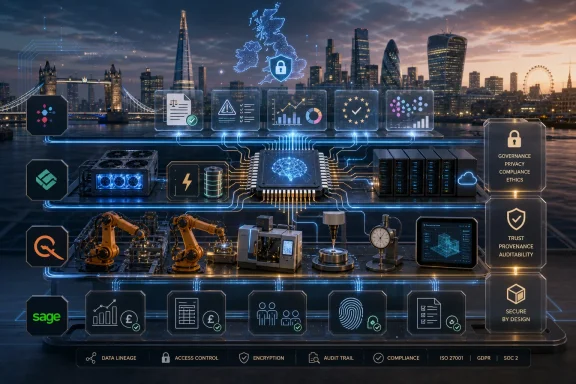 The AI Trade Has Escaped the Data Center
For the first phase of the generative AI boom, the market narrative was almost cartoonishly physical: GPUs, power, cooling, racks, real estate, and hyperscale capital expenditure. That was not wrong. The first constraint was compute, and compute is built from metal, silicon, land, electricity, and supply contracts.But the second phase is different. AI infrastructure now describes a chain of dependencies that runs from semiconductor design to accounting software, from metrology equipment to credit decisioning, and from legal databases to cloud implementation partners. The three Kalkine pieces capture that widening lens by grouping six UK-linked names across software, hardware, and data.
The risk is that “AI exposure” becomes a lazy market sticker. Almost every enterprise technology company can point to automation, analytics, or machine learning somewhere in its pitch deck. The better question is whether AI changes a company’s pricing power, customer retention, development cost, regulatory exposure, or strategic position in the stack.
That is where the six-company basket becomes more interesting than the usual AI watchlist. Sage and Kainos represent the enterprise adoption layer. Arm and Renishaw sit closer to the physical substrate of compute and advanced manufacturing. RELX and Experian occupy the information layer, where proprietary data and trusted workflows may matter more than raw model capability.
Sage Shows Why Boring Enterprise Software Is Suddenly Strategic
Sage is not an AI lab, and that is precisely why it matters. Its core business lives in accounting, payroll, finance, and business management software — places where companies do not want magic so much as reliability. In those workflows, AI’s value is less about dazzling demonstrations and more about reducing administrative friction without breaking compliance.The accounting-software opportunity is obvious. Small and mid-sized businesses produce invoices, reconcile bank feeds, prepare payroll, chase payments, manage tax obligations, and generate management accounts. These are structured, repetitive, rules-heavy tasks with a strong demand for automation and a low tolerance for hallucination.
That makes Sage’s AI positioning different from the consumer-chatbot narrative. A finance team does not need a model to improvise. It needs systems that can classify transactions, detect anomalies, forecast cash flow, pre-fill reports, and explain the basis for a recommendation in language that a controller or auditor can accept.
This is where enterprise AI will either prove durable or disappoint. The real adoption test is not whether a vendor can bolt a chatbot onto a dashboard. It is whether the system can make trusted suggestions inside messy business processes where liability, audit trails, permissions, and local regulation all matter.
For Windows administrators and IT pros, this has a familiar shape. It resembles the move from standalone desktop accounting packages to cloud subscriptions and integrated identity. AI becomes another platform shift that changes procurement questions: where data is stored, how permissions are inherited, how logs are retained, and whether automation can be disabled or governed.
Kainos Is a Reminder That Implementation Is the Unsexy Bottleneck
If Sage represents packaged software, Kainos represents the labor of actually making digital transformation happen. That matters because AI adoption is not a download. It is a program of process redesign, data cleanup, application integration, security review, training, and support.The market often talks about AI as if enterprises are waiting for one killer model. In practice, many organizations are still wrestling with old estates, inconsistent data, brittle integrations, and governance committees that move slower than the technology. The implementation layer is where the hype meets procurement reality.
Kainos has long been associated with digital services and enterprise technology projects, including public-sector and commercial modernization work. That kind of services business does not always enjoy the valuation glamour of software platforms, but it can become strategically important when customers need help translating new tools into actual operations.
There is a catch. Services companies can ride demand, but they can also absorb it inefficiently. AI may increase project volume while simultaneously pressuring margins if customers expect automation to make delivery cheaper. The best-positioned firms will be those that use AI internally to improve delivery speed, not merely those that add “AI transformation” to sales material.
For IT departments, the takeaway is blunt: AI readiness is mostly systems readiness. If identity, data classification, endpoint management, cloud architecture, and application ownership are chaotic, introducing AI agents will amplify the chaos. Implementation partners may profit from that mess, but customers still pay the integration tax.
Arm’s AI Moment Is Bigger Than Another Chip Cycle
Arm’s inclusion in the AI hardware conversation is unsurprising, but the reasons are changing. Historically, Arm was the quiet architecture inside phones, embedded devices, and increasingly efficient compute platforms. Its value came from licensing designs and maintaining a vast ecosystem rather than selling finished processors directly.The AI era has made efficiency a boardroom issue. Training frontier models grabs headlines, but inference — running models repeatedly for real users and applications — is where cost, latency, energy consumption, and deployment flexibility become existential. That brings Arm’s strengths into sharper focus.
Arm’s recent move toward production silicon for AI infrastructure marks a strategic broadening of its traditional role. The company has framed this as an expansion of its compute platform rather than a simple abandonment of licensing. Still, the symbolism is hard to miss: the neutral architecture supplier is edging closer to finished hardware in a market where control of the stack is increasingly valuable.
That creates opportunity and tension. Customers want optimized, power-efficient compute. Partners want roadmaps that reduce time to market. But licensees may also watch carefully if Arm moves too far into territory that looks competitive rather than enabling.
For Windows users, Arm’s trajectory also intersects with the long-running question of Windows on Arm. AI PCs, local inference, neural processing units, and battery-efficient laptops all depend on the same broader shift: more workloads moving toward specialized or efficient compute rather than brute-force x86 scaling. The AI data center and the AI endpoint are different markets, but they rhyme.
Renishaw Puts the Factory Floor Back Into the AI Story
Renishaw is a less obvious AI name, which is why it is worth discussing. Precision engineering, measurement systems, calibration, and advanced manufacturing tools do not look like AI in the consumer sense. They look like the industrial foundation beneath everything that makes AI hardware possible.Semiconductors and advanced components depend on tolerances that ordinary language undersells. Manufacturing complex hardware requires measurement, process control, repeatability, and quality assurance. As AI increases demand for sophisticated chips, high-performance systems, and automated production environments, the companies that help factories measure and manufacture precisely become part of the same infrastructure story.
That does not mean Renishaw suddenly becomes a pure AI proxy. It means the AI boom expands the market’s appreciation for industrial capabilities that were already critical. The hardware supply chain is not just chip designers and fabs; it includes inspection, metrology, tooling, motion control, additive manufacturing, and the less glamorous machinery of precision.
There is also a geopolitical angle. Countries now talk about semiconductor sovereignty, critical manufacturing, and technology supply chains with a seriousness that would have sounded dramatic a decade ago. Companies with specialized engineering know-how sit inside that strategic conversation, even when they are not household technology brands.
For sysadmins, this may feel distant. It is not. The cost and availability of AI-enabled hardware — from servers to laptops to edge devices — are downstream from the manufacturing ecosystem. A supply constraint in advanced production can become a procurement problem six months later.
RELX Suggests Proprietary Data Still Has a Moat
RELX is often lazily described through its publishing heritage, but its modern business is much more about information services, analytics, legal tools, risk products, scientific content, and decision support. In an AI market obsessed with models, RELX is a reminder that high-quality proprietary data may be the harder asset to replicate.Generative AI has created a paradox for information businesses. On one hand, models can summarize, search, draft, and classify text in ways that threaten legacy interfaces. On the other hand, trusted, licensed, structured, and domain-specific information becomes more valuable when customers need reliable answers rather than plausible ones.
That distinction matters in law, science, compliance, insurance, and risk. A generic model can produce fluent text. A professional workflow needs authority, provenance, update discipline, permissions, and domain constraints. RELX’s opportunity is to embed AI into the workflow while making its proprietary data and customer relationships more central, not less.
The danger is interface displacement. If users begin asking questions through general-purpose AI assistants rather than dedicated databases, information providers must ensure they remain the trusted backend rather than being abstracted away. That is why partnerships, licensing terms, product integration, and customer workflow control matter so much.
For enterprise IT, RELX-like products raise familiar governance questions. Can AI-generated outputs be traced to sources? Are user prompts retained? Does the tool respect client confidentiality? Does it integrate with identity systems and records policies? The AI value proposition is only as strong as the trust architecture around it.
Experian Turns AI Into a Question of Trust, Identity, and Risk
Experian sits in a similarly important but different part of the information economy. Its business depends on data, analytics, identity, fraud prevention, credit decisioning, and risk assessment. These are exactly the domains where AI can improve speed and pattern recognition — and exactly the domains where mistakes can be consequential.The company has been explicit about using AI across decisioning and analytics platforms, including agentic workflows and data-driven automation. That is a natural evolution for a firm whose customers already use models and scores to make operational decisions. The shift is from analytics as a tool to analytics as a semi-automated process layer.
But credit, identity, and fraud are not casual use cases. They carry regulatory scrutiny, fairness concerns, explainability demands, and reputational risk. AI can help detect synthetic identity fraud or automate complex workflows, but it can also create opaque decisions that customers, regulators, and affected individuals may challenge.
This makes Experian a useful example of why enterprise AI will be governed more like infrastructure than like software features. If an AI system participates in a lending, identity, or fraud decision, then logging, model governance, bias testing, access control, and auditability are not optional extras. They are part of the product.
Security-minded readers should pay special attention here. AI-driven identity and fraud systems are defensive tools, but attackers also use AI to scale impersonation, phishing, document forgery, and social engineering. The arms race favors organizations with broad data visibility and strong decisioning systems, but it also raises the stakes of false confidence.
The Real AI Stack Is Less Glamorous and More Durable
The six companies in Kalkine’s trio of articles are not equivalent, and investors should be wary of treating them as interchangeable AI beneficiaries. A chip architecture company, a metrology specialist, an accounting software vendor, a public-sector digital services firm, a legal and risk analytics group, and a credit data bureau do not share the same economics.What they do share is adjacency to the AI stack. Not the simplistic stack shown in conference slides, but the operational stack that real organizations use: hardware, cloud, devices, identity, data, software workflows, compliance systems, integration partners, and audit trails. AI has to pass through all of it.
That is why the UK market angle is interesting. London does not have a direct equivalent to Nvidia in the FTSE indices, but it does have companies that touch enterprise adoption, professional data, precision engineering, and chip IP. The AI boom has forced investors to look beyond obvious megacap winners and ask where second-order effects may appear.
Second-order effects are harder to value. They can be real but slow. They can improve retention without producing explosive revenue growth. They can protect margins in one business while increasing costs in another. They can also be overstated by marketing departments eager to attach themselves to the strongest technology narrative in the market.
The right framing, then, is not “six UK AI stocks.” It is “six ways the AI build-out reaches into ordinary enterprise and industrial systems.” That is less catchy, but more accurate.
Enterprise IT Will Decide Which AI Claims Survive
The next stage of the AI cycle will be judged less by demos and more by deployment. CIOs, CISOs, finance chiefs, procurement teams, and regulators will decide whether these tools become embedded infrastructure or expensive experiments. That process favors companies already inside critical workflows.Sage benefits if AI becomes a trusted assistant for finance operations. Kainos benefits if organizations need help implementing AI safely across legacy estates. Arm benefits if efficient compute becomes a defining constraint. Renishaw benefits if advanced manufacturing demand raises the value of precision. RELX benefits if proprietary data and professional workflows remain defensible. Experian benefits if AI strengthens identity, fraud, and decisioning products without undermining trust.
But none of these outcomes is automatic. AI can commoditize parts of software. It can shift value from services labor to platforms. It can create channel conflict for chip licensors. It can expose data providers to copyright, privacy, and access disputes. It can make regulated analytics more powerful and more controversial at the same time.
The practical lesson for WindowsForum readers is that AI infrastructure is not just what sits in a hyperscale data center. It is also what touches endpoints, business applications, directories, SaaS admin consoles, compliance exports, and the human workflows that still sit between systems.
A sysadmin may never buy from Arm directly or negotiate with RELX. But the effects will show up in device architectures, software subscriptions, identity integrations, audit requirements, and the pressure to make old data estates usable by new automation layers. AI strategy will arrive as a thousand smaller procurement and governance decisions.
The London AI Basket Says More About the Stack Than the Stocks
The concrete reading of this news is not that every named company will win equally. It is that the AI build-out has moved beyond the obvious hardware bottleneck and into the less glamorous layers where enterprises actually operate. That shift is where durable technology change usually becomes visible.- Sage and Kainos represent the enterprise software and implementation layer, where AI must become reliable enough for finance, payroll, public services, and operational workflows.
- Arm and Renishaw show that AI hardware exposure includes architecture, power efficiency, manufacturing precision, and the industrial systems behind compute capacity.
- RELX and Experian underline the growing value of proprietary, trusted, and structured data in a market flooded with general-purpose AI outputs.
- The strongest AI claims will be those tied to pricing power, workflow control, customer retention, auditability, or measurable productivity gains.
- IT departments should treat AI adoption as an infrastructure and governance issue, not merely a feature rollout or vendor branding exercise.
References
- Primary source: Kalkine Media
Published: 2026-06-21T06:30:16.150283
AI infrastructure surge puts UK software names Sage Group and Kainos in the spotlight [FTSE 350]
UK software companies Sage Group and Kainos attract attention as artificial intelligence infrastructure, enterprise technology adoption, and digital transformation remain prominent themes.kalkinemedia.com
