

AI-generated travel content is no longer limited to over-polished hotel photos. It is sending people to attractions that do not exist.
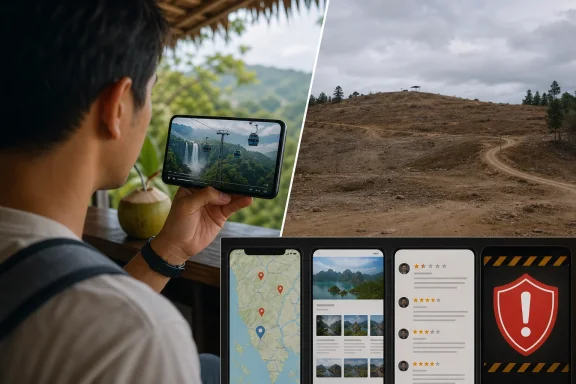
In July 2025, an elderly Malaysian couple traveled from Kuala Lumpur to Perak after watching a realistic video promoting the fictional “Kuak Skyride” cable car. As reported by Lowyat.NET and PetaPixel, the video used a news-style format, complete with an on-camera presenter and apparent visitors, but the attraction was entirely fabricated. Reports said it appeared to have been made with Google’s Veo 3 video generator.
A similar episode unfolded in Tasmania this year. An AI-written post published by tour operator Tasmania Tours advertised “Weldborough Hot Springs,” a supposedly secluded geothermal retreat. The Independent reported that visitors arrived in the remote town only to learn the springs did not exist. The post was removed after the company acknowledged its AI content process had gone badly wrong.
Travelers have traditionally used photos, reviews and maps to decide whether a destination is worth the cost and time. Generative AI can now produce plausible footage, fake testimonials and polished editorial-style copy quickly enough to imitate that entire discovery process.
Tennessee’s Department of Tourist Development said in June that only 5% of respondents in its survey could correctly identify all real destination images when shown alongside AI-generated alternatives. The agency has since introduced a photo-certification initiative and pledged not to replace its own marketing photography with generative AI.
That does not mean every suspicious image is fake, nor that an AI detector can conclusively settle the question. Image-detection services are inconsistent, especially after an image has been cropped, compressed or edited. The more useful test is whether the claimed place has independent evidence outside the original post.
For Windows users, the practical defense is less about installing an “AI detector” browser extension and more about basic cross-checking: open Maps, search official sources in separate tabs, and do not let a polished clip become the only evidence that a place—or a booking site—is real.
In July 2025, an elderly Malaysian couple traveled from Kuala Lumpur to Perak after watching a realistic video promoting the fictional “Kuak Skyride” cable car. As reported by Lowyat.NET and PetaPixel, the video used a news-style format, complete with an on-camera presenter and apparent visitors, but the attraction was entirely fabricated. Reports said it appeared to have been made with Google’s Veo 3 video generator.
A similar episode unfolded in Tasmania this year. An AI-written post published by tour operator Tasmania Tours advertised “Weldborough Hot Springs,” a supposedly secluded geothermal retreat. The Independent reported that visitors arrived in the remote town only to learn the springs did not exist. The post was removed after the company acknowledged its AI content process had gone badly wrong.
 The problem is provenance, not just bad pixels
Travelers have traditionally used photos, reviews and maps to decide whether a destination is worth the cost and time. Generative AI can now produce plausible footage, fake testimonials and polished editorial-style copy quickly enough to imitate that entire discovery process.Tennessee’s Department of Tourist Development said in June that only 5% of respondents in its survey could correctly identify all real destination images when shown alongside AI-generated alternatives. The agency has since introduced a photo-certification initiative and pledged not to replace its own marketing photography with generative AI.
That does not mean every suspicious image is fake, nor that an AI detector can conclusively settle the question. Image-detection services are inconsistent, especially after an image has been cropped, compressed or edited. The more useful test is whether the claimed place has independent evidence outside the original post.
Verify the destination before the booking
A convincing video should be treated as an advertisement, not proof that an attraction exists. Before committing money or a long drive, travelers should:- Check the attraction on the official tourism authority site and in a mainstream mapping service.
- Search for independent visitor photos, reviews and coverage from multiple sources, not just reposts of the same promotional clip.
- Confirm that the location has a consistent address, contact details and recent activity across maps, official sites and established booking services.
- Pay by credit card through a recognized hotel, airline or booking platform; avoid wire transfers, cryptocurrency, gift cards or payment links sent through social media.
For Windows users, the practical defense is less about installing an “AI detector” browser extension and more about basic cross-checking: open Maps, search official sources in separate tabs, and do not let a polished clip become the only evidence that a place—or a booking site—is real.
References
- Primary source: Travelers Today
Published: 2026-07-18T02:42:49+00:00
AI Fake Destinations Are Fooling Travelers: How to Spot One Before You Book
AI fake travel destinations are fooling real travelers — a June 2026 Talker Research survey found only 5% of Americans can correctly identify real destination photos in a side-by-side test, even aswww.travelerstoday.com