

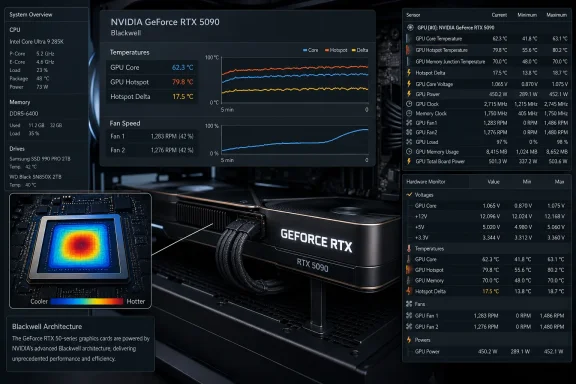
AIDA64’s latest beta adds GeForce RTX 50-series GPU hot-spot temperature monitoring, giving Windows users another supported way to expose a sensor NVIDIA has not documented through its standard public interface. The change landed in AIDA64 v8.30.8337 on July 15, according to the utility’s release notes, which list “GPU Hotspot temperature measurement on NVIDIA Blackwell.”
VideoCardz reports that the update follows recent RTX 50 hot-spot support in CPUID HWMonitor and HWiNFO. The practical result is straightforward: owners of Blackwell-based GeForce cards can now view a temperature closer to the hottest measured point on the GPU die, rather than relying only on the usual GPU edge temperature.
That can be useful when diagnosing abnormal cooling behavior, poor thermal-interface contact, unstable fan curves, or throttling that does not line up with the headline GPU temperature. It is not, however, a new NVIDIA-supported telemetry path.
MSI Afterburner itself still lacks built-in RTX 50 hot-spot reporting. Its developer, Alexey “Unwinder” Nikolaychuk, has said NVIDIA’s supported NVAPI interface does not expose Blackwell hot-spot or VRAM temperatures. The methods used by newer monitoring utilities reportedly rely on private interfaces or direct register access, neither of which is a straightforward fit for a partner-branded application such as Afterburner.
A community developer using the handle Talon2016 has now released a third-party Afterburner plug-in, BlackwellHotspot.dll. Per VideoCardz, it exposes six temperature readings and a “Hotspot Delta” value representing the spread between the lowest and highest reported readings.
That plug-in is experimental, not an MSI Afterburner release. Windows users should not treat a DLL downloaded from a forum as a routine telemetry update: verify its origin, scan it, retain a rollback path, and expect it to stop working after an Afterburner, driver, or NVIDIA firmware change. For most systems, AIDA64, HWiNFO, or HWMonitor is the less risky route.
In other words, a newly visible number should be treated as a diagnostic clue, not a standalone pass/fail verdict. Compare it under the same workload over time, watch the delta against core temperature, and investigate sharp changes rather than assuming one reading proves a hardware fault.
NVIDIA had not responded to VideoCardz’s questions on July 16 about a documented public interface or whether future drivers might restrict the currently used access methods.
VideoCardz reports that the update follows recent RTX 50 hot-spot support in CPUID HWMonitor and HWiNFO. The practical result is straightforward: owners of Blackwell-based GeForce cards can now view a temperature closer to the hottest measured point on the GPU die, rather than relying only on the usual GPU edge temperature.
That can be useful when diagnosing abnormal cooling behavior, poor thermal-interface contact, unstable fan curves, or throttling that does not line up with the headline GPU temperature. It is not, however, a new NVIDIA-supported telemetry path.
 MSI Afterburner gets an unofficial route
MSI Afterburner itself still lacks built-in RTX 50 hot-spot reporting. Its developer, Alexey “Unwinder” Nikolaychuk, has said NVIDIA’s supported NVAPI interface does not expose Blackwell hot-spot or VRAM temperatures. The methods used by newer monitoring utilities reportedly rely on private interfaces or direct register access, neither of which is a straightforward fit for a partner-branded application such as Afterburner.A community developer using the handle Talon2016 has now released a third-party Afterburner plug-in, BlackwellHotspot.dll. Per VideoCardz, it exposes six temperature readings and a “Hotspot Delta” value representing the spread between the lowest and highest reported readings.
That plug-in is experimental, not an MSI Afterburner release. Windows users should not treat a DLL downloaded from a forum as a routine telemetry update: verify its origin, scan it, retain a rollback path, and expect it to stop working after an Afterburner, driver, or NVIDIA firmware change. For most systems, AIDA64, HWiNFO, or HWMonitor is the less risky route.
The number may not be definitive
Igor’sLAB has separately released IBHE, or igor’sLAB Blackwell Hotspot Estimation, a diagnostic tool that can access certain telemetry with administrator rights and combines it with model-based estimates. Igor Wallossek cautions that the six apparent temperature values still need validation and interpretation. That matters because different utilities may display different “hot-spot” figures from the same RTX 50 card.In other words, a newly visible number should be treated as a diagnostic clue, not a standalone pass/fail verdict. Compare it under the same workload over time, watch the delta against core temperature, and investigate sharp changes rather than assuming one reading proves a hardware fault.
NVIDIA had not responded to VideoCardz’s questions on July 16 about a documented public interface or whether future drivers might restrict the currently used access methods.
References
- Primary source: videocardz.com
Published: 2026-07-16T11:47:37+00:00
- Related coverage: adrenaline.com.br
AIDA64 e MSI Afterburner passam a exibir temperatura hotspot das GeForce RTX 50 - Adrenaline
Porém, NVIDIA ainda não se manifestou sobre os acessos e alguns desenvolvedores irão esperar para habilitar o monitoramento em suas ferramentaswww.adrenaline.com.br